

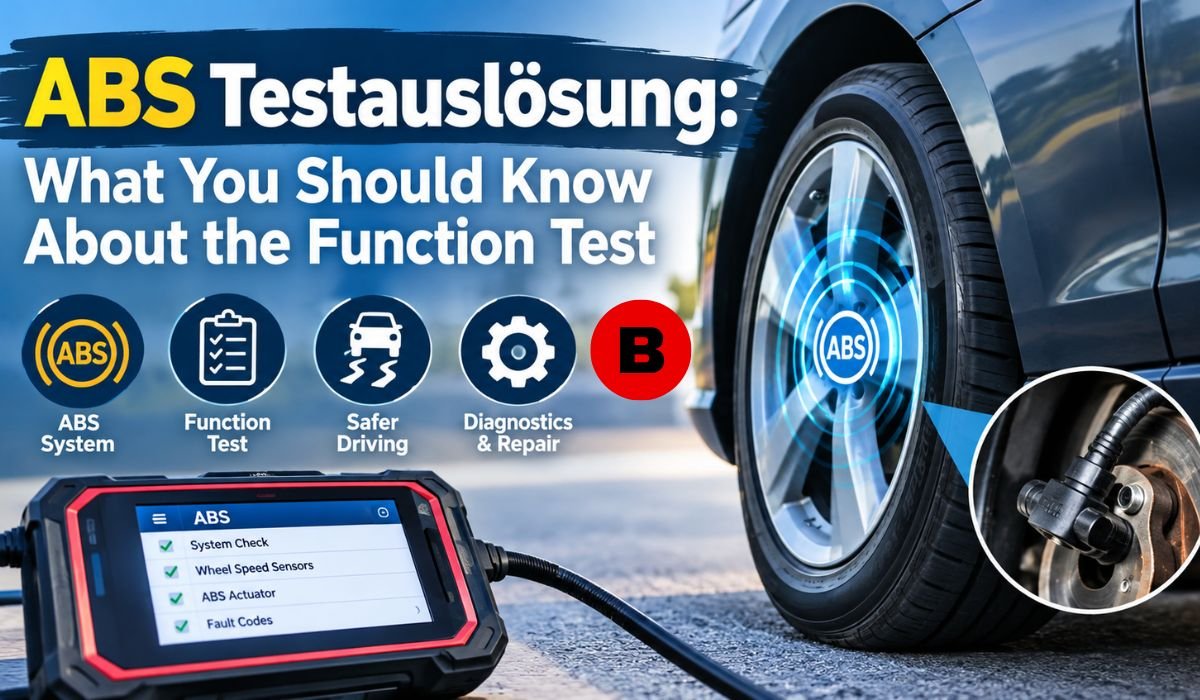
ABS Testauslösung refers to the controlled activation or functional testing of a vehicle’s Anti-lock Braking System (ABS). For most drivers, ABS isn’t something they think about during everyday journeys. It usually gets noticed only when a sudden braking situation occurs and the brake pedal begins to pulse beneath the foot. A rapid clicking, buzzing, or mechanical sound may accompany the sensation. While that can initially feel unsettling, it’s often the result of the ABS doing exactly what it was designed to do.
The Anti-lock Braking System constantly monitors how the vehicle’s wheels are rotating during braking. When the system detects that a wheel is approaching a locking condition, it can automatically adjust the braking force. This helps control excessive wheel slip and supports the driver’s ability to maintain steering control during hard braking.
There’s an important distinction to understand, however. An ABS system activating during a hard stop isn’t necessarily the same as a complete ABS Function Test performed by a professional. A workshop can use diagnostic equipment to check for stored fault codes, examine wheel-speed sensors, inspect wiring, and evaluate other components. Understanding that difference makes ABS Testauslösung easier to understand and can also help drivers recognize when a vehicle needs attention.
Quick Bio Information
ABS Full Name: Anti-lock Braking System.
ABS Main Purpose: To Help Control Wheel Slip During Hard Braking.
Primary Sensor: Wheel-Speed Sensor.
Main Electronic Component: ABS Control Unit.
Braking Control: Brake Pressure Can Be Automatically Modulated.
ABS Activation: Usually Occurs Automatically When Wheel Slip Approaches A Lock-Up Condition.
Common Driver Sensation: Rapid Brake-Pedal Pulsation.
Possible Sound: Clicking, Buzzing, Or Mechanical Noise During Intervention.
Important Dashboard Signal: ABS Warning Light.
Professional Testing: Electronic Diagnostics Combined With Physical Inspection.
Key ABS Function: Continuous Monitoring Of Wheel Rotation.
Wheel Lock Concern: A Locked Wheel Can Reduce Directional Control.
Safe Testing Environment: A Suitable Controlled Area Or Professional Training Facility.
Public-Road Testing: Deliberately Triggering ABS On A Public Road Is Not Recommended.
Post-Repair Check: Relevant Brake, Wheel, Sensor, And Wiring Repairs May Require ABS Verification.
Stopping Distance: ABS Does Not Guarantee A Shorter Stopping Distance In Every Condition.
Safety Benefit: ABS Helps Control Wheel Slip During Hard Braking.
Related Systems: Modern Vehicles May Integrate ABS With Other Electronic Brake And Stability Systems.
What Does ABS Testauslösung Mean?
The term ABS Testauslösung can describe the deliberate activation or functional examination of an Anti-lock Braking System. During heavy braking, ABS may automatically intervene when it detects that one or more wheels are approaching excessive slip or lock-up. Rather than allowing the affected wheel to remain locked, the system regulates brake pressure.
The expression can also arise when discussing workshop-based testing. In that setting, technicians may be checking whether the electronic and mechanical parts of the ABS are operating as intended. Depending on the vehicle and the issue being investigated, this can involve diagnostic scanning, checking wheel-speed sensors, examining electrical connections, and inspecting relevant braking components.
One point is especially important: experiencing ABS activation doesn’t prove that the entire system has passed a complete inspection. If the brake pedal pulses during a hard stop, that tells you ABS intervened during that particular event. It doesn’t necessarily confirm that every sensor, wire, control component, or diagnostic function is working perfectly.
The system itself is designed to monitor wheel rotation and respond to changes in wheel slip. NHTSA describes ABS as a system that senses wheel rotation, processes that information, and adjusts braking forces through its control components. That continuous feedback is what allows ABS to respond when traction changes.
What Is ABS And Why Does It Matter?
The Anti-lock Braking System is one of the most important safety technologies fitted to modern vehicles. Its primary purpose is to help prevent excessive wheel lock during heavy braking. When a wheel locks, it stops rotating while the vehicle is still moving. That can reduce useful directional control and make it more difficult for the driver to steer around an obstacle.
ABS is designed to address this problem by monitoring wheel behavior and adjusting braking force whenever necessary. Rather than allowing a wheel to remain locked, the system can regulate pressure so the wheel continues rotating within an appropriate range.
That doesn’t mean ABS can overcome every driving hazard. Tires, road conditions, vehicle speed, weather, brake condition, and available traction still have a major influence on how a vehicle behaves. ABS is an additional safety system, not a substitute for suitable speed, properly maintained tires, or attentive driving.
Its real value becomes apparent in situations where braking suddenly becomes urgent. A driver may have only seconds to react, and maintaining as much control as possible can make a significant difference.
How Does The ABS System Work?
The ABS process begins with Wheel-Speed Sensors. These sensors monitor the rotation of individual wheels and continuously send information to the vehicle’s ABS Control Unit. If the system detects a rapid change that suggests a wheel is approaching lock-up, it can respond by modifying the braking force.
The ABS Control Unit processes the information received from the sensors and determines how the system should respond. Depending on what the vehicle requires, braking pressure can be reduced, held, or increased again. This process can happen repeatedly during a single braking event.
The speed of this process is one reason ABS can feel so different from normal braking. The system is reacting to changing wheel conditions far more quickly than a driver could manually adjust brake pressure.
The exact design varies between vehicle manufacturers and models, but the basic principle remains consistent. The system monitors wheel rotation, identifies excessive slip, and automatically adjusts braking force to help prevent prolonged wheel lock.
What Happens During An ABS Testauslösung?
When ABS activates during hard braking, the driver will often feel Pulsation In The Brake Pedal. A clicking, buzzing, or mechanical sound may also come from the braking system. For someone who hasn’t experienced ABS before, the sensation can be surprising and may even feel as though something has gone wrong.
In many cases, though, those sensations are simply the result of brake-pressure modulation. As the system detects a wheel approaching lock-up, it can reduce or hold braking pressure and then increase it again as conditions change. The process can repeat rapidly throughout the braking event.
That distinction between normal ABS behavior and a genuine fault is worth remembering. Pedal pulsation during a demanding braking maneuver can be an expected part of ABS operation. On the other hand, an ABS Warning Light, unusual braking behavior, or unexpected ABS intervention during ordinary driving deserves further investigation.
The best response during an emergency is to remain focused on controlling the vehicle and follow the braking instructions provided by the vehicle manufacturer.
ABS Test Activation Vs. Normal Braking
Normal braking doesn’t automatically mean that ABS is operating. When the driver presses the Brake Pedal and the wheels continue rotating without excessive slip, the vehicle can slow down normally without ABS intervention.
An ABS Activation occurs when the system detects that one or more wheels are approaching a locking condition. At that point, the ABS system begins regulating braking pressure automatically.
This is why simply pressing the brake pedal hard doesn’t guarantee that ABS will activate. The system responds to actual wheel behavior, which depends on several factors. Tire grip, road surface, vehicle speed, braking force, and available traction can all affect whether ABS intervention is necessary.
For instance, a hard stop on a dry surface with good tire grip might not produce noticeable ABS activity. The same vehicle could experience clear ABS intervention on a surface offering substantially less traction.
Why Is An ABS Function Test Important?
An ABS Function Test matters because ABS is a safety system that may sit unnoticed for long periods before being needed. A driver can go months or even years without feeling the system activate. Then, during an unexpected hazard, it may suddenly become extremely important.
An ABS fault doesn’t necessarily mean that all braking ability disappears. Depending on the vehicle and the nature of the failure, conventional braking may continue to work even when the anti-lock function has developed a problem. However, the additional protection provided by ABS may no longer be available.
That’s why an ABS Warning Light shouldn’t be ignored simply because the brake pedal still feels normal. A vehicle may appear to brake normally during everyday driving while the anti-lock function remains unavailable.
A function check can help identify problems before the system is unexpectedly needed. That’s particularly important for safety equipment whose value is greatest during situations that drivers can’t predict.
How Is ABS Tested Professionally?
A professional ABS Diagnostic Test involves considerably more than deliberately activating ABS during a braking maneuver. A qualified technician can connect appropriate diagnostic equipment to the vehicle and communicate with the ABS Control System.
This can reveal stored Fault Codes and other diagnostic information. Depending on the problem, the technician may also inspect Wheel-Speed Sensors, wiring, electrical connections, wheel-related components, and parts of the braking system.
A fault code can provide an important clue, but it doesn’t always mean that the component named in the code is definitely defective. A damaged wire, poor connection, contamination, or power-supply issue can sometimes produce symptoms that appear to point toward a particular sensor or component.
That’s why proper diagnosis combines electronic information with physical inspection and vehicle-specific technical information. Replacing parts based only on a dashboard warning can be expensive and may fail to address the real problem.
What Does The ABS Warning Light Tell You?
The ABS Warning Light is an important part of the vehicle’s self-monitoring system. In many cars, it illuminates briefly when the ignition is switched on as part of the initial system check. It should then go out according to the vehicle manufacturer’s normal procedure.
If the light remains on or appears while driving, it can indicate a problem with the anti-lock braking function. The exact meaning varies by vehicle, but potential causes can include a Wheel-Speed Sensor fault, damaged wiring, an electrical problem, or an issue with the ABS Control Unit.
The warning light should therefore be treated as useful information rather than something to ignore. The owner’s manual can provide vehicle-specific guidance, while a professional diagnostic check can determine what caused the warning.
It’s also important not to assume that a functioning conventional brake pedal means the ABS system is fully operational. The two functions are related, but they aren’t identical.
Common Problems That Can Affect ABS Testauslösung
Several different problems can interfere with ABS operation. One of the more common areas of concern is the Wheel-Speed Sensor or its associated wiring. These components operate close to the wheels, where they can be exposed to dirt, moisture, road debris, corrosion, and physical damage.
Electrical connections can cause problems as well. A damaged cable, loose connector, or power-supply issue may interrupt the information being sent between a sensor and the ABS Control Unit.
The hydraulic side of the system can also develop faults. Components responsible for controlling Brake Pressure must work correctly for ABS to regulate braking force as intended.
Previous repair work is another factor worth considering. Work around wheels, brakes, hubs, suspension components, or sensors can potentially affect ABS-related wiring or components. If an ABS warning appears shortly after such work, the timing is worth mentioning to the technician.
ABS Testauslösung After Brake Repairs And Maintenance
An appropriate ABS Function Check can be especially useful after work involving the Brake System, Wheels, Wheel Hubs, Suspension Components, Wheel-Speed Sensors, or related wiring.
The exact inspection depends on what was repaired. If a Wheel-Speed Sensor has been replaced, for example, the technician may need to confirm that it is correctly installed and producing an appropriate signal. If wiring has been disturbed, the relevant connections should also be inspected.
Post-repair verification adds another layer of confidence that the electronic safety system is communicating correctly with the mechanical components involved.
That doesn’t mean every brake service automatically requires the same ABS procedure. The appropriate checks depend on the vehicle, the work performed, the manufacturer’s instructions, and whether any warning lights or fault codes are present.
Can You Test ABS Yourself?
Drivers may experience ABS during a controlled emergency-braking exercise, but deliberately trying to activate the system on a public road isn’t a sensible way to test a vehicle.
Creating an artificial emergency situation can put the driver, passengers, and other road users at unnecessary risk. If a practical ABS exercise is appropriate, it should be carried out in a suitable controlled environment and, ideally, under qualified instruction.
There’s another important reason not to rely on self-testing. Feeling the ABS pedal pulsate during one braking event doesn’t amount to a complete system inspection. An intermittent electrical problem, stored Diagnostic Fault, or sensor issue might not reveal itself through a single braking maneuver.
If the goal is to determine whether the ABS system has a fault, professional diagnostic testing is a much safer and more informative option.
What Should You Do When ABS Activates?
ABS activation can be startling, especially for drivers who have never felt it before. The brake pedal may pulse rapidly, and the system may make sounds that seem unusual. The best response is to stay focused on controlling the vehicle and follow the braking procedure recommended for that particular vehicle.
ABS is designed to regulate Wheel Slip automatically. During an ABS event, braking pressure may be reduced, held, and reapplied as the system responds to changing wheel conditions.
Drivers shouldn’t become distracted by the pedal vibration or noise. The purpose of the system is to manage wheel slip while the driver remains responsible for steering and overall vehicle control.
Once the emergency has passed, pay attention to what happens next. If the ABS Warning Light remains illuminated or another unusual symptom appears, the vehicle should be assessed.
A single ABS event during genuinely hard braking isn’t automatically evidence of a fault. Unexpected ABS activation during light or ordinary braking, however, is a different matter and should be investigated.
Does ABS Always Reduce Stopping Distance?
One common misconception is that ABS guarantees a shorter stopping distance in every situation. It doesn’t.
The primary purpose of ABS is to help prevent excessive Wheel Lock and manage Wheel Slip during hard braking. By preventing prolonged wheel lock, the system can help maintain steering control while braking.
Actual stopping distance depends on numerous factors. Tire condition, tire grip, road surface, speed, weather, vehicle load, brake condition, and available traction all play a role.
This is particularly important on wet, icy, loose, or otherwise slippery surfaces. ABS can help a driver retain greater control during braking, but it can’t create traction that simply isn’t available.
For that reason, ABS should be viewed as an important safety aid rather than a guarantee of a particular stopping distance.
Signs That Your ABS May Need Inspection
An ABS Warning Light that remains illuminated is one of the clearest reasons to arrange an inspection. Other warning signs deserve attention, too, including unexpected ABS activation, unusual Brake-Pedal behavior, new dashboard messages, or changes that appear after wheel or brake repairs.
If ABS seems to activate during gentle braking, that shouldn’t simply be dismissed as normal. Unusual noises or changes in braking performance should also be investigated.
At the same time, drivers shouldn’t try to identify the failed component based solely on symptoms. Modern ABS systems combine sensors, electronic controls, hydraulic components, and wiring. A professional diagnostic process is often needed to determine where the actual problem lies.
The sooner a potential fault is investigated, the easier it can be to understand what has happened and what repair may be required.
ABS Testauslösung And Driving Safety
The importance of ABS Testauslösung becomes clearer when ABS is viewed as part of the vehicle’s wider safety system. Most drivers won’t notice ABS during normal journeys, yet the system is designed for precisely those situations when sudden braking and changing traction create a greater risk of wheel lock.
ABS continuously monitors wheel rotation and responds when wheel slip changes. This feedback-based operation allows the system to react far more quickly than a driver could manually adjust brake pressure.
Modern vehicles can also combine ABS technology with other electronic braking and stability systems. Depending on the vehicle, these may include Electronic Stability Control, Traction Control, Brake Assist, and other electronically managed functions.
As a result, an ABS warning shouldn’t automatically be treated as a minor dashboard nuisance. The exact effect of a fault depends on the vehicle and the system involved, but a warning indicates that something deserves attention.
How Often Should An ABS System Be Checked?
There isn’t one universal inspection interval that applies to every vehicle. The appropriate schedule depends on the manufacturer’s maintenance recommendations, the vehicle’s age and condition, previous repairs, warning indicators, and any symptoms noticed while driving.
Routine servicing can provide an opportunity to inspect relevant Brake and Wheel components. However, an ABS Warning Light or unusual braking behavior shouldn’t necessarily be left until the next scheduled service.
Following the manufacturer’s maintenance instructions is a good starting point. If a warning appears or the vehicle begins behaving differently, a professional inspection is more appropriate than waiting for a routine service appointment.
ABS Testauslösung: Important Mistakes To Avoid
One common misunderstanding is that ABS should activate whenever the brake pedal is pressed hard. That isn’t necessarily the case. ABS intervenes when the system detects wheel behavior that requires anti-lock control, and road and tire conditions can vary considerably.
Another mistake is treating Brake-Pedal Pulsation as a complete health check. Pulsation during a genuine ABS event indicates that the system intervened at that moment, but it doesn’t prove that every ABS component is working perfectly under every condition.
Drivers should also avoid deliberately testing ABS on public roads. Creating an emergency braking situation simply to see whether the pedal vibrates introduces an unnecessary safety risk.
Ignoring the ABS Warning Light is another mistake worth avoiding. Even when conventional braking appears normal, the anti-lock function may not be available. A persistent warning should therefore be investigated rather than dismissed.
Finally, replacing an ABS component based solely on a warning light or a guessed diagnosis can waste both time and money. A Sensor Fault, for example, might involve the sensor itself, its wiring, its connector, or another related issue. Proper diagnosis should come before unnecessary parts replacement.
Final Thoughts
ABS Testauslösung is best understood as part of a broader discussion about ABS Activation, Function Testing, and Professional Diagnosis. The Anti-lock Braking System continuously monitors Wheel Rotation and can regulate Brake Pressure when a wheel approaches excessive Slip. This helps reduce the risk of prolonged Wheel Lock and supports controlled braking.
The familiar Brake-Pedal Pulsation during ABS intervention is only one visible part of the process. A proper ABS Function Test can go much further, examining Fault Codes, Wheel-Speed Sensors, wiring, Control Components, and other parts of the system.
For drivers, the practical message is straightforward. Learn what normal ABS intervention feels like, pay attention to warning lights, avoid deliberately testing the system in traffic, and arrange professional diagnosis when something seems unusual.
A properly functioning ABS can’t eliminate every braking risk, and it can’t overcome limited tire grip or unsafe driving conditions. What it can provide is an important layer of control when hard braking causes significant Wheel Slip. That makes proper ABS maintenance, accurate diagnosis, and responsible driving important parts of vehicle safety.
FAQs About ABS Testauslösung
What Is ABS Testauslösung?
ABS Testauslösung refers to the controlled activation or functional testing of a vehicle’s Anti-lock Braking System. The term can describe ABS intervention during hard braking or a more formal inspection performed with diagnostic equipment.
What Happens When ABS Activates?
When ABS detects excessive Wheel Slip, it automatically adjusts Brake Pressure. The driver may feel rapid Brake-Pedal Pulsation and hear clicking, buzzing, or other mechanical sounds. These sensations are commonly associated with the system regulating braking force.
Why Does The ABS Warning Light Stay On?
A continuously illuminated ABS Warning Light can indicate a fault affecting the anti-lock function. Possible causes include Sensor Problems, Wiring Faults, Electrical Issues, or Control-System Problems. The exact cause should be established through proper vehicle diagnosis.
Can I Activate ABS Myself?
ABS may be experienced during a controlled braking exercise, but deliberately activating it on a public road isn’t recommended. If the purpose is to determine whether the system has a fault, professional diagnostics are safer and provide much more useful information.
Is ABS Activation The Same As An ABS Diagnostic Test?
No. ABS Activation means the anti-lock system intervened during a particular braking event. A Professional Diagnostic Test can examine Fault Codes, Sensor Signals, Wiring, Control Components, and other system functions. One doesn’t replace the other.
Should ABS Be Checked After Brake Repairs?
Relevant Brake, Wheel, Sensor, Hub, Suspension, or Wiring Repairs can affect ABS-related components. The appropriate post-repair check depends on the work performed and the vehicle manufacturer’s procedures, but verification can help confirm that the system is operating correctly.
Does ABS Always Make A Car Stop Faster?
No. ABS doesn’t guarantee a shorter stopping distance in every situation. Its primary purpose is to control Wheel Slip and help prevent prolonged Wheel Lock. Tire Condition, Road Surface, Speed, Weather, Vehicle Load, and available traction all influence stopping performance.
Can I Drive With The ABS Warning Light On?
An illuminated ABS Warning Light should be taken seriously because it can indicate that the anti-lock function has developed a fault. Depending on the vehicle and the nature of the failure, conventional braking may still operate, but the intended ABS function may not be available. The vehicle should be assessed according to the manufacturer’s guidance and, where appropriate, by a qualified technician.
Learn more and explore exciting content on: Susan Attenborough: Inside the Private Life of David Attenborough’s Daughter