

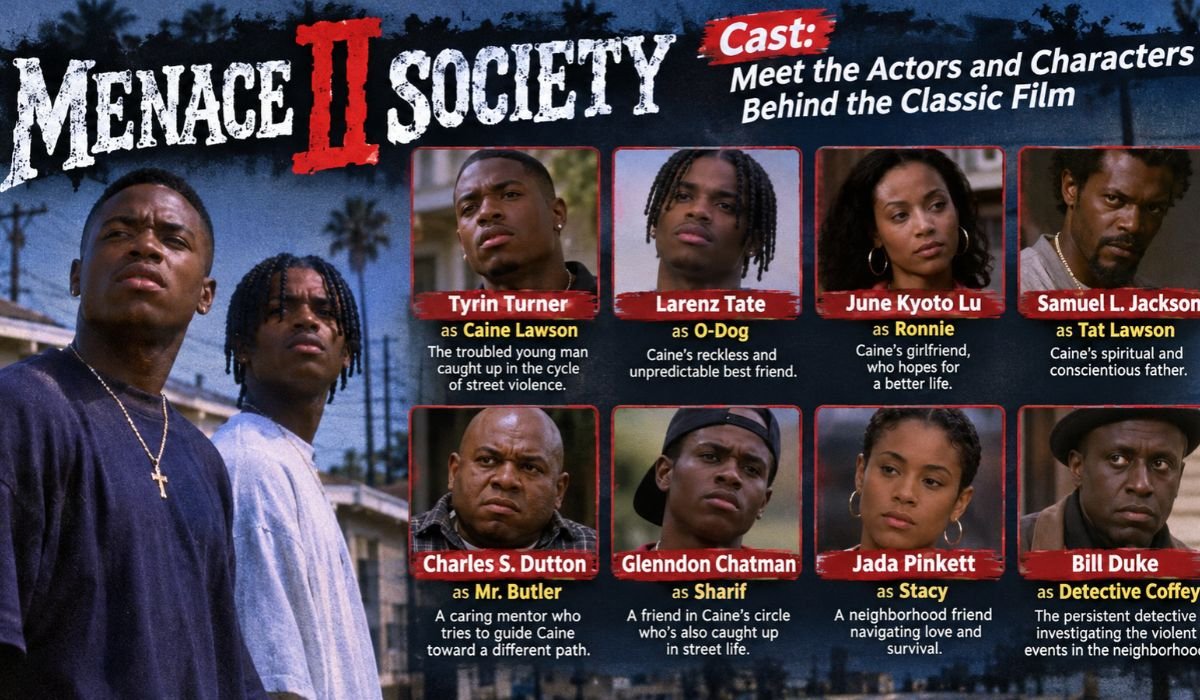
More than three decades after its release, Menace II Society continues to hold an important place in American crime cinema. Directed by brothers Albert and Allen Hughes, the film takes viewers into the life of Caine Lawson, a young man growing up in Watts, Los Angeles, where friendship, family history, violence, and personal choices continually collide.
A large part of the film’s staying power comes from the Menace 2 Society Cast. Tyrin Turner anchors the story as Caine, while Larenz Tate delivers an intense and memorable performance as his close friend O-Dog. Jada Pinkett plays Ronnie, with Samuel L. Jackson, Khandi Alexander, Glenn Plummer, Charles S. Dutton, Vonte Sweet, MC Eiht, Bill Duke, Clifton Powell, and several other recognizable performers appearing around them.
Looking back at the movie in 2026 is particularly interesting because many of these actors went on to establish long careers in film and television. Their later success, however, isn’t the only reason the cast deserves attention. Each major character serves a purpose in Caine’s story, representing a different relationship, influence, responsibility, or possible future.
That depth helps explain why audiences still want to know more about the actors and characters behind this influential film.
Quick Bio Information
| Movie Fact | Information |
|---|---|
| Official Title | Menace II Society |
| Common Search Name | Menace 2 Society |
| Release Year | 1993 |
| U.S. Release Date | May 26, 1993 |
| Country | United States |
| Running Time | 97 Minutes |
| Rating | R |
| Main Character | Caine Lawson |
| Caine Actor | Tyrin Turner |
| O-Dog Actor | Larenz Tate |
| Ronnie Actress | Jada Pinkett |
| Tat Lawson Actor | Samuel L. Jackson |
| Pernell Actor | Glenn Plummer |
| Sharif Actor | Vonte Sweet |
| A-Wax Actor | MC Eiht |
| Directors | Albert Hughes And Allen Hughes |
| Screenplay | Tyger Williams |
| Producer | Darin Scott |
| Cinematography | Lisa Rinzler |
| Music | Quincy Jones III, Credited As QD III |
Menace 2 Society Movie Overview
At the heart of Menace II Society is KayDee “Caine” Lawson, a young man trying to make sense of a life shaped by experiences that began long before adulthood. Crime, drugs, and violence were part of his childhood environment, and those influences continue to surround him as he considers what comes next.
What makes the story effective is that Caine isn’t surrounded by people who all see life the same way. O-Dog embraces violence with alarming ease. Ronnie wants greater stability. Caine’s grandparents try to provide moral structure, while Sharif and Mr. Butler offer perspectives that differ sharply from some of the influences around him.
Those competing voices give the movie much of its dramatic weight.
The film reached American theaters in May 1993 after screening in the Directors’ Fortnight at Cannes. Its uncompromising subject matter quickly attracted attention, but the movie’s impact wasn’t based on violence alone. Its performances, visual style, storytelling, and focus on consequences gave audiences something more complicated to consider.
Rather than treating crime simply as entertainment, Menace II Society repeatedly asks what happens to people when violence becomes part of ordinary life.
Tyrin Turner As Caine Lawson
Tyrin Turner carries much of that question on his shoulders as Caine Lawson, the protagonist and narrator whose experiences shape the audience’s understanding of the film.
Caine isn’t written as an uncomplicated hero. Nor does the movie excuse his actions simply because of the environment in which he grew up. He makes damaging choices and participates in criminal behavior, yet Turner also allows viewers to see his uncertainty, vulnerability, loyalty, and growing concern about where his life is heading.
That tension makes the character compelling.
Around O-Dog and his friends, Caine can appear confident and comfortable. Put him in a conversation about responsibility or the future, however, and another side begins to emerge. He knows that his world is dangerous, but recognizing danger doesn’t automatically provide a way out.
His relationships deepen that conflict. O-Dog connects him to the life he already knows. Ronnie offers a glimpse of something more stable. His grandparents provide guidance, and Mr. Butler challenges him to think more seriously about his future.
Turner avoids making those changes feel sudden. Caine’s doubts develop gradually, even as the consequences of earlier decisions continue closing in around him.
Larenz Tate As O-Dog
If Caine is the film’s conflicted center, O-Dog is its unpredictable force.
Larenz Tate’s performance as Caine’s close friend remains one of the most recognizable elements of Menace II Society. O-Dog can seem relaxed and almost playful in one moment before becoming frighteningly dangerous in the next. That unpredictability gives Tate’s scenes an uncomfortable tension.
Yet O-Dog isn’t important simply because he’s violent.
His presence creates an essential contrast with Caine. Both young men come from the same broader environment and share a close friendship, but they don’t appear to process that environment in exactly the same way. Caine increasingly questions what his lifestyle may cost him. O-Dog seems far less troubled by the violence that surrounds them.
Their friendship therefore becomes an important part of the movie’s larger argument. People can share the same streets, friends, and experiences without making identical choices.
Tate gives O-Dog an intensity that makes the character difficult to forget, while the screenplay uses him to show one possible direction Caine’s life could take if violence becomes completely normal.
Jada Pinkett As Ronnie
Jada Pinkett brings a noticeably different energy to the movie as Ronnie. Where many scenes surrounding Caine are defined by uncertainty and danger, Ronnie introduces the possibility of emotional stability.
She has a history with Pernell and is raising their son, Anthony. As Caine becomes more involved with Ronnie and the child, his responsibilities begin to stretch beyond his immediate circle of friends.
That makes Ronnie much more than a romantic interest.
Through her, Caine can imagine a future that doesn’t look exactly like his present. Ronnie’s desire to leave Los Angeles and build a more stable life creates an opportunity for him to reconsider his own direction.
Pinkett plays those moments without making Ronnie feel like a symbolic device created only to rescue Caine. She has her own priorities and responsibilities, and her decisions are shaped by what she believes will provide a better life for herself and Anthony.
That grounded performance gives the quieter parts of the film considerable emotional value.
Samuel L. Jackson And The Lawson Family
Caine’s problems didn’t begin when the main story starts, and the film makes that clear by looking back at his childhood.
Samuel L. Jackson portrays Tat Lawson, Caine’s father, while Khandi Alexander plays his mother, Karen Lawson. Brandon Hammond appears as Caine at five years old, giving audiences a direct look at some of the experiences that helped shape him.
Marilyn Coleman plays Grandmama, while Arnold Johnson portrays Grandpapa. Caine’s grandparents later provide a home with considerably different expectations and values from those he encountered earlier in childhood.
That contrast matters.
The film doesn’t argue that Caine has never encountered guidance or structure. Instead, it shows how deeply earlier experiences can influence a person even when alternative examples are available.
Jackson’s appearance as Tat is particularly striking for viewers revisiting the movie today. The role came before many of the performances that would turn him into one of Hollywood’s most recognizable actors. Within Caine’s story, however, Tat’s importance isn’t about Jackson’s later fame. His behavior forms part of Caine’s earliest understanding of adulthood, power, and violence.
Glenn Plummer As Pernell
Glenn Plummer’s Pernell doesn’t need constant screen time to have a significant effect on the story.
Pernell is connected to Ronnie and is Anthony’s father, but he also has an important relationship with Caine. Those connections place him at the center of several decisions that eventually influence Caine’s future.
Through Pernell, Ronnie, and Anthony, Caine begins encountering a form of responsibility that goes beyond his own immediate needs. That shift doesn’t instantly change him, but it does give him more to consider.
Pernell’s circumstances also make Ronnie’s desire for stability easier to understand. She isn’t imagining a different future for abstract reasons. Her choices grow out of what she has already experienced.
Plummer brings enough presence to the character that Pernell remains important even when he isn’t physically involved in every development.
Vonte Sweet As Sharif And MC Eiht As A-Wax
Caine’s circle of friends contains more variety than it may initially appear.
Vonte Sweet plays Sharif, a friend whose outlook differs noticeably from O-Dog’s. That distinction is valuable because it prevents the movie from suggesting that everyone raised in the same neighborhood inevitably develops the same worldview.
Sharif lives within the same broader environment, but his priorities and beliefs aren’t identical to those of the people around him.
MC Eiht, meanwhile, portrays A-Wax. His casting also reinforces the movie’s connection to early-1990s West Coast hip-hop culture. That relationship between music and film extends beyond a single performer, with several musicians appearing throughout the cast.
Together, Sharif and A-Wax help make Caine’s social circle feel like a collection of individuals rather than anonymous background figures. Each brings a slightly different personality and perspective to the world the Hughes brothers created.
Charles S. Dutton As Mr. Butler
Charles S. Dutton plays Mr. Butler, one of the adults who challenges Caine to think beyond the life immediately in front of him.
His role adds an important layer to the story. Caine isn’t portrayed as someone whom nobody has ever tried to guide. Advice exists. Alternatives exist. People do attempt to reach him.
The difficult part is turning that advice into action.
Leaving behind destructive habits would also mean changing relationships and distancing himself from parts of the identity he has known for years. Mr. Butler can point toward another path, but he can’t walk it for Caine.
Dutton brings quiet authority to the role. He doesn’t need exaggerated speeches to make Mr. Butler credible. His presence instead reinforces one of the movie’s most important ideas: outside guidance matters, but personal responsibility can’t be handed over to somebody else.
Supporting Menace 2 Society Cast
Beyond its central performers, the Menace 2 Society Cast is filled with actors and musicians who give the movie additional depth.
Clifton Powell plays Chauncy, while Bill Duke appears as a detective. Too $hort portrays Lew-Loc, Saafir plays Harold Lawson, Reginald Ballard appears as Clyde, Anthony Johnson portrays Tony, and Cynthia Calhoun plays Jackee.
The film’s opening also depends heavily on June Kyoto Lu and Toshi Toda as the grocery store woman and man. Their appearances are brief, but the sequence immediately establishes the danger and unpredictability that will define much of what follows.
Clifton Collins Jr. appears in a supporting role and was credited at the time under an earlier professional name. Yolanda “Yo-Yo” Whittaker appears as a girl at a party, while Samuel Monroe Jr. portrays Ilena’s cousin.
Brandon Hammond deserves particular attention as young Caine because his scenes provide essential context rather than simply showing the protagonist at a younger age.
Viewed decades later, these credits are fascinating partly because so many performers went on to establish recognizable careers. More importantly, their work gives Caine’s neighborhood and social world a convincing sense of life beyond the central storyline.
Why Caine And O-Dog’s Friendship Matters
The friendship between Caine and O-Dog is one of the film’s strongest relationships because it can’t easily be reduced to a simple lesson about peer pressure.
They genuinely care about one another. Their history, loyalty, and shared experiences connect them in ways that make separation difficult.
At the same time, their attitudes toward violence increasingly reveal important differences.
O-Dog appears comfortable remaining inside the world they know. Caine, although hardly innocent, begins to question whether that same world offers any meaningful future.
That creates a problem far more personal than simply deciding to move somewhere else. If Caine wants to change, he may also have to reconsider friendships that have helped define who he is.
Turner and Tate make that conflict believable because their characters don’t feel artificially placed on opposite sides of a moral argument. They’re friends first, and that’s precisely what makes their differences matter.
Ronnie, Pernell And Caine’s Relationship
Ronnie and Pernell introduce another kind of pressure into Caine’s life: responsibility.
Ronnie has a child with Pernell, and Caine’s relationship with both of them gradually changes the way he thinks about his own future. As he becomes closer to Ronnie and Anthony, his decisions begin to affect people outside his immediate group of friends.
That development gives Caine something tangible to consider.
Ronnie’s desire for greater stability also opens the possibility of leaving Los Angeles. For Caine, that possibility becomes more than an abstract idea. He can begin to picture what another life might actually involve.
The contrast with O-Dog is difficult to miss. One relationship keeps Caine connected to the world he already understands; another suggests that leaving might be possible.
The tension comes from whether he can make that transition before the consequences of his previous choices remove the opportunity.
The Hughes Brothers And Creative Team
Albert Hughes and Allen Hughes directed Menace II Society together as the Hughes Brothers. The movie marked their feature-film directorial debut, an impressive achievement considering how assured much of the filmmaking feels.
Before moving into features, the brothers had gained experience working on music videos and shorter projects. That background can be seen in the movie’s visual confidence, although reducing Menace II Society to style would miss what makes it effective.
Tyger Williams wrote the screenplay and shares story credit with Albert and Allen Hughes. Darin Scott produced the film, while Lisa Rinzler served as director of photography. Christopher Koefoed handled the editing, Tony Lee oversaw casting, Penny Barrett served as production designer, and Quincy Jones III, credited as QD III, composed the music.
The creative team’s work gives the actors room to perform while maintaining a strong visual identity. Fast, unsettling moments sit beside quieter conversations in which characters reveal what they want, fear, or refuse to acknowledge.
That balance helped distinguish the Hughes brothers’ debut from a conventional crime picture.
Filming In Watts And The Movie’s Sense Of Place
Watts isn’t simply a name attached to the story. The location is central to the film’s identity.
Production records show that principal photography included work in Watts and that residents of the Jordan Downs Housing Project participated as background performers. That real-world connection helps give the movie a particularly strong sense of place.
The neighborhood is communicated through more than establishing shots. Streets, houses, businesses, clothing, vehicles, music, and everyday interactions all contribute to Caine’s environment.
The movie also places its contemporary story against a larger historical background. Its opening incorporates archival footage connected with the 1965 Watts uprising before shifting into Caine’s life.
That framing matters because it encourages viewers to consider the characters within a broader social and historical context. Caine’s choices remain his own, but the movie doesn’t pretend those choices occur in an empty space.
Music And The Film’s Atmosphere
Music is woven deeply into the identity of Menace II Society.
Quincy Jones III, credited as QD III, composed the film’s music, while the broader soundtrack contributes heavily to its early-1990s atmosphere. The connection between music and casting is equally noticeable.
MC Eiht, Too $hort, Saafir, and Yo-Yo all came from musical backgrounds, while the Hughes brothers themselves entered feature filmmaking after developing experience in music videos.
Those connections help the movie feel rooted in the cultural moment it depicts.
Still, music is only one part of the atmosphere. Lisa Rinzler’s cinematography, Christopher Koefoed’s editing, the production design, locations, performances, clothing, and dialogue all work together.
The result is a film unmistakably connected to its era without depending solely on nostalgia. Its world feels specific because so many creative elements point in the same direction.
From Cannes To A Lasting Film Legacy
Menace II Society gained international exposure before its American theatrical release when it screened in the Directors’ Fortnight at the 1993 Cannes Film Festival. It subsequently opened in the United States on May 26.
Over the decades that followed, the movie’s reputation continued to develop rather than disappearing with its original theatrical run.
Its later inclusion in the Criterion Collection is one sign of that continuing interest. A director-approved restoration of the directors’ cut helped make the film available to viewers interested not only in its story but also in its filmmaking and historical place within American cinema.
That continuing institutional attention is worth noting because it separates the movie’s reputation from simple nostalgia.
People certainly remember its famous scenes and performances, but Menace II Society also continues to be examined for its direction, visual language, social themes, music, and treatment of character.
That helps explain why searches for the Menace 2 Society Cast remain relevant more than three decades after the movie first appeared.
Where The Menace 2 Society Cast Went After The Film
Time has made the cast even more interesting.
Larenz Tate continued building an extensive career in film and television after his performance as O-Dog. Jada Pinkett Smith likewise became a widely recognized actress and public figure.
Samuel L. Jackson’s career expanded dramatically in the years that followed, eventually making him one of the most familiar actors in modern Hollywood. For viewers who first encounter Menace II Society today, seeing him in the comparatively brief role of Tat Lawson can be surprising.
Khandi Alexander went on to accumulate substantial television and film credits, while Clifton Powell became a prolific character actor. Charles S. Dutton continued earning recognition for dramatic work, and Clifton Collins Jr. developed a broad career spanning numerous genres.
Tyrin Turner remains especially associated with Caine Lawson. Rather than fading with time, that connection has endured partly because the movie itself has continued finding new audiences.
The careers may have moved in very different directions, but the film remains an important point of connection among them.
Why The Menace 2 Society Cast Still Stands Out
What makes this ensemble effective isn’t simply the number of recognizable names in the credits. It’s how carefully the characters fit around Caine.
O-Dog represents loyalty tangled up with danger and violence. Ronnie offers affection, responsibility, and the possibility of change. Caine’s grandparents provide structure and moral guidance. Mr. Butler challenges him to think differently, while Pernell’s circumstances bring another kind of responsibility into his life.
None of those influences automatically determines what Caine will do.
That’s important because the movie doesn’t reduce his life to a simple struggle between obviously good and obviously bad people. Instead, it places him within overlapping relationships, expectations, habits, and consequences.
The Hughes brothers keep the audience close enough to Caine to understand his uncertainty without asking viewers to ignore the damage caused by his choices.
That complexity is where the Menace 2 Society Cast proves its value. These performers aren’t memorable merely because some later became famous. Their characters give Caine’s story its emotional and dramatic structure.
Final Thoughts
The Menace 2 Society Cast remains one of the clearest reasons the film continues to resonate decades after its original release.
Tyrin Turner gives Caine Lawson the uncertainty and complexity needed to carry the story. Larenz Tate’s O-Dog provides a volatile counterweight, while Jada Pinkett’s Ronnie introduces the possibility of a more stable future. Samuel L. Jackson, Khandi Alexander, Glenn Plummer, Charles S. Dutton, Vonte Sweet, MC Eiht, Bill Duke, Clifton Powell, and the wider supporting ensemble make the world around those central characters feel remarkably complete.
The history behind the production adds another layer. Albert and Allen Hughes were making their feature-film debut. The production filmed in Watts, the movie appeared in the Directors’ Fortnight at Cannes, and later restoration and institutional recognition helped bring it to subsequent generations of viewers.
Yet the film’s endurance ultimately comes back to its people.
The characters surrounding Caine aren’t simply there to move the plot forward. They represent friendships he doesn’t want to lose, responsibilities he can’t easily ignore, influences from his childhood, guidance he may or may not follow, and different versions of the future available to him.
That network of relationships gives Menace II Society much of its dramatic power. It also explains why viewers in 2026 continue returning to the movie and searching for the actors behind Caine, O-Dog, Ronnie, and the rest of the Menace 2 Society Cast.
FAQs About Menace 2 Society Cast
Who Played Caine In Menace 2 Society?
Tyrin Turner played KayDee “Caine” Lawson, the film’s protagonist and narrator. Much of the story is experienced from Caine’s perspective as he confronts the consequences of his lifestyle while considering whether he can build a different future.
Who Played O-Dog In Menace 2 Society?
Larenz Tate played O-Dog, Caine’s close friend and one of the movie’s most memorable characters. Tate gives O-Dog an unpredictable intensity, while the character’s comfort with violence provides an important contrast with Caine’s growing doubts.
Was Samuel L. Jackson In Menace 2 Society?
Yes. Samuel L. Jackson portrayed Tat Lawson, Caine’s father. His screen time is limited, but the character is important because Caine’s childhood experiences help explain some of the influences that shaped his understanding of violence and adulthood.
Who Played Ronnie In Menace 2 Society?
Jada Pinkett played Ronnie. She becomes increasingly important in Caine’s life and represents the possibility of greater stability. Her plans for herself and Anthony also become connected with Caine’s opportunity to leave his current environment.
Who Played Sharif In Menace 2 Society?
Vonte Sweet portrayed Sharif. Although he belongs to Caine’s social circle, Sharif has a different outlook from O-Dog, helping demonstrate that people living within the same environment don’t necessarily develop identical beliefs or make the same choices.
Who Played A-Wax In Menace 2 Society?
MC Eiht played A-Wax. The rapper’s involvement is also part of the movie’s strong connection with early-1990s West Coast hip-hop culture, which can be seen in both its music and several members of its cast.
Who Directed Menace II Society?
Albert Hughes and Allen Hughes directed the film together as the Hughes Brothers. Menace II Society was their feature-film directorial debut, following earlier experience with music videos and shorter projects.
Where Was Menace II Society Filmed?
The story is strongly associated with Watts, Los Angeles, and principal photography included filming in Watts. Production history also records the participation of residents from the Jordan Downs Housing Project as background performers, helping strengthen the movie’s connection to its setting.
Learn more and explore exciting content on: How Old Is Mick Jagger in 2026? Age, Career, Family, and Life Today