

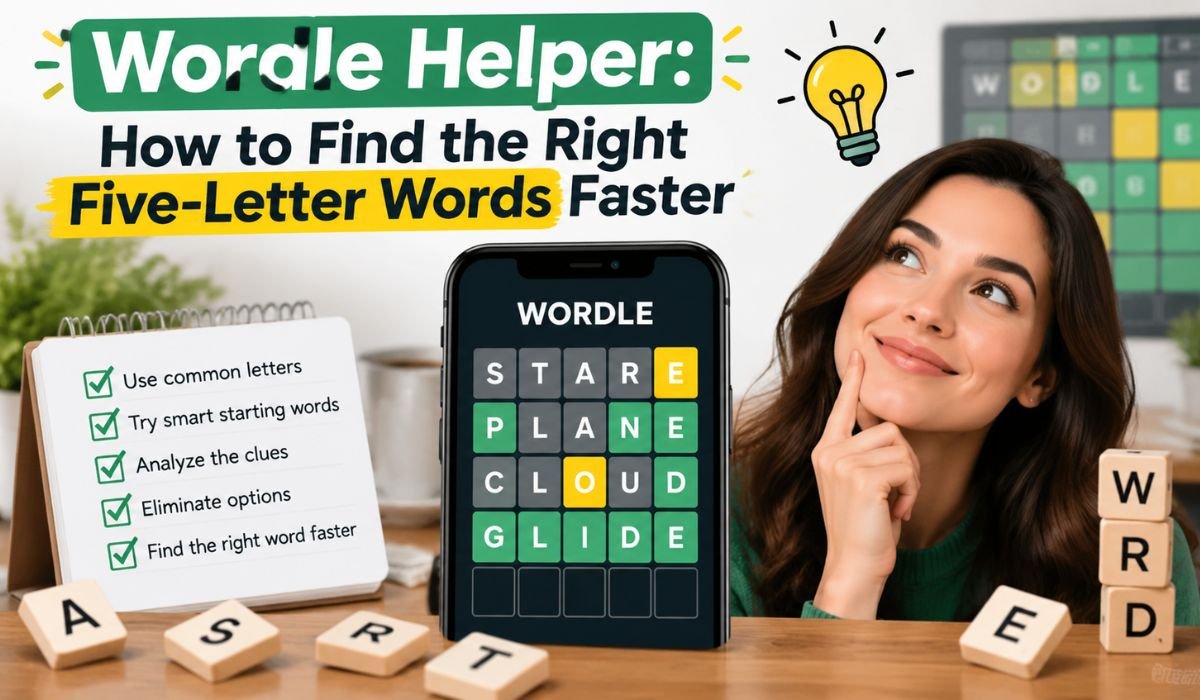
Wordle has a wonderfully simple premise: find one five-letter word in six attempts. Actually solving the puzzle, however, isn’t always quite so simple. A strong opening guess may reveal one or two useful letters, only for the next move to leave you staring at several equally convincing possibilities.
That’s where a Wordle Helper can be useful. Rather than searching through five-letter words at random, the tool takes information from guesses you’ve already made and uses it to narrow the field. Correctly positioned letters can be fixed in place, misplaced letters can be moved to other positions, and letters that have genuinely been ruled out can be excluded.
Collins Dictionary is one well-known provider of this type of Wordle Helper. Its tool lets players enter clues from their game and search for five-letter words that fit those conditions.
A helper won’t do all the thinking for you, nor does every suggestion automatically represent the day’s answer. Used properly, though, it can make a difficult puzzle easier to analyze. It can also teach you something about letter placement, word patterns, elimination, and the value of choosing an informative guess.
This guide explains how a Wordle Helper works in 2026, how to interpret Wordle’s green, yellow, and gray feedback, and how to turn those clues into smarter guesses.
Quick Bio Information About Wordle Helper
| Information | Details |
|---|---|
| Tool Name | Wordle Helper |
| Tool Category | Online Word-Finding Tool |
| Main Purpose | Find Possible Five-Letter Words |
| Popular Example | Collins Dictionary Wordle Helper |
| Supported Word Length | Five Letters |
| Related Game | Wordle |
| Wordle Publisher | The New York Times |
| Maximum Wordle Guesses | Six |
| Green Tile Meaning | Correct Letter In The Correct Position |
| Yellow Tile Meaning | Correct Letter In The Wrong Position |
| Gray Tile Meaning | Letter Is Absent Or An Extra Occurrence |
| Main Search Method | Filtering Words Using Letter Clues |
| Required Information | Results From Previous Wordle Guesses |
| Correct Letter Input | Known Letters And Positions |
| Misplaced Letter Input | Letters Present In Different Positions |
| Excluded Letter Input | Letters Ruled Out By Previous Guesses |
| Main Advantage | Reduces The Number Of Possible Words |
| Suitable Users | Beginners And Experienced Players |
| Related Tools | Wordle Solver And Five-Letter Word Finder |
| Official Wordle Affiliation | Collins Helper Is Independent Of The New York Times |
What Is A Wordle Helper?
A Wordle Helper is essentially a filtering tool for five-letter words. It takes what you’ve learned from previous guesses and searches for words that remain compatible with those clues.
Imagine you’ve discovered that A is definitely the second letter. You also know the answer contains R, although R isn’t yet in the correct position. Meanwhile, S, T, and O have been ruled out. Even with that information, thinking through every possible English word can be difficult.
A Wordle Helper handles the repetitive part of that search. You enter the clues you know, and the tool removes words that don’t satisfy them.
It’s important to understand what the resulting list means. The helper isn’t necessarily revealing the hidden answer. Instead, it’s showing words that meet the conditions you’ve supplied. If several words still fit, you’ll need to decide which one makes the most useful next guess.
That makes a Wordle Helper less of an answer machine and more of a practical way to organize evidence.
How Does A Wordle Helper Work?
Every Wordle guess places new restrictions on what the answer can be. A Wordle Helper simply combines those restrictions and compares them with a list of five-letter words.
Green letters provide the strongest positional evidence because they identify both a correct letter and its exact location. Yellow letters confirm that a character belongs somewhere in the answer while simultaneously ruling out one position. Gray letters can remove possibilities altogether, although duplicate letters require a more careful reading.
As those conditions accumulate, the pool of possible words becomes smaller.
Consider the difference between knowing that a word contains A and E and knowing that A must occupy the second position while E cannot appear in the fourth. The second set of information is much more powerful because it limits both the letters and their locations.
The results are only as good as the clues entered. Mark a yellow letter incorrectly or exclude a letter that actually appears in the answer, and legitimate candidates may disappear. That’s why understanding Wordle’s feedback comes before using any Wordle Solver effectively.
Understanding Green, Yellow, And Gray Tiles
Wordle’s three feedback colors may look straightforward, but small details matter.
A green tile tells you that the letter is correct and in exactly the right position. From that point forward, any potential answer should keep that letter there.
Yellow means the letter occurs in the answer but isn’t in the position where you guessed it. In other words, yellow provides two clues at once: keep the letter, but don’t put it back in that same location.
Gray usually indicates that the guessed letter doesn’t occur in the answer. The complication comes when a guess contains the same letter more than once.
Suppose you enter a word containing two E’s while the answer contains only one E. Depending on the positions involved, one E can receive positive feedback while the other is gray. That gray tile doesn’t suddenly mean E is absent. Instead, it can tell you that you’ve guessed more copies of E than the answer contains.
This distinction becomes particularly important when transferring clues into a Wordle Helper. Treating every gray tile as a completely excluded letter can accidentally remove the correct answer from your search.
How To Use Collins Dictionary Wordle Helper
Collins Dictionary’s Wordle Helper is built around the same clue system players encounter in Wordle. After making a guess in the game, you transfer what you’ve learned into the helper.
The interface provides five letter boxes for known characters. When a letter is in its confirmed position, the tick option can be used to mark it as correct. If the letter belongs in the word but appeared in the wrong position, the question-mark option identifies it as misplaced.
There’s also a field for letters that have been ruled out.
Suppose C, H, and E are no longer possible. Those letters can be entered into the excluded-letter field. If you haven’t confidently eliminated any letters yet, the field can remain empty.
Once the clues are entered, the Find Words function returns possible five-letter words matching the information supplied. Collins also allows users to explore dictionary definitions for suggested words, which can be helpful when an unfamiliar term appears among the results.
The key is accuracy. Before searching, compare every entry with the actual feedback from your Wordle guesses, especially if duplicate letters are involved.
A Practical Wordle Helper Example
A worked example shows why clue filtering can be so effective.
Imagine that the hidden answer is PLANT, although as the player you don’t know that yet. You begin with CRANE.
In this example, C is gray, R is gray, A is green, N is yellow, and E is gray.
Suddenly, you know quite a lot.
A must occupy the third position. N definitely occurs in the word, but it cannot be in the fourth position. C, R, and E can be eliminated based on this particular guess.
A Wordle Helper can now search for five-letter words that satisfy those restrictions. PLANT fits them, but it isn’t the only possibility. THANK, for instance, also matches those clues.
That matters because a helper shouldn’t be mistaken for a guaranteed answer lookup. At this stage, the real question isn’t simply which word appears first in the results. It’s which next guess will give you the most useful information.
A carefully chosen second guess could separate PLANT from THANK and other surviving candidates by testing letters on which those words differ. That’s the point at which the helper and your own judgment work together.
How To Find Five-Letter Words Faster
Speed in Wordle doesn’t come from typing guesses more quickly. It comes from extracting as much useful information as possible from each attempt.
During the early part of a game, testing several different letters can reveal which characters deserve further attention. As green and yellow tiles begin to appear, the strategy changes. Instead of exploring the alphabet broadly, you’re trying to solve increasingly specific placement problems.
A Five-Letter Word Finder can shorten that process by removing words that contradict known clues. Even then, you shouldn’t automatically choose the first word it returns.
Suppose five candidates remain and four of them share most of the same letters. Guessing one candidate may work, but a carefully chosen word containing several of the uncertain letters could tell you far more if it doesn’t.
There is a trade-off. A guess designed mainly to gather information may not itself be a likely answer. Early in the game, that can be worthwhile. With only one attempt left, it usually isn’t.
Good Wordle play therefore involves two questions: could this word be the answer, and how much will I learn if it isn’t?
Choosing A Strong Starting Word
Opening words attract plenty of debate among Wordle players, but there’s no single word everyone needs to use.
A useful first guess usually tests several common letters. Words such as CRANE, SLATE, TRACE, and STARE are appealing because each contains five different characters and combines frequently encountered vowels and consonants.
Using unique letters at the start has a practical advantage. A five-letter word with no repeated characters tests five parts of the alphabet in one attempt. An opening word containing a duplicate tests fewer distinct letters.
That doesn’t make repeated-letter opening words wrong. It simply means they gather a different amount of information.
Vowels deserve attention too, although testing as many vowels as possible isn’t automatically the best strategy. Consonants carry valuable information, and the most useful opening guesses tend to balance both.
More importantly, your opening word is only the beginning. Once Wordle gives you feedback, continuing to play the same preset strategy makes little sense. From the second guess onward, the puzzle itself should guide your decisions.
Using Green Letters More Effectively
Green tiles are valuable because they remove uncertainty about an exact position.
If your clues produce a pattern such as _ A _ E _, you no longer need a general list of words containing A and E. You need words with A specifically in position two and E specifically in position four.
That is a much narrower problem.
A Wordle Helper can lock those letters in place and search only for candidates that fit the remaining gaps. As more letters become green, the search usually becomes increasingly focused.
Human judgment still has a role. Familiar English spelling patterns can help you decide which combinations look plausible around the fixed letters. Certain consonants frequently appear together, while some beginnings and endings are more common than others.
Those patterns should be treated as supporting evidence, though. The colored clues remain more important than intuition about what a word ought to look like.
Making Better Use Of Yellow Letters
Yellow tiles can be easy to underestimate. In reality, each one gives you both a positive clue and an exclusion.
Suppose R appears yellow in the second position. You now know R belongs in the answer, but position two is impossible.
Place R in position four on a later guess and receive yellow again, and you’ve eliminated another location. Without ever seeing a green R, you’ve started to narrow down where it must go.
This is particularly useful when several guesses contain the same yellow letter. Keeping track of every failed position prevents you from wasting attempts by returning the letter to places already ruled out.
When entering information into a Wordle Helper, preserve those positional restrictions whenever the tool allows it.
Yellow doesn’t mean “put this letter somewhere.” More precisely, it means “this letter belongs in the answer, but not here.” Remembering both halves of that clue can make a significant difference.
Handling Gray Letters Correctly
Gray tiles often produce the fastest eliminations. If a letter appears once in a guess and receives gray feedback, it can generally be removed from consideration.
That sounds simple until duplicates appear.
Imagine guessing a word containing two L’s when the hidden answer contains only one. If one L receives green or yellow feedback and the other turns gray, eliminating L completely would be a mistake.
Instead, the feedback is telling you something about quantity. The answer contains an L, but it doesn’t support both occurrences in your guess in those circumstances.
This is why experienced players look at the complete word rather than evaluating every tile in isolation.
The same care is needed when using a Wordle Answer Helper. Before putting a gray letter into an exclusion field, check whether another copy of that letter received green or yellow feedback. If it did, the letter itself hasn’t been eliminated.
Repeated Letters In Wordle
Duplicate letters are one of Wordle’s most useful traps because they’re easy to overlook.
A five-letter answer doesn’t need five different letters. Familiar words such as APPLE, LEVEL, and SHEEP show how naturally English words can repeat characters.
The difficulty is that finding one occurrence doesn’t tell you whether another exists.
If you’ve confirmed an E, for example, the answer might contain one E or multiple E’s. You need additional evidence before deciding.
Wordle’s feedback accounts for how many relevant copies of a letter occur in the solution, as well as their positions. As a result, two identical letters in the same guess can receive different colors.
Not every Wordle Helper handles duplicate-letter constraints with the same level of detail. When the interface can’t fully represent what you’ve learned, manually inspect the suggested words before playing one.
This is one situation where your interpretation of the puzzle can be more precise than a simple word filter.
Choosing Between Several Possible Answers
A Wordle Helper becomes especially interesting when it doesn’t reduce the puzzle to one word.
Suppose several candidates survive every clue. Rather than guessing among them randomly, compare what makes those words different.
If three candidates share four letters and vary only in one position, you may be able to test several of those uncertain letters with a separate word. That guess might not be a likely solution itself, but it could reveal which candidate is correct.
Whether that strategy makes sense depends heavily on how many attempts remain.
With four guesses left, spending one attempt gathering information may be sensible. On your sixth and final attempt, information has little value unless the word you play can actually solve the puzzle.
This changing balance between exploration and commitment is part of what makes Wordle interesting. A good strategy isn’t fixed; it responds to both the clues and the number of guesses still available.
Wordle Helper Vs Wordle Solver
You’ll often see Wordle Helper, Wordle Solver, and Five-Letter Word Finder used for similar tools, but the terms aren’t governed by a universal definition.
A Wordle Helper typically allows you to enter clues and filter matching words. A Wordle Solver may do the same thing while also ranking potential guesses or applying a particular solving strategy.
A Five-Letter Word Finder is broader. It may simply search a dictionary for words matching certain characters or patterns, without being designed specifically for Wordle.
That difference matters.
A general dictionary can contain far more vocabulary than a particular puzzle uses for its answers. Consequently, a word appearing in a search result shouldn’t automatically be treated as a guaranteed Wordle solution.
When evaluating a tool, focus less on what it’s called and more on what its results actually represent.
Common Wordle Helper Mistakes
The most common problems with a Wordle Helper usually begin with the information entered into it.
A forgotten yellow restriction can bring already impossible words back into the results. An incorrectly excluded duplicate can remove legitimate candidates. Even a single misplaced green letter changes the search completely.
Another mistake is assuming that the first suggestion must be the best next move. Several words may satisfy the same clues, and their strategic value can differ considerably.
Word lists are another consideration. A dictionary-based helper may contain vocabulary beyond the set of words used as Wordle answers. Seeing a word in the results therefore doesn’t prove that it’s the hidden solution.
Before starting a new search, quickly review all previous guesses rather than only the latest one. Confirm every fixed position, remember where yellow letters have already failed, and check duplicate-letter feedback before excluding anything.
A few seconds of verification can prevent an entire search from being built on the wrong assumptions.
Can A Wordle Helper Improve Your Skills?
A Wordle Helper can teach useful solving habits if you pay attention to why its results change.
For instance, compare the candidate list before and after adding one positional restriction. You’ll quickly see that knowing where a letter can’t appear can be almost as useful as knowing where it does appear.
Over time, this kind of comparison can strengthen pattern recognition. Players become more familiar with common letter combinations, likely word structures, and the value of eliminating several possibilities with one guess.
There’s a vocabulary benefit as well. Collins Dictionary’s helper lets users explore definitions for suggested words, which can make unfamiliar results more useful than simply seeing them on a list.
The learning value disappears, however, if the tool becomes something you consult without thinking.
A more rewarding approach is to make your own assessment first, then use the helper to test it. Ask why certain candidates remain and why others disappeared. Eventually, some of that filtering process becomes instinctive.
Is Using A Wordle Helper Cheating?
Whether a Wordle Helper counts as cheating is largely a question of how you choose to play.
For some people, solving without outside assistance is the entire appeal. Others enjoy using a helper only after they’ve become stuck. Some treat the tool as a way to study words and solving strategies.
There is also a meaningful difference between using your earned clues to generate possible words and simply looking up the day’s answer. A clue-based helper still asks you to interpret the puzzle and decide what to guess next, even though it provides outside assistance.
If you’re comparing scores with friends or taking part in an informal competition, it’s sensible to agree on what tools are allowed. That way, everyone is playing under the same expectations.
For individual play, the better question may be whether the helper improves or diminishes your enjoyment. If it helps you learn while preserving the challenge you like, it can serve a useful purpose.
Tips For Better Wordle Helper Results
Getting better results from a Wordle Helper starts with accuracy, not clever tricks.
Carry information forward from every previous guess. Green letters should stay fixed. Yellow letters should remain included while avoiding positions that have already failed. Gray letters should be excluded only when the complete feedback supports doing so.
When the candidate list remains long, look for a guess that can divide it efficiently. Testing several useful unknown letters can sometimes be better than choosing one of many similar possible answers.
As the list gets shorter and your remaining attempts disappear, priorities change. The focus moves from gathering broad information toward identifying the most plausible solution.
Most importantly, remember what the tool can and can’t do. It can search a word list far faster than a person can, but it doesn’t replace accurate clue interpretation or strategic judgment.
The strongest approach combines both. Let the Wordle Helper handle the filtering while you decide what makes a useful next guess.
Understanding Wordle Hard Mode
Wordle’s Hard Mode changes the strategy because revealed hints must be used in subsequent guesses.
That reduces your freedom to play completely unrelated words simply to test new letters. Confirmed green letters need to remain in their established positions, while revealed yellow-letter information must be respected according to the game’s requirements.
As a result, an information-gathering guess that works perfectly well in normal play may not be available in Hard Mode.
This matters when choosing words from a Wordle Helper. A suggestion can fit your broader solving strategy yet still fail to satisfy Hard Mode’s restrictions.
If you’re playing with Hard Mode enabled, evaluate each candidate against the game’s requirements before entering it. The best normal-mode guess and the best Hard Mode guess won’t necessarily be the same.
Final Thoughts
A Wordle Helper is most useful when it turns the clues you’ve already earned into a clearer picture of what remains possible.
Green letters establish fixed positions. Yellow letters tell you both what belongs in the answer and where it doesn’t belong. Gray letters remove possibilities, provided they’re interpreted carefully when duplicates are involved. Put those clues together and a seemingly enormous search can become surprisingly manageable.
Tools such as Collins Dictionary’s Wordle Helper make that filtering process quicker. They can also introduce unfamiliar words and help players see patterns that aren’t immediately obvious.
But the tool is only part of the solution.
Wordle still rewards judgment: choosing an informative opening word, reading feedback accurately, deciding when to test new letters, recognizing repeated-letter possibilities, and knowing when it’s time to stop exploring and commit to an answer.
That’s also why the best Wordle Helper isn’t necessarily the one that produces the longest list of words. The real value lies in helping you make sense of the information already on the board.
Used that way, a Wordle Helper doesn’t have to take the puzzle out of Wordle. It can make the reasoning behind each guess easier to understand, sharpen your solving habits, and help you approach those five empty boxes with a better plan.
FAQs About Wordle Helper
What Is A Wordle Helper?
A Wordle Helper is a tool that searches for possible five-letter words using clues from your previous Wordle guesses. It can narrow the field according to confirmed positions, misplaced letters, and characters that have been eliminated.
How Does A Wordle Helper Find Words?
The tool compares the information you enter with its available word list. Candidates that contradict those conditions are filtered out, leaving words that remain compatible with your clues. The usefulness of the results depends on both the tool’s vocabulary and the accuracy of your input.
Can A Wordle Helper Find The Exact Answer?
Sometimes the available clues reduce the possibilities to one candidate, but that doesn’t mean every single result is guaranteed to be the official Wordle answer. Different tools can use different word lists, and incomplete clues may leave multiple valid-looking possibilities.
What Do Green, Yellow, And Gray Mean?
Green means you’ve found the correct letter in the correct position. Yellow confirms that the letter appears in the answer but belongs somewhere else. Gray generally indicates that a letter isn’t present, although duplicate-letter guesses can make gray feedback more nuanced.
Can Wordle Answers Contain Repeated Letters?
Yes. A Wordle answer can contain the same letter more than once. That’s why players shouldn’t assume that identifying one copy of a character rules out another. Duplicate-letter feedback needs to be considered as a whole.
Is Wordle Helper The Same As Wordle Solver?
Not necessarily, although the names are often used interchangeably. A Wordle Helper generally filters words according to clues, while some Wordle Solvers also rank or recommend potential guesses. Features vary from one tool to another.
Is Collins Dictionary Wordle Helper Official?
No. Collins Dictionary’s Wordle Helper is an independent tool. Wordle is owned by The New York Times, and the Collins helper isn’t an official New York Times Wordle product.
Is Using A Wordle Helper Cheating?
There’s no universal answer for casual personal play. Some players prefer solving completely unaided, while others use helpers when they’re stuck or want to learn. If you’re competing with other people, agreeing on whether outside tools are permitted is the fairest approach.
Learn more and explore exciting content on: Word Tips Explained: How to Find Words and Improve Your Word Game Skills