

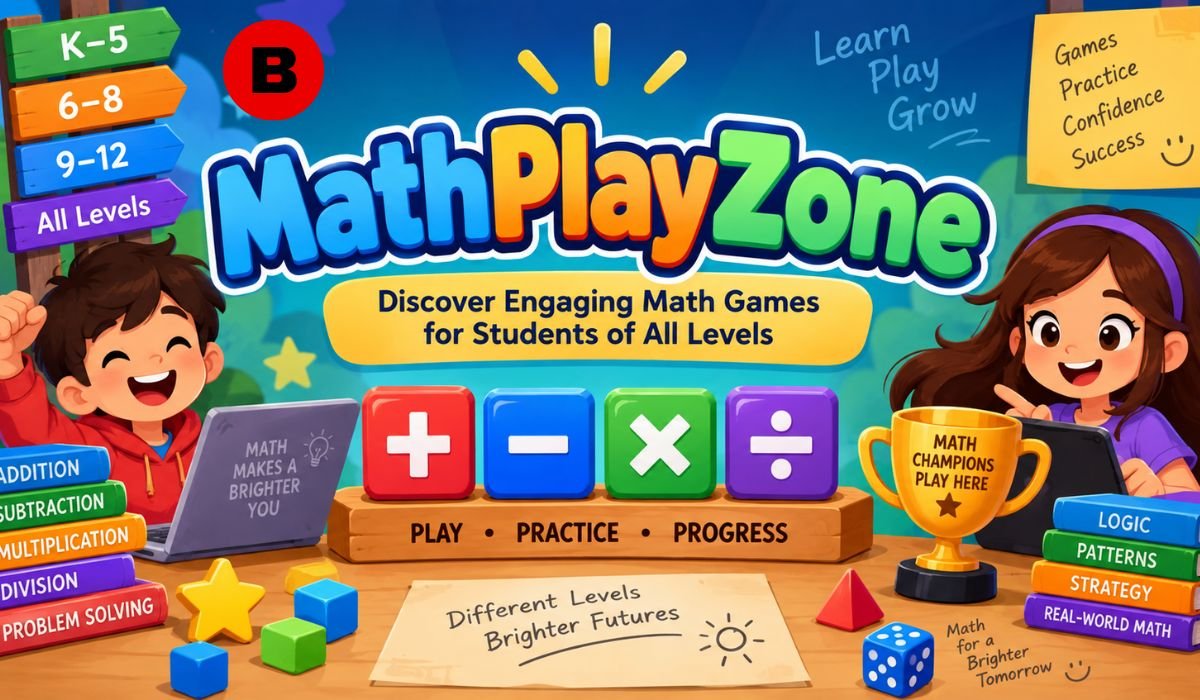
For many students, learning math means working through worksheets, memorizing formulas, and solving one problem after another. That traditional approach has its place, but it isn’t always the easiest way to keep every learner interested. Interactive activities can offer a welcome change, particularly for students who learn best by doing.
That’s where MathPlayZone comes into the picture. The platform presents itself as an online resource built around math games, puzzles, challenges, and interactive learning activities. Its published content covers several familiar areas of mathematics, including addition, subtraction, multiplication, division, fractions, geometry, decimals, percentages, and logic.
The idea behind game-based learning goes beyond simply making lessons more entertaining. A well-designed math game gives students a chance to solve problems, make decisions, receive feedback, and try again. Research into game-based mathematics learning has found encouraging results, although the benefits vary depending on the quality of the activity, the learning objective, and how the game is used. That makes an important distinction worth keeping in mind: MathPlayZone can support math practice, but it shouldn’t be treated as a substitute for effective teaching.
What Is MathPlayZone?
MathPlayZone is an online educational website that combines mathematics with interactive activities. According to its published material, the platform gives learners opportunities to work with math through games, puzzles, and challenges rather than relying entirely on conventional worksheets and textbooks.
The site’s content discusses several areas of mathematics, including basic arithmetic, fractions, geometry, decimals, percentages, logic, and problem-solving. These subjects cover many of the skills students encounter throughout their school years, although the availability of a particular topic can vary from one activity to another.
What sets the concept apart is the format. Instead of presenting every mathematical problem as a conventional exercise, MathPlayZone puts practice into a more interactive environment. For students who enjoy challenges or become bored with repetitive worksheets, that difference may make practice feel more approachable.
At the same time, it’s important to keep expectations realistic. MathPlayZone is best understood as a supplementary learning resource. It can provide extra practice and variety, but it doesn’t replace a teacher, a structured curriculum, or the detailed explanation students sometimes need when a concept is difficult.
These details are based primarily on information published by MathPlayZone. Since online platforms can update their content and features, readers should check individual activities on the current website rather than assume that every feature or subject is available everywhere.
How Does MathPlayZone Work?
The basic idea behind MathPlayZone is fairly straightforward. Learners interact with mathematical content through online activities instead of relying solely on written exercises. Depending on the activity, a student may need to calculate an answer, identify a pattern, solve a puzzle, or work through another type of mathematical challenge.
That active element is important. Reading an explanation can help a student understand a concept, but mathematics also requires practice. Learners need opportunities to apply what they’ve been taught, make mistakes, recognize what went wrong, and try again.
MathPlayZone’s published material emphasizes this interactive approach. The platform is therefore most useful when it’s treated as another place to practice rather than as a complete mathematics course. Students who need detailed instruction should still have access to teachers, textbooks, structured lessons, and other appropriate educational resources.
Exploring MathPlayZone Math Games
The appeal of MathPlayZone Math Games comes partly from the variety that interactive practice can bring to learning. When every exercise follows the same format, students can quickly lose interest. A game or challenge can introduce a different pace and give familiar mathematical skills a new context.
MathPlayZone’s published material describes activities involving arithmetic, fractions, geometry, decimals, percentages, logic, and problem-solving. Each area can encourage a somewhat different kind of thinking. Arithmetic activities may help reinforce calculation fluency, while logic-based challenges can place greater emphasis on reasoning and strategy.
Still, there’s an important point that often gets overlooked: not every activity described as a “math game” automatically provides strong educational value. The quality of the experience depends on whether the activity actually supports a meaningful mathematical objective. For parents and teachers, that’s worth considering before choosing any online math game.
Math Skills Students Can Practice
MathPlayZone’s published material covers a broad selection of mathematical topics. Addition and subtraction form the foundation of basic arithmetic, while multiplication and division help students build the fluency they need for more advanced work.
Fractions, decimals, and percentages introduce relationships between numbers that often require repeated practice before they become intuitive. Interactive activities can give students another opportunity to work with these ideas in a less formal setting.
Geometry brings a different dimension to mathematics. Students may encounter shapes, measurements, angles, and spatial relationships, while logic activities can encourage them to identify patterns, compare possibilities, and think through a problem step by step.
Having access to different types of practice can be useful, particularly when students have different strengths and weaknesses. However, learners should still choose activities that fit what they’re currently studying rather than assuming every game will be equally helpful.
MathPlayZone For Different Learning Levels
No two students develop mathematical skills at exactly the same pace. One learner may feel comfortable with basic arithmetic but struggle with fractions, while another may need more time with multiplication before moving on to more advanced topics.
MathPlayZone’s published material describes its activities as suitable for different skill levels and mentions both basic arithmetic and subjects such as fractions, percentages, and geometry. That suggests a range of practice opportunities, although specific age or grade suitability should always be judged by the individual activity.
For parents and teachers, matching the challenge to the learner matters. An activity that’s far too easy may not provide enough meaningful practice. One that’s too difficult can be frustrating and may cause the student to disengage.
The goal should be progress rather than simply completing the hardest available game. When students work at an appropriate level and gradually take on more difficult challenges, online practice can become a more useful part of their routine.
Why Game-Based Math Learning Can Be Engaging
Games can change the feel of repeated practice. A conventional exercise asks a student to find an answer, while a game may add a goal, challenge, decision, or immediate response. Those small differences can make learners more willing to stay with an activity.
Research provides a useful perspective here. Studies of game-based mathematics learning have generally reported positive effects, but they also show considerable variation between different studies and learning environments. In other words, the presence of a game doesn’t guarantee a particular educational outcome.
That finding is helpful when thinking about MathPlayZone. The objective shouldn’t be to keep a child playing for as long as possible. Instead, the activity should have a clear mathematical purpose and encourage the learner to think about the problem being presented.
The strongest game-based learning experiences are those in which the entertainment supports the mathematics rather than distracting from it.
Educational Benefits Of MathPlayZone
One of the clearest potential benefits of MathPlayZone is the additional practice it can provide. Students often need repeated exposure before mathematical procedures become familiar, and interactive activities can offer another way to get that repetition.
There’s also an active-learning element. Rather than simply reading a worked example, students have to respond to a problem. They may need to make a calculation, recognize a pattern, or choose a strategy. That direct involvement can make practice feel more immediate.
However, it’s important not to overstate what an online game can accomplish. MathPlayZone isn’t a guaranteed solution for improving mathematical performance, and game-based learning doesn’t work identically for every student. Its usefulness depends on the activity, the learner’s needs, and the instruction surrounding it.
Used thoughtfully, though, it can give students another opportunity to work with concepts they’ve already encountered and reinforce skills through additional practice.
MathPlayZone For Parents
For parents searching for online math games, MathPlayZone can serve as a possible supplementary resource for home practice. The most useful approach is to connect the activity with something the child is already learning rather than choosing games at random.
Suppose a child is currently working on multiplication. A parent might choose a relevant activity and then follow it with a few written multiplication questions. If the child is studying geometry, the online activity could be followed by a simple exercise involving shapes, angles, or measurements found around the house.
Parents can also turn game time into a conversation. Asking, “How did you work that out?” or “What made you choose that answer?” encourages children to explain their reasoning. That’s much more valuable than focusing only on whether they achieved a high score.
As with any digital learning resource, balance matters. Online math practice works best alongside reading, writing, hands-on activities, classroom learning, and reasonable limits on screen time.
MathPlayZone For Teachers
Teachers can potentially use interactive math games as an additional practice tool after introducing a concept. Depending on the activity, a game might work as a review exercise, independent practice, enrichment activity, or a change of pace during a lesson.
The key is to start with the learning objective. If students are supposed to understand fractions, for example, the chosen activity should actually reinforce fraction concepts. A colorful or entertaining game isn’t necessarily useful simply because it carries an educational label.
Interactive activities can also give teachers another way to engage students who respond well to digital learning. Even so, they work best alongside explanation, discussion, written work, assessment, and direct feedback.
In that sense, MathPlayZone can complement classroom teaching without trying to replace it.
MathPlayZone Compared With Traditional Math Practice
Traditional math practice and interactive math games don’t have to compete. Each approach can serve a different purpose.
A worksheet gives students space to show calculations, write explanations, and practice a procedure in a structured way. An interactive game can make repeated practice feel more dynamic and give students another reason to engage with a familiar skill.
A teacher, meanwhile, can explain why a method works and identify misunderstandings that a game may not catch. That’s why combining different approaches is often more sensible than choosing one and abandoning the others.
A student might learn fractions in class, complete written fraction problems, and then use an interactive activity to reinforce the same concept. In that situation, MathPlayZone becomes part of the learning process rather than the entire process.
How To Get More From MathPlayZone
Students are likely to get more from MathPlayZone when they use it with a clear purpose. Choosing an activity that matches a current learning need is generally more useful than selecting one simply because it looks entertaining.
Short, consistent practice can also be easier to manage than occasional marathon sessions. Students need time to think about mistakes and understand why an answer was incorrect. Clicking quickly through questions just to finish isn’t the same as learning from them.
It also helps to take mathematics off the screen. After completing a multiplication activity, a student can solve a few written examples. After a geometry game, they might identify shapes or angles in their surroundings. A parent or teacher can ask the learner to explain the strategy they used.
These small connections turn a digital game into part of a broader learning experience.
Is MathPlayZone Free And Easy To Access?
The MathPlayZone material currently published on the website states that many games and activities are available for free. It’s more accurate, however, to say many activities are described as free than to suggest that every feature or activity will always be free.
Online platforms can change their content, access arrangements, and features. For that reason, readers should check the current website when looking for information about a particular activity.
The same caution applies to questions about registration, advertising, device compatibility, and individual game requirements. Unless the platform clearly confirms a feature, it shouldn’t be presented as a universal fact.
That kind of careful wording isn’t just an SEO consideration. It makes the article more useful to readers who are trying to decide whether a resource is appropriate for themselves or their children.
Is MathPlayZone Suitable For Children?
Parents evaluating an online educational resource should consider more than its learning content. Privacy, cookies, advertising, external links, and the handling of user information can all matter, particularly when children are involved.
Parents should therefore review the website’s current policies before allowing younger children to use the platform independently. It’s also worth checking whether a particular activity matches the child’s age, ability, and current learning needs.
Supervision can be useful as well. When a parent understands what a child is learning, it’s easier to discuss mistakes, encourage good problem-solving habits, and keep digital practice within a balanced daily routine.
MathPlayZone can be considered a learning resource, but responsible use still matters. Online activities should sit alongside classroom instruction, offline practice, reading, physical activity, and other parts of a healthy learning routine.
What We Know And What Readers Should Check
When evaluating an online platform, it’s helpful to distinguish between information that is directly published by the platform and assumptions made about how the service works.
MathPlayZone’s published material confirms that the site focuses on interactive mathematics activities and discusses subjects including arithmetic, fractions, geometry, decimals, percentages, logic, and problem-solving. Those are the details that can be confidently used to describe the platform.
Other questions may require readers to check the current website directly. These include the suitability of every game for a particular grade, whether every listed subject appears across the platform, device support, registration requirements, advertising arrangements, and the availability of specific features.
This distinction is especially important for parents and teachers. They’re not simply looking for an attractive description of a website. They need practical information that can help them decide whether a particular resource fits a real learner.
Clear sourcing, careful language, and a willingness to identify what isn’t confirmed make an article more trustworthy.
The Future Of Online Math Learning
Digital learning continues to change, and mathematics education is no exception. Future platforms may offer more personalized practice, adaptive difficulty, detailed feedback, and better ways of identifying the areas where an individual student needs additional help.
Those developments could make online math practice more useful, but newer technology isn’t automatically better. Artificial intelligence, advanced analytics, and immersive experiences may have valuable applications, yet a simple activity that clearly reinforces an important mathematical idea can still be more effective than a complicated one.
The real opportunity for platforms such as MathPlayZone is to make digital practice more meaningful without allowing the technology to overshadow the mathematics itself.
Advantages And Limitations Of MathPlayZone
The main appeal of MathPlayZone is its interactive approach to mathematics practice. Its published material describes games, puzzles, challenges, and a range of mathematical subjects, giving students another way to engage with familiar concepts.
That variety can be particularly useful for learners who find conventional practice repetitive. A student may enjoy working through an interactive challenge and then returning to written exercises with a stronger sense of familiarity with the topic.
There are limitations, however. Games can’t replace comprehensive mathematics instruction, and no single activity will suit every learner. Students still need opportunities to write solutions, explain their reasoning, receive feedback, and tackle unfamiliar problems.
A balanced view is therefore the most useful one. MathPlayZone can be a valuable addition to math practice, but its greatest value comes when it’s used alongside, rather than instead of, broader educational support.
Final Thoughts
MathPlayZone offers an interactive approach to mathematics practice through games, puzzles, and challenges. Its published material covers several familiar areas of school mathematics, including arithmetic, fractions, geometry, decimals, percentages, and logic.
For students, the biggest attraction may simply be the chance to practice mathematics in a different setting. Instead of relying entirely on worksheets, learners can use MathPlayZone Math Games to add variety to their routine and spend additional time working with concepts they may already be studying.
Parents and teachers can also make the platform more useful by connecting its activities to broader learning goals. A game becomes more meaningful when a student can explain what they learned from it, apply the same idea to a written problem, or recognize the concept in a real-world situation.
The broader evidence surrounding game-based learning is encouraging, but it isn’t a reason to make sweeping promises. Outcomes depend on the design and purpose of the activity, as well as how it fits into the learner’s wider education.
That makes a balanced approach the most sensible one. MathPlayZone isn’t a magic solution for learning mathematics, nor does it need to be. Used thoughtfully, it can provide students with another engaging opportunity to practice important skills, explore mathematical ideas, and become more comfortable with problem-solving.
FAQs About MathPlayZone
What Is MathPlayZone?
MathPlayZone is an online educational website focused on interactive mathematics activities, including games, puzzles, and challenges. Its published content discusses areas such as arithmetic, fractions, geometry, decimals, percentages, logic, and problem-solving.
What Math Topics Are Covered On MathPlayZone?
The MathPlayZone material mentions addition, subtraction, multiplication, division, fractions, geometry, decimals, percentages, logic, and problem-solving. The exact content can vary by activity, so students should check individual games when looking for practice in a specific area.
Is MathPlayZone Free?
The site’s published material states that many of its games and activities are available for free. Because online platforms can change their features and access arrangements, readers should check the current website for the latest information rather than assume that every activity has identical access conditions.
Who Can Use MathPlayZone?
MathPlayZone is presented as a resource for students and learners with different levels of mathematical ability. Parents and teachers can also consider suitable activities as supplementary practice. The right activity will depend on the learner’s age, existing skills, and current learning goals.
Can MathPlayZone Be Used For Home Learning?
Yes. Parents can incorporate suitable activities into a broader home-learning routine. The most useful approach is to connect games with concepts children are already studying and then reinforce those ideas through written practice, discussion, or real-world examples.
Can Teachers Use MathPlayZone?
Teachers can potentially use appropriate interactive math games for review, independent practice, enrichment, or additional reinforcement. The important consideration is whether the activity supports the mathematical objective being taught.
Does MathPlayZone Replace Traditional Math Practice?
No. Interactive games are best treated as supplementary practice. Students still benefit from structured lessons, written work, teacher explanations, assessment, and opportunities to apply mathematics to unfamiliar problems.
Are Math Games Effective For Learning?
Research suggests that game-based mathematics learning can produce positive results, but the outcome varies according to the design of the activity, the learner, and the educational context. A game shouldn’t be assumed to improve learning simply because it is interactive.
Learn more and explore exciting content on: Who Is Elaine Starchuk? Inside The Life Of Tommy Lee’s Ex-Wife