

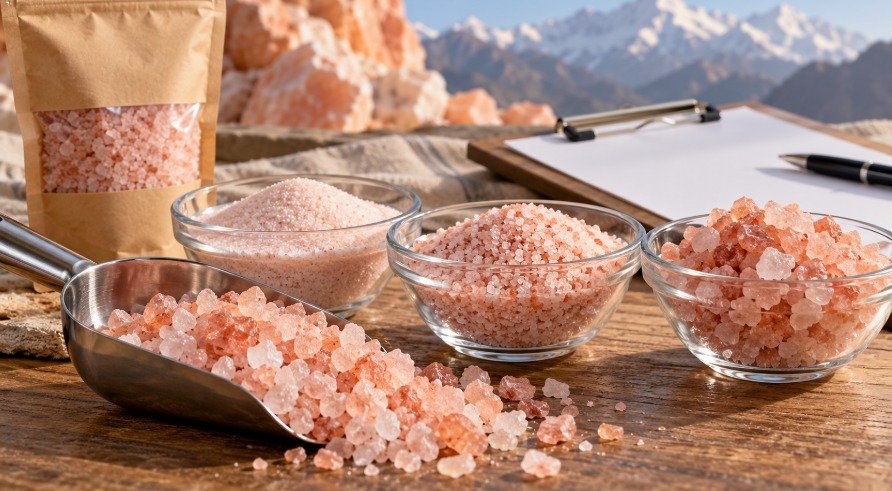
The sample looks good. The price seems competitive. The supplier says everything is ready to ship. Then the practical questions begin: will it work in your grinder, which tests belong to this batch, and what will the order cost when it reaches your warehouse?
A bulk purchase needs more than an attractive product photograph. You are buying a specification, a supply process, and an agreement about what happens if the delivery does not match your expectations.
Before approving an order, get clear written answers to these seven questions.
1 Is this salt suitable for the intended use
Say exactly what you plan to sell or manufacture. Salt intended for food needs different consideration from salt supplied for bath products, decoration, or industrial use. Similar appearance does not establish suitability.
Ask for the food-grade specification, ingredient information, and documentation relevant to your destination market. Codex’s Standard for Food-Grade Salt covers composition, contaminants, hygiene, and labeling. It is a useful international reference, while applicable national requirements still need to be checked.
If you are researching suppliers such as Sobaan Salts, begin with the edible product category and describe your application in the inquiry. “Pink salt for a retail kitchen grinder” gives the supplier a much clearer brief than “best quality salt.”
2 Which grain specification am I actually ordering
Words such as fine and coarse are convenient, but two suppliers may use them differently. Ask for a measurable particle-size range or sieve specification, including the allowed variation.
Then test a representative sample in the actual application. Check how it passes through a grinder, dispenses from a shaker, or behaves in your production process. A photograph cannot answer those questions.
For a starting comparison, Sobaan Salts’ bulk edible salt range describes its edible supply options. Use that information to request the exact grade and sample you need, then make the approved specification part of the purchase agreement.
3 Can I connect the test report to the supplied lot
A certificate of analysis, often called a COA, records test results for a sample. Ask which lot it represents, when testing occurred, which laboratory performed it, and what methods and acceptance criteria were used.
Look beyond whether a document says “passed.” Check that the product description matches the order and that the results cover the relevant specifications. Have a qualified laboratory or food-safety adviser help define appropriate testing if this is outside your expertise.
Keep the sample and document references together. A report for a different product or an unidentified sample gives you less information about the shipment you are purchasing. Agree whether a shipment-specific report or independent testing will be required before release.
4 What do the certificates actually cover
Ask for the current certificate, issuing body, named facility, scope, and validity dates. A certificate related to a management system does not automatically prove that a particular shipment meets every product requirement.
Be precise with US regulatory language. FDA states that it does not issue food facility registration certificates and does not recognize such certificates issued by private businesses. Do not treat an “FDA certificate” graphic as proof of product approval.
Verify the documents that matter to your transaction with their issuer or a qualified adviser. The purpose is to understand the evidence, not to collect the largest number of logos.
5 How will the salt be packed and identified
Confirm the pack size, packaging materials, closure, carton or pallet arrangement, and lot identification. Ask how the product will be protected during the expected transport and storage conditions.
For retail packaging, check the filled pack rather than an empty mockup. Can the closure be opened and resealed? Is the label readable? Does the grinder work with the chosen grade? Are the cartons practical for your warehouse?
Keep a copy of the approved artwork and packaging specification. If the material or pack format changes later, require a discussion before production. Small packaging changes can affect both the customer experience and the costs you planned around.
6 What is the full cost at my destination
Ask what the quotation includes and which delivery term applies. Product price alone may exclude packaging, freight, insurance, clearance, duties, taxes, inland delivery, or other destination charges.
Build a comparison using the same quantity, grade, packaging, and delivery basis for every supplier. Include expected testing and handling expenses. Use current freight and customs advice for your route rather than treating a supplier’s rough estimate as a final landed cost.
A lower per-kilogram price may come with a larger minimum order that ties up more cash. Compare the quantity you can realistically sell and store, not just the cheapest unit price on the page.
7 What happens if the delivery does not match
Agree on inspection, acceptance criteria, and the process for reporting a problem before paying the deposit. Specify the evidence required, the contact person, the reporting window, and the remedies available under the contract.
Also confirm the production timeline, approval milestones, and who tells you about delays. A planned shipping date is different from an arrival date. Your launch schedule should allow for the steps between them.
For a new relationship, consider a manageable trial order where commercially practical. It gives you a chance to evaluate communication and consistency before increasing the commitment.
Put the answers into one order brief
Record the intended use, destination, approved grade, sample reference, tests, packaging, quantity, delivery basis, and acceptance terms in a single brief. Ask the supplier to confirm it in writing.
The right bulk purchase is one you can evaluate against clear requirements when it arrives. A good sample starts the conversation. A complete specification makes the purchase easier to manage.
Editorial handoff
INTERNAL NOTES • Remove this page before publication
Brand: Sobaan Salts | Intended publisher: bgomagazine.com
Planned publishing date: 18 October 2026 | Draft for Wasim’s review
Audience and tone: Business and lifestyle readers; actionable supplier checklist.
Article length: approximately 956 words. Two brand hyperlinks in article copy.
Suggested meta description: Ask these seven questions about specifications, testing, packaging, and costs before buying bulk pink salt.
Featured-image alt text: Fine and coarse pink salt samples beside a scoop, pouch, and clipboard.
Image: original AI-generated editorial illustration. It does not depict a verified person, brand facility, named font specimen, or product test.
Sources and checks
FAO and WHO Codex: Standard for Food-Grade Salt CXS 150-1985, amended 2025; composition, hygiene, labeling and contaminants.
https://openknowledge.fao.org/handle/20.500.14283/cd8957en
US FDA: Food facility registration certificates are not issued or recognized by FDA.
https://www.fda.gov/food/guidance-regulation-food-and-dietary-supplements/questions-regarding-whether-food-facilities-are-required-pay-registration-fees-and-private
Sobaan Salts: Supplier product offering only; certifications not independently established.
https://sobaansalts.com/bulk-edible-salt/
Sources checked 17 October 2026. Examples and exercises are original editorial illustrations; no firsthand product, platform, or lab testing is claimed. Publisher placement and publication remain unconfirmed. Byline to be supplied by the publisher or approved contributor.
Research scope: source verification and publisher topic-fit review. US organic ranking order and a full eight-result competitor audit were not verified. Owned-site template and schema checks do not apply to this guest-post handoff.
 Admin
Admin