

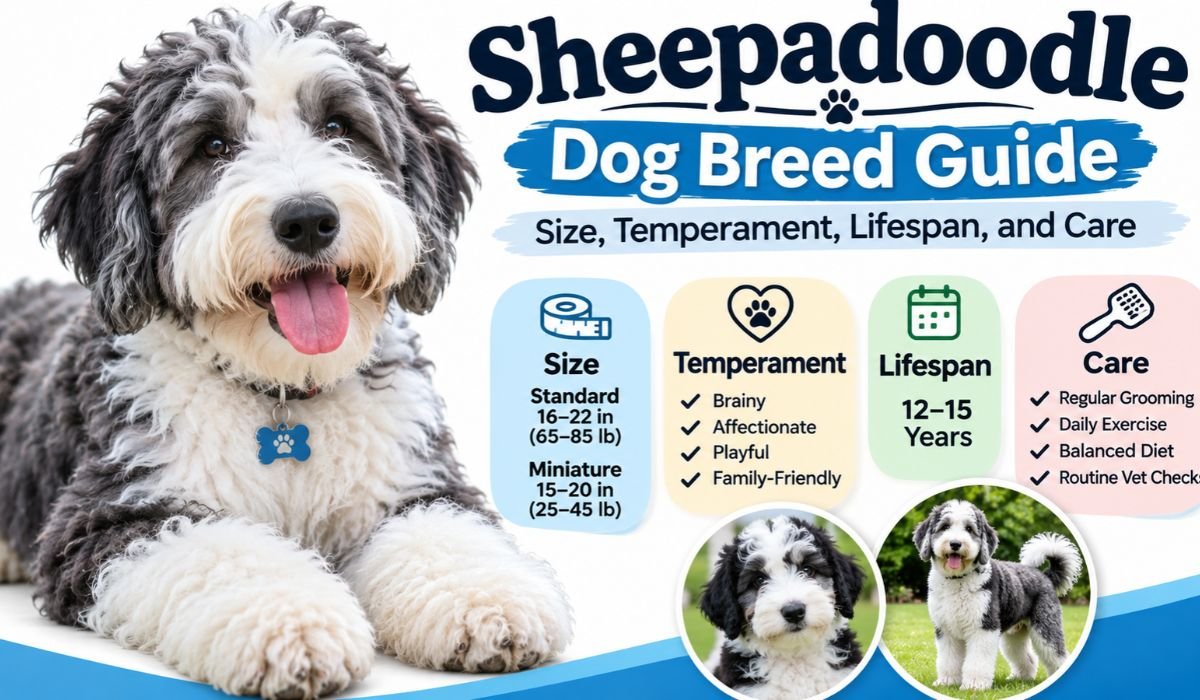
It’s hard not to smile when you see a Sheepadoodle. With its fluffy coat, expressive eyes, and playful personality, this charming dog often looks more like an oversized teddy bear than a traditional family pet. But behind that adorable appearance is an intelligent, energetic companion that needs plenty of attention and care.
A cross between the Old English Sheepdog and the Poodle, the Sheepadoodle brings together traits from two hardworking breeds. Many are affectionate, eager to learn, and happiest when they’re involved in family life. Still, their beautiful coats require regular maintenance, and their lively personalities need an appropriate outlet.
If you’re thinking about welcoming a Sheepadoodle into your home, there’s plenty worth knowing first. This guide explores Sheepadoodle size, temperament, lifespan, grooming, health, training, and everyday care to help you decide whether this lovable mixed breed fits your lifestyle.
Sheepadoodle Quick Bio Information
| Characteristic | Information |
|---|---|
| Breed Name | Sheepadoodle |
| Breed Type | Mixed Breed |
| Parent Breeds | Old English Sheepdog and Poodle |
| Origin | Exact Origin Not Documented |
| Standard Weight | Commonly 65–85 Pounds |
| Mini Weight | Commonly 25–45 Pounds |
| Standard Height | Often 16–22 Inches |
| Mini Height | Often 15–20 Inches |
| Average Lifespan | Approximately 12–15 Years |
| Temperament | Affectionate, Intelligent, Playful |
| Coat Texture | Wavy, Curly, or Straighter |
| Common Colors | Black, White, Gray, Cream |
| Shedding Level | Varies by Individual |
| Grooming Needs | High |
| Exercise Needs | Moderate to High |
| Trainability | Generally Good |
| Family Compatibility | Often Good With Socialization |
| Allergy Friendly | Not Guaranteed |
| Health Considerations | Joint, Eye, and Inherited Conditions |
| Ideal Home | Active Household With Time for Care |
These figures are commonly reported estimates rather than official breed standards. Individual Sheepadoodles may fall outside the listed ranges.
What Is a Sheepadoodle?
A Sheepadoodle is a mixed-breed dog created by crossing an Old English Sheepdog with a Poodle. Although the combination is relatively modern, both parent breeds have long histories as working dogs.
Old English Sheepdogs traditionally helped move livestock, while Poodles were developed to retrieve waterfowl. Those backgrounds help explain why Sheepadoodles are often intelligent, active, and enthusiastic about learning.
However, a Sheepadoodle isn’t a standardized purebred dog. Major kennel organizations, including the American Kennel Club, don’t recognize it as a separate purebred breed with an official standard.
That means puppies can inherit different combinations of physical and behavioral characteristics. One Sheepadoodle might have a tightly curled coat and a calmer personality, while another could have loose waves and seemingly endless energy.
Understanding this natural variation is important. The name Sheepadoodle describes the dog’s ancestry, not a guarantee of how it will look or behave.
Sheepadoodle Size and Weight
One of the first questions prospective owners ask is how big their Sheepadoodle will become. Unfortunately, there’s no single answer.
Adult size depends heavily on genetics, particularly the size of the Poodle parent. Standard Sheepadoodles commonly weigh between 65 and 85 pounds, although some grow considerably larger. Mini Sheepadoodles usually fall around 25 to 45 pounds.
Height also varies. Standard Sheepadoodles are often described as standing around 16 to 22 inches tall, while smaller varieties may measure approximately 15 to 20 inches. These ranges aren’t universal, and individual dogs can differ.
Breeders sometimes advertise Mini, Medium, and Standard Sheepadoodles. However, these labels aren’t regulated by a universal breed standard.
Growth continues beyond the early puppy months. Many Sheepadoodles approach their adult height during their first year, but larger dogs may continue filling out and developing muscle afterward.
If adult size matters to your household, ask about both parents’ measurements. They provide useful clues, even though they can’t guarantee exactly how large a puppy will become.
Sheepadoodle Appearance and Coat Colors
The Sheepadoodle’s coat is undoubtedly one of its biggest attractions. Thick, soft-looking fur gives many of these dogs their familiar teddy-bear appearance.
Yet not every Sheepadoodle has the same coat. Some inherit loose, flowing waves, while others develop tighter curls similar to those of a Poodle. A few have straighter hair that more closely resembles their Old English Sheepdog ancestry.
Black and white is a particularly recognizable color combination. Gray, cream, blue-gray, and other patterns are also possible.
Interestingly, a Sheepadoodle puppy’s coat may change as it grows. Some dogs develop lighter coloring or different textures as their adult coat replaces their puppy fur.
Their floppy ears, dark eyes, sturdy bodies, and prominent noses complete their distinctive appearance. Long facial hair sometimes covers the eyes, so careful trimming may be needed.
Although that fluffy coat looks wonderful in photographs, it also creates one of the breed’s biggest responsibilities: regular grooming.
Sheepadoodle Temperament and Personality
Spend time around a well-socialized Sheepadoodle, and you’ll quickly understand why people find them so appealing. Many are affectionate, curious, playful, and eager to participate in whatever their families are doing.
Their intelligence is another attractive quality. Both parent breeds have working backgrounds, and many Sheepadoodles enjoy learning commands, solving puzzles, and playing interactive games.
That intelligence comes with responsibilities, though. A dog that enjoys mental challenges may become restless when its days lack activity or stimulation.
Boredom can contribute to chewing, jumping, excessive barking, or other unwanted behaviors. Regular exercise and consistent training help prevent these habits from becoming established.
Some Sheepadoodles also inherit herding-related instincts. You might notice an individual dog chasing movement or attempting to guide children running through the yard.
Of course, personality isn’t determined by genetics alone. Early experiences, socialization, training, and the home environment all shape how a Sheepadoodle behaves.
Are Sheepadoodles Good Family Dogs?
For the right household, a Sheepadoodle can be a wonderful family companion. Many enjoy being around people and happily join in games, walks, and everyday activities.
Their playful personalities often appeal to families with children. However, larger Sheepadoodles can become overly enthusiastic during play.
A friendly dog doesn’t need to be aggressive to accidentally knock over a small child. That’s why adult supervision and teaching children how to interact respectfully with dogs are essential.
Sheepadoodles may also get along with other household pets, including cats and dogs. Gradual introductions and positive early experiences can make those relationships easier.
First-time dog owners may appreciate the Sheepadoodle’s intelligence and willingness to learn. Still, it’s worth remembering that a trainable dog isn’t necessarily a low-maintenance dog.
Families should be realistic about grooming, exercise, training, and companionship. Sheepadoodles generally do best in homes where people can devote meaningful time to their daily needs.
Sheepadoodle Grooming and Coat Care
That beautiful Sheepadoodle coat requires more work than many new owners expect.
Dense, wavy, or curly hair can become tangled surprisingly quickly. Without proper brushing, those tangles may develop into tight mats that pull on the skin and cause discomfort.
Daily brushing is often helpful, especially for Sheepadoodles with longer coats. Pay particular attention to areas behind the ears, beneath the collar, around the legs, and under the armpits.
Professional grooming is commonly needed every six to eight weeks. Some dogs require more frequent appointments, depending on their coat texture, length, and lifestyle.
Grooming isn’t limited to haircuts, either. Regular nail trimming, dental care, and ear inspections are important parts of maintaining good health.
Because Sheepadoodles have floppy ears, moisture can sometimes remain trapped inside. Redness, unpleasant odors, or persistent scratching may indicate a problem that needs veterinary attention.
Another common question concerns shedding. Some Sheepadoodles shed relatively little, while others lose noticeably more hair.
Despite popular marketing claims, no Sheepadoodle is guaranteed to be hypoallergenic. Dog allergens are found in saliva and skin particles as well as material associated with shedding.
Sheepadoodle Exercise and Daily Activities
A Sheepadoodle may enjoy relaxing beside you, but don’t mistake its cuddly appearance for a naturally inactive lifestyle.
Many Sheepadoodles have plenty of energy and need regular opportunities to move, explore, and play.
Daily walks are a good starting point. Retrieving games, supervised outdoor activities, and suitable interactive play can provide additional exercise.
The amount needed depends on the dog’s age, size, fitness, and individual temperament. An energetic adult may enjoy longer outings, while a growing puppy needs shorter, gentler sessions.
Young dogs shouldn’t be pushed into excessive repetitive jumping or strenuous running while their joints are developing.
Mental exercise deserves just as much attention. Puzzle feeders, scent games, and short training sessions can keep a Sheepadoodle interested and engaged.
When their physical and mental needs are met, many Sheepadoodles are better able to settle comfortably at home.
How to Train a Sheepadoodle
Training a Sheepadoodle can be a rewarding experience, particularly when lessons are consistent, enjoyable, and built around positive reinforcement.
These dogs often respond well to food rewards, praise, and play. Rather than relying on punishment, owners should reward the behaviors they want to encourage.
Start with everyday essentials such as responding to a name, coming when called, walking politely on a leash, and settling calmly around visitors.
Early socialization is equally important. Puppies benefit from safe, positive introductions to unfamiliar people, sounds, environments, and suitable animals.
House training takes patience. Predictable bathroom opportunities, supervision, and rewarding successful behavior can help puppies understand expectations.
Jumping is another behavior worth addressing early, especially in larger Sheepadoodles. Teaching calm greetings while the dog is young can prevent problems later.
Short, regular lessons are often more productive than long sessions. Most importantly, training should strengthen the relationship between the dog and its owner.
Sheepadoodle Diet and Nutrition
Good nutrition plays a major role in keeping a Sheepadoodle healthy throughout its life.
A complete and balanced diet should match the dog’s age, body size, activity level, and individual health requirements.
Puppies need food formulated for growth. Larger Sheepadoodle puppies may benefit from diets designed specifically for large-breed development, which provide appropriate nutrient and mineral levels.
Adult dogs have different requirements, and their portions should reflect their body condition and the calorie content of their food.
Overfeeding can lead to excess weight, increasing pressure on joints and potentially contributing to other health problems.
Fresh drinking water should always be available, while treats should make up only a small part of daily calorie intake.
Certain human foods must be avoided. Chocolate, grapes, raisins, and products containing xylitol can be dangerous or toxic to dogs.
If your Sheepadoodle has digestive problems, suspected food allergies, or a medical condition, consult a veterinarian before making significant dietary changes.
Sheepadoodle Health Problems
Like every dog, a Sheepadoodle can develop health problems. Some conditions may be inherited from either parent breed, while others can occur regardless of ancestry.
Hip dysplasia is one concern worth understanding. It develops when the hip joint forms abnormally and may eventually cause pain, stiffness, reduced mobility, or arthritis.
Progressive retinal atrophy is another inherited condition. It gradually damages the retina and can lead to vision loss or blindness.
Larger, deep-chested Sheepadoodles may also face a risk of gastric dilatation-volvulus, commonly called GDV.
This serious emergency occurs when the stomach becomes distended and twists, interfering with normal circulation.
Warning signs include repeated attempts to vomit without producing anything, abdominal swelling, restlessness, excessive drooling, weakness, or collapse. Suspected GDV requires immediate emergency veterinary treatment.
Ear infections and certain inherited endocrine conditions are additional concerns that may affect some individuals.
Responsible breeders should discuss relevant health screening for both parent dogs. Regular veterinary examinations are also important because early detection can improve the management of many conditions.
Sheepadoodle Lifespan and Healthy Aging
The commonly reported Sheepadoodle lifespan is around 12 to 15 years. However, this range is an estimate, not a promise.
Some dogs may live longer, while others experience health problems that shorten their lives.
Genetics influence longevity, but everyday care also matters. Maintaining a healthy weight, providing appropriate exercise, feeding a balanced diet, and arranging preventive veterinary care can support long-term well-being.
Routine appointments give veterinarians opportunities to assess dental health, joint mobility, body condition, and other developing concerns.
As Sheepadoodles grow older, they may slow down or become less enthusiastic about demanding activities.
Stiffness, changes in vision, reduced hearing, or unusual behavior should be discussed with a veterinarian rather than dismissed as normal aging.
Senior dogs often benefit from comfortable bedding, gentler exercise, and adjustments that make daily life easier.
Sheepadoodle Puppies and Early Development
Welcoming a Sheepadoodle puppy into your home is exciting, but those first months also involve plenty of learning.
Puppies need a safe environment, nutritious food, suitable chew toys, regular rest, and a predictable routine.
Early grooming practice is particularly valuable for this crossbreed. Gently introducing brushing, paw handling, ear examinations, and other care activities can make future grooming much easier.
Socialization should begin with carefully managed positive experiences. Rather than overwhelming a puppy with unfamiliar situations, focus on helping it feel safe and confident.
Teething, chewing, and occasional difficulty concentrating are normal parts of puppy development.
Adolescence can introduce new challenges as dogs become more independent or easily distracted. Consistent training helps owners navigate these changes.
Growth also varies between individuals. Larger Sheepadoodles may take longer to reach full physical maturity than smaller dogs.
Regular veterinary guidance helps owners make appropriate decisions about feeding, exercise, vaccinations, and development.
Sheepadoodle Price and Ownership Costs
Before bringing home a Sheepadoodle, it’s important to consider the full financial commitment.
The initial purchase price can vary widely depending on location, breeder practices, demand, and health-screening arrangements.
However, an expensive puppy isn’t automatically a responsibly bred puppy. Buyers should look beyond the price and ask about health records, parent dogs, and living conditions.
Ongoing expenses can be substantial. Sheepadoodles need food, grooming, veterinary care, parasite prevention, training, and everyday supplies.
Professional grooming is especially important to budget for because many Sheepadoodles require regular appointments throughout their lives.
Unexpected veterinary bills can also arise. Pet insurance or a dedicated emergency fund may help owners prepare.
Adoption is another option worth exploring. Some shelters and rescue organizations occasionally have Sheepadoodles or similar Poodle mixes available.
Whatever route you choose, responsible ownership means being prepared for the dog’s needs over its entire lifetime.
Sheepadoodle vs. Goldendoodle
Sheepadoodles and Goldendoodles are frequently compared because both are popular Poodle crosses with fluffy coats and affectionate reputations.
The main difference lies in their ancestry.
A Sheepadoodle combines an Old English Sheepdog with a Poodle, while a Goldendoodle combines a Golden Retriever with a Poodle.
Both crosses can be intelligent, playful, energetic, and strongly attached to their families.
However, Sheepadoodles may inherit herding-related tendencies, while Goldendoodles may show retrieving behaviors associated with their Golden Retriever ancestry.
Coat texture, shedding, size, and grooming requirements can vary considerably in both crosses.
Neither is automatically calmer, healthier, or easier to train.
Instead of choosing based on popularity, prospective owners should consider the individual dog’s temperament, health, activity requirements, and compatibility with their household.
Sheepadoodle History and Origins
Although Sheepadoodles have become familiar companions, their exact beginnings remain uncertain.
The cross is generally associated with the growing popularity of Poodle mixes during the late twentieth century, but a precise origin date hasn’t been firmly documented.
Its parent breeds have much longer histories.
The Old English Sheepdog developed in Britain as a working dog used to move livestock. Despite its name, it isn’t considered one of the oldest dog breeds.
The Poodle originated in Germany, where it was developed as a water retriever. Its intelligence, athletic ability, and distinctive coat later helped establish its popularity across Europe.
Today’s Sheepadoodles are primarily companion dogs rather than livestock workers or retrievers.
Even so, their ancestry helps explain why many enjoy learning, staying active, and spending time with people.
Choosing a Responsible Sheepadoodle Breeder or Rescue
Finding the right Sheepadoodle starts with choosing a trustworthy breeder or adoption organization.
Responsible breeders should be open about the health and temperament of their dogs. They should also explain which veterinary examinations and inherited-disease screenings have been completed.
Ask about the puppy’s parents, early socialization, living conditions, and available medical records.
Be cautious of anyone who guarantees that every puppy will be completely hypoallergenic, free from inherited health problems, or a precise adult size.
These promises overlook the natural variation found in mixed-breed dogs.
Rescue organizations and shelters may also offer opportunities to adopt Sheepadoodles or similar dogs.
Whether you’re adopting an adult or purchasing a puppy, focus on health, temperament, and suitability rather than appearance alone.
Final Thoughts
There’s plenty to love about the Sheepadoodle. Its playful personality, intelligence, affectionate nature, and unmistakably fluffy appearance make it an appealing companion for many households.
Still, the qualities that make this dog special also bring responsibilities. That beautiful coat needs regular care, an active mind needs stimulation, and an energetic body needs suitable exercise.
Good nutrition, patient training, preventive veterinary care, and a stable home environment all contribute to a Sheepadoodle’s quality of life.
Before welcoming one into your family, think carefully about your schedule, living arrangements, grooming budget, and long-term commitment.
For people who can provide the attention and care these dogs need, a Sheepadoodle can become much more than an adorable pet. It can be a devoted companion that brings affection, playfulness, and genuine joy into everyday life.
FAQs About Sheepadoodle
Are Sheepadoodles Good for Beginners?
Sheepadoodles can be suitable for first-time owners who are ready to commit to training, grooming, and daily exercise. Many learn quickly and enjoy interacting with people. However, their grooming requirements and energetic personalities may be challenging for someone expecting a low-maintenance dog.
Do Sheepadoodles Bark a Lot?
Some Sheepadoodles are quite vocal, particularly when they’re excited, bored, or responding to unfamiliar sounds. Others are naturally quieter. Consistent training, socialization, and sufficient mental stimulation can help manage excessive barking.
Are Sheepadoodles Hypoallergenic?
No Sheepadoodle is completely hypoallergenic. Although some individuals shed less than other dogs, allergens are still present in their saliva and skin particles. People with allergies should spend time around individual dogs before deciding to bring one home.
How Big Does a Sheepadoodle Get?
Standard Sheepadoodles commonly weigh around 65 to 85 pounds, while Mini Sheepadoodles are often approximately 25 to 45 pounds. Their actual adult size depends on genetics, and some dogs grow beyond these estimates.
How Long Do Sheepadoodles Live?
Sheepadoodles are commonly estimated to live between 12 and 15 years. Individual longevity varies according to genetics, nutrition, health conditions, body weight, and preventive veterinary care.
Are Sheepadoodles Easy to Train?
Many Sheepadoodles respond well to positive-reinforcement training because they are intelligent and enjoy interaction. Consistency, patience, and early socialization are important for developing reliable behavior.
Can Sheepadoodles Live in Apartments?
Some Sheepadoodles adapt well to apartment living when their exercise, enrichment, and companionship needs are consistently met. Larger or particularly energetic individuals may need more outdoor activity and careful management in smaller spaces.
How Often Should a Sheepadoodle Be Groomed?
Most Sheepadoodles need frequent brushing to prevent tangles and matting. Dogs with longer or curlier coats may require daily attention. Professional grooming is commonly scheduled every six to eight weeks, although individual needs vary.
Learn more and explore exciting content on: Best Kitten Food in 2026: Top Healthy Picks for Growing Kittens