

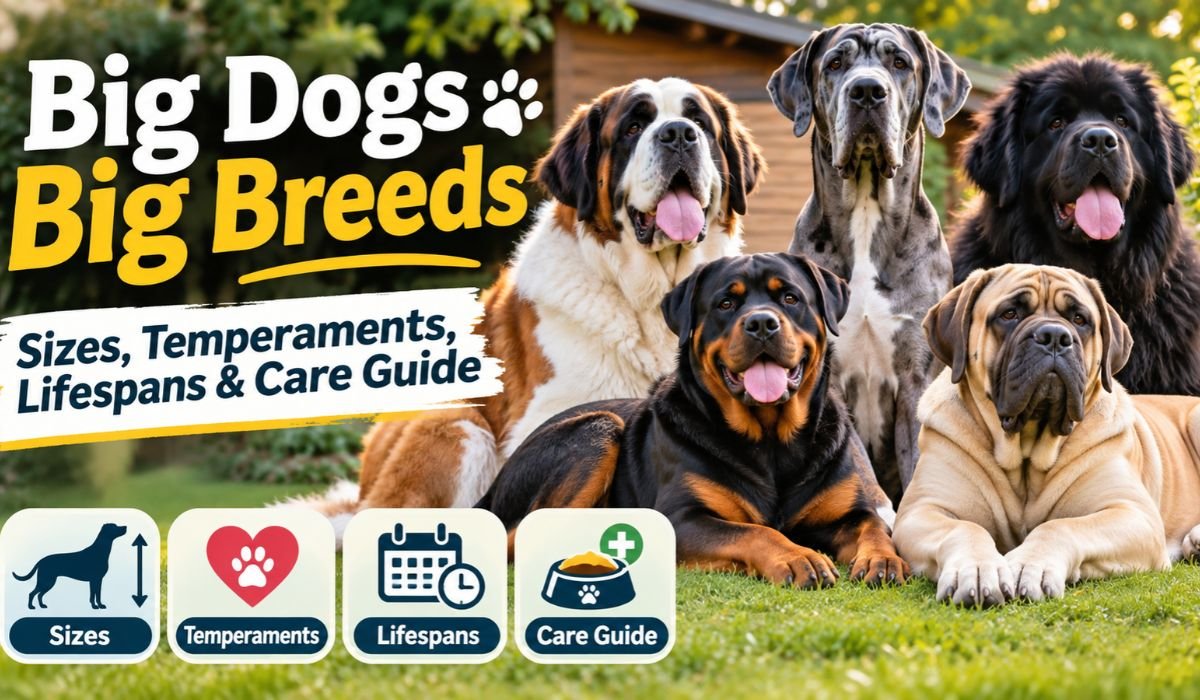
Introduction: Big Dogs, Big Personalities, And Lots Of Love
There’s something undeniably appealing about a big dog big. A Great Dane may casually rest its enormous head on your shoulder, while a Labrador Retriever might greet you at the door as though you’ve been gone for weeks instead of an hour. Large dogs take up plenty of physical space, but for many owners, it’s their personalities that really fill the home.
Of course, choosing a big dog isn’t simply a matter of finding the largest or fluffiest breed you can. Large dog breeds differ enormously in temperament, exercise requirements, grooming needs, trainability, and health. An energetic Weimaraner may be perfect for someone who spends weekends outdoors, while a mature Mastiff might be happier with a more relaxed daily routine.
If you’re researching Big Dogs Big Breeds, this guide introduces 30 popular large and giant dogs, along with their typical sizes, temperaments, lifespans, and care requirements. More importantly, it explains what living with a large dog is actually likely to involve, helping you decide which breed may fit naturally into your household.
Quick Bio Information: Interesting Facts About Big Dogs
Largest Terrier Breed: Airedale Terrier
Japanese Working Breed: Akita
Arctic Sled Dog: Alaskan Malamute
French Herding Dog: Beauceron
Swiss Farm Dog: Bernese Mountain Dog
Exceptional Scent Hound: Bloodhound
South African Guardian: Boerboel
Russian Sighthound: Borzoi
Belgian Farm Dog: Bouvier des Flandres
British Guardian Breed: Bullmastiff
Italian Guardian Breed: Cane Corso
Waterfowl Retriever: Chesapeake Bay Retriever
Exceptionally Tall Breeds: Great Dane and Irish Wolfhound
One Of The Heaviest Breeds: English Mastiff
Water Rescue Heritage: Newfoundland
Alpine Rescue Heritage: Saint Bernard
Thick Double Coat: Tibetan Mastiff
Energetic Sporting Breed: Weimaraner
What Is Considered A Big Dog Breed?
There’s no single universal rule separating medium, large, and giant dogs. As a practical guideline, dogs weighing roughly 50–100 pounds as adults are commonly described as large, while dogs exceeding 100 pounds are often placed in the giant category.
Weight doesn’t tell the whole story, though.
An Irish Wolfhound can tower over many other breeds without having the bulky build of an English Mastiff. A Great Dane is similarly tall and comparatively lean, while breeds such as the Boerboel and Bullmastiff carry considerable muscle and body mass.
Those differences become surprisingly important in everyday life. Large dogs generally eat more than smaller dogs and need appropriately sized beds, crates, collars, harnesses, and other equipment. Transportation can require more planning, and some apartments or rental properties have breed or size restrictions.
Veterinary expenses may also be higher, particularly when medication doses are calculated according to body weight.
What size can’t predict is personality. Some enormous dogs are remarkably relaxed indoors. Others come from working, hunting, herding, or guarding backgrounds and need considerable physical activity and mental stimulation.
That’s why choosing a large dog based on appearance alone can be a mistake.
30 Big Dog Breeds: Sizes, Temperaments, And Lifespans
The world’s large dog breeds were developed for very different purposes. Some protected livestock and property. Others retrieved game, pulled sleds, tracked scents, herded animals, or worked closely alongside people.
That history still influences how many of these dogs behave today.
The figures below provide a useful comparison of 30 Big Dog Breeds. Adult weight and lifespan ranges are approximate rather than guarantees. Sex, genetics, health, nutrition, and individual development can all influence a dog’s final size and longevity.
| Dog Breed | Adult Weight | Typical Lifespan |
|---|---|---|
| Airedale Terrier | 50–70 lbs | 11–14 years |
| Akita | 70–130 lbs | 10–14 years |
| Alaskan Malamute | 75–85 lbs | 10–14 years |
| Beauceron | 70–110 lbs | 10–12 years |
| Bernese Mountain Dog | 70–115 lbs | 7–10 years |
| Bloodhound | 80–110 lbs | 10–12 years |
| Boerboel | 150–200 lbs | 9–11 years |
| Borzoi | 60–105 lbs | 9–14 years |
| Bouvier des Flandres | 70–110 lbs | 10–12 years |
| Bullmastiff | 100–130 lbs | 7–9 years |
| Cane Corso | 88–110 lbs | 9–12 years |
| Chesapeake Bay Retriever | 55–80 lbs | 10–13 years |
| Doberman Pinscher | 60–100 lbs | 10–12 years |
| Dogo Argentino | 80–100 lbs | 9–15 years |
| Dogue de Bordeaux | 99+ lbs | 5–8 years |
| German Shepherd | 50–90 lbs | 12–14 years |
| Golden Retriever | 55–75 lbs | 10–12 years |
| Great Dane | 110–175 lbs | 7–10 years |
| Great Pyrenees | 85+ lbs | 10–12 years |
| Irish Wolfhound | 105–120 lbs | 6–8 years |
| Labrador Retriever | 55–80 lbs | 11–13 years |
| Leonberger | 90–170 lbs | Around 7 years |
| English Mastiff | 120–230 lbs | 6–10 years |
| Neapolitan Mastiff | 110–150 lbs | 7–9 years |
| Newfoundland | 100–150 lbs | 9–10 years |
| Old English Sheepdog | 60–100 lbs | 10–12 years |
| Saint Bernard | 120–180 lbs | 8–10 years |
| Scottish Deerhound | 75–110 lbs | 8–11 years |
| Tibetan Mastiff | 70–150 lbs | 10–12 years |
| Weimaraner | 55–90 lbs | 10–13 years |
Understanding Their Personalities
Looking at numbers is useful, but personality is where these breeds really begin to separate from one another.
The Airedale Terrier is intelligent, adventurous, and unmistakably terrier-like. Akitas tend to be more reserved and independent, often forming strong attachments to their families. Alaskan Malamutes, meanwhile, come from a demanding working background and generally appreciate plenty of physical activity.
The Beauceron is an athletic herding breed that does particularly well when training gives both its body and brain something to do. Bernese Mountain Dogs are better known for their affectionate nature, while Bloodhounds bring an entirely different talent to the table: an exceptional sense of smell and a powerful desire to follow interesting scents.
Guardian breeds deserve particular consideration. Boerboels, Bullmastiffs, Cane Corsi, and Tibetan Mastiffs can be devoted companions, but their combination of physical strength, independence, and protective instincts means thoughtful training and socialization are essential.
Then there are the sighthounds. Borzois and Scottish Deerhounds are elegant, fast dogs that appreciate opportunities to run safely in secure areas.
Chesapeake Bay Retrievers, Doberman Pinschers, German Shepherds, and Weimaraners generally fit more comfortably into active homes where exercise isn’t treated as an occasional weekend activity. They need opportunities to think as well as move.
At the other end of the personality spectrum, Golden Retrievers and Labrador Retrievers are widely known for their sociable nature. Great Danes, Newfoundlands, Leonbergers, and Saint Bernards can also be affectionate companions despite their formidable dimensions.
Breed tendencies are useful, but they aren’t personality guarantees. Genetics, early experiences, socialization, training, health, and the individual dog all matter.
What Are The Biggest Dog Breeds In The World?
Calling one breed the “biggest dog in the world” isn’t quite as straightforward as it sounds. Are we talking about weight or height?
When weight is the measure, the English Mastiff belongs near the top. Some individuals exceed 200 pounds, though actual adult weight depends on factors including sex, genetics, nutrition, and overall body condition. Boerboels, Saint Bernards, Great Danes, and Leonbergers can also reach impressive sizes.
Height produces a different set of contenders.
Great Danes and Irish Wolfhounds are among the tallest dog breeds, with adults often reaching around 30 inches or more at the shoulder. Their long-legged frames create a very different silhouette from the broader, heavier Mastiff breeds.
These aren’t merely interesting statistics. A particularly tall dog may need additional space in a vehicle, while an extremely heavy breed needs supportive bedding and equipment capable of handling its weight. Everyday tasks that seem trivial with a 20-pound dog can require considerably more planning when your companion weighs 150 pounds.
Best Big Dog Breeds For Families With Children
Families looking for large family dogs often gravitate toward Golden Retrievers, Labrador Retrievers, Bernese Mountain Dogs, and Newfoundlands. These breeds are frequently associated with affectionate, sociable personalities.
Leonbergers and Saint Bernards may also settle comfortably into family life when their exercise, training, and social needs are properly met.
Still, the phrase “family-friendly breed” shouldn’t be treated as a guarantee. A 100-pound dog can accidentally knock over a young child simply by becoming excited during play. Children also need to learn that dogs aren’t toys. Sleeping, eating, and resting dogs should be given space.
Supervision matters even with a dog that has never shown aggression. When choosing a family companion, look beyond breed reputation and consider the individual dog’s temperament, history, training, energy level, and comfort around children.
Best Large Dog Breeds For First-Time Owners
A first dog teaches you an enormous amount, and starting with a giant, independent guardian can make that learning curve unnecessarily steep.
First-time owners often find cooperative, people-oriented breeds easier to understand and train. Golden Retrievers and Labrador Retrievers are common examples, provided their owners are ready for the exercise, attention, and training these active dogs require.
Boerboels, Cane Corsi, Akitas, and Tibetan Mastiffs present a different challenge. Their size alone demands good handling, while guarding instincts or independent personalities can require a more experienced approach to training and socialization.
There’s also an option prospective owners sometimes overlook: adopting an adult dog.
An adult rescue with an established temperament may be more predictable than a puppy whose personality and energy level are still developing. Ultimately, the best first dog isn’t determined by popularity. It’s the dog whose needs realistically match your skills, schedule, resources, and lifestyle.
Which Big Dog Breeds Need The Most Exercise?
One of the biggest misconceptions about large dog breeds is that size automatically determines energy level. It doesn’t.
Weimaraners, German Shepherds, Doberman Pinschers, and Alaskan Malamutes are generally active dogs. Regular walks are useful, but many of these breeds also thrive when exercise includes training, retrieving, scent work, swimming, or other mentally engaging activities.
Without enough stimulation, energetic dogs may find their own entertainment. That can mean chewing, digging, excessive barking, or restless behavior around the house.
By contrast, Bullmastiffs and many mature Great Danes tend to have more moderate exercise requirements. They still need regular activity, but they aren’t necessarily looking for an endurance workout every morning.
Exercise should always be adjusted to the individual dog. Age, health, fitness, and weather all matter. Large-breed puppies deserve particular care because their bones and joints are still developing, making excessive or inappropriate exercise a poor substitute for gradual, age-appropriate activity.
Big Fluffy Dog Breeds And Their Grooming Needs
Few dogs attract attention quite like enormous, fluffy breeds. That magnificent coat, however, comes with work attached.
Newfoundlands, Great Pyrenees, Leonbergers, and Bernese Mountain Dogs have thick coats that benefit from regular brushing. Double-coated breeds can shed heavily, particularly when seasonal coat changes arrive.
Old English Sheepdogs require even more attention. Their long coats can develop uncomfortable mats when grooming is neglected.
Short-coated dogs such as Great Danes and Dobermans are generally simpler to brush, but “short coat” doesn’t mean “no shedding.”
Good grooming also extends beyond fur. Nail trimming, dental care, ear checks, and routine skin inspections should be part of normal care. Grooming sessions have another advantage: they give owners a regular opportunity to notice skin irritation, unusual lumps, sore areas, or other physical changes that might otherwise go unnoticed.
Common Health Problems In Large And Giant Dog Breeds
Health deserves serious consideration before bringing home any giant dog breed.
Hip dysplasia, elbow dysplasia, arthritis, and certain heart conditions occur in some large breeds. That doesn’t mean every large dog will develop these problems, and risk varies substantially between breeds and individual dogs.
Maintaining an appropriate body weight is particularly important. Extra weight adds unnecessary stress to joints and can complicate existing mobility problems.
Another concern for owners of large, deep-chested dogs is gastric dilatation-volvulus, better known as GDV or bloat. This is a life-threatening emergency in which the stomach becomes distended and twists.
Warning signs can include repeated attempts to vomit without producing anything, excessive drooling, restlessness, abdominal swelling, weakness, and collapse. Suspected GDV requires immediate emergency veterinary treatment.
Owners of breeds considered at higher risk can also discuss preventive gastropexy with their veterinarian. The procedure is designed to help prevent the stomach from twisting.
Why Do Giant Dogs Often Have Shorter Lifespans?
One of the harder realities of giant-dog ownership is that bigger breeds generally don’t live as long as smaller dogs.
Large breeds commonly live around 10–12 years, while many giant breeds have average lifespans closer to 8–10 years. Individual breeds and individual dogs can, of course, fall outside those ranges.
Longevity isn’t controlled by size alone. Genetics, responsible breeding, nutrition, maintaining a healthy weight, preventive veterinary care, exercise, and early treatment of medical problems can all influence a dog’s health and quality of life.
For prospective owners, lifespan is worth considering before choosing a breed. It’s part of understanding the full commitment rather than focusing only on the puppy years.
What Should You Feed A Big Dog?
Nutrition becomes especially important while a large-breed puppy is growing.
It’s tempting to assume that faster growth is better, but that’s not the goal. Puppies expected to become large or giant adults need nutrition that supports controlled development and an appropriate mineral balance. Excess calories can encourage unnecessary weight gain and place additional stress on developing bones and joints.
Once dogs reach adulthood, feeding should reflect age, activity level, health, ideal weight, and body condition rather than relying entirely on a number printed on a food package.
Portion control matters, too. Large dogs can consume substantial amounts of food, and those calories add up quickly when treats and table scraps are added throughout the day.
Regularly monitoring body condition and discussing nutrition with a veterinarian can help owners adjust feeding as their dog’s needs change.
Owners of deep-chested dogs should also talk with their veterinarian about GDV risk, meal routines, and any breed-specific feeding considerations.
How Much Does It Cost To Own A Big Dog?
A large dog’s purchase or adoption fee is only a small part of the long-term financial picture.
Food is an obvious expense. A 150-pound Mastiff simply needs a different quantity of food than a small companion breed. Beds, crates, collars, harnesses, and other equipment also need to be appropriately sized and sturdy.
Veterinary care can become more expensive as well. Some preventive medications are priced according to weight, and treating orthopedic or other serious health conditions can involve substantial costs.
Grooming varies considerably by breed. Maintaining a Newfoundland or Old English Sheepdog coat may involve far more time and professional grooming than caring for the coat of a Great Dane.
Training, boarding, pet insurance, emergency veterinary treatment, and transportation should also be considered before choosing a giant breed.
The point isn’t that large dogs are prohibitively expensive. It’s that realistic budgeting makes ownership considerably less stressful when an unexpected expense eventually arrives.
Can Big Dogs Live Comfortably In Apartments?
A big yard can be useful, but it isn’t a requirement for every large dog.
Some mature Great Danes, English Mastiffs, and Bullmastiffs can adapt surprisingly well to apartment life when their exercise and social needs are consistently met. A calm dog that gets meaningful walks and plenty of interaction may be more comfortable in an apartment than an energetic dog that’s left alone all day in a large house.
Energy level matters more than many prospective owners expect.
A Weimaraner or Alaskan Malamute can be considerably more demanding in a small home if there aren’t reliable opportunities for exercise and enrichment.
Practical details matter as well. Think about elevators, stairs, narrow hallways, nearby walking areas, landlord restrictions, and what would happen if an injured or elderly 120-pound dog suddenly couldn’t manage the stairs.
Square footage is only one part of the equation. Daily routine matters just as much.
Training And Socializing Big Dogs The Right Way
A poorly trained 15-pound dog can be frustrating. A poorly trained 120-pound dog can become genuinely difficult to manage.
That’s why training should begin early and continue throughout a large dog’s life.
Everyday skills such as loose-leash walking, reliable recall, calm greetings, and responding to basic cues make life safer and more pleasant for both dog and owner.
Positive reinforcement gives owners a practical way to teach these behaviors using rewards, praise, and consistency rather than fear or intimidation.
Socialization matters just as much. Puppies benefit from safe, positive exposure to different people, environments, sounds, surfaces, and appropriate interactions with other animals.
The goal isn’t to force a puppy to greet everyone it meets. Good socialization teaches a dog to remain comfortable and confident around normal experiences. Gradual exposure is generally far more useful than overwhelming a young dog in the name of “getting it used to things.”
How To Choose The Right Big Dog Breed For Your Lifestyle
The best Big Dog Big Breed isn’t necessarily the tallest, most powerful, or most impressive-looking one. It’s the dog whose needs you can comfortably meet for years.
Start with your actual routine rather than the lifestyle you hope you’ll have after getting a dog.
If you’re genuinely active and enjoy regular outdoor adventures, a Labrador Retriever, German Shepherd, or Weimaraner may complement that lifestyle. If you prefer a slower pace, a mature Mastiff or another comparatively relaxed dog might make more sense.
Then consider grooming. Are you comfortable brushing a heavy double coat regularly, or would a shorter coat fit your schedule better?
Training experience matters, particularly with guardian breeds. So do children, other pets, available space, housing rules, travel habits, and long-term finances.
Health deserves equal attention. Prospective owners buying from a breeder should research breed-specific health screening and ask about the health history of the parents. Responsible breeders should be willing to discuss those subjects openly.
Adoption is another route worth exploring. Breed-specific rescues and general shelters sometimes have adult large dogs whose personalities and needs are already easier to assess.
Choosing slowly is far better than discovering later that a breed’s needs don’t fit your household.
Final Thoughts: Finding Your Perfect Big Dog Companion
There’s no single type of big dog.
A Weimaraner can bring seemingly endless enthusiasm to an active household. A Newfoundland may offer a gentler presence. Great Danes combine extraordinary height with personalities that can be surprisingly affectionate, while guardian breeds such as the Cane Corso bring a completely different set of instincts and responsibilities.
That’s what makes choosing carefully so important.
Rather than starting with appearance, think about what daily life with the dog will actually involve. Consider exercise, grooming, training, health care, space, finances, and the amount of time you can realistically give.
Breed research provides a valuable starting point, but it shouldn’t replace getting to know the individual dog.
Whether your attention is drawn to a Labrador Retriever, Great Dane, Bernese Mountain Dog, English Mastiff, or one of the other Big Dog Breeds covered here, the best match is ultimately the one whose needs fit naturally into your life.
Big dogs certainly require big commitments. With thoughtful preparation, good training, appropriate veterinary care, and plenty of companionship, they can also bring an enormous amount to the families prepared to care for them.
FAQs About Big Dog Breeds
What Is The Biggest Dog Breed In The World?
It depends on how “biggest” is measured. The English Mastiff is among the heaviest dog breeds, and some individuals weigh more than 200 pounds. Great Danes and Irish Wolfhounds, meanwhile, rank among the tallest breeds. Weight and height therefore produce different answers.
Which Big Dog Breed Is The Friendliest?
Golden Retrievers and Labrador Retrievers are widely associated with friendly, sociable personalities. Newfoundlands and Bernese Mountain Dogs are also often described as gentle companions. Breed tendencies aren’t guarantees, though. Genetics, socialization, training, health, and individual personality all influence how a dog behaves.
What Are The Best Big Dogs For Families?
Golden Retrievers, Labrador Retrievers, Newfoundlands, and Leonbergers can make excellent family companions in suitable homes. Families should consider more than friendliness, however. Exercise requirements, size, training, individual temperament, and the dog’s behavior around children all matter. Interactions between young children and dogs should be supervised.
Which Large Dog Breeds Are The Calmest?
English Mastiffs, Bullmastiffs, Great Danes, and Saint Bernards are often relatively calm indoors, particularly once they’re mature. Calm doesn’t mean inactive, though. These dogs still need regular exercise, companionship, training, and opportunities for mental stimulation.
What Big Dog Breeds Shed The Least?
Some breeds, including Giant Schnauzers and Standard Poodles, tend to shed less noticeably than heavily coated breeds, although their coats require regular grooming. There’s no completely non-shedding dog, and no breed can be guaranteed to be hypoallergenic for every person.
Can Big Dogs Live In Small Houses?
Yes. Some large dogs adapt very well to smaller homes when their exercise, training, comfort, and companionship needs are consistently met. Energy level and temperament can be more important than the property’s square footage.
How Long Do Big Dogs Usually Live?
Many large breeds have average lifespans of roughly 10–12 years, while giant breeds often have shorter averages. Lifespan varies by breed and individual and is influenced by genetics, health conditions, nutrition, body weight, preventive care, and other factors.
Are Big Dogs More Expensive To Care For?
They often are. Large dogs generally eat more food, require bigger equipment, and may need higher doses of medications that are priced according to weight. Grooming, training, boarding, insurance, and veterinary treatment can increase the overall cost further.
Learn more and explore exciting content on: Beautyrest Ultra Plush Cuddler Pet Bed Review: Comfort, Orthopedic Support, Features & Value