

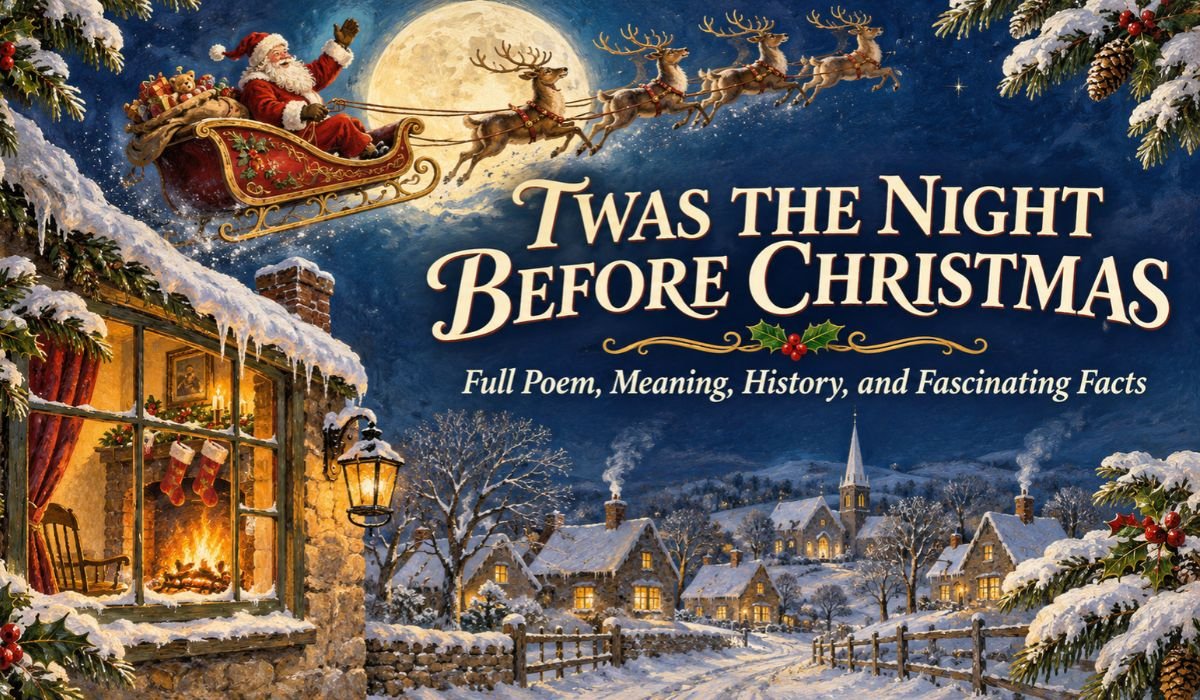
There’s something special about the quiet hours before Christmas morning. The stockings are hanging by the fireplace, the children are tucked into bed, and the house is filled with anticipation. Few works of literature capture that feeling as beautifully as Twas the Night Before Christmas.
First published on December 23, 1823, and traditionally attributed to Clement Clarke Moore, the poem helped shape the way generations of readers picture Santa Claus. Its flying reindeer, snowy rooftops, and cheerful gift-giver have become familiar symbols of the holiday season.
December 2026 marks 203 years since its original publication. Yet the poem hasn’t lost its charm. Behind its playful verses lies a fascinating history, an unresolved authorship debate, and a lasting influence on Christmas traditions.
What Is Twas the Night Before Christmas?
Twas the Night Before Christmas, also known as A Visit from St. Nicholas, is a classic narrative poem about a mysterious visitor arriving at a family home on Christmas Eve.
The story unfolds through the eyes of a father who witnesses something extraordinary while the rest of his household sleeps. What begins as a peaceful evening quickly turns into a magical encounter with St. Nicholas and his eight flying reindeer.
Across just 56 lines, the poem captures suspense, humor, affection, and childhood wonder. Its approachable portrayal of St. Nicholas helped establish the familiar image of a cheerful Christmas visitor who brings gifts while children are asleep.
Quick Bio Information
| Information | Details |
|---|---|
| Popular Title | Twas the Night Before Christmas |
| Alternative Title | A Visit from St. Nicholas |
| Original Published Title | Account of a Visit from St. Nicholas |
| Traditionally Credited Author | Clement Clarke Moore |
| Alternative Authorship Claim | Henry Livingston Jr. |
| First Publication | December 23, 1823 |
| Original Newspaper | Troy Sentinel |
| Country of Origin | United States |
| Original Language | English |
| Genre | Narrative Poetry |
| Setting | Christmas Eve |
| Total Lines | 56 |
| Common Stanza Arrangement | 14 Four-Line Stanzas |
| Rhyme Scheme | Rhyming Couplets |
| Poetic Meter | Anapestic Tetrameter |
| Narrator | A Father |
| Main Character | St. Nicholas |
| Number of Reindeer | Eight |
| Main Themes | Generosity, Family, Imagination, and Joy |
| Copyright Status | Original Poem in the Public Domain |
Twas the Night Before Christmas: Full Poem
The following is a widely circulated version of the classic public-domain poem. Readers familiar with older editions may notice slight differences in punctuation, spelling, and the names of certain reindeer.
‘Twas the night before Christmas, when all through the house
Not a creature was stirring, not even a mouse.
The stockings were hung by the chimney with care,
In hopes that St. Nicholas soon would be there.
The children were nestled all snug in their beds,
While visions of sugar-plums danced in their heads.
And mamma in her ‘kerchief, and I in my cap,
Had just settled our brains for a long winter’s nap.
When out on the lawn there arose such a clatter,
I sprang from the bed to see what was the matter.
Away to the window I flew like a flash,
Tore open the shutters and threw up the sash.
The moon on the breast of the new-fallen snow
Gave the lustre of mid-day to objects below.
When, what to my wondering eyes should appear,
But a miniature sleigh, and eight tiny reindeer.
With a little old driver, so lively and quick,
I knew in a moment it must be St. Nick.
More rapid than eagles his coursers they came,
And he whistled, and shouted, and called them by name!
“Now Dasher! Now, Dancer! Now, Prancer and Vixen!
On, Comet! On, Cupid! On, on Donner and Blitzen!
To the top of the porch! To the top of the wall!
Now dash away! Dash away! Dash away all!”
As dry leaves that before the wild hurricane fly,
When they meet with an obstacle, mount to the sky.
So up to the house-top the coursers they flew,
With the sleigh full of toys, and St. Nicholas too.
And then, in a twinkling, I heard on the roof
The prancing and pawing of each little hoof.
As I drew in my head, and was turning around,
Down the chimney St. Nicholas came with a bound.
He was dressed all in fur, from his head to his foot,
And his clothes were all tarnished with ashes and soot.
A bundle of toys he had flung on his back,
And he looked like a peddler, just opening his pack.
His eyes—how they twinkled! His dimples how merry!
His cheeks were like roses, his nose like a cherry!
His droll little mouth was drawn up like a bow,
And the beard of his chin was as white as the snow.
The stump of a pipe he held tight in his teeth,
And the smoke it encircled his head like a wreath.
He had a broad face and a little round belly,
That shook when he laughed, like a bowlful of jelly!
He was chubby and plump, a right jolly old elf,
And I laughed when I saw him, in spite of myself!
A wink of his eye and a twist of his head,
Soon gave me to know I had nothing to dread.
He spoke not a word, but went straight to his work,
And filled all the stockings, then turned with a jerk.
And laying his finger aside of his nose,
And giving a nod, up the chimney he rose!
He sprang to his sleigh, to his team gave a whistle,
And away they all flew like the down of a thistle.
But I heard him exclaim, ‘ere he drove out of sight,
“Happy Christmas to all, and to all a good-night!”
Twas the Night Before Christmas Summary
At the beginning of the poem, everything seems perfectly ordinary. The children are sleeping, the stockings are ready, and their parents have settled down for the night. Then, without warning, a loud noise outside interrupts the silence.
Curious about the disturbance, the father rushes to the window. What he discovers is far beyond anything he expected: a miniature sleigh pulled by eight flying reindeer and driven by St. Nicholas.
Moments later, Santa comes down the chimney and begins filling the stockings. His friendly expression reassures the astonished father. Once his work is finished, he returns to the rooftop and disappears into the winter night, leaving behind one of literature’s most recognizable Christmas greetings.
History of Twas the Night Before Christmas
The story first appeared anonymously in the Troy Sentinel, a newspaper in Troy, New York, on December 23, 1823. Historical materials preserved by the Library of Congress offer valuable insight into its publication and influence on American Christmas customs.
At the time, Christmas celebrations in the United States were gradually becoming more focused on family life, children, and gift-giving. The poem fit naturally into those changing traditions, presenting Christmas Eve as a warm and imaginative occasion centered around the home.
As newspapers reprinted the verses and publishers released illustrated editions, the story reached a wider audience. What began as an anonymous newspaper publication eventually became a cherished part of Christmas celebrations.
Who Was Clement Clarke Moore?
Born in 1779, Clement Clarke Moore was an American scholar, professor, and poet. He taught biblical literature at New York’s General Theological Seminary, where he became known for his academic work.
Interestingly, the literary piece for which he’s best remembered is very different from his scholarly pursuits. Although the Christmas poem originally appeared without an author’s name, an anthology published in 1837 attributed it to Moore.
In 1844, he included the work in his own poetry collection, titled Poems. Moore died in 1863, but his association with the beloved holiday classic has endured. He remains its traditionally credited author, despite continuing questions about who actually wrote it.
The Authorship Debate
Not everyone is convinced that Clement Clarke Moore was responsible for the poem. Another name frequently mentioned in discussions about its origins is Henry Livingston Jr., an American poet who died in 1828.
Livingston’s descendants maintained that he had recited the verses to his family years before they appeared in the Troy Sentinel. Researchers supporting this claim have studied the language, rhythm, and writing style of the poem, identifying possible similarities with Livingston’s other work.
Supporters of Moore’s authorship, however, continue to defend the traditional attribution. Since the original publication was anonymous and the historical evidence remains contested, the most accurate approach is to acknowledge both claims rather than treat the matter as conclusively settled.
Meaning and Main Themes
On the surface, Twas the Night Before Christmas tells a simple story about Santa delivering gifts. Look a little closer, though, and its emotional appeal becomes easier to understand.
Generosity lies at the heart of the poem. St. Nicholas doesn’t ask for praise or attention. He arrives quietly, completes his work, and leaves before the sleeping children discover what has happened.
Family warmth and childhood imagination are equally important. The peaceful household creates a comforting atmosphere, while the father’s growing amusement reminds readers that wonder isn’t limited to childhood. The combination of these themes helps explain why the poem resonates with readers of different ages.
Literary Devices and Poetic Style
Much of the poem’s enduring appeal comes from the way it sounds. Written predominantly in anapestic tetrameter, its lines generally contain four rhythmic groups, each consisting of two unstressed syllables followed by a stressed syllable.
The result is a lively, bouncing rhythm that almost resembles the movement of galloping reindeer. Rhyming couplets help carry the story forward and make individual verses easier to remember.
The poem’s comparisons are equally memorable. Santa’s rosy cheeks resemble flowers, while his laughing belly shakes like jelly. Repetition builds urgency as he calls his reindeer, and the father’s first-person narration draws readers directly into the unfolding adventure. Together, these techniques make the poem particularly rewarding when read aloud.
Understanding the Older Vocabulary
Some of the language may sound unfamiliar to modern readers, especially children. That’s hardly surprising for a poem written more than two centuries ago.
Sugar-plums, for instance, refer to traditional sweet treats rather than ordinary fresh plums. A kerchief is a cloth worn around the head or neck, while a sash refers to the frame holding a window’s glass panes.
The word coursers traditionally describes swift horses, although it’s used for reindeer in the poem. Lustre means brightness or shine, and droll describes something amusing. Meanwhile, thistle down is the soft material that helps carry a thistle’s seeds through the air. Understanding these expressions makes the story’s vivid descriptions even more enjoyable.
Santa’s Eight Reindeer
Dasher, Dancer, Prancer, Vixen, Comet, Cupid, Donner, and Blitzen are among the most recognizable names associated with Christmas. Their appearance in Twas the Night Before Christmas helped establish the enduring tradition of Santa’s flying reindeer.
However, the names haven’t always been spelled the same way. The original 1823 publication referred to the final two as Dunder and Blixem, expressions associated with thunder and lightning. Later versions introduced variations such as Donder, Donner, and Blitzen.
And what about Rudolph? His absence is easy to explain. Robert L. May created the famous red-nosed reindeer in 1939, more than a century after the original poem appeared.
How the Poem Shaped Santa Claus
Imagine Santa Claus today, and chances are you’ll picture a smiling man with a white beard, a round belly, and a sleigh full of presents. Many of those familiar characteristics owe part of their popularity to Twas the Night Before Christmas.
The poem helped establish the image of St. Nicholas traveling through the sky, landing on rooftops, entering homes through chimneys, and leaving gifts in stockings. However, it wasn’t responsible for every detail of modern Santa Claus folklore.
Earlier European traditions and American literature had already presented St. Nicholas as a gift-giver. Later, nineteenth-century illustrator Thomas Nast contributed further visual details, notably through his famous 1881 Santa portrait. The character we recognize today developed gradually through literature, artwork, and popular tradition.
Original and Modern Versions
Anyone comparing different editions of the poem will notice that the wording isn’t always identical. Punctuation, capitalization, spelling, and certain expressions have changed over the years.
The variations in reindeer names are particularly noticeable. Publishers have also presented the story through different illustrations and layouts, often making it more accessible to younger audiences.
Fortunately, the original nineteenth-century poem is in the public domain in the United States, allowing readers to reproduce and share its text freely. That doesn’t automatically apply to every modern edition, however. Recent illustrations, recordings, translations, and adaptations may still be protected by their own copyrights.
Fascinating Facts About the Poem
One of the most surprising details emerges when you compare the original description of St. Nicholas with his modern appearance.
Rather than presenting Santa as a large figure dressed in a bright red suit, the poem describes a small, cheerful elf wearing fur clothing covered in soot. The color red is never mentioned as part of his outfit.
Readers might also be surprised to learn that the poem says nothing about the North Pole, Santa’s workshop, or his toy-making helpers. Those familiar elements became popular through other stories and illustrations. It’s a fascinating reminder that Christmas folklore has continued evolving with every generation.
Why Children Love the Poem
Children are naturally drawn to stories filled with surprises, recognizable characters, and imaginative adventures. Twas the Night Before Christmas offers all three, along with a rhythm that makes listening almost as enjoyable as following the story itself.
The poem also provides valuable opportunities for learning. Its rhymes can help children recognize sound patterns, while unfamiliar vocabulary encourages questions and discussion. Following Santa’s journey introduces young readers to the basic sequence of storytelling.
Parents and teachers might pause after the opening verses and ask what they think will happen next. Comparing the quiet beginning with Santa’s energetic arrival is another simple way to explore how writers build excitement.
A Special Christmas Eve Tradition
For many families, reading Twas the Night Before Christmas is a familiar part of their holiday celebrations. It’s often shared just before bedtime, when the excitement of Christmas morning is beginning to build.
Younger children may enjoy looking at an illustrated edition, while older children can take turns reading different stanzas aloud. Drawing Santa’s sleigh or discussing a favorite scene gives everyone an opportunity to participate.
There’s no need for elaborate preparations. Sometimes, the most memorable family traditions are the simplest ones. Spending a few quiet minutes together with a familiar story can create memories that children carry into adulthood.
Famous Adaptations and Cultural Influence
Over the years, the poem has inspired countless illustrated books, holiday recordings, theatrical performances, and animated productions. Its familiar opening line has also become part of everyday Christmas culture.
One notable example is the 1974 animated television special ‘Twas the Night Before Christmas, which develops its own fictional storyline around the traditional Christmas setting.
While later adaptations often introduce new characters and situations, many retain the original story’s sense of anticipation and wonder. Its influence can still be seen in greeting cards, seasonal decorations, festive entertainment, and family storytelling. Few poems of such modest length have left such a recognizable cultural legacy.
Final Thoughts
More than two centuries after its first appearance, Twas the Night Before Christmas continues to bring a little magic into homes around the world. Its playful rhythm, unforgettable characters, and warm portrayal of Christmas Eve have helped it remain relevant across generations.
In 2026, the poem still offers something for everyone. Children can enjoy its magical adventure, students can explore its literary qualities, and adults can rediscover a familiar piece of holiday nostalgia.
Perhaps that’s the real secret behind its lasting popularity. Beneath the flying reindeer and snowy rooftops is a simple reminder that generosity, imagination, and time spent with loved ones can make Christmas truly memorable.
FAQs About Twas the Night Before Christmas
Who Wrote Twas the Night Before Christmas?
Clement Clarke Moore is traditionally recognized as the author. However, Henry Livingston Jr. has also been proposed as its writer. Historians and literary researchers continue to debate the competing authorship claims.
When Was Twas the Night Before Christmas First Published?
The poem appeared anonymously in the Troy Sentinel newspaper in New York on December 23, 1823. It was subsequently reprinted in poetry collections, newspapers, and illustrated books.
What Is the Original Title of the Poem?
Its original published title was Account of a Visit from St. Nicholas. It later became widely known as A Visit from St. Nicholas before gaining popularity under its familiar opening words.
How Many Lines Are in Twas the Night Before Christmas?
The complete poem contains 56 lines, commonly arranged into 14 four-line stanzas. Its rhyming couplets and lively poetic rhythm make it particularly enjoyable to read aloud.
Why Is Rudolph Not in the Poem?
Rudolph was created by Robert L. May in 1939. Since the poem was originally published in 1823, it features only the eight reindeer named in its traditional verses.
What Is the Main Message of the Poem?
The poem celebrates kindness, generosity, family togetherness, childhood imagination, and the excitement surrounding Christmas Eve. It also highlights the quiet happiness of doing something thoughtful for others without expecting recognition.
Is Twas the Night Before Christmas in the Public Domain?
Yes. The original nineteenth-century poem is in the public domain in the United States and can be shared or reproduced freely. However, modern illustrations, recordings, and creative adaptations may have separate copyright protection.
Learn more and explore exciting content on: Ralph Lauren Christmas: Timeless Decor Ideas for an Elegant Holiday Season