

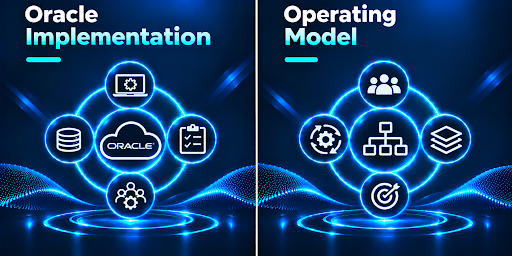
An enterprise resource planning (ERP) transformation represents a significant investment in technology, organizational capabilities and business performance. Yet replacing legacy applications with modern cloud platforms does not automatically resolve inefficient processes, fragmented responsibilities or inconsistent management practices.
A successful Oracle implementation requires organizations to examine how work should be performed, how information should flow and how decisions should be made. These considerations form the foundation of an effective operating model.
By addressing organizational design alongside technology deployment, businesses can move beyond system modernization toward sustainable improvements in financial performance, operational efficiency and enterprise agility.
Why ERP modernization is a business transformation
Organizations often initiate ERP projects because existing applications are expensive to maintain, difficult to integrate or unable to support changing business requirements.
However, migrating existing processes into a modern platform can preserve the inefficiencies that originally limited performance.
An Oracle implementation provides an opportunity to reconsider established workflows, eliminate unnecessary customization and introduce standardized business practices.
The operating model determines how these changes will influence organizational structures, service delivery and accountability. Addressing both dimensions allows businesses to improve how they operate rather than simply changing the technology they use.
What is Oracle implementation?
Oracle implementation is the process of configuring, integrating and deploying Oracle enterprise applications to support business functions such as finance, procurement, supply chain and human resources.
Depending on organizational requirements, implementation may involve Oracle Fusion Cloud ERP, Human Capital Management, Supply Chain Management and Enterprise Performance Management applications.
The scope typically includes process design, system configuration, data migration, integration, testing and workforce readiness.
The objective is to establish a reliable technology environment that supports business requirements while enabling future improvements.
What is an operating model in ERP transformation?
An operating model defines how an organization combines people, processes, technology, governance and organizational structures to deliver its business strategy.
In ERP transformation, it establishes how responsibilities will be distributed, which activities will be standardized and how business functions will collaborate.
For example, an organization introducing a centralized financial platform must determine whether transaction processing will remain within individual business units or move into shared services.
These decisions influence system configuration, access permissions, reporting structures and performance expectations.
Five organizational decisions that shape implementation success
1. Determine where standardization creates value
Organizations operating across multiple locations frequently maintain different procedures for similar activities.
An Oracle implementation offers opportunities to introduce common processes for purchasing, financial reporting, expense management and other enterprise activities.
However, standardization should accommodate legitimate regulatory, commercial and operational differences rather than impose unnecessary uniformity.
2. Establish end-to-end process ownership
Business processes frequently extend across departmental boundaries. Procure-to-pay, for example, involves purchasing, receiving, accounts payable and treasury activities.
The operating model should establish accountability for the complete process rather than individual transactions. This helps prevent functional improvements from creating inefficiencies elsewhere.
3. Evaluate service delivery arrangements
Modern cloud applications can support centralized, decentralized and hybrid service delivery structures.
Organizations should determine which activities benefit from shared capabilities and which require local business knowledge. These choices influence staffing requirements, service levels and technology configuration.
4. Clarify decision rights and governance
An integrated enterprise platform increases the importance of consistent governance.
Organizations need clear authority over master data, system changes, process exceptions and financial approvals. Defined responsibilities help maintain operational consistency as business requirements evolve.
5. Redesign workforce responsibilities
Automation can reduce manual transaction processing while increasing the importance of analytical, technical and process management capabilities.
Workforce planning should therefore address future responsibilities and skills rather than simply transferring existing roles into a new technology environment.
How Oracle applications support cross-functional transformation
Different Oracle applications can support connected business capabilities when implementation is aligned with organizational priorities.
| Business function | Technology-enabled opportunity |
| Finance | Standardized accounting, financial close and reporting |
| Procurement | Integrated purchasing and supplier management |
| Supply chain | Connected inventory, planning and fulfillment |
| Human resources | Unified workforce information and employee services |
| Enterprise planning | Coordinated financial and operational forecasts |
| Project management | Improved visibility into project costs and resources |
A coordinated Oracle implementation can reduce information fragmentation across these functions. The operating model ensures that greater visibility supports meaningful collaboration and business decisions.
Why excessive customization can weaken transformation outcomes
Organizations sometimes customize ERP applications to reproduce established business practices. Although certain requirements justify customization, excessive modifications can increase maintenance costs and complicate future upgrades.
Before approving a customization, leaders should determine whether the requirement reflects a genuine business need or an outdated process.
An effective operating model provides a framework for evaluating these decisions. It encourages organizations to distinguish essential differentiation from practices that can be standardized.
This approach can improve long-term flexibility and reduce technical complexity.
Managing the transition from legacy systems to cloud operations
An Oracle implementation introduces changes that extend beyond the initial deployment.
Cloud environments require ongoing attention to application updates, security, integrations and emerging functionality. Business and technology teams must collaborate to evaluate changes and determine their operational implications.
The future operating model should therefore establish responsibilities for continuous improvement, application management and workforce support.
Without these capabilities, organizations may struggle to maintain the benefits achieved during implementation.
The emerging role of AI in Oracle-enabled transformation
Artificial intelligence is expanding the capabilities available within enterprise cloud environments.
AI-enabled applications can support financial analysis, supplier information retrieval, workforce services and operational exception management. Generative AI can also help employees interpret reports and access relevant enterprise knowledge.
Organizations planning an Oracle implementation should evaluate these capabilities against specific business requirements.
Rather than introducing AI independently, businesses can incorporate intelligent capabilities into redesigned workflows with appropriate data permissions, validation requirements and human oversight.
How should organizations measure implementation success?
Completing an Oracle implementation on schedule and within budget is important, but these measures provide only a partial view of transformation success.
Organizations should also assess whether the investment improves business performance through indicators such as:
- Financial close cycle time and reporting quality.
- Transaction processing costs and workforce productivity.
- Procurement cycle times and spending visibility.
- Inventory performance and order fulfillment.
- Employee service quality and administrative efficiency.
- Application maintenance costs and system reliability.
Operating model effectiveness should be evaluated through process ownership, decision speed and service delivery performance.
Establishing baselines before transformation enables organizations to compare realized benefits with original investment expectations.
Frequently asked questions
Should organizational redesign happen before ERP implementation?
Key organizational decisions should be established before detailed system configuration. However, process design and technology evaluation can progress together as requirements become clearer.
Can Oracle applications support different service delivery structures?
Yes. Oracle applications can support centralized, decentralized and hybrid structures, subject to appropriate configuration, integration and governance.
What happens after the system goes live?
Organizations should monitor performance, address operational issues, evaluate new functionality and continue improving business processes.
Conclusion
An Oracle implementation creates an opportunity to improve enterprise performance through integrated technology, standardized processes and better information accessibility.
Its long-term value depends on an operating model that establishes clear accountability, effective governance and coordinated service delivery.
Organizations that treat ERP modernization as a business transformation rather than a technology replacement are better positioned to reduce operational complexity, strengthen organizational capabilities and achieve sustainable returns on their technology investments.
 Admin
 MUNJAL BLOG