

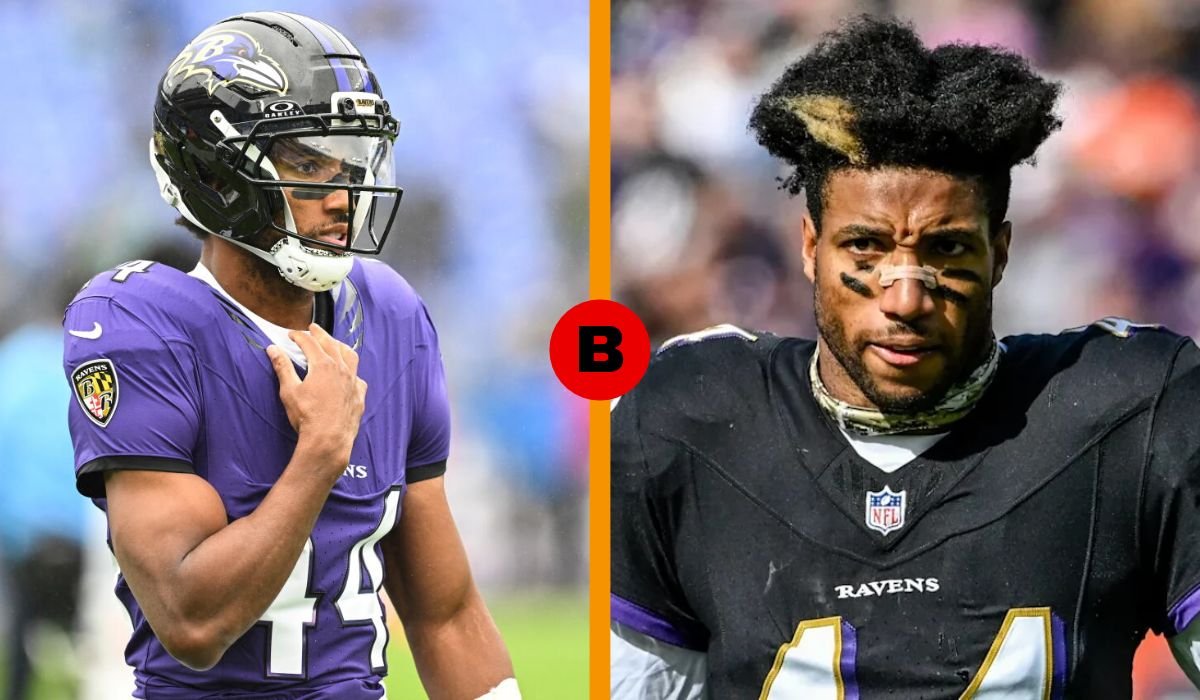
Baltimore Ravens cornerback Marlon Humphrey won’t play against the Carolina Panthers on November 22, 2026, after comments he made about Baltimore sparked criticism across the city and prompted disciplinary action from the team.
Ravens Head Coach Jesse Minter announced on November 19 that Humphrey had been sent home from the team facility and would be deactivated for one game. The decision came after Humphrey described Baltimore as being “best at making criminals” during an episode of The Marlon Humphrey Show.
Humphrey has since apologized, but the issue didn’t end there. Baltimore Mayor Brandon Scott publicly challenged the remarks and called for more than a verbal apology, while several Ravens players and coaches were asked to address the situation.
It’s an unusually significant moment for a player whose professional identity has been tied almost entirely to Baltimore. Humphrey has spent his full NFL career with the Ravens, developed into one of the franchise’s most accomplished defensive backs, and built personal connections with the city.
His absence also arrives at a difficult point in Baltimore’s 2026 season. Here’s a closer look at what Humphrey said, why the Ravens acted, how Baltimore responded, and what could happen next.
Marlon Humphrey Quick Bio
| Information | Details |
|---|---|
| Full Name | Marlon N. Humphrey |
| Profession | Professional Football Player |
| Position | Cornerback |
| Team | Baltimore Ravens |
| Jersey Number | 44 |
| Age | 30 |
| Height | 6 Feet |
| Weight | 200 Pounds |
| College | Alabama |
| NFL Draft | 2017 |
| Draft Round | First Round |
| Overall Pick | No. 16 |
| NFL Experience In 2026 | 10th Season |
| NFL Teams | Baltimore Ravens |
| Pro Bowl Selections | Four |
| First-Team All-Pro Honors | Two |
| Career Interceptions Through 2025 | 23 |
| 2026 Tackles Through 10 Games | 40 |
| 2026 Passes Defended Through 10 Games | 9 |
| 2026 Interceptions Through 10 Games | 0 |
Humphrey entered the NFL as the 16th overall pick in the 2017 NFL Draft after playing at Alabama. He has since earned four Pro Bowl selections and was named a First-Team All-Pro in 2019 and 2024, establishing himself as one of Baltimore’s most decorated defensive players of the past decade.
Why Was Marlon Humphrey Benched By The Ravens?
For readers trying to understand the story quickly, the reason is straightforward: the Ravens deactivated Humphrey after his controversial podcast comments about Baltimore.
Minter announced the decision on November 19 following discussions within the organization. Humphrey was sent home from the team facility and did not practice as Baltimore prepared to face Carolina.
The coach said Humphrey was remorseful and understood the weight of his words. At the same time, Minter made it clear that the comment didn’t reflect how the Ravens wanted their organization represented.
There’s an important technical distinction in how Baltimore handled the situation. The Ravens announced a one-game deactivation, not an NFL suspension. While Humphrey is effectively being benched for the Panthers game, he hasn’t been suspended by the league.
That difference matters because terms such as “benched,” “inactive,” “deactivated,” and “suspended” aren’t necessarily interchangeable under NFL rules and player contracts.
For now, the confirmed punishment covers one game. Anything beyond that would require further action or clarification from the organization.
What Did Marlon Humphrey Say About Baltimore?
The controversy began on The Marlon Humphrey Show, where a casual conversation took an unexpectedly serious turn.
During the discussion, co-host Jeremiah Pittman asked Humphrey what Baltimore was best known for making. Humphrey initially mentioned The Star-Spangled Banner and National Bohemian beer before saying the city was “best at making criminals.”
Pittman immediately reacted, and Humphrey appeared to recognize that the comment could create a problem. The episode was later removed, but by then the remark had circulated widely enough to attract public attention.
The criticism wasn’t simply about whether the joke was funny. For many people in Baltimore, the larger issue was the stereotype behind it.
Humphrey has worn Baltimore’s name on his uniform throughout his professional career. As a prominent Ravens player, his words naturally carry more weight in the city than those of someone with no connection to the community.
That history is a major reason a short podcast remark developed into a much larger story.
How Marlon Humphrey Responded
Humphrey didn’t wait long to address the backlash. Speaking with reporters at his locker, he apologized directly to Baltimore and acknowledged that his words could affect people.
He also pointed to the depth of his connection with the city.
Humphrey has spent his entire NFL career with the Ravens, remained in the area during multiple offseasons, welcomed a son there, and invested locally. Those aren’t insignificant ties, and they help explain why the situation became uncomfortable so quickly.
His apology also highlighted an important contradiction at the center of the controversy. Humphrey clearly sees Baltimore as an important part of his life, yet his podcast comment relied on a broad and negative characterization of the same city.
The apology addressed what he had said, but it didn’t immediately settle the matter. For some critics, including city leaders, the next question was whether Humphrey would follow his words with meaningful action.
Baltimore Mayor Brandon Scott Called For More Than An Apology
Baltimore Mayor Brandon Scott was among the most outspoken figures to respond.
Scott acknowledged Humphrey’s apology but said a verbal apology by itself wasn’t enough. His concern centered partly on the example Ravens players set for young people, particularly young Black boys in Baltimore who may view professional athletes as symbols of what they can achieve.
The mayor also used football to illustrate why sweeping generalizations can be damaging.
He suggested that Humphrey probably wouldn’t appreciate prominent Baltimore residents using recent struggles to claim that the city no longer produced good defensive backs. The comparison was designed to show how an unfair generalization can reduce a much larger story to a negative stereotype.
Scott didn’t stop at criticism, however.
He invited Humphrey to meet Baltimore residents who had returned to their communities after involvement with the criminal justice system and were now working to prevent other people from making similar mistakes.
Subsequent reporting indicated that Humphrey reached out to Scott about accepting the invitation.
That development could prove important. It offers a path for the controversy to become something more constructive than a cycle of criticism and apology.
Jesse Minter Explained The Ravens’ Position
Minter had to make his decision against an uncomfortable football backdrop.
Baltimore entered the week at 4-6 and was trying to stop a five-game losing streak. Under normal circumstances, voluntarily removing a veteran defensive back from the lineup wouldn’t make that challenge any easier.
The Ravens did it anyway.
Minter framed the decision around responsibility and organizational standards rather than competitive convenience. He said Humphrey understood the seriousness of the situation, though he declined to reveal the details of their private conversations.
That restraint is worth keeping in mind when evaluating the story.
The public evidence clearly connects Humphrey’s deactivation to the controversy surrounding his remarks. It doesn’t tell us everything that was discussed behind closed doors or establish every factor considered by team leadership.
Minter also stopped short of publicly outlining what Humphrey might have to do to rebuild trust. For the time being, the team’s confirmed action remains limited to the one-game deactivation.
Ravens Players Balanced Accountability With Support
The Ravens’ locker room largely avoided turning the controversy into a public feud.
Ronnie Stanley said Humphrey’s choice of words surprised him, while also stressing that he knew how much his longtime teammate cared about Baltimore.
Roquan Smith backed Minter’s authority to make the decision and made clear that he didn’t agree with Humphrey’s statement.
Derrick Henry brought a different perspective because his relationship with Humphrey goes back to their college days at Alabama. Henry described the remark as a mistake and said he believed Humphrey’s apology was sincere.
Defensive Coordinator Anthony Weaver struck perhaps the clearest balance between accountability and loyalty. His message was that players have the ability to express themselves, but that doesn’t mean their words come without consequences.
At the same time, Weaver argued that making a mistake shouldn’t automatically mean teammates abandon one another.
It’s an important distinction. The Ravens can believe Humphrey crossed a line, impose a consequence, and still support him as a teammate. Those positions aren’t mutually exclusive.
Why Marlon Humphrey’s Ravens Career Matters
Humphrey’s history in Baltimore gives this story a different dimension.
The Ravens selected him with the 16th overall pick in the 2017 NFL Draft following his college career at Alabama. Unlike many NFL veterans who move between several franchises, Humphrey has spent his entire professional career in Baltimore.
During that time, he has built an impressive résumé.
Humphrey has been selected to four Pro Bowls and earned First-Team All-Pro honors in 2019 and 2024. Through the end of the 2025 season, he had recorded 23 career interceptions.
His ability to create turnovers has extended beyond interceptions. The Ravens’ official player biography credited him with 19 forced fumbles through 2025, an exceptional number for a defensive back.
Those achievements have made Humphrey one of the defining players of Baltimore’s defense over the past decade.
They’ve also made him highly visible.
A rookie or short-term player might not have the same relationship with the community. Humphrey has represented the Ravens for nearly a decade, which naturally raises expectations about how he talks about the city away from the field.
Marlon Humphrey’s 2026 Performance Adds Another Layer
The controversy didn’t arrive in isolation. Humphrey was already playing through a season in which his performance had attracted additional scrutiny.
Through 10 games in 2026, official Ravens statistics list him with 40 total tackles and nine passes defended. He had not recorded an interception.
That’s a noticeable change from the previous two seasons. Humphrey intercepted six passes in 2024 before adding four more in 2025.
Some independent coverage statistics have also suggested that opposing receivers have enjoyed greater success against him this season. Those numbers require care, however, because coverage statistics can vary between analytics providers depending on how responsibility is assigned on a particular play.
That makes it important not to combine two separate stories.
Humphrey’s performance may eventually influence Baltimore’s decisions about his playing time or future with the franchise. But the Ravens haven’t publicly said his 2026 statistics were the reason he was deactivated against Carolina.
The announced disciplinary action followed his comments about Baltimore.
Baltimore’s Recent Crime Data Provides Important Context
The controversy also raises a factual question: does Humphrey’s characterization reflect what has recently been happening in Baltimore?
The picture is considerably more complicated.
Baltimore continues to face genuine public-safety challenges, but official data shows substantial improvement in some of the city’s most serious categories of violent crime.
The Baltimore Police Department reported that homicides fell from 194 in 2024 to 133 in 2025, a decline of roughly 31 percent. Nonfatal shootings also dropped significantly during that period.
The trend continued into the first half of 2026. BPD reported 50 homicides compared with 65 during the same period in 2025, representing a 23 percent reduction.
Those numbers shouldn’t be used to suggest that Baltimore has solved every crime problem. It hasn’t. Crime statistics are also subject to revision, and preliminary figures can change as investigations and records are updated.
Still, the broader trend provides valuable context.
Describing Baltimore primarily through criminality overlooks both the people who live there and meaningful recent progress in reducing violence. That helps explain why Humphrey’s remark struck such a nerve with local officials and residents.
Was Marlon Humphrey Suspended?
No NFL suspension was announced.
It’s a simple point, but an important one because the terminology surrounding the story can easily become confusing.
Minter described the action as a one-game deactivation. Humphrey was sent home from the team facility, didn’t practice during the week, and won’t play against Carolina.
That certainly amounts to discipline from the Ravens, but it isn’t the same thing as the NFL announcing a suspension.
There has also been discussion about what the distinction could mean financially. A deactivation and a formal disciplinary suspension can carry different contractual implications.
However, the Ravens haven’t publicly provided a detailed explanation of why they selected this particular disciplinary route or what it means for every aspect of Humphrey’s compensation.
Claims about private contractual strategy should therefore be treated as analysis unless the team, player, union, or another authoritative source confirms them.
The clearest description remains the simplest: Baltimore disciplined Humphrey by sending him home and deactivating him for one game.
Who Replaces Marlon Humphrey Against Carolina?
Once the discussion moves back onto the field, Baltimore has an immediate problem to solve.
Humphrey normally occupies an important role in the secondary, and those snaps have to go somewhere.
Minter identified Chidobe Awuzie and T.J. Tampa as two cornerbacks expected to receive increased playing time against Carolina.
Awuzie brings significant NFL experience, making him an obvious option for a larger workload. Tampa represents something different.
Baltimore selected Tampa in the fourth round of the 2024 NFL Draft, and additional snaps give the coaching staff another chance to evaluate his development in meaningful regular-season action.
That doesn’t necessarily mean one player will take Humphrey’s entire role.
Modern NFL defenses frequently change personnel depending on down, distance, offensive formations, and individual matchups. Baltimore can distribute the missing snaps between several defensive backs rather than simply inserting one replacement for every play.
For a Ravens team trying to end a five-game losing streak, how that reshuffled secondary performs will be worth watching.
Could The Controversy Affect Marlon Humphrey’s Future?
It’s understandable that the controversy has generated questions about Humphrey’s future in Baltimore. It’s also too early to answer them with certainty.
The Ravens announced a one-game deactivation, not an indefinite punishment.
Weaver’s comments further suggested that the organization doesn’t view accountability as synonymous with giving up on a player after one mistake.
There are, however, legitimate football reasons Humphrey’s longer-term status will remain a subject of discussion.
He’s 30 years old, playing his 10th NFL season, and entered 2026 in the final year of the five-year extension he signed in 2020. His performance was also under scrutiny before his podcast comments became a national story.
Taken together, those circumstances make his future worth following.
They don’t make his departure inevitable.
NFL roster decisions are influenced by performance, contracts, salary-cap planning, injuries, younger players’ development, coaching preferences, and broader team strategy. The controversy could become part of that larger picture, but there’s no basis yet for presenting a specific outcome as settled.
Why The Marlon Humphrey Controversy Matters Beyond Football
There’s a broader lesson in the Humphrey story that reaches beyond the Ravens.
Professional athletes have more ways than ever to communicate directly with the public. Podcasts, livestreams, and social media allow players to show more personality and speak with far less formality than they typically would at a press conference.
That access can be refreshing. It can also create problems.
A conversation may feel informal to the people sitting behind the microphones, but the audience can number in the thousands or millions. A joke made casually can quickly become a public statement associated with both the player and his employer.
Humphrey is entitled to his own opinions, but he’s also one of the most visible representatives of a franchise carrying Baltimore’s name.
Those realities exist at the same time.
The episode therefore isn’t simply about whether an athlete should be allowed to say something controversial. It’s also about what happens when public speech conflicts with the standards an organization wants associated with its brand and community.
For Humphrey, the consequence was immediate: criticism, an apology, a week away from the team, and a missed game.
What Happens Next For Marlon Humphrey?
What Humphrey does after the Carolina game may ultimately tell us more than the controversy itself.
He has already apologized. Baltimore has imposed its immediate punishment. Mayor Scott has offered a route toward direct engagement with people whose experiences challenge the stereotype behind Humphrey’s remark.
If that meeting takes place, it could give Humphrey an opportunity to listen rather than simply issue another public statement.
Football questions remain as well.
Awuzie and Tampa will receive additional opportunities while Humphrey is unavailable, giving Baltimore more information about the depth of its secondary. Once Humphrey returns, the coaching staff will have to decide how those snaps should be distributed.
There is also the larger issue of his future beyond 2026, although no final conclusion should be drawn from the current controversy alone.
For now, the next steps are relatively clear: Humphrey serves the one-game deactivation, the Ravens play Carolina, and attention then turns toward how both the player and organization move forward.
Final Thoughts
The Marlon Humphrey controversy carries unusual weight because of how closely the veteran cornerback is connected to Baltimore.
He’s not a newcomer passing through the organization. Humphrey is a four-time Pro Bowler and two-time First-Team All-Pro who has spent his entire NFL career in a Ravens uniform. Baltimore has been his professional home since 2017.
That history made his comment more consequential.
The basic facts aren’t especially complicated. Humphrey made a disparaging remark about Baltimore on his podcast. The comment generated criticism. He apologized. The Ravens sent him home and deactivated him for one game. Mayor Brandon Scott, meanwhile, challenged Humphrey to go beyond an apology and engage directly with people working to improve the community.
The more interesting part of the story begins now.
An apology can acknowledge a mistake, and a one-game punishment can establish accountability. Neither automatically determines what happens afterward.
Humphrey’s actions from this point forward will carry more weight than another carefully worded statement. How he engages with Baltimore, responds inside the Ravens organization, and performs when he returns to the field will help determine whether this episode remains a damaging moment in an accomplished career or becomes an opportunity to rebuild trust with the city he has represented for nearly a decade.
FAQs About Marlon Humphrey
Why Was Marlon Humphrey Benched By The Ravens?
The Baltimore Ravens deactivated Marlon Humphrey for one game after controversial comments he made about Baltimore on his podcast. Head Coach Jesse Minter said the remarks didn’t reflect how the organization wanted to operate. Humphrey was also sent home from the team facility and did not practice with the Ravens during the week.
What Did Marlon Humphrey Say About Baltimore?
During a discussion on The Marlon Humphrey Show about what Baltimore was known for producing, Humphrey said the city was “best at making criminals.” The remark was widely criticized for reinforcing a negative stereotype about Baltimore and its residents.
Did Marlon Humphrey Apologize?
Yes. Humphrey publicly apologized to Baltimore and acknowledged that his words could affect people. He also emphasized his strong personal ties to the city, noting that he has spent his entire NFL career there, remained in the area during offseasons, invested locally, and welcomed a son there.
Is Marlon Humphrey Suspended From The NFL?
No. The NFL did not announce a suspension. The Ravens described their disciplinary action as a one-game deactivation for the Carolina Panthers matchup. Although Humphrey was sent home and will miss the game, describing the punishment as an NFL suspension would be inaccurate.
How Long Has Marlon Humphrey Played For The Ravens?
Baltimore selected Humphrey with the 16th overall pick in the 2017 NFL Draft. The 2026 season is his 10th NFL season, and every one of those seasons has been with the Ravens. That long relationship with the franchise is one reason his comments about Baltimore attracted so much attention.
How Many Pro Bowls Has Marlon Humphrey Made?
Humphrey has earned four Pro Bowl selections during his Ravens career. He was also named a First-Team All-Pro in 2019 and 2024, making him one of Baltimore’s most accomplished defensive backs of his era.
Who Will Replace Marlon Humphrey?
Jesse Minter said Chidobe Awuzie and T.J. Tampa would receive additional snaps while Humphrey is unavailable. Baltimore doesn’t necessarily have to use one direct replacement, however. The Ravens can adjust their defensive personnel depending on Carolina’s formations and individual matchups.
Will Marlon Humphrey Return After The Panthers Game?
The Ravens announced a one-game deactivation rather than a longer suspension. Nothing in the team’s announcement establishes additional games away from the lineup. Minter has kept internal discussions about Humphrey private, so any claims about further punishment or his long-term status would currently be speculation.
Learn more and explore exciting content on: Best PS5 Games of All Time (2026): Top PlayStation 5 Games Worth Playing