

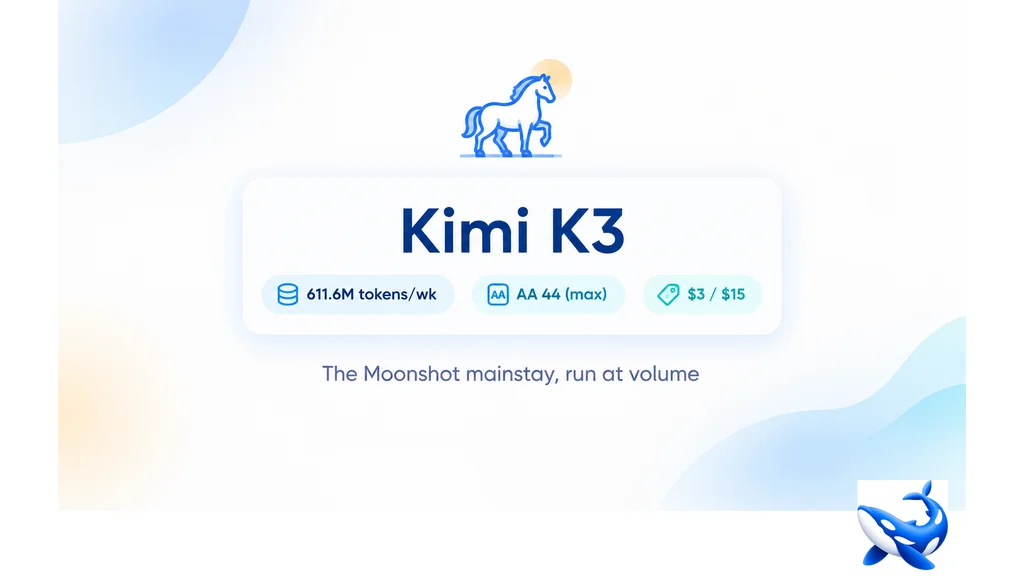
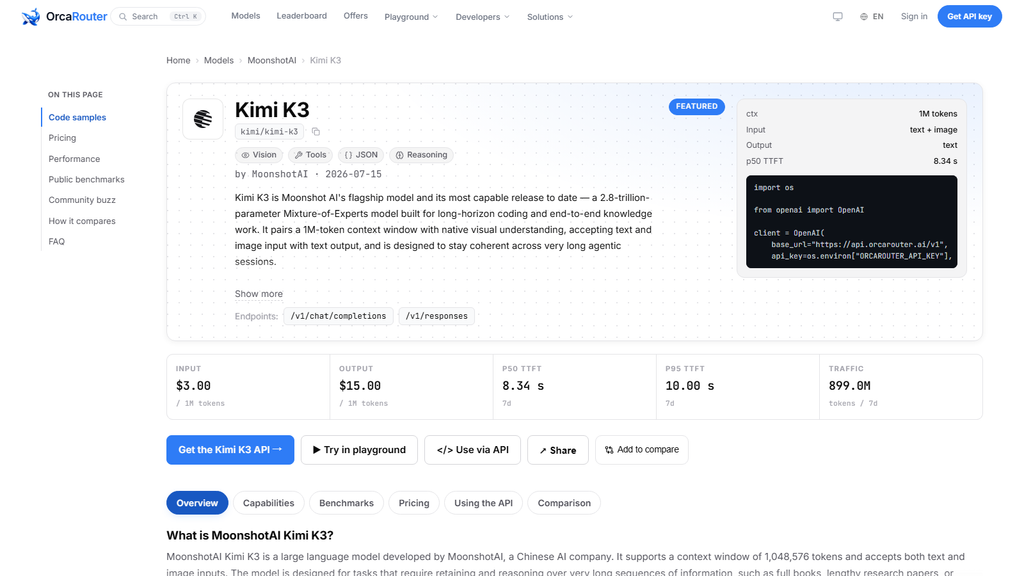
On OrcaRouter we host the Kimi K3 model — Moonshot’s general-purpose flagship, shipped on July 15, 2026, priced at $3 per million input tokens and $15 per million output, with a 1M-token context window. Artificial Analysis scores it 44 at its highest configuration, with an output speed of 41.7 tokens per second and a per-task cost of $2.00. In production its seven-day token volume is 611.6 million — the flagship volume this fleet sees from a family’s mainstay card. It is carried at list price on the same key as every other Moonshot model, with the live telemetry on the linked page.
A flagship at $3 / $15 that still moves over 600 million tokens a week is a card the market has already decided on, and this article is about reading that decision honestly.
The premium card the market actually runs
The traffic is the story before the specs: 611.6 million tokens in seven days is flagship-level volume, the kind of weekly usage a model earns only by surviving production — incidents, cost reviews, scale tests — and being chosen anyway. At $3 / $15, Kimi K3 is priced near the premium end of this fleet, and premium cards do not move that volume by accident. The market is running Moonshot’s mainstay at scale, which is the strongest evidence available that the 44 (max) reading on the board is not a single favorable run.
The independent record supports the same conclusion from the other direction. The 44 (max) score is the highest configuration the benchmark site lists, and the per-task cost of $2.00, while real, does not deter the volume. The card’s argument is not that it is cheap — it is that the quality ceiling justifies the premium, and the weekly traffic is the market’s repeated, paid confirmation of exactly that claim.
Moonshot’s flagship on the board
| model | context | input / output | AA index | output speed | per-task cost | 7-day tokens | p50 TTFT |
| Kimi K3 | 1M | $3 / $15 | 44 (max) | 41.7 tok/s | $2.00 | 611.6M | 8.38 s |
| Kimi K2.7 Code | 256K | $0.95 / $4.00 | 26 | 81.1 tok/s | $0.54 | 12.0M | 3.65 s |
Context windows and rate cards are what Moonshot lists; the index scores, output speeds and per-task costs are Artificial Analysis’ live readings; the token volumes and TTFT figures are production telemetry from the linked pages. The table is the Moonshot line in two rows: a premium generalist carrying 611.6M tokens a week, and a code-specialist card at a third of the price carrying 12.0M. The traffic gap between them is not about quality — it is about role. The flagship is the volume generalist; the specialist is the niche. Both earn their rungs, and the flagship earns the volume.

The honest price of 41.7 tokens per second
The output speed of 41.7 tokens per second is the number to weigh carefully, because it is the slowest premium rung on this article’s board. A long generation on K3 takes a long time — a 10,000-token output streams for about four minutes — and at $3 / $15, that stream is also expensive. The two numbers together are the card’s honest burden: the market pays premium prices and accepts deliberate output for the quality the 44 (max) reading represents. The volume says the trade is acceptable; the speed says the volume is not coming from generation-heavy sweeps.
The p50 first token of 8.38 seconds on our production record completes the picture. A premium flagship that takes over eight seconds to answer its first token is a card bought for quality, not for feel — interactive users feel the wait, and the workloads that dominate the 611.6 million weekly tokens are the ones where quality outweighs the pause. This article’s job is to name that trade plainly, and the numbers on the linked page are exactly the evidence for it.
What the volume verdict means
The production record is the verdict, and it is a strong one: 611.6 million tokens a week is the market running Moonshot’s mainstay at scale, at premium prices, against alternatives on the same key. That is not a sample or a launch-week spike; it is steady, repeatable, paid volume, and it says the quality ceiling holds up in production. For a buyer deciding on K3, the weekly traffic is the single most honest number on the page — it is the accumulated decision of every team that already pays the premium.
The honest caveat is the workload fit. Premium pricing and deliberate output mean K3 is not the card for volume text transforms or latency-sensitive loops — the code-specialist sibling at $0.95 / $4.00 is the cheaper seat, and the value rungs elsewhere in the fleet cover the bulk. K3’s seat is the quality-bound generalist workload: the task where the 44 (max) ceiling is the requirement and the premium is the price of admission. The linked page shows the volume that has already chosen that seat.
There is one further reading of the 611.6 million worth keeping straight, because premium volume is easy to misread as premium cheapness. The market is not running K3 because $15 output is cheap — it is the opposite: the teams on this card have decided the 44 (max) ceiling is worth the premium, and they route their highest-value work to it while pushing volume elsewhere. That is why the flagship carries six hundred million tokens while the specialist carries twelve million: the gap is a measure of how much of Moonshot’s production actually demands the ceiling. A buyer reading the traffic number as “everyone uses K3 for everything” would be wrong; reading it as “a large base of teams pays premium prices for this quality repeatedly” is exactly right. Volume at a premium is a quality verdict, not a price verdict — and it is the most valuable single signal on the page.
The takeaway
Kimi K3 is Moonshot’s general-purpose flagship: $3 / $15, a 1M context window, an independent score of 44 (max) at 41.7 tokens per second and $2.00 per task, and a p50 first token of 8.38 seconds on our production record. Its 611.6 million weekly tokens — flagship-level volume at premium prices — are the market’s repeated decision to run Moonshot’s mainstay at scale, and this article reports that verdict as the strongest evidence on the page. It is the quality-bound generalist: premium, deliberate, and carrying the workload that needs the ceiling. If that is the shape of your work, the card is live at list price, with the telemetry on the linked page.
Sourcing note: release date, context window and rate card are what Moonshot lists and have not been independently reproduced. The Intelligence Index score, output speed and per-task cost are from Artificial Analysis’ live model page, read 2026-10-08; the “44 (max)” figure is the highest configuration the benchmark site lists. The p50 time-to-first-token and seven-day token volume are OrcaRouter production telemetry from the linked model page. All checked 2026-10-08.
 Prime Star
  Admin
Admin  Sky Bloom IT