

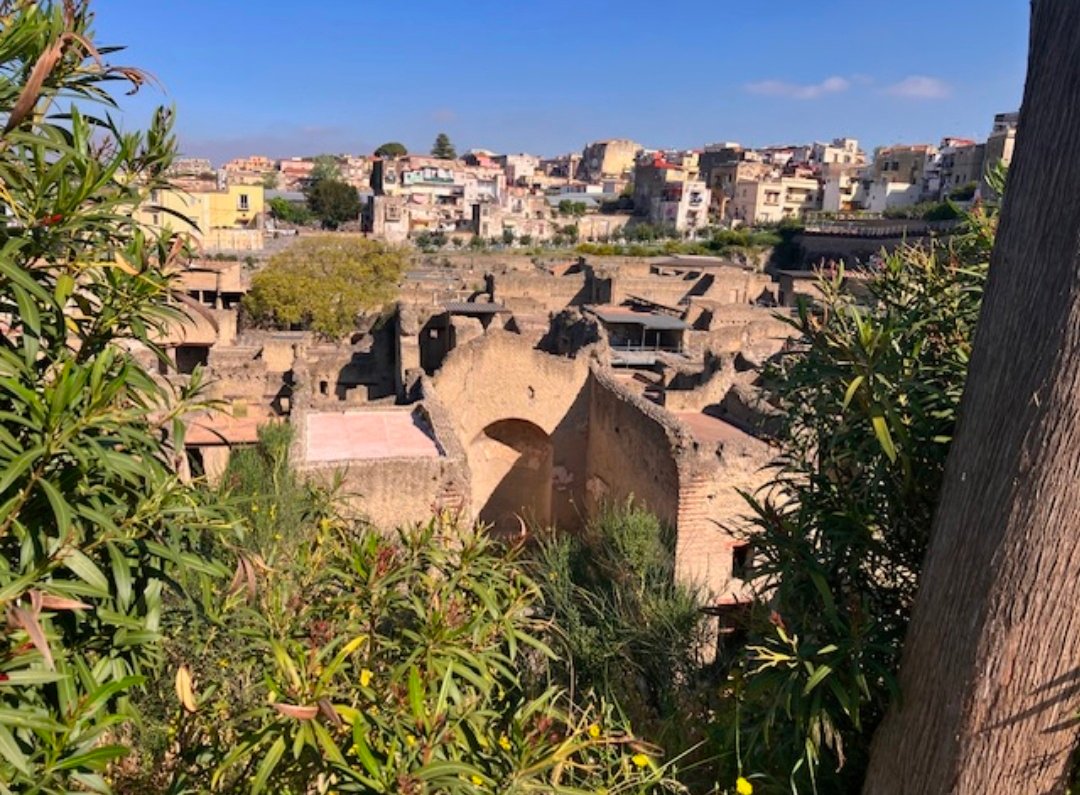
There are journeys in Italy that stay with you long after you return home. A quiet morning overlooking the Amalfi Coast, the first taste of an authentic Neapolitan pizza, a glass of local wine beneath Mount Vesuvius and, somewhere between them, the extraordinary feeling of walking through a city that disappeared almost two thousand years ago.
Pompeii and Herculaneum offer exactly that kind of experience.
Located close to Naples and beneath the presence of Mount Vesuvius, these ancient Roman cities allow travelers to see a side of Italy that cannot be experienced in a modern museum. Streets, homes, mosaics, frescoes and everyday details remain remarkably preserved, creating an intimate connection with a world that existed long before modern Italy.
The secret is not simply deciding to visit. It is knowing when to go, how to include the visit in your itinerary, and how to experience it without turning a memorable journey into a rushed one.
Best time of year to visit Pompeii and Herculaneum
For travelers looking for a more comfortable and relaxed experience, March, April, May, late September, October and November are particularly appealing months to explore the archaeological sites.
The weather during these periods is generally milder than in the height of summer, making it more pleasant to spend several hours walking through ancient streets and open archaeological areas. They can also offer a welcome alternative to the busiest periods of the Italian travel season.
Summer has its own attraction, of course, but the combination of stronger heat and larger numbers of visitors can make a long archaeological visit more demanding.
For this reason, experienced travelers often look beyond simply asking, “Which month should I visit?” The better question is: What time of day will give me the best experience?
Why an early morning visit makes a difference
An early morning start can completely change the character of your visit.
The first hours of the day are often more comfortable before the strongest heat arrives and before the midday tourist rush becomes noticeable. More importantly, an early start gives you time to explore without feeling that you are constantly watching the clock.
For travelers continuing towards Sorrento, the Amalfi Coast or another destination in Southern Italy, this can be especially valuable. A well-planned morning visit can become one beautiful chapter of a much larger journey.
En-route stopovers: visiting Pompeii during your transfer
One of the most enjoyable ways to experience Pompeii or Herculaneum is not necessarily to plan a completely separate excursion.
If you are traveling from Rome or Naples towards Sorrento, the Amalfi Coast or further south, an archaeological stop can be incorporated naturally into your route.
A carefully planned two- to three-hour stopover can give you enough time to experience the atmosphere of Pompeii or Herculaneum before continuing your journey. This can be an ideal option for travelers arranging a private transfer from Naples to the Amalfi Coast or a Sorrento transfer, allowing the historical visit to become part of the journey rather than a separate commitment.
This approach is particularly attractive for private travelers who value time and comfort. Instead of spending additional hours returning to the same destination, the historical visit becomes part of the journey itself.
The same idea works beautifully for cruise passengers arriving in Napoli or Salerno. With limited time ashore, having transportation organized around the day’s itinerary can make it possible to combine ancient history with the landscapes and flavors of Southern Italy.
Travel with comfort, not luggage
There is another advantage to arranging the visit as part of a private transfer.
With a Driver Service Naples transfer package, travelers can enjoy door-to-door transportation while their luggage remains safely in the vehicle during the archaeological visit. This removes one of the less enjoyable parts of travel moving bags from one place to another simply to make a short stop.
For travelers who want to understand the ruins rather than simply walk through them, there is also the option of arranging a private licensed tour guide. A Pompeii private driver or tour can make the experience easier to organize, particularly when the visit is part of a longer journey through Southern Italy.
A knowledgeable guide can bring the streets, homes and buildings to life, explaining details that might otherwise be easy to miss. The result is not simply a visit to an archaeological site, but a much deeper understanding of the people who once lived there.
Pompeii vs. Herculaneum: Which site should you choose?
Both destinations are extraordinary, but they offer different experiences.
The story begins in 79 AD, when Mount Vesuvius erupted and dramatically changed the surrounding landscape.
At Pompeii, layers of ash and volcanic material covered the city, preserving an extraordinary picture of Roman life. Walking through its ancient streets, visitors can discover homes, public spaces, mosaics, frescoes and details that reveal how people lived, worked and socialized nearly two thousand years ago.
Herculaneum, meanwhile, offers a different form of preservation. The city was overwhelmed by volcanic flows and deposits, which helped preserve remarkable architectural details and organic materials.
For some travelers, Pompeii’s scale and famous streets are the natural choice. Others may prefer Herculaneum for its more intimate atmosphere and exceptional preservation.
There is no universally better option. The right choice depends on how much time you have, what interests you most and where your journey is taking you next.
A glimpse into everyday Roman life
What makes these places so fascinating is not only their age.
They offer something much more personal: a glimpse into ordinary Roman life.
A beautifully preserved fresco can reveal the taste and imagination of a homeowner. A mosaic can tell us something about decoration and status. An ancient street can make it possible to imagine merchants, families and travelers moving through the same space almost two thousand years ago.
This is why Pompeii and Herculaneum feel different from simply looking at historical objects behind glass. You are walking through the environment in which people actually lived.
Continue the experience beyond the ruins
A visit to Pompeii or Herculaneum does not need to be the final chapter of the day.
Southern Italy rewards travelers who leave room for discovery.
After exploring the ruins, you might return towards Naples for an authentic Neapolitan pizza, prepared in the city that made this simple dish famous around the world.
For wine lovers, another memorable possibility is a wine tasting and lunch at a vineyard on the slopes of Mount Vesuvius. Here, the same volcano that shaped the history of Pompeii and Herculaneum becomes part of a completely different experience, one built around local wine, food and the landscape.
And then there is the coastline.
A private drive towards Sorrento or the Amalfi Coast allows the day to continue through some of the most beautiful scenery in Southern Italy. After spending the morning among ancient Roman streets, watching the coastline unfold from the comfort of a private vehicle creates a wonderful contrast.
The luxury of seeing more, without rushing
The best Italian journeys are rarely about seeing as many places as possible.
They are about seeing the right places in the right way.
Pompeii or Herculaneum can become much more than a historical stop on a busy itinerary. With the right timing and route planning, the experience can combine ancient history, private transportation, local cuisine, volcanic landscapes and the beauty of Southern Italy all within one seamless journey.
For travelers arriving by cruise, coming from Rome or Naples, or continuing towards Sorrento and the Amalfi Coast, this approach offers something increasingly valuable: the freedom to experience more of Italy without sacrificing comfort, time or the pleasure of the journey itself.
And perhaps that is the most beautiful way to discover Pompeii or Herculaneum not as a destination that interrupts your Italian adventure, but as one of the unforgettable experiences that becomes part of it.
 Admin