

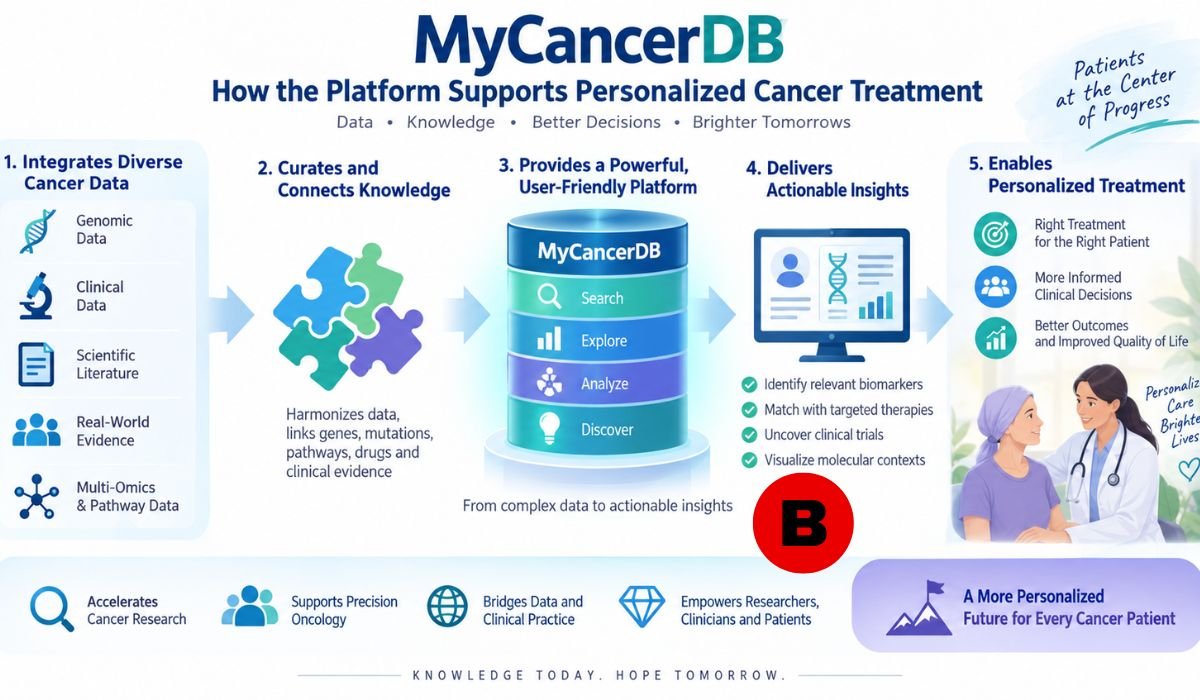
Introduction: What Is MyCancerDB?
Cancer care is becoming increasingly data-driven. Advances in genomic testing and precision medicine are giving doctors more detailed information about individual tumors, which can sometimes help guide treatment decisions. The National Cancer Institute describes precision medicine as an approach that uses information about a person’s genes, proteins, and other characteristics to help prevent, diagnose, or treat disease. In cancer care, information about a tumor can help inform treatment planning and monitoring.
MyCancerDB is presented as a Cloud-Native Platform built around this broader idea of Personalized Cancer Treatment. According to the company’s public Fundable profile, its technology is intended to help individual cancer patients better understand their illness and make greater use of their own data when considering treatment. The company also says its technology supports institutions serving cancer patients with Therapeutic And Diagnostic Analysis at lower cost and at scale.
That combination of patient empowerment, genomic information, and technology makes MyCancerDB an interesting company to examine. Still, there’s an important distinction to keep in mind. The company’s public materials explain its mission, technology concept, and founding story, but they don’t independently establish that the platform improves cancer survival or guarantees better treatment outcomes.
Quick Bio Information
| MyCancerDB Fact | Information |
|---|---|
| Company Name | MyCancerDB |
| Main Focus | Personalized Cancer Treatment |
| Technology | Cloud-Native Platform |
| Primary Audiences | Cancer Patients And Cancer-Care Institutions |
| Patient Goal | Help Patients Make Greater Use Of Their Data |
| Institutional Goal | Support Therapeutic And Diagnostic Analysis |
| Data Focus | Medical And Genomic Information |
| Core Approach | Patient-Centered Cancer Data |
| Founder Highlighted | Stephen Aldrich |
| Founder’s Cancer | Stage 4 Adenocarcinoma Of The Esophagus |
| Founder’s Data | Full Genomic Sequence Data |
| Treatment Approach Mentioned | Personalized Immunotherapy |
| Vaccine Mentioned | Personalized Neoantigen Vaccine |
| Ownership Claim | Owned And Controlled By Cancer Patients |
| Founding Members | Cancer Patients |
| Founding Members’ Roles | Initial Customers And Investors |
| Advisory Role | Informal Advisory Board |
| Fundraising Status | Private Fundraise On Fundable |
| Investor Reference | Accredited Investors |
| Stated Mission | Help Patients Use Their Data For Treatment Decisions |
Why Personalized Cancer Treatment Matters
Personalized Cancer Treatment, often referred to as Precision Medicine, starts with the understanding that cancers can differ at the molecular level. Two people may receive the same broad cancer diagnosis while having different genetic changes inside their tumors. Those differences can influence how a cancer develops and whether particular treatments are likely to work.
The National Cancer Institute explains that Biomarker Testing can identify genes, proteins, and other characteristics that may help doctors select cancer treatments. Some targeted therapies and immunotherapies work only when a patient’s cancer has particular biomarkers.
That doesn’t mean genomic testing automatically produces a perfect treatment match. In many cases, testing may find changes that don’t affect treatment decisions, while some patients won’t have an actionable biomarker at all. Even when a treatment matches a biomarker, there’s no guarantee that it will work. Cancer biology can also change over time.
This context is important when looking at MyCancerDB. Its stated purpose is to help patients and institutions make greater use of cancer-related information. It shouldn’t be interpreted as a claim that genomic data alone can determine the right treatment for every patient.
How MyCancerDB Uses Patient Data
Patient Data sits at the center of the MyCancerDB concept. The company says its goal is to enable patients to use their own information when making treatment decisions and to directly access advanced therapy options.
That idea fits into a much wider shift in cancer medicine. Cancer genomics examines the genetic and molecular characteristics of tumors, while clinical information can provide context about treatment response, disease progression, and drug resistance. NCI describes cancer genomics as a rapidly developing field that brings together laboratory, computational, and clinical information to improve understanding of cancer.
For patients, however, having more information isn’t necessarily the same as having clearer answers. A genomic report may contain actionable findings, results whose significance remains uncertain, or genetic changes with no established treatment relevance. NCI notes that many changes identified through biomarker testing don’t provide information that can guide treatment.
MyCancerDB’s approach therefore sits within a broader effort to make cancer information more useful and accessible while keeping treatment decisions grounded in appropriate medical interpretation.
MyCancerDB’s Cloud-Native Platform
MyCancerDB describes its technology as a Cloud-Native Platform. Its public profile presents the platform as serving two main audiences: individual cancer patients and institutions that provide services to people with cancer.
For patients, the company’s stated goal is to help them know more and do more about their illness. For institutions, MyCancerDB says the technology can support Therapeutic And Diagnostic Analysis at lower cost and at scale.
The public profile doesn’t provide enough technical information to describe the platform’s complete architecture, specific software components, security controls, integrations, or current deployment model. That’s an important limitation when discussing the technology.
Based on the information that is publicly available, the most accurate description is that MyCancerDB is designed around cloud-based cancer data and analysis, with patient use and institutional analysis forming two important parts of its stated purpose.
How MyCancerDB Supports Cancer Patients
MyCancerDB describes its patient mission in straightforward terms: helping people with cancer understand more and do more about treating their illness. That places access to useful information at the heart of the platform.
The approach is particularly relevant because modern cancer care can involve pathology reports, imaging, biomarker results, treatment histories, genomic testing, clinical trials, and information about emerging therapies. Understanding how these pieces fit together can be difficult, particularly without appropriate professional guidance.
Biomarker Testing is one established example of how patient-specific information can influence cancer treatment. According to NCI, doctors can use biomarker results to determine whether certain targeted treatments or immunotherapies may be appropriate and, in some cases, whether a patient may qualify for a clinical trial.
MyCancerDB’s stated approach is to help patients make greater use of this kind of information. That’s different from practicing medicine. The platform is better understood as part of an information and analysis process rather than as a replacement for an oncologist or another qualified healthcare professional.
Supporting Therapeutic And Diagnostic Analysis
MyCancerDB isn’t presented solely as a patient-facing service. The company also describes an institutional role, saying its technology can support organizations serving cancer patients with Therapeutic And Diagnostic Analysis.
That institutional focus reflects a larger trend in cancer research. Modern oncology increasingly depends on analyzing substantial amounts of molecular and clinical information. NCI’s work in cancer genomics, for example, involves studying genetic and molecular characteristics alongside clinical information to better understand cancer biology, treatment response, and resistance.
MyCancerDB’s stated goal of supporting analysis at lower cost and at scale fits within this broader data-driven direction. However, the public company profile doesn’t identify enough specific institutional deployments or independently verified performance measurements to establish the size of its current impact.
That’s an important distinction for readers: the potential application is described by the company, while the platform’s measurable real-world results require additional independent evidence.
MyCancerDB And Genomic Data
Genomic Data plays a major role in the story behind MyCancerDB. In cancer care, genomic testing can reveal molecular changes within a tumor that may influence treatment decisions.
NCI explains that different types of biomarker testing can examine individual genes, groups of genes, proteins, or broader genetic patterns. Some tests examine all the genes in a tumor, while whole-genome sequencing examines DNA across both genes and regions outside genes.
Genomic information is particularly important to the MyCancerDB founding story. According to the company’s profile, its late founder, Stephen Aldrich, was able to use his full genomic sequence data when making treatment decisions after being diagnosed with advanced cancer.
That personal experience appears to have influenced the company’s wider philosophy: patients should have meaningful opportunities to use their own information when considering treatment possibilities.
The Story Of Founder Stephen Aldrich
Stephen Aldrich is central to MyCancerDB’s founding story. According to the company’s public profile, Aldrich was a Stage 4 adenocarcinoma of the esophagus patient who used his full genomic sequence data in making treatment decisions.
The company says his experience demonstrated the potential value of giving patients greater access to their cancer data. MyCancerDB subsequently built its mission around helping other patients use their own information when considering treatment options.
Because these details come primarily from MyCancerDB’s own public materials, they should be understood as the company’s account rather than independent evidence of the platform’s clinical effectiveness.
Even so, the story helps explain why patient control, genomic information, and access to advanced therapies are so prominent in MyCancerDB’s identity.
Personalized Immunotherapy And Aldrich’s Experience
MyCancerDB says Aldrich gained access to Personalized Immunotherapy options, including a Personalized Neoantigen Vaccine. The company further states that this treatment experience led to him surviving and thriving for three full years beyond expectations.
Neoantigen-based treatment is a genuine area of cancer research. Neoantigens are proteins or protein fragments associated with mutations in cancer cells that may be recognized by the immune system. Personalized cancer vaccines are designed around characteristics identified in an individual patient’s tumor.
Research in this area has produced promising findings, although it remains an evolving field. In 2025, NCI reported promising results from two small clinical trials involving personalized neoantigen treatment vaccines in kidney and pancreatic cancer. The vaccines were created for individual patients using genetic analyses of their tumors.
NCI also lists ongoing clinical research involving personalized neoantigen vaccines. For example, an active Phase I/II study is examining a personalized neoantigen peptide-based vaccine alone and in combination with pembrolizumab for certain advanced solid tumors.
That scientific context is useful, but Aldrich’s experience should still be treated as an individual case. It shouldn’t be presented as proof that a personalized neoantigen vaccine, or MyCancerDB itself, will produce the same outcome for other patients.
How MyCancerDB Puts Patients At The Center
One of the most distinctive statements in MyCancerDB’s public profile is that the company is owned and controlled by cancer patients.
That patient-centered approach is closely tied to the company’s founding story. Rather than describing cancer patients simply as end users, MyCancerDB says patients have been involved in ownership, investment, service development, and advising.
That perspective can be valuable. People living with cancer often encounter practical challenges that aren’t obvious from a purely technical or institutional viewpoint. Their experiences can help identify information gaps, usability concerns, and needs that might otherwise be overlooked.
Still, patient experience works best alongside clinical expertise and scientific evidence. Personal experience can provide valuable insight, but it can’t independently establish whether a diagnostic method or treatment is safe or effective.
Who Are MyCancerDB’s Founding Members?
According to the company’s public profile, MyCancerDB’s founding members are all cancer patients. The company also describes them as its initial customers and investors.
That combination gives the founding group several perspectives. They’re people with direct experience of cancer, early users of the service, and participants in the company’s financial development.
MyCancerDB says its service offering is being designed around their needs and with their input. In other words, the company presents its early development as patient-led rather than based entirely on assumptions made by a technology team.
Founding Members As An Informal Advisory Board
MyCancerDB says its founding members also act as an informal advisory board. Their role is to provide input as the company develops its service offering.
For a healthcare technology company, that kind of feedback can be especially useful. Patients can point to practical concerns that may not be obvious to developers, investors, or healthcare institutions.
At the same time, a patient advisory role should complement, rather than replace, medical, scientific, regulatory, privacy, and security expertise. A platform handling sensitive health and genomic information needs strong safeguards and evidence-based practices in addition to patient feedback.
The public MyCancerDB profile doesn’t provide enough detail to independently evaluate those areas, so they shouldn’t be assumed.
Key Benefits MyCancerDB Highlights
The benefits described by MyCancerDB fall broadly into two areas. For patients, the company emphasizes access to information, greater use of personal data, support for treatment decision-making, and potential access to advanced therapy options. For institutions, it highlights Therapeutic And Diagnostic Analysis, lower costs, and the ability to operate at scale.
Those goals fit with the broader development of Precision Oncology. NCI explains that genomic and biomarker testing can sometimes identify molecular characteristics associated with particular treatments. Some approved therapies can even be selected based on certain genomic biomarkers rather than solely on where a tumor originated.
But there’s an important qualification. Not every cancer has an actionable biomarker, and finding a biomarker that matches a treatment doesn’t guarantee that the treatment will work. NCI specifically notes that biomarker testing doesn’t benefit everyone and that several factors can limit its usefulness.
That makes MyCancerDB’s focus on data and analysis potentially relevant, while also showing why its capabilities should be evaluated through evidence rather than promotional claims alone.
What Makes MyCancerDB Different?
MyCancerDB brings together three themes: Cancer Technology, Genomic Data, and Patient Empowerment.
Its public description goes beyond providing general cancer information. The company presents a platform designed to help patients make greater use of their own data while also supporting institutions with cancer-related analysis.
Its patient-led founding structure adds another layer. MyCancerDB says cancer patients have been involved as owners, founding members, initial customers, investors, and informal advisors.
Perhaps the most distinctive part of the MyCancerDB story, then, isn’t a single technical feature. It’s the company’s underlying philosophy: putting patients closer to the information and data involved in their cancer treatment journey.
What Is Known About MyCancerDB’s Fundraising?
The available Fundable profile identifies MyCancerDB as a Private Fundraise and says the company may be interested in raising funds from accredited investors. More detailed information on the company’s business plan is restricted on the public page.
That means readers shouldn’t make assumptions about MyCancerDB’s valuation, revenue, profitability, complete funding history, or investment performance based solely on the publicly visible profile.
Anyone evaluating the company as an investment opportunity would need to obtain appropriate current disclosures and conduct independent due diligence.
What The Public Information Does Not Tell Us
This is one of the most important points when assessing MyCancerDB.
The public material explains the company’s purpose, technology concept, and founding story, but it doesn’t answer every question a prospective patient, healthcare professional, or investor might reasonably have. The profile doesn’t provide comprehensive public information about current patient numbers, pricing, specific institutional customers, detailed technical architecture, independent clinical validation, regulatory status, or measured patient outcomes.
It also doesn’t provide enough information to determine how widely the platform is currently used or how its real-world performance compares with other cancer data platforms.
Being open about these gaps makes the discussion more trustworthy. It prevents a company’s promotional description from being mistaken for independent clinical evidence.
Is MyCancerDB A Replacement For Medical Advice?
No. MyCancerDB shouldn’t be presented as a substitute for an oncologist, genetic counselor, pathologist, or another qualified healthcare professional.
Precision medicine involves interpreting molecular and clinical information within the context of an individual’s disease. NCI recommends discussing biomarker testing with a healthcare provider because test results don’t always identify a treatment that will work, and some findings have uncertain or no treatment relevance.
That point becomes particularly important when discussing advanced therapies or experimental approaches such as Personalized Neoantigen Vaccines. NCI continues to list clinical research involving these approaches, which shows that the field is still being studied.
MyCancerDB can therefore be discussed as a technology and information platform, but treatment decisions should remain under appropriate medical supervision.
MyCancerDB’s Vision For The Future Of Cancer Treatment
MyCancerDB’s vision fits into a much larger transformation taking place in oncology. Researchers are using increasingly detailed genomic and molecular information to understand tumors and identify potential treatment targets. NCI’s precision medicine programs use molecular testing to help assign patients to treatments based on specific clinical and molecular characteristics.
The company’s stated contribution is to bring patients closer to that information. Its goal is to help people use their own data while supporting organizations that analyze cancer information.
Whether that vision ultimately produces broad clinical benefits will depend on evidence, accessibility, implementation, privacy, security, regulatory considerations, and clinical validation. Those are the standards that will ultimately determine the value of any technology used in cancer care.
Final Thoughts: MyCancerDB And Personalized Cancer Care
MyCancerDB represents an interesting idea at the intersection of Personalized Cancer Treatment, Genomic Data, Cancer Technology, and Patient Empowerment.
Its public profile describes a Cloud-Native Platform designed to help patients use cancer-related information and to support institutions with Therapeutic And Diagnostic Analysis. Its founding story, particularly the experience of Stephen Aldrich, helps explain why patient access to genomic information became such an important part of the company’s mission.
There is also a broader scientific foundation for the concept. Biomarker testing and genomic profiling are established components of modern Precision Medicine, although they don’t provide a useful treatment match for every patient and can’t guarantee a successful outcome. Personalized Neoantigen Vaccines are another promising but still developing area of cancer research, with ongoing clinical trials and important questions still being studied.
For readers researching MyCancerDB in 2026, the most balanced conclusion is that the company presents a patient-centered approach to cancer data and personalized treatment, but the publicly available information doesn’t yet provide enough independent evidence to judge its full clinical impact.
That distinction matters. The future of Personalized Cancer Care won’t depend simply on having more data. It will depend on turning accurate data into clinically meaningful information that patients and healthcare professionals can use safely, responsibly, and effectively.
FAQs About MyCancerDB
What Is MyCancerDB?
MyCancerDB is described by its public company profile as a Cloud-Native Platform designed to help cancer patients understand more about their illness and make greater use of their own data when considering treatment. The company also says its technology can support institutions serving cancer patients with Therapeutic And Diagnostic Analysis.
What Does MyCancerDB Do?
MyCancerDB’s stated purpose is to connect cancer-related data with treatment decision-making and analysis. For patients, the emphasis is on using personal information to better understand treatment possibilities. For institutions, the company describes support for Therapeutic And Diagnostic Analysis at lower cost and scale.
Is MyCancerDB A Cancer Treatment?
No. MyCancerDB is presented as a technology platform, not as a cancer drug, medical procedure, or standalone treatment. Its stated role involves information, data, and analysis rather than directly replacing cancer treatment delivered by healthcare professionals.
How Does Genomic Data Relate To MyCancerDB?
Genomic Data is important to the company’s founding story. MyCancerDB says its late founder, Stephen Aldrich, used his full genomic sequence data when making treatment decisions. More broadly, genomic and biomarker testing are established parts of Precision Medicine and can sometimes help identify treatments associated with specific molecular characteristics.
Who Was Stephen Aldrich?
Stephen Aldrich was the late founder highlighted in MyCancerDB’s public company story. The company says he had Stage 4 adenocarcinoma of the esophagus and used full genomic sequence data while exploring treatment options. His experience became a major part of MyCancerDB’s patient-centered mission.
What Is A Personalized Neoantigen Vaccine?
A Personalized Neoantigen Vaccine is an experimental form of cancer immunotherapy designed around neoantigens associated with mutations in an individual’s tumor. Research has shown promising results in some early studies, but the approach remains an active area of clinical research. NCI continues to list trials investigating personalized neoantigen vaccines in advanced cancers.
Can MyCancerDB Guarantee A Personalized Cancer Treatment?
No. The available information doesn’t establish that MyCancerDB can guarantee a treatment or clinical outcome. NCI explains that biomarker testing doesn’t help every patient, and even when a biomarker matches a treatment, that treatment may not work.
Is MyCancerDB A Replacement For A Doctor?
No. Cancer treatment requires professional medical evaluation and may involve pathology, imaging, biomarker testing, medical history, previous treatment response, and other factors. A technology platform can support information and analysis, but treatment decisions should be made with qualified healthcare professionals.
Learn more and explore exciting content on: Bella Thornton: Inside The Private Life Of Billy Bob Thornton’s Daughter
 IQ newswire
  ENGR NEWSWIRE