

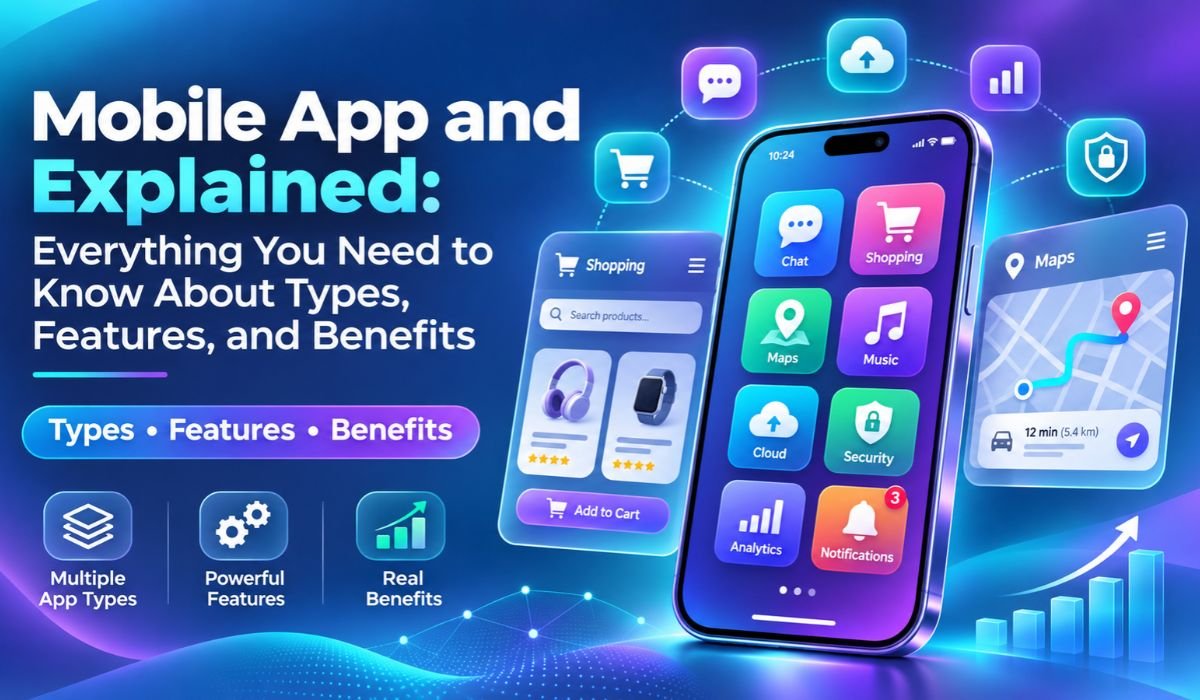
Think about how often you reach for your smartphone throughout the day. You might check the weather before leaving home, order lunch through a delivery service, transfer money using a banking application, or watch your favorite show in the evening. Behind each of these activities is a Mobile App designed to make everyday life a little easier.
Mobile applications have changed how people communicate, shop, learn, work, and manage their finances. For businesses, they’ve opened new opportunities to connect with customers, improve services, and generate revenue.
Understanding a Mobile App and its related technologies is especially valuable in 2026, as digital services become more connected and increasingly personalized. However, building an application simply because competitors have one isn’t always a sensible investment. The real value comes from solving a problem that matters to users.
This comprehensive guide explores Mobile App Types, Features, Benefits, Development Costs, Security, and emerging technologies. Whether you’re a beginner, a business owner, or simply curious about the technology you use every day, you’ll find practical information to help you understand this rapidly evolving industry.
Quick Bio Information About Mobile Apps
| Information | Details |
|---|---|
| Full Name | Mobile Application |
| Common Name | Mobile App |
| Definition | Software Designed for Mobile Devices |
| Primary Purpose | Providing Digital Services and Functionality |
| Supported Devices | Smartphones and Tablets |
| Major Operating Systems | Android and iOS |
| Main Development Approaches | Native, Cross-Platform, Hybrid, and PWA |
| Apple App Store Launch | July 2008 |
| Popular Distribution Platforms | Google Play and Apple App Store |
| Programming Languages | Swift, Kotlin, Java, Dart, and JavaScript |
| Development Frameworks | Flutter, React Native, and Ionic |
| Internet Requirement | Depends on Application Functionality |
| Common Features | Notifications, Personalization, and Hardware Access |
| Revenue Models | Subscriptions, Advertising, and Purchases |
| Common Reviewed Development Costs | $10,000–$49,999 |
| Estimated Market Size in 2025 | $298.40 Billion |
| Projected Market Size in 2026 | $330.02 Billion |
| App Store Consumer Spending in 2025 | $167 Billion |
| Emerging Technologies | AI, Augmented Reality, and Cloud Computing |
| Future Outlook | Continued Growth and Innovation |
What Is a Mobile App?
A Mobile App is a software program designed primarily for smartphones, tablets, and other compatible mobile devices. Unlike traditional desktop software, mobile applications are built with portability in mind. Their interfaces are generally designed for smaller screens, touch controls, and convenient access while traveling or completing everyday activities.
Some applications perform simple tasks, such as calculating expenses or setting reminders. Others provide much more complex services, including online banking, video streaming, navigation, and international communication.
One characteristic that makes mobile applications particularly useful is their ability to interact with device hardware. Depending on permissions and technical capabilities, an application can access a smartphone’s camera, microphone, GPS, or biometric sensors.
A navigation application, for instance, uses location information to provide directions. Similarly, a banking application may allow customers to sign in using fingerprint recognition instead of repeatedly entering a password.
At its core, a Mobile Application exists to make a particular service or activity more accessible, efficient, and convenient.
History and Evolution of Mobile Apps
Mobile applications didn’t begin with modern smartphones. Earlier mobile phones already included basic software such as calculators, calendars, messaging tools, and simple games. Although their capabilities were limited, these programs introduced people to the convenience of carrying useful digital tools in their pockets.
The industry changed significantly in July 2008, when Apple launched its App Store with approximately 500 applications. Android’s application ecosystem emerged during the same year, eventually developing into the platform now known as Google Play.
For software developers, these marketplaces created a more accessible way to distribute applications. Businesses could reach customers directly through mobile devices, while consumers gained access to a growing selection of digital services.
Improvements in smartphone performance, internet connectivity, and Cloud Computing accelerated this transformation. Applications gradually became more sophisticated, supporting everything from financial transactions to real-time video communication.
By 2026, Mobile App Development has expanded far beyond basic functionality. Today’s applications can process complex information, automate repetitive activities, and provide experiences tailored to individual users.
How Does a Mobile App Work?
Although using a Mobile App often feels effortless, several technical processes may be happening behind the screen. Most internet-connected applications rely on three important components: the Frontend, Backend, and Application Programming Interface (API).
The Frontend is the part users interact with directly. It includes the screens, buttons, menus, images, and navigation elements that make an application usable. Behind that interface is the Backend, which manages activities such as account authentication, information storage, and payment processing.
An API allows these components to exchange information. When you open a banking application to check your balance, for example, the application sends a request to the bank’s server. After processing that request, the server returns the relevant information, which appears on your screen.
Not every application needs constant communication with a server. Calculators, certain games, and basic note-taking tools can work independently. Other applications store selected information locally, allowing users to access saved content even when their internet connection becomes unreliable.
Different Types of Mobile Apps
Not all Mobile Applications are developed in the same way. Developers commonly discuss four approaches, each offering a different balance of performance, flexibility, development costs, and technical capabilities.
Native Mobile Apps
Native Apps are developed specifically for an individual operating system. Developers commonly use Swift when creating iOS applications and Kotlin when building applications for Android.
Because these applications are designed around a particular platform, they can take advantage of its hardware capabilities, software features, and design conventions.
Native Development is particularly suitable for products requiring specialized hardware access, demanding graphics, or advanced operating system integration. However, maintaining separate applications for multiple platforms can require additional resources.
Cross-Platform Mobile Apps
Cross-Platform Apps allow developers to share substantial portions of code across Android and iOS devices. Flutter and React Native are among the best-known frameworks supporting this approach.
For businesses that want to reach users on both platforms, cross-platform development can reduce duplicated work and simplify maintenance. It may also shorten development timelines compared with building two completely separate applications.
That doesn’t mean every feature works identically across devices. Certain functions still require platform-specific programming, testing, and adjustments.
Hybrid Mobile Apps
Hybrid Apps combine web technologies with a native application container. Developers can use technologies such as HTML, CSS, and JavaScript while distributing their applications through conventional app stores.
This approach offers flexibility and opportunities for code reuse. However, performance depends heavily on how the application is built. Products requiring particularly demanding graphics or complex hardware integration may need a different development strategy.
Progressive Web Apps
Progressive Web Apps, commonly known as PWAs, provide app-like experiences through web browsers. When properly implemented, they can support home-screen installation, offline functionality, and push notifications on compatible platforms.
PWAs are often attractive to businesses that want to reach customers without requiring a conventional app store download.
Their capabilities vary depending on the browser and operating system. Choosing between a PWA and another development approach therefore requires careful consideration of the application’s intended purpose.
Popular Categories and Examples
The Mobile App industry covers nearly every area of daily life. Communication applications such as WhatsApp make it easier to maintain personal and professional relationships, while Instagram provides a platform for sharing content and interacting with communities.
Entertainment services such as Netflix and Spotify allow people to enjoy movies, television programs, and music without relying on traditional broadcasting schedules. Educational platforms like Duolingo offer flexible learning opportunities, while Google Maps helps travelers navigate unfamiliar places.
Shopping applications simplify the purchasing process, and banking applications provide convenient access to financial services. Fitness platforms help users monitor physical activities, while productivity applications support scheduling, collaboration, and task management.
Artificial Intelligence applications have introduced another category of digital assistance, helping people with research, writing, education, and everyday problem-solving.
These examples demonstrate how Mobile Technology has become a practical part of both personal routines and professional responsibilities.
Essential Features of a Successful Mobile App
An application doesn’t need dozens of complicated features to succeed. In many cases, the most valuable products are those that perform their intended tasks reliably and without unnecessary distractions.
A well-designed User Experience begins with straightforward navigation, readable content, responsive controls, and reasonable loading times. Users should be able to find what they need without searching through confusing menus.
Secure authentication, relevant personalization, useful search functions, and carefully managed Push Notifications can further improve the experience. Notifications should provide genuine value rather than repeatedly interrupting users with unnecessary messages.
Accessibility deserves equal attention. Suitable color contrast, readable text, screen reader compatibility, and appropriately sized buttons help people with different abilities use an application more comfortably.
Developers should also test their applications across various screen sizes, network conditions, and hardware configurations. A product that performs smoothly on an expensive smartphone should remain reasonably accessible to people using more affordable devices.
Benefits of Mobile Apps for Everyday Users
Convenience is one of the biggest reasons Mobile Applications have become so widely used. Activities that once required traveling to a physical location can now often be completed within minutes using a smartphone.
People can arrange appointments, purchase products, transfer money, communicate with colleagues, and access educational materials from almost anywhere. For individuals with demanding schedules, these services can save considerable time.
Personalization adds another layer of convenience. Music applications can recommend songs based on listening preferences, while navigation platforms use location and traffic information to suggest suitable routes.
Offline functionality is particularly useful when internet connectivity becomes unreliable. Someone preparing for a trip, for instance, can download maps before arriving at their destination.
From managing household expenses to organizing professional responsibilities, Mobile Apps give users greater flexibility in how they approach everyday activities.
Benefits of Mobile Apps for Businesses
For businesses, a Mobile Application can become an important connection between a company and its customers. A thoughtfully designed application makes it easier for people to explore products, place orders, monitor deliveries, and receive customer support.
Personalized recommendations and loyalty programs may encourage customers to return. Businesses can also analyze responsibly collected usage information to identify popular features and understand where customers encounter difficulties.
The advantages extend beyond customer-facing services. Internal applications can help organizations manage inventory, coordinate employees, track deliveries, and reduce repetitive administrative work.
However, application downloads alone aren’t a reliable measure of business success. A company may attract thousands of downloads without seeing meaningful improvements in sales or customer satisfaction.
Metrics such as Customer Retention, Conversion Rates, Customer Satisfaction, and repeat usage offer a clearer picture of whether an application is delivering lasting value.
Mobile Apps vs. Mobile Websites
Choosing between a Mobile App and a Mobile Website is one of the most important decisions businesses face when planning their digital presence.
A responsive website operates through a browser and generally doesn’t require installation. It’s easily accessible, relatively straightforward to update, and particularly useful for businesses that rely on search engines to attract new customers.
Dedicated Mobile Applications can offer deeper integration with device hardware, more sophisticated personalization, and additional opportunities for repeated engagement. Modern websites and PWAs, however, can also provide selected app-like capabilities.
For example, Apple introduced Web Push support for eligible home-screen web applications with iOS and iPadOS 16.4. This development demonstrates that notifications aren’t exclusively available to conventional mobile applications.
A restaurant that simply needs to display opening hours, contact information, and menus may be better served by a responsive website. A delivery company requiring ongoing location tracking and specialized operational tools could benefit considerably from a dedicated application.
The decision should ultimately reflect what customers need rather than what appears more technologically advanced.
Disadvantages of Mobile Apps
Despite their many benefits, Mobile Applications come with responsibilities and potential drawbacks. Development may require substantial financial investment, particularly when an application includes advanced features or supports multiple operating systems.
Launching the product is only the beginning. Businesses must continue addressing software bugs, security vulnerabilities, operating system changes, and customer feedback.
For users, applications may consume valuable storage space, mobile data, and battery power. Privacy also becomes a concern when software requests permissions unrelated to its intended purpose or collects unnecessary personal information.
Businesses face additional challenges involving app store requirements, customer acquisition expenses, and competition from established platforms.
An application that fails to provide a compelling reason for people to return may struggle to deliver a worthwhile financial return. Realistic planning, responsible development practices, and ongoing improvements are essential to managing these risks.
Mobile App Development Process
Successful Mobile App Development starts long before anyone writes the first line of code. The initial stage involves understanding the intended audience, identifying a problem, and deciding how the application could provide a meaningful solution.
Once the requirements are established, designers develop the User Interface (UI) and User Experience (UX). These early designs help clarify how customers will navigate the application and complete important tasks.
Development teams then select appropriate technologies. Swift and Kotlin remain common choices for native development, while Flutter, React Native, and Ionic support other development approaches. Technologies such as Firebase and Node.js can assist with backend functionality.
Many businesses begin with a Minimum Viable Product (MVP). Rather than investing immediately in every possible feature, they release an initial product containing the core functionality needed to solve the customer’s problem.
Testing helps identify security weaknesses, usability issues, and performance limitations before launch. Once the application becomes available, monitoring crashes, loading times, customer feedback, and engagement helps guide future improvements.
Mobile App Development Cost in 2026
How much does it actually cost to develop a Mobile App? The answer depends on what the application needs to accomplish.
According to Clutch’s 2026 App Development Pricing Guide, most mobile application projects reviewed on its platform cost between $10,000 and $49,999. Its reported average exceeds $90,000, reflecting the influence of larger and more expensive projects.
A relatively simple application with basic functionality will generally require fewer resources than a platform supporting real-time communication, financial transactions, complex integrations, or specialized security requirements.
Development expenses are also influenced by designer and developer rates, project timelines, operating system requirements, and technical infrastructure.
Businesses should remember that initial development represents only part of the overall investment. Cloud hosting, third-party services, customer support, security updates, and continued maintenance create additional expenses.
These industry figures are useful planning benchmarks, not guaranteed prices. Obtaining project-specific estimates after clearly defining the requirements remains the most reliable way to establish a realistic development budget.
How Mobile Apps Make Money
Mobile Applications generate revenue in several ways, and the most appropriate business model depends on the service being offered.
Subscription-based applications charge customers recurring fees for continued access. This approach is common among entertainment, productivity, education, and fitness platforms.
Freemium applications take a slightly different approach. Users can access basic features without paying, while additional tools or premium content require a purchase.
Advertising allows applications to earn revenue by displaying promotional material. Gaming applications frequently generate income through in-app purchases, while online marketplaces may receive commissions whenever customers complete transactions.
Some businesses don’t charge people to use their applications at all. Instead, the application supports revenue by encouraging purchases of existing products and services.
Developers must also consider app store fees, operating expenses, and applicable payment policies when evaluating profitability. A sustainable Mobile App Monetization strategy should respect customer expectations, offer transparent pricing, and avoid advertisements or restrictions that undermine the overall experience.
Mobile App Security and Privacy
As Mobile Applications become more involved in financial activities, communication, and personal record management, protecting sensitive information becomes increasingly important.
Developers should implement secure authentication, encrypted communication, responsible information storage, and regular vulnerability testing. Sensitive information should only be retained when necessary and protected using appropriate security measures.
The OWASP Mobile Application Security Verification Standard (MASVS) provides recognized guidance for evaluating the security of mobile applications. Following established standards can help development teams identify potential weaknesses before they become serious problems.
Users also have a role to play. Downloading applications from trusted sources, reviewing requested permissions, installing software updates, and avoiding suspicious links can reduce exposure to common security threats.
Businesses must explain how customer information is collected, stored, and used through clear privacy policies. Strong Mobile App Security isn’t a feature developers can complete once and forget. It requires ongoing attention throughout the application’s operational lifetime.
Mobile App Market and Future Trends
The Mobile App industry represents a substantial and growing part of the global digital economy. Fortune Business Insights estimates that the worldwide mobile application market was valued at $298.40 billion in 2025 and could reach $330.02 billion in 2026.
Sensor Tower’s State of Mobile 2026 report presents another measure of the industry’s scale. Worldwide spending on paid applications and in-app purchases across iOS and Google Play reached $167 billion in 2025. Non-gaming applications surpassed games in this revenue category for the first time.
These figures measure different aspects of the mobile economy, so they shouldn’t be directly compared. Together, however, they demonstrate the considerable commercial activity surrounding mobile applications.
Looking ahead, Artificial Intelligence, Augmented Reality, wearable technology, Cloud Computing, and improved connectivity are influencing development priorities. Intelligent recommendations, automated assistance, and more personalized interfaces are creating opportunities for businesses to improve their services.
Still, adopting new technology doesn’t automatically make an application better. The most successful innovations are likely to be those that address genuine problems while maintaining reliability, accessibility, and customer trust.
Final Thoughts
Understanding a Mobile App and its features, development approaches, and benefits provides a clearer picture of how modern digital services operate.
Mobile Applications have transformed everyday activities, from communication and education to shopping, entertainment, and financial management. They’ve also given businesses new opportunities to improve customer relationships and operate more efficiently.
However, developing a successful application requires more than selecting a popular programming language or introducing advanced technology. Businesses need to understand their audience, establish realistic budgets, protect customer information, and focus on functionality that delivers meaningful results.
As Mobile Technology continues to evolve throughout 2026 and beyond, simplicity will remain an important advantage. Applications that respect people’s time, work reliably, and solve real problems are better positioned to build lasting relationships with their users.
Ultimately, the greatest measure of a Mobile App’s success isn’t how many features it contains, but how effectively those features improve someone’s life.
FAQs About Mobile Apps
What Is a Mobile App?
A Mobile App is a software application designed primarily for smartphones, tablets, and other compatible mobile devices. It enables users to access digital services, communicate, manage information, enjoy entertainment, and perform everyday activities through an interface optimized for mobile use.
What Are the Four Types of Mobile Apps?
The four commonly discussed development approaches are Native Apps, Cross-Platform Apps, Hybrid Apps, and Progressive Web Apps. These approaches offer different advantages regarding performance, development expenses, compatibility, hardware access, and maintenance. Choosing the right one depends on the application’s requirements and available resources.
Can Mobile Apps Work Without the Internet?
Yes. Calculators, offline games, and certain note-taking applications can operate without an internet connection. Some navigation and entertainment applications also allow users to download content for offline access. However, features involving live communication, financial transactions, or real-time information generally require connectivity.
How Much Does a Mobile App Cost in 2026?
Mobile App Development costs vary considerably depending on complexity, features, design requirements, and technical infrastructure. Clutch’s 2026 industry data indicates that most reviewed projects cost between $10,000 and $49,999. More advanced applications can require substantially larger investments, especially when ongoing maintenance and security are included.
How Do Free Mobile Apps Make Money?
Free Mobile Applications can generate revenue through advertising, premium subscriptions, in-app purchases, sponsorships, and transaction commissions. Some applications also generate indirect income by helping businesses sell their existing products and services. The appropriate monetization model depends on the application’s purpose and customer expectations.
Can I Develop a Mobile App Without Coding?
Yes. Low-code and no-code development platforms allow users to create relatively simple applications through visual design tools without extensive programming knowledge. However, applications involving advanced security, specialized integrations, or complex functionality may still require experienced software developers.
Does Every Business Need a Mobile App?
No. Businesses that primarily provide information, display products, or attract customers through search engines may find that a responsive website meets their requirements. A dedicated Mobile App becomes more valuable when customers need frequent access, personalized services, offline functionality, or advanced integration with smartphone hardware.
Learn more and explore exciting content on: Home Depot Christmas Tree Guide 2026: Best Picks, Prices, and Holiday Deals
 Apex Apex
 Wild Rise