

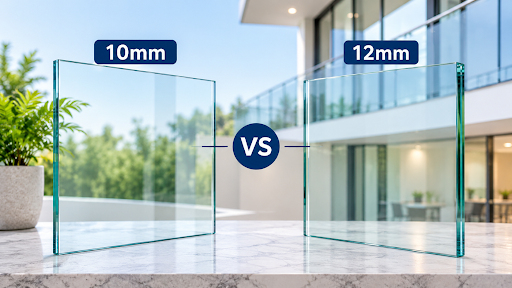
Choosing the right glass thickness is an important decision for any glass railing project. Whether installing panels on a balcony, staircase, deck, or terrace, the thickness can influence the overall appearance, weight, hardware compatibility, and structural requirements.
Both 10mm and 12mm tempered glass panels are used in architectural applications. Although the difference is only 2mm, each option has specific considerations. Understanding these differences helps homeowners, builders, and contractors select the right glass specification for their projects.
Understanding 10mm and 12mm Tempered Glass Panels
Glass panel thickness refers to the measurement between its two surfaces. Both 10mm and 12mm options are available in tempered safety glass, which undergoes a heat-treatment process to improve its strength compared with ordinary annealed glass.
10mm tempered glass panels offer a relatively lightweight option for applications where the railing system is specifically designed for this thickness. Their slimmer profile can complement certain interior and architectural installations.
12mm tempered glass panels provide a thicker profile and greater stiffness under comparable conditions. They are commonly considered for architectural railing systems that require this specification. However, their additional weight means the supporting structure and mounting hardware must be suitable for the installation.
Neither option should be selected based on thickness alone. Panel dimensions, support conditions, structural requirements, and local building regulations all influence the appropriate choice.
10mm vs 12mm Glass Panels: Key Differences
Although both options offer a clean and contemporary appearance, there are some practical differences to consider.
| Comparison Factor | 10mm Glass Panels | 12mm Glass Panels |
| Thickness | 10mm | 12mm |
| Weight | Relatively lighter | Relatively heavier |
| Appearance | Slimmer profile | More substantial profile |
| Stiffness | Lower under comparable conditions | Generally higher under comparable conditions |
| Hardware | Requires compatible fittings | Requires compatible fittings |
| Installation | Depends on system design | Requires consideration of additional weight |
The right option depends on the railing configuration and its engineering requirements. A thicker panel does not automatically mean a safer installation, as the complete system must be designed to withstand the required loads.
Factors to Consider When Choosing Glass Thickness
Before selecting glass panels for railings, it is important to consider where and how they will be installed. Balcony, staircase, deck, and terrace applications may have different structural and safety requirements.
Hardware compatibility is another important factor. Components such as stainless steel spigots, clamps, brackets, and base channels are manufactured for specific glass thicknesses. A fitting designed for 10mm glass should not automatically be used with a 12mm panel.
Installation conditions also matter. The supporting surface, panel dimensions, mounting arrangement, and exposure to outdoor conditions should all be evaluated before finalizing the glass specification.
Consulting the railing system manufacturer or a qualified structural professional helps ensure that the selected glass and hardware meet the project’s requirements.
Hardware Compatibility and Installation Considerations
Choosing the correct hardware is just as important as selecting the glass itself. Glass Railing Spigots, clamps, brackets, base channels, and other fittings are manufactured for specific glass dimensions and system requirements.
A fitting designed for 10mm glass should not automatically be assumed suitable for a 12mm panel. Using incompatible components can affect panel security and the overall installation.
Before purchasing glass railing components, contractors should verify:
- Compatibility between the glass thickness and mounting hardware.
- Structural capacity of the supporting surface.
- Required panel dimensions and edge finishing.
- Suitability of the system for indoor or outdoor conditions.
- Manufacturer installation instructions and applicable building codes.
Proper coordination between the glass supplier, hardware supplier, and installer helps avoid compatibility problems during installation.
Which Glass Thickness Is Right for Your Project?
There is no universal answer when comparing 10mm vs 12mm glass panels. A 10mm specification may work for certain applications when supported by an appropriately designed system, while other railing configurations may require 12mm glass or a different engineered specification.
The decision should be based on structural calculations, applicable building codes, hardware compatibility, and the intended design.
For homeowners and contractors exploring glass railing solutions, RF Transparent offers tempered glass panels and stainless steel railing hardware for residential and commercial projects. Selecting compatible components is an important step towards achieving a functional and visually appealing installation.
Frequently Asked Questions
What is the main difference between 10mm and 12mm glass panels?
The main difference is thickness and weight. A 12mm panel is thicker and generally heavier, while a 10mm panel has a slimmer profile.
Are 10mm tempered glass panels suitable for railings?
They may be suitable for certain railing applications, provided the complete system is engineered and approved for that thickness.
Are 12mm glass panels stronger than 10mm panels?
Under comparable conditions, 12mm glass generally offers greater stiffness. However, overall railing safety depends on the complete system design and installation.
Can both glass thicknesses use the same hardware?
Not necessarily. Spigots, clamps, and brackets must be compatible with the selected glass thickness and manufacturer specifications.
Which glass thickness is better for balcony railings?
The appropriate thickness depends on panel dimensions, mounting arrangements, structural requirements, and local building codes.
Does thicker glass mean better safety?
Not always. Glass type, structural support, hardware compatibility, and professional installation are equally important for railing safety.
 Admin