

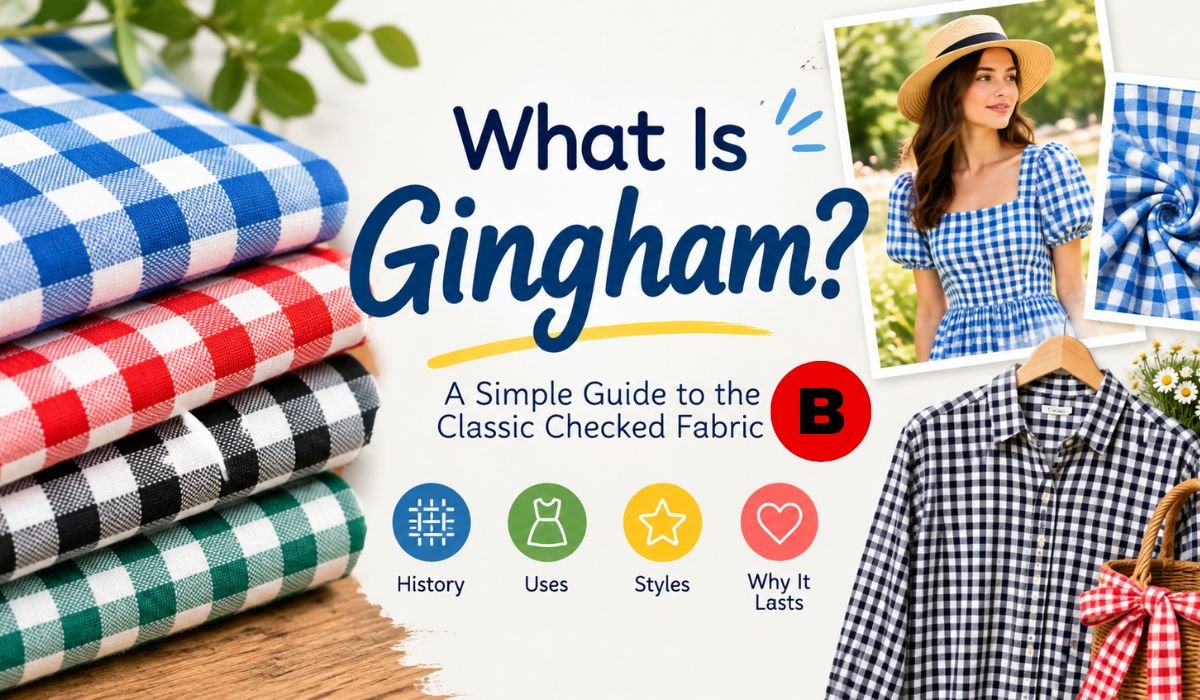
Gingham is one of those fabrics most people recognize at a glance, even if they couldn’t immediately explain what makes it Gingham. It might bring to mind a picnic tablecloth, a summer dress, a classic button-down shirt, or Dorothy’s familiar blue-and-white dress from The Wizard of Oz. But behind that simple checked appearance is a textile with a surprisingly long and varied history.
Traditionally, Gingham is a yarn-dyed, plain-weave fabric most commonly made from cotton or a cotton blend. Its familiar checks are formed during the weaving process rather than simply printed onto the finished fabric. Because the colored yarns are woven into the material, traditional Gingham has a balanced appearance that generally looks similar on both sides.
Although the pattern is often associated with casual clothing and country-style décor, Gingham has never been limited to either. It’s appeared in sophisticated fashion, formal garments, accessories, beachwear, and contemporary interiors. Its appeal comes partly from its simplicity: change the color, scale, fabric, or styling, and the same basic check can take on an entirely different personality.
This guide takes a closer look at what Gingham is, how it’s made, where the name may have come from, how it differs from plaid, and why this classic checked fabric continues to be used today.
Quick Bio Information: Gingham
| Gingham Fact | Information |
|---|---|
| Textile Type | Woven Fabric |
| Traditional Fiber | Cotton |
| Modern Construction | Cotton And Cotton-Blend Fabrics Are Common |
| Basic Weave | Plain Weave |
| Traditional Dye Method | Yarn-Dyed |
| Classic Design | Regular Checks |
| Earlier Forms | Striped And Checked Designs |
| Classic Color Combination | Blue And White |
| Another Traditional Combination | Red And White |
| Check Size | Small, Medium, And Large Scales |
| Traditional Appearance | Generally Similar On Both Sides |
| European History | Associated With International Textile Trade In The 17th Century |
| Later Manufacturing | Checked Gingham Was Produced In English Textile Mills |
| French Name | Vichy |
| Common Clothing Uses | Shirts And Dresses |
| Other Fashion Uses | Skirts, Jackets, Gowns, And Accessories |
| Home Uses | Tablecloths, Curtains, Upholstery, And Bedding |
| Construction Detail | Traditional Checks Are Created During Weaving |
| Printed Alternative | Gingham-Style Checks Can Be Printed Onto Other Fabrics |
| Famous Cultural Example | Dorothy’s Blue-And-White Gingham Costume In The Wizard Of Oz |
What Is Gingham?
Gingham is traditionally a cotton or cotton-blend textile made with a plain weave and yarns that are dyed before the fabric is woven. The yarns are arranged in the warp and weft directions to produce the familiar striped or checked appearance.
In classic checked Gingham, a colored yarn is commonly combined with a lighter yarn, often white. Where the colored yarns cross, the intersections appear deeper in color, creating the characteristic check pattern. This means a seemingly simple two-color fabric can actually display several shades as a result of the weaving process.
Gingham is often described simply as a checked fabric, but its construction is an important part of what traditionally defines it. Today, however, the word is also used for printed fabrics that imitate the familiar check. As a result, not every material that looks like Gingham is necessarily woven Gingham.
That distinction becomes especially useful when you’re buying fabric for sewing, clothing, upholstery, or other projects where the actual construction and fiber content matter.
What Does Gingham Fabric Look Like?
The classic Gingham Pattern is made up of evenly arranged squares or checks. Blue-and-white Gingham is probably the combination most people recognize, while red-and-white is another traditional choice. Modern versions can be found in a much wider range of colors.
The size of the checks can change the entire appearance of the fabric. Small checks tend to look delicate and traditional, while larger squares create a bolder, more noticeable effect. Designers can use this difference to make Gingham feel subtle, playful, dramatic, or contemporary.
Traditional woven Gingham also has a balanced appearance. Since its color comes from yarns woven into the material, rather than from a design printed onto only one surface, the fabric generally looks similar on both sides.
That combination of a simple grid, strong color contrast, and different check sizes gives Gingham its remarkable versatility. It’s recognizable without being restricted to one particular look.
How Is Gingham Fabric Made?
The story of Gingham starts with yarn rather than a finished piece of cloth. In traditional production, the yarns are dyed before they’re woven. The colored yarns are then arranged in the warp and weft and interlaced using a plain weave.
Plain weave is the most basic type of textile construction. The weft yarn passes over and under the warp yarns in a regular sequence. When differently colored yarns are arranged at consistent intervals in both directions, their intersections create the familiar Gingham checks.
This detail is particularly important when discussing Gingham Fabric. A material can carry a Gingham-style design without actually being made in the traditional way. A printed fabric, for example, may have the same visual appearance but a completely different construction.
Traditional Gingham has most commonly been associated with cotton because cotton works well for lightweight and everyday woven textiles. Modern Gingham products can also contain blends or other fibers, so it’s always worth checking the fabric label if fiber content is important to you.
In other words, appearance tells only part of the story. The yarn, weave, dyeing method, and fiber content can all affect how a particular Gingham fabric feels and performs.
What Colors And Patterns Does Gingham Come In?
Blue and white may be the most familiar Gingham combination, but the pattern certainly isn’t limited to those colors. Red, black, green, navy, pink, yellow, and many other shades can be used to create very different versions of the classic check.
Color has a major influence on the personality of the fabric. A pale pastel Gingham can feel soft and summery, while a dark navy or black check may appear more refined. Brighter colors can make the pattern feel playful and energetic.
Check size matters just as much. Small checks can blend into an outfit or room more easily, while oversized squares can become a strong focal point.
That’s part of the reason Gingham has managed to move so easily between different eras and design trends. The basic pattern stays recognizable, but color and scale allow it to evolve.
Where Does The Word “Gingham” Come From?
The origin of the word Gingham isn’t completely straightforward, and more than one explanation has been proposed over the years.
One widely cited explanation connects the English word with the Dutch gingang and, ultimately, the Malay word genggang, which was associated with the idea of something striped. This explanation is particularly interesting because early forms of the textile were associated with stripes rather than only the checked design that’s most familiar today.
Another theory connects the name with Guingamp, a town in Brittany, France. This explanation has appeared in historical discussions of Gingham, although it should be treated as an alternative theory rather than a settled fact.
There’s also a strong French connection to the textile’s name. In France, Gingham is commonly known as Vichy, or Vichy check.
The different names and theories reflect the fabric’s international history. Rather than belonging neatly to one place or tradition, Gingham developed within a much wider world of textile production and trade.
A Brief History Of Gingham
Gingham has a much longer history than its modern association with picnic cloths might suggest. Textile records connect its early history with Southeast Asian textiles that entered European markets during the 17th century.
Early versions were associated with striped designs, which helps explain why some historical descriptions of Gingham don’t match the familiar checked fabric seen today.
As textile manufacturing expanded in Europe, checked versions became increasingly important. By the 18th century, English textile manufacturers, particularly in and around Manchester, were producing checked Gingham.
The blue-and-white check eventually became one of the fabric’s most recognizable forms, although striped versions also continued to exist.
This history shows that Gingham didn’t suddenly appear as the picnic pattern we know today. Its appearance and use evolved over time, influenced by international textile trade, manufacturing, changing consumer preferences, and fashion.
Its straightforward construction also made it practical for everyday textiles, helping the material move from functional clothing and household goods into the wider world of fashion and design.
Why Is Gingham So Popular?
Gingham has an advantage that many patterns don’t: it’s simple enough to feel familiar, but flexible enough to keep changing.
Its regular checks add visual interest without creating the complexity associated with some larger or more elaborate patterns. That makes Gingham relatively easy to combine with solid colors and, when styled carefully, other prints.
Its versatility can be seen in both fashion and interiors. A Gingham Shirt might create a relaxed everyday look when worn with jeans, while a carefully tailored Gingham Dress can look polished and sophisticated. In a home, the same pattern can appear on a tablecloth, curtain, cushion, or upholstered chair.
The fabric’s long association with practical cotton clothing has also contributed to its approachable character. Yet designers have repeatedly shown that Gingham can be elevated through tailoring, unusual colors, larger checks, and more luxurious materials.
That ability to move between casual and sophisticated settings is a major part of its staying power.
Gingham Vs. Plaid: What’s The Difference?
Gingham and plaid are sometimes treated as interchangeable because both can involve intersecting lines. They aren’t quite the same, though.
Traditional Gingham generally has a straightforward, balanced structure, commonly created by using two colors in the warp and weft. The result is a regular check pattern with a relatively simple visual rhythm.
Plaid is a broader pattern category. It can contain several colors, stripes of different widths, and much more complicated arrangements. Tartan is another related pattern with its own distinct historical traditions.
The difference can become harder to spot in modern retail because the word Gingham is sometimes used loosely for printed check patterns. If you’re concerned about the actual textile rather than simply its appearance, check the product description for information about the weave, fiber content, and printing method.
Put simply, Gingham has a recognizable traditional structure, while plaid covers a much wider range of intersecting stripe and check designs.
How Is Gingham Used In Fashion?
Gingham has a long history in clothing, and shirts and dresses remain two of its most familiar applications. But that’s only part of the story.
Designers have used Gingham for skirts, jackets, trousers, gowns, capes, and other garments. The pattern can be subtle or dramatic depending on the size and color of the checks.
A small blue-and-white check might create a classic, understated look, while a large high-contrast pattern can become the main feature of an outfit.
Gingham also has a place beyond everyday clothing. Its association with Brigitte Bardot’s famous Gingham wedding dress helped demonstrate how the pattern could work in a romantic and highly fashionable setting.
The lesson is simple: Gingham itself doesn’t determine whether a garment looks casual or formal. Cut, fabric quality, color, scale, and styling all play a role.
How To Wear Gingham Casually
A Gingham Shirt is one of the easiest ways to add the pattern to an everyday wardrobe. It can be paired with jeans, trousers, or other simple pieces, creating an outfit that feels put together without requiring much effort.
A Gingham Dress can work in much the same way. Since the check already provides visual interest, the rest of the outfit can stay relatively uncomplicated.
Check size is one of the easiest things to consider when choosing casual Gingham. Smaller checks tend to be quieter, while larger checks naturally draw more attention.
Color can change the mood just as dramatically. Traditional blue-and-white or red-and-white versions have a familiar classic feel, while unexpected color combinations can make Gingham look much more contemporary.
How To Wear Gingham To Work
Gingham can also find a place in professional and smart-casual wardrobes, provided the garment and styling suit the workplace.
A well-fitted Gingham button-down shirt can be worn with trousers or slacks, while a structured Gingham Dress can provide a polished alternative to a solid-colored outfit.
For more conservative workplaces, smaller checks and restrained colors tend to create a quieter appearance. More relaxed environments may allow brighter colors or larger patterns.
The key is balance. Gingham already provides a repeating visual pattern, so simpler pieces can help keep the overall outfit coordinated.
This versatility is one reason Gingham shirts remain practical. Short-sleeve versions can suit warmer weather, while long-sleeve designs can transition more easily between seasons.
Can You Dress Up Gingham?
Gingham may have a casual reputation, but it can look surprisingly sophisticated when it’s used thoughtfully.
Brigitte Bardot’s Gingham wedding dress remains one of the most memorable examples. Its significance lies partly in how it challenged the idea that Gingham belonged only to everyday clothing or country-inspired styles.
Designers have also incorporated Gingham into gowns, capes, jackets, and other statement pieces. Once again, the pattern itself isn’t what determines the level of formality.
A refined silhouette, high-quality fabric, careful tailoring, and sophisticated color choice can give Gingham a completely different character. A structured Gingham jacket, for example, can feel worlds apart from a lightweight checked picnic shirt.
Gingham For Summer And Beachwear
Gingham has a natural connection with warm-weather fashion. Its clean checks work particularly well with relaxed seasonal clothing, which is why the pattern frequently appears on dresses, shirts, skirts, bathing suits, and beach accessories.
There’s an important technical distinction, however. A swimsuit or beach towel can have a Gingham Print without actually being made from woven Gingham Fabric.
In a printed material, the check is applied to the surface of an existing fabric. Traditional woven Gingham, by contrast, gets its pattern from colored yarns incorporated during the weaving process.
The difference may not be obvious when you’re simply looking at the finished product, but it can matter if you’re interested in texture, construction, durability, sewing properties, or fiber content.
How To Use Gingham Accessories
If wearing a full Gingham garment feels like too much, accessories provide an easy alternative.
Scarves, pocket squares, headbands, bags, and other small pieces can introduce the pattern without allowing it to dominate an outfit. This can be especially useful for someone who likes Gingham but prefers a more understated look.
The orderly nature of the pattern also makes it possible to experiment with mixing prints. A small Gingham accessory can work alongside another pattern when the colors and proportions are carefully coordinated.
Sometimes a little is enough. A Gingham headband or pocket square can add personality to an otherwise simple outfit without changing its overall character.
How To Use Gingham In Home Décor
Gingham has been part of home décor for generations, with tablecloths being perhaps its most familiar application. But the pattern can be used throughout a home, including on curtains, chair upholstery, bedding, cushions, kitchen textiles, and other decorative pieces.
Its regular geometry makes it relatively easy to coordinate with solid colors. The size and color of the checks can then be adjusted to suit the room.
Small, soft-colored checks can create a traditional and understated feeling, while large, contrasting checks can make a much stronger statement.
Gingham is especially useful when a room needs some pattern without the visual complexity of a heavily detailed print. It adds structure and character while remaining easy to work with.
Gingham In Popular Culture
Gingham’s connection with Dorothy in The Wizard of Oz is one of the most recognizable examples of the fabric in popular culture. Judy Garland’s Dorothy wore a blue-and-white checked Gingham pinafore in the famous 1939 film, helping turn the pattern into an instantly recognizable part of the character’s visual identity.
The costume’s influence goes beyond the film itself. Dorothy’s dress has become one of the most memorable examples of Gingham in popular culture and has helped reinforce the fabric’s nostalgic image for generations.
Yet Hollywood is only one small part of Gingham’s story. The textile’s broader history is tied to international trade, Asian textile traditions, European manufacturing, cotton production, and changing fashion.
That’s what makes Gingham particularly interesting. A pattern that now seems simple and familiar has connections reaching across countries, centuries, and very different areas of design.
Is Gingham Still Popular Today?
Gingham has managed to stay relevant because the pattern can change without losing its identity.
Designers can alter its colors, check size, fabric weight, and garment shape while keeping the basic visual character intact. That allows Gingham to move between casual shirts, summer dresses, tailored pieces, accessories, and more dramatic fashion designs.
The same flexibility applies to interiors. A traditional small check can create a very different effect from a large, high-contrast pattern, even though both are unmistakably Gingham.
Its popularity isn’t simply a matter of nostalgia. Gingham offers something practical: a recognizable pattern that’s easy to coordinate and adaptable to different tastes.
That balance between familiarity and flexibility is one of the main reasons it continues to appear in fashion and interior design.
Final Thoughts On Gingham
Gingham may look like a straightforward checked fabric, but there’s considerably more to it than meets the eye. Traditional Gingham is a yarn-dyed, plain-weave textile, most commonly associated with cotton, with its characteristic checks created by the arrangement of colored yarns during weaving.
Its history is equally interesting. The textile is connected with international trade and Southeast Asian textile traditions, while European manufacturing helped establish the checked forms that became increasingly familiar. Over time, Gingham moved from practical everyday textiles into fashion, home décor, popular culture, and even formal clothing.
For anyone trying to identify genuine Gingham, the most useful clues are its regular check, traditional yarn-dyed construction, and plain weave. For anyone interested in fashion or decorating, its greatest strength may simply be its flexibility.
The same basic check can look casual on a shirt, romantic on a dress, sophisticated in a tailored garment, cheerful on a tablecloth, or modern in an interior. Few patterns can move between those settings so easily.
That adaptability is ultimately what has kept Gingham relevant. Its design is simple, but it never has to look the same.
FAQs About Gingham
What Is Gingham Made Of?
Traditional Gingham is most commonly associated with cotton or cotton-blend yarns. It’s generally made with a plain weave, with the yarns dyed before weaving so that their arrangement creates the characteristic checked or striped design.
Modern fabrics marketed as Gingham can contain different fibers, so checking the fabric label is the best way to determine the actual composition of a particular product.
Is Gingham A Fabric Or A Pattern?
It can be both. Traditionally, Gingham describes a yarn-dyed woven textile with a characteristic checked or striped design. In modern fashion and retail, however, the term is also commonly used for the visual pattern itself.
As a result, a fabric can have a Gingham-style print without being traditional woven Gingham.
Is Gingham The Same As Plaid?
No. Traditional Gingham generally has a simpler and more balanced check structure, often created using two main colors. Plaid is a broader category that can include several colors, intersecting stripes, and patterns of different widths.
Some modern Gingham designs may resemble plaid, but the traditional constructions and pattern structures are different.
Why Does Traditional Gingham Look Similar On Both Sides?
Traditional Gingham gets its pattern from dyed yarns woven into the fabric rather than from a design applied only to the surface. Because the colors are part of the woven structure, both sides generally show a similar arrangement.
This is one of the useful characteristics that can help distinguish traditional woven Gingham from some printed fabrics.
What Colors Does Gingham Come In?
Blue and white and red and white are among the most familiar combinations, but Gingham can be produced in many colors. Black, green, navy, pink, yellow, and pastel shades are all possible.
Color has a major effect on how the finished pattern looks, so modern Gingham can range from soft and understated to bright and bold.
Can Gingham Be Formal?
Yes. Although Gingham is often associated with casual clothing, it has also been used for sophisticated dresses, gowns, jackets, capes, and other fashion pieces.
The final appearance depends on factors such as fabric quality, tailoring, silhouette, color, and check size. A carefully designed Gingham garment can look very different from a casual cotton shirt.
Is Printed Gingham Real Gingham?
Not necessarily. A printed Gingham-style fabric may look almost identical to woven Gingham, but the construction is different.
Traditional Gingham gets its pattern from colored yarns woven into the cloth. Printed Gingham has the check applied to the surface of another fabric. The distinction can matter when considering texture, durability, sewing behavior, and fiber composition.
Why Is Gingham Still Popular?
Gingham remains popular because it’s simple, recognizable, and remarkably adaptable. The pattern works across clothing, accessories, beachwear, and home décor, while different colors and check sizes allow designers to give it very different personalities.
Its long history also gives it a sense of familiarity, but its basic design is flexible enough to be continually reinterpreted. That’s why Gingham can feel classic without being confined to the past.
Learn more and explore exciting content on: Ron Jeremy: Biography, Career, Early Life, and Personal Story
 IQ newswire