

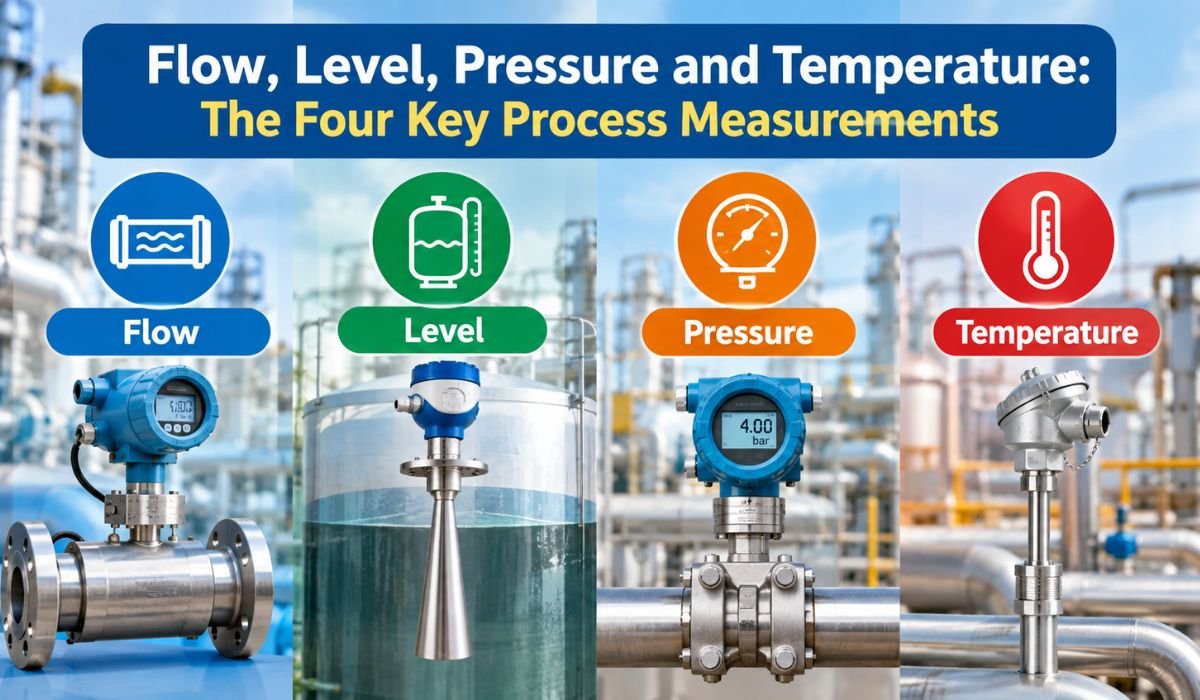
On a production line, a few measurements tell you a lot about what is happening in the process. Four you will see almost everywhere are:
- Flow — the amount of liquid, gas, or steam passing through a pipe.
- Level — how much material is inside a tank or vessel.
- Pressure — the pressure inside a pipe, tank, or other equipment.
- Temperature — how hot or cold the process medium is.
These numbers help operators spot changes and adjust the process when needed. For example, low flow may mean a pump needs checking, while a high tank level may mean filling needs to stop.
The measurements can also affect each other. Heating a liquid can change its pressure. Opening or closing a valve can change both flow and pressure.
There are several ways to take these measurements:
- For flow, common options are Coriolis, electromagnetic, ultrasonic, vortex, and thermal mass meters.
- Level can be measured using radar, ultrasonic, capacitive, or hydrostatic methods.
- Pressure is commonly checked with gauges and pressure transmitters.
- An RTD, thermocouple, thermistor, or infrared sensor can be used to measure temperature.
Which instrument fits the job depends on the process medium, operating range, and conditions at the measurement point.
Why Process Measurement Matters in Industrial Automation
A control system needs measurements to know what is happening in the process. Sensors and instruments continuously check variables such as flow, level, pressure, and temperature and send the readings to a PLC, DCS, or another controller.
The basic process looks like this:
Process → Sensor/Instrument → Signal → Controller → Control Element → Process Adjustment
For example, a temperature sensor detects that a process is getting too hot. The controller receives the signal and can reduce heating or open a cooling valve.
Process instruments, including equipment from Endress+Hauser, are commonly used for:
- Monitoring — showing operators what is happening in pipes, tanks, and equipment.
- Closed-loop control — automatically adjusting valves, pumps, heaters, or other equipment when a measured value changes.
- Alarms — warning operators when a value moves outside its normal range.
- Process optimization — helping keep production stable while reducing unnecessary use of energy or materials.
- Equipment protection — detecting conditions such as high pressure, overheating, or low liquid level before they cause damage.
Bad measurements can create problems even when the rest of the equipment is working correctly. A wrong reading may cause the controller to make the wrong adjustment, affecting product quality, energy use, production speed, or equipment safety.
The Four Key Process Variables at a Glance
Flow, level, pressure, and temperature describe different parts of a process. Here is a quick comparison:
| Variable | What It Measures | Common Units | Typical Instruments |
| Flow | Movement of liquid, gas, or steam | m³/h, L/min, kg/h | Flow meter |
| Level | Amount/height of material in a vessel | mm, m, %, volume | Level transmitter |
| Pressure | Force per unit area | bar, Pa, psi | Pressure transmitter |
| Temperature | Thermal condition | °C, °F, K | RTD, thermocouple, transmitter |
The instrument has to fit the actual process. What works for clean water may not work for steam, gas, chemicals, or a thick liquid. The medium, pressure, temperature, accuracy needed, installation conditions, and purpose of the measurement all affect the choice.
Flow Measurement
Flow measurement tells us how much liquid, gas, or steam is moving through a process. In most cases, the measurement is taken in a pipe and used to see whether the right amount of material is passing through.
Flow can be measured in two main ways:
- Volumetric flow — measures the volume passing through a point over time, such as L/min or m³/h.
- Mass flow — measures the actual mass moving through the system, usually in units such as kg/h.
Flow readings are used for many everyday process tasks. A plant may need them to dose an ingredient, fill a batch, monitor water or compressed air use, calculate energy consumption, or adjust a process automatically.
For example, if a production step requires 100 liters of liquid, the flow meter can track how much has entered the process. Once the required amount is reached, the control system can close a valve or stop a pump.
Common Flow Measurement Technologies
There are several ways to measure flow, and each technology works better with certain media and process conditions.
- Electromagnetic flow meters — used for conductive liquids such as water, wastewater, and many chemical solutions. They have no moving parts in the flow path.
- Coriolis flow meters — measure mass flow directly and can be used with both liquids and gases. They can also provide density measurement.
- Ultrasonic flow meters — use sound waves to measure flow. Depending on the design, they can work with liquids or gases. Clamp-on versions can measure flow without cutting into the pipe.
- Vortex flow meters — commonly used for liquids, gases, and steam. They measure the vortices created as the medium passes a bluff body inside the meter.
- Thermal mass flow meters — mainly used for gases. They measure mass flow based on heat transfer between the sensor and the moving gas.
- Differential-pressure flow measurement — uses the pressure difference created by a restriction such as an orifice plate or Venturi tube. It is used across a wide range of industrial processes.
What Affects Flow Measurement?
A flow meter that works well in one process may perform poorly in another. Before choosing one, check:
- fluid type;
- conductivity;
- viscosity and density;
- process temperature and pressure;
- solids or gas bubbles in the medium;
- pipe diameter;
- expected flow range and flow profile;
- available installation space and required straight pipe runs.
Some of these factors matter more for certain technologies. An electromagnetic meter, for example, needs a conductive liquid. Gas bubbles or solids may affect some measurement methods, while a poor flow profile can reduce measurement accuracy.
Field Insight:
“Don’t choose a flow meter from pipe size alone. Start with the medium, flow range, pressure, temperature, required accuracy, and installation conditions.”
Level Measurement
Level measurement shows how much liquid or bulk material is inside a tank, vessel, silo, or other container. It helps operators know when a tank needs filling, when it is getting too full, or how much product is available.
There are two basic ways to measure level:
- Continuous level measurement — gives a reading across the full measuring range. For example, it can show that a tank is 35%, 60%, or 90% full.
- Point-level measurement — detects when the material reaches a specific point. It is often used for high- or low-level alarms.
Common Level Measurement Technologies
The technology depends on the material in the tank and the conditions inside it.
- Radar — provides non-contact measurement and is widely used for liquids and bulk solids in tanks and vessels.
- Guided wave radar — sends a radar signal along a probe and provides continuous level measurement.
- Ultrasonic — measures the distance to the material using sound waves without contacting it.
- Hydrostatic — calculates liquid level from the pressure created by the liquid above the measuring point.
- Capacitive — detects changes in capacitance and can be used with liquids or bulk materials, depending on the application.
- Float — follows the surface of a liquid as the level rises or falls.
- Vibrating fork — commonly used as a point-level switch to detect whether liquid or bulk material has reached a set position.
What Affects Level Measurement?
The measuring range is only one part of choosing a level instrument. What is happening inside the tank can be just as important.
Check factors such as:
- liquid or bulk solid;
- dielectric properties of the material;
- foam on the liquid surface;
- vapor inside the vessel;
- dust from bulk solids;
- tank shape and internal structures;
- agitators or other moving equipment;
- process temperature and pressure;
- changes in liquid density.
For example, foam or vapor may interfere with some measuring methods, while an agitator can create an uneven surface. Density changes can affect hydrostatic measurements because this method calculates level from pressure.
For this reason, the instrument should be selected for the actual tank conditions, not simply the tank height or required measuring range.
Pressure Measurement
Pressure tells us how much force a liquid or gas applies over a certain area. It is one of the basic measurements used to check whether industrial equipment is operating normally.
Pressure is commonly monitored in:
- pipelines;
- pumps and compressors;
- tanks and pressure vessels;
- filters;
- hydraulic systems;
- pneumatic systems.
Pressure readings can also tell us something about other process variables. For example, pressure can be used to calculate liquid level in a tank or flow through a restriction in a pipe.
Types of Pressure Measurement
There are three common ways to measure pressure:
- Gauge pressure — pressure measured relative to atmospheric pressure. This is the type commonly used for compressed-air and many industrial pressure readings.
- Absolute pressure — pressure measured relative to a perfect vacuum.
- Differential pressure — the difference in pressure between two points in a process.
The right type depends on what you actually need to know. Sometimes the pressure at one point is enough. In other applications, the difference between two points provides more useful information.
Common Pressure Instruments
Several types of instruments are used for pressure measurement:
- Pressure gauges — provide a local pressure reading that an operator can see directly.
- Pressure sensors — detect pressure and convert it into an electrical signal.
- Pressure transmitters — measure pressure and send a standardized signal to a PLC, DCS, or other control system.
- Differential-pressure transmitters — measure the pressure difference between two points.
A differential-pressure transmitter, for example, can be installed across a filter. As dirt builds up in the filter, the pressure drop increases. A rising differential-pressure reading can therefore show that the filter is becoming clogged and may need cleaning or replacement.
What Affects Pressure Measurement?
Before selecting a pressure instrument, check the actual process conditions:
- Pressure range — the instrument needs to cover the normal operating range.
- Overpressure — temporary pressure spikes should not damage the sensor.
- Temperature — both process and ambient temperatures can affect the instrument.
- Process medium — water, steam, oil, gas, and chemicals may require different materials.
- Pulsation — pumps and compressors can create rapidly changing pressure.
- Vibration — machine vibration can affect readings and instrument life.
- Diaphragm and seal materials — wetted parts need to be compatible with the process medium.
- Connection type — the process connection must fit the installation.
- Required accuracy — some applications need tighter measurement tolerances than others.
A pressure transmitter should therefore be chosen for the conditions at the measurement point, not just the normal pressure shown on the system specification.
Applications Across Process Industries
Flow, level, pressure, and temperature are measured across many industries. The equipment may be different, but these four variables are often needed to keep the process under control.
Chemical Processing
Chemical plants use process measurements throughout production:
- Flow — dosing chemicals and controlling feed rates.
- Level — checking storage tanks and process vessels.
- Pressure — monitoring reactors, pumps, and pipelines.
- Temperature — keeping chemical reactions within the required range.
Water and Wastewater
Water treatment systems need measurements at different stages of collection, treatment, and distribution:
- Flow — measuring water moving through pipes and treatment lines.
- Level — checking tanks, reservoirs, and basins.
- Pressure — monitoring pumps and distribution lines.
- Temperature — checking water and process conditions.
Food and Beverage
Here, measurements are used during mixing, filling, heating, cooling, and storage:
- Flow — controlling ingredients during batching and filling.
- Level — monitoring product in tanks and vessels.
- Pressure — checking processing and transfer lines.
- Temperature — controlling heating, cooling, and other temperature-sensitive steps.
Oil and Gas
Oil and gas facilities work with liquids and gases under a wide range of operating conditions:
- Flow — measuring liquid and gas movement.
- Level — monitoring separators, tanks, and other vessels.
- Pressure — checking pipelines and process equipment.
- Temperature — tracking conditions throughout the process.
Power and Energy
Power plants rely heavily on process instrumentation, especially in steam and water systems:
- Flow — measuring steam, feedwater, and other process fluids.
- Level — monitoring drums, tanks, and vessels.
- Pressure — checking steam and water pressure.
- Temperature — monitoring boilers, steam lines, and other process equipment.
Pharmaceutical Manufacturing
Pharmaceutical processes often need close control of operating conditions:
- Flow — dosing liquids and controlling ingredient addition.
- Level — monitoring storage and process vessels.
- Pressure — controlling pressure in vessels and process lines.
- Temperature — keeping temperature-sensitive production steps within the required range.