

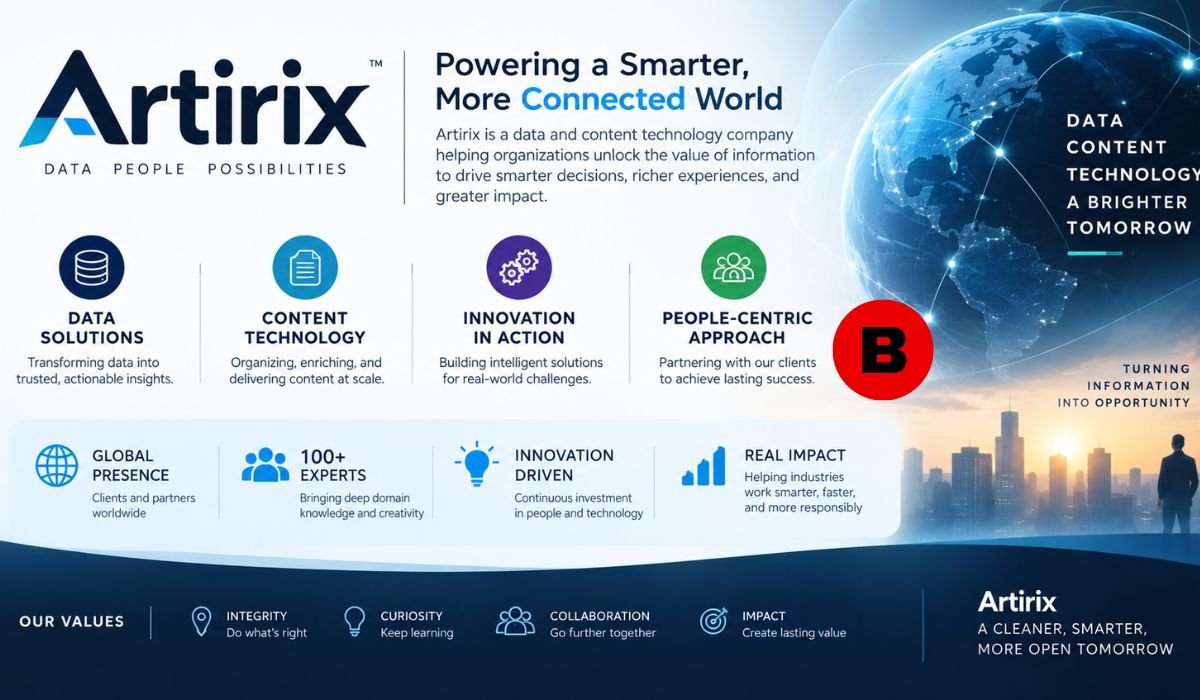
Artirix is a UK technology company with a history rooted in Search Technology, Data, Content, and Information Technology Consultancy. Its work has been particularly relevant to businesses that need to collect large volumes of information, improve that information, make it easier to search, and turn it into useful digital services.
Public descriptions of Artirix have linked the company with Classifieds, Directories, Vertical Search, Business Information, Content Aggregation, Big Data, and large-scale Search. Historical project information has also connected the company with digital products in areas such as Publishing, Real Estate, and Travel.
There is, however, an important point to keep in mind when researching Artirix in 2026. Information about the company comes from a mix of current corporate records, older business directories, professional profiles, and historical project descriptions. Those sources don’t always provide the same details. The UK legal entity, Artirix Ltd, company number 07111468, is currently listed as active, with its registered office at 1 Fore Street Avenue, London, EC2Y 9DT.
That distinction helps put the company’s story into context without presenting older estimates or historical descriptions as if they were current company disclosures.
Quick Bio Information
| Company Information | Details |
|---|---|
| Company Name | Artirix Ltd |
| Company Number | 07111468 |
| Legal Status | Active |
| Incorporation Date | December 22, 2009 |
| Commonly Reported Founding Year | 2010 |
| Registered Office | 1 Fore Street Avenue, London, EC2Y 9DT |
| Business Classification | Information Technology Consultancy Activities |
| SIC Code | 62020 |
| Previous Name | Globane Limited |
| Company Type | Private Limited Company |
| Core Technology Areas | Data, Content, Search, And Software |
| Platform Concept | Feed, Enrich, Search, Monetise, And Analyze |
| Historical Applications | Classifieds, Directories, Vertical Search, And Search-Based Services |
| Known Project Connections | WSJ Real Estate And Teletext Holidays |
| Reported Customers/Business Connections | Dow Jones, WSJ, Euromoney, Teletext Holidays, DMGT, And Reed Business |
| Current Registered Director | Dr Daniel James Lee |
| Accounts Last Made Up To | December 31, 2024 |
| Previous Company Name Period | Globane Limited Until May 26, 2010 |
What Is Artirix?
Artirix has historically positioned itself around a straightforward but important challenge: helping businesses get more value from their Data and Content.
Its platform concept can be summed up in five words: Feed, Enrich, Search, Monetise, and Analyze. In practical terms, that means bringing information into a system, improving and organizing it, making it easier to find, creating opportunities to generate commercial value from it, and using analysis to understand what the information can tell a business.
That approach makes particular sense for information-heavy websites. A Classifieds Platform, Business Directory, Travel Search Engine, Publisher, or specialized Search Service might deal with thousands or even millions of records. Storing those records is only part of the job. Customers need relevant results, businesses need reliable data, and information often has to be updated or enriched continuously.
Artirix’s historical descriptions reflect precisely this type of challenge, particularly in relation to Search-Based Web Businesses, Classifieds, Directories, and Vertical Search.
The corporate information above is based primarily on UK company records rather than directory estimates. Companies House information identifies Artirix Ltd as active and supports its company number, incorporation date, registered office, business classification, and current directorship information.
Artirix was incorporated on December 22, 2009, under the name Globane Limited before changing its name to Artirix Limited in May 2010. The company is registered under SIC code 62020, covering Information Technology Consultancy Activities.
Artirix And Data Intelligence
Data Intelligence is an important part of the Artirix story because having large amounts of information isn’t particularly useful if a business can’t organize, retrieve, or understand it.
Companies often collect information from numerous sources. That data may need to be structured, processed, enriched, indexed, and analyzed before it can support a useful customer-facing service. When those processes work together, organizations can build better digital products while making their information easier for both customers and internal teams to use.
Historical material connected with Artirix describes a Big Data Platform intended for Analytics and large-scale Search. A professional recommendation from a former Artirix-related executive also describes the platform’s APIs and administrative tools as helping development teams build applications while reducing some of the risks and effort associated with taking a completely open-source approach.
That evidence gives a more useful picture of Artirix than simply calling it a generic software business. Its technology history is closely tied to the practical problems involved in handling information at scale.
Data Enrichment And Information Quality
Data Enrichment is essentially about making existing information more useful by adding structure, context, classifications, or related data.
The need becomes obvious when dealing with large datasets. Consider a travel company with thousands of hotel records gathered from different sources. The same property could appear under slightly different names, contain incomplete details, or be duplicated across datasets. Before customers can search that information effectively, the records need to be cleaned and organized.
Historical project information associated with Artirix provides a real-world example. A professional profile states that Artirix supplied federation technology to Teletext Holidays along with a cleansed set of hotel records.
That example shows why Data Enrichment isn’t simply a technical buzzword. The quality of the underlying data can have a direct impact on how useful and reliable a customer’s Search experience becomes.
Artirix Search Technology
Search Technology has long been one of the strongest themes in Artirix’s public history.
A 2012 report from Travolution described Artirix co-founder and chief executive Dr Daniel Lee as specializing in next-generation Search Technology. The report also connected Lee’s role at Artirix with Teletext Holidays and highlighted his earlier experience with the property Search Engine Globrix.com.
The importance of Search becomes clear when a business manages a large information database. Users don’t want to browse through thousands of records manually. They expect relevant results, useful filters, fast responses, and information that closely matches what they’re looking for.
Artirix’s historical work with WSJ Real Estate provides another example. A professional project description identifies an end-to-end platform for a subscription-based WSJ real estate portal.
Taken together, these examples help explain Artirix’s technology focus more clearly than a generic list of software categories. Search has historically been central to the kinds of digital products the company worked on.
Content Aggregation And Management
Content Aggregation involves bringing information from different sources together so it can be organized, searched, and presented through a single digital service.
That sounds simple until the volume and variety of information increase. Publishers, travel companies, directories, marketplaces, and information providers may receive data in different formats. Records can be duplicated, descriptions can vary, and information may need additional processing before it is ready for customers.
This is where the Feed and Enrich concepts associated with Artirix become particularly relevant. Information first needs to enter the system, but simply collecting it isn’t enough. It must then be organized and improved before Search, Analysis, or Monetization can deliver meaningful results.
The broader lesson is straightforward: good Search depends heavily on good underlying information. Even the most attractive Search interface can’t completely compensate for incomplete, inconsistent, or poorly structured data.
Classifieds And Marketplaces
Classifieds and Consumer Marketplaces are natural applications for Search and Data Enrichment because they can contain huge numbers of listings that change frequently.
A marketplace might include property listings, vehicles, jobs, travel offers, or other products and services. Each listing can have its own categories, locations, descriptions, prices, images, and dates. Keeping all those details consistent and searchable is a significant technology challenge.
Artirix’s historical positioning specifically included Classifieds, Directories, and Vertical Search. That makes the company particularly interesting in situations where Search isn’t simply another feature but a core part of the product itself.
For these businesses, effective Data Search can make the customer journey much smoother. Instead of navigating through an enormous database, users can narrow the information down to the records that are most relevant to their needs.
Data Monetization And Business Value
The word Monetise in Artirix’s platform description points toward a larger business question: how can organizations create commercial value from the information they collect?
Data Monetization can take many forms. Depending on the business, information might support subscription products, premium databases, targeted advertising, lead generation, marketplaces, specialized research services, or Business Intelligence tools.
Artirix shouldn’t be presented as guaranteeing any particular financial outcome. The more accurate interpretation is that its platform concept recognizes the commercial potential of well-organized Data and Content.
Technology can make information easier to process, search, and analyze, but the actual business result depends on much more, including the company’s audience, business model, market, implementation, content quality, and execution.
Business Information And Meta Search
Business Information services depend heavily on the ability to organize and retrieve large collections of data.
A Business Directory, for example, might contain company names, locations, categories, descriptions, contact information, and other attributes. For users, the value of that database depends largely on how quickly and accurately they can find what they need.
Meta Search extends this concept by bringing information from multiple sources into a broader Search experience.
Artirix’s historical association with Information Retrieval and Search-Based Web Businesses makes this area particularly relevant to its technology heritage. Search, in this context, isn’t simply a box placed on a webpage. It’s part of the infrastructure that allows an information product to function.
Customers And Industry Connections
Artirix has been associated in supplied company material with organizations including Dow Jones, The Wall Street Journal, Euromoney, Teletext Holidays, DMGT, and Reed Business.
Some of those historical relationships have additional supporting evidence. In 2012, Travolution reported that Dr Daniel Lee, then chief executive and co-founder of Artirix, had joined the board of Teletext Holidays. The report described Lee’s background in Search Technology and online businesses.
Professional project information also identifies Artirix’s work on Teletext Holidays and WSJ Real Estate. In the Teletext Holidays project, Artirix is described as supplying federation technology and a cleansed set of hotel records. The WSJ Real Estate project is described as an end-to-end platform for a subscription-based real estate portal.
These examples are valuable because they illustrate the types of information-intensive environments in which Artirix’s technology has historically been used.
At the same time, historical customer or project references shouldn’t automatically be interpreted as evidence that every organization remains a current Artirix customer in 2026.
Technology And Software Capabilities
Third-party directories have associated Artirix with technologies such as JavaScript and HTML, but those listings shouldn’t be treated as a complete or current technology stack.
More useful evidence comes from historical project and professional material. Public information associated with Artirix describes APIs, administrative tools, Big Data capabilities, Analytics, and large-scale Search. A professional recommendation specifically describes the Artirix Big Data Platform as supporting complex analytics applications and large-scale Search projects.
The same source highlights APIs and administrative tools that developers found useful when building applications on the platform.
Other publicly available professional material has associated Artirix development work with technologies such as Ruby on Rails and Python. However, those references describe particular projects or periods and shouldn’t be interpreted as a definitive statement of the company’s current technology stack.
The safest conclusion is that Artirix has a technology history rooted in Web Software, Search, Data Processing, APIs, Analytics, and information-heavy digital platforms.
Artirix’s Company History And Current Status
Artirix Ltd was incorporated in the UK on December 22, 2009, under company number 07111468. Its previous legal name was Globane Limited, which changed to Artirix Limited in May 2010. UK company information currently lists Artirix Ltd as active.
The company is classified under SIC code 62020, which covers Information Technology Consultancy Activities. Its current registered office is listed at 1 Fore Street Avenue, London, EC2Y 9DT.
These details matter because older online sources may display different addresses or corporate information. When sources conflict, current corporate records are the more appropriate reference for legal status and registered-office information.
Companies House also makes clear that its public register provides company information but doesn’t itself check the accuracy of information filed by companies. That is another reason to distinguish official registry information from independently verified descriptions of products, customers, or technology.
Financial And Employee Information
Online business directories have published estimates for Artirix’s revenue and employee count, including a reported revenue figure of around $7 million. Those figures shouldn’t be presented as confirmed current financial information without stronger evidence.
The employee figures found across third-party sources also vary. For example, one current business-data source reports zero employees in its 2024 filing-derived data, while another older database lists six employees. Inc. has historically listed Artirix in the 11–50 employee range and recognized the company on its 2015 Inc. 5000 list.
These differences demonstrate why employee counts from business directories should be treated cautiously. They may reflect different reporting periods, filing methods, or definitions of employees.
For an accurate company profile, it’s better to acknowledge those discrepancies than select one number and present it as definitive.
The same principle applies to estimated revenue, Web Rank, technology counts, and directory-generated competitor lists. Such data can provide useful clues, but it isn’t equivalent to audited financial statements, official company disclosures, or current product documentation.
Competitors And The Wider Market
Some business directories identify companies such as Adobe, InVision, Sketch, Axure Software Solutions, Marvel, and UXPin as Artirix competitors. That list needs to be treated carefully, though.
Those companies don’t necessarily compete with Artirix across the same products, technologies, or customer segments. Artirix’s historical specialization is more closely associated with Search Technology, Data Platforms, Classifieds, Directories, Information Retrieval, and content-heavy digital services.
For someone evaluating Artirix or another technology provider, a more useful comparison would focus on actual business requirements. Search relevance, Data Enrichment, Content Aggregation, APIs, Analytics, scalability, integrations, security, implementation, support, and total cost are far more meaningful comparison points than a generic competitor list.
What Makes Artirix Useful?
The most interesting part of Artirix isn’t necessarily one individual technology. It’s the way several capabilities fit together.
Information can be fed into a system, enriched, searched, analyzed, and potentially turned into a commercial service. That integrated model can be particularly useful when information itself is central to the product.
A Publisher may need to organize a large collection of articles. A Travel Website may need to normalize hotel information. A Classifieds Platform may have to process thousands of listings. A Business Information provider may need fast retrieval across a large database.
The underlying challenge is similar in each case: turn large volumes of information into something useful, accessible, and commercially valuable.
That’s where the Feed, Enrich, Search, Monetise, and Analyze model provides a helpful way of understanding Artirix’s historical proposition.
What Should Businesses Consider?
Businesses evaluating a Search or Data Platform should look beyond a simple feature list.
The right solution depends on the organization’s data sources, Search requirements, expected traffic, integrations, security needs, development resources, budget, and long-term plans. It also matters how information is ingested, how often it can be updated, how Search relevance is managed, and how the system performs as datasets grow.
For Artirix specifically, current product offerings should be verified directly before a purchasing decision is made. Much of the publicly available information about the company’s technology dates from earlier stages of its history, while current corporate records confirm that Artirix Ltd remains active.
That doesn’t diminish the value of the company’s historical record. It simply gives readers a more accurate basis for understanding what is documented about Artirix and what would require current confirmation.
Final Thoughts
Artirix is best understood as a technology company with a long-standing connection to Data, Content, Search, and Information Technology.
Its history shows how these areas can come together in practical digital products, including Search-Based Web Businesses, Classifieds, Directories, Travel Services, and Publishing Platforms. Professional project information connects Artirix with Teletext Holidays and WSJ Real Estate, while industry reporting has highlighted the company’s Search Technology background.
The company’s five-part concept of Feed, Enrich, Search, Monetise, and Analyze provides a useful framework for understanding its broader technology proposition. Rather than focusing on one isolated software feature, the model looks at the entire information journey, from getting data into a system to making it useful and potentially creating business value from it.
At the same time, a trustworthy profile needs to separate historical project information from current claims and distinguish official corporate records from third-party estimates. That distinction is especially important when discussing revenue, employee numbers, addresses, customers, or technology stacks that may have changed over time.
For readers researching Artirix in 2026, the clearest picture is therefore a balanced one. Artirix Ltd has an established history in Search and information technology, its UK legal entity remains active, and public evidence documents work involving data-intensive digital products.
FAQs About Artirix
What Is Artirix?
Artirix Is A UK Technology Company Associated With Data, Content, Search, And Information Technology Consultancy. Its Historical Platform Concept Centers On Feeding, Enriching, Searching, Monetizing, And Analyzing Information.
When Was Artirix Founded?
Artirix Is Commonly Described As Founded In 2010, But The UK Legal Entity, Artirix Ltd, Was Incorporated On December 22, 2009. Its Previous Name Was Globane Limited Before The Company Changed Its Name To Artirix Limited In May 2010.
What Does Artirix Do?
Artirix Has Historically Developed Technology For Information-Heavy Digital Businesses. Its Areas Of Focus Have Included Search, Data Processing, Data Enrichment, Classifieds, Directories, Vertical Search, Content Aggregation, Analytics, And Business Information.
Where Is Artirix Based?
Artirix Ltd Is Registered In London, United Kingdom. Current Company Information Lists Its Registered Office At 1 Fore Street Avenue, London, EC2Y 9DT. Older Online Sources May Show Different Addresses, So The Current Corporate Record Is The Better Reference.
Has Artirix Worked With Major Companies?
Publicly Available Historical Material Associates Artirix With Organizations Including Dow Jones, The Wall Street Journal, Euromoney, Teletext Holidays, DMGT, And Reed Business. Professional project information specifically identifies work involving Teletext Holidays And WSJ Real Estate.
Is Artirix A Search Technology Company?
Search Technology Has Been A Major Part Of Artirix’s Historical Identity. A 2012 industry report described Artirix co-founder Dr Daniel Lee in connection with next-generation Search Technology and noted his appointment to the Teletext Holidays board.
Does Artirix Work With Big Data?
Historical professional material describes an Artirix Big Data Platform used for Analytics and large-scale Search projects. It also references APIs and administrative tools designed to help development teams build applications on the platform.
Is Artirix Still Active?
Yes. Current UK company information lists Artirix Ltd, company number 07111468, as an active company. Its registered business activity is Information Technology Consultancy Activities under SIC code 62020.
Learn more and explore exciting content on: FintechZoom.com: A Complete Guide to Its Markets, Crypto, and Finance Coverage
 Apex Apex
  IQ newswire
  Sky Bloom IT