

Artificial intelligence is transforming customer service by helping businesses respond to inquiries faste automate repetitive tasks and deliver more consistent support.
From answering frequently asked questions to categorizing support tickets and assisting agents with complex cases AI can improve operational efficiency while creating better customer experiences.
However successful AI implementation requires more than installing a chatbot or connecting a language model to a help center.
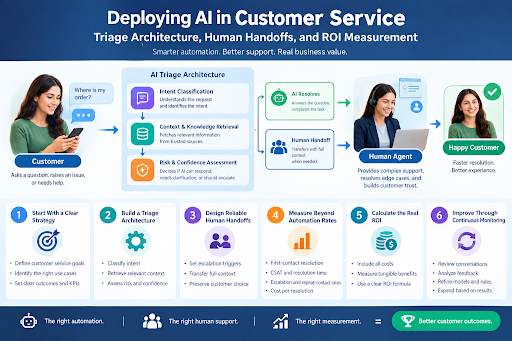
Businesses need a reliable triage architecture clearly defined escalation rules effective human handoffs, and a measurable return on investment ROI.
Without these foundations automation may increase frustration produce inaccurate responses or transfer unresolved problems to human agents without the necessary context.
A practical implementation strategy begins by identifying the right use cases, designing clear decision pathways, and measuring outcomes throughout the customer support journey.
1. Start With a Clear Customer Service Strategy
Before deploying AI, organizations should identify the customer service problems they want to solve.
Common priorities include reducing response times, managing high ticket volumes, improving first-contact resolution, and helping agents handle complex requests more efficiently.
Not every support interaction should be automated.
Routine questions about shipping account access product features and business hours are often suitable for AI assistance.
By contrast, sensitive complaints, complicated billing disputes account security incidents and situations requiring policy exceptions may need human judgment.
Businesses should evaluate each use case according to its frequency complexity risk and potential business value.
This prevents teams from investing in automation simply because a particular technology is available.
A useful starting point is to define the desired outcome for each use case.
For example an organization might aim to reduce the time required to resolve order-status inquiries without lowering customer satisfaction.
This creates a measurable objective against which the implementation can be evaluated.
Organizations planning their first deployment can benefit from guidance on choosing an AI project and defining decision criteria. Establishing the decision required evidence and success criteria before selecting a model helps teams focus on business outcomes instead of technical novelty.
2. Build an Effective AI Triage Architecture
AI triage is the process of understanding an incoming customer request, determining its urgency and complexity, and directing it toward the most appropriate resolution path.
An effective architecture usually combines several components.
Intent Classification
The first step is identifying what the customer needs. Natural language processing and large language models can interpret messages written in everyday language and classify them into categories such as technical support, billing, order tracking, returns, and account management.
Accurate classification helps prevent customers from navigating complicated menus or repeatedly explaining their concerns. When the system cannot confidently determine the intent, it should request clarification or route the conversation to a human agent.
Context and Knowledge Retrieval
After identifying the request, the system should retrieve relevant information from approved knowledge sources, customer records, and connected business applications.
For example, a customer asking about a delayed order may need an answer based on the latest shipping information rather than a generic explanation of delivery policies. Connecting AI to reliable, current information improves relevance and reduces the risk of misleading responses.
Access should be controlled through appropriate authentication and permissions. The system should retrieve only the information needed to address the request.
Risk and Confidence Assessment
Not all customer requests carry the same level of risk. Businesses should define rules that determine whether AI can respond independently, should seek clarification, or must escalate the issue.
Low-risk, well-documented requests may be suitable for automated resolution. Requests involving sensitive information, uncertain answers, financial adjustments, or exceptions to established policies may require human review.
Confidence scores can help inform these decisions, but they should not be treated as guarantees of accuracy. Organizations should also consider the consequences of an incorrect answer, the reliability of the available evidence, and the actions the system is permitted to perform.
3. Design Reliable Human Handoffs
Human handoffs are essential to an AI-supported customer service operation. Even a capable system will encounter ambiguous questions, unusual circumstances, dissatisfied customers, and requests that require discretion.
A well-designed handoff should make the transition feel like a continuation of the same conversation rather than a fresh support request.
Define Escalation Triggers
Businesses should establish explicit conditions for transferring conversations to human agents. These may include repeated unsuccessful attempts, low confidence in the available answer customer requests to speak with a person negative sentiment, security concerns, and situations requiring authorization.
Escalation policies should be consistent across channels while allowing additional safeguards for higher-risk interactions.
Transfer the Full Conversation Context
When a conversation moves to a human agent the receiving agent should have access to a concise summary of the customer’s issue relevant messages troubleshooting already completed verified account information and the reason for escalation.
This reduces repetition and allows agents to focus on solving the problem instead of reconstructing the interaction.
A structured implementation plan can help organizations establish these processes. The AI in customer service implementation and human-handoff checklist provides a relevant reference for planning triage escalation and the coordination between automated systems and human support teams.
Preserve Customer Choice
Customers should be able to request human assistance without being trapped in an endless automated loop. When an agent is unavailable, the system should explain the available options such as joining a queue, requesting a callback, or submitting a ticket.
The handoff should also preserve ownership of the issue.
If an agent needs additional information or another department must become involved the customer should receive clear expectations about the next steps.
4. Measure AI Performance Beyond Automation Rates
A successful AI deployment should be evaluated by the quality of its outcomes, not simply by the number of conversations it handles.
For example, a chatbot may answer thousands of questions without transferring them to human agents, yet still perform poorly if customers must contact support again to resolve the same problems.
Businesses should establish baseline measurements before implementation and compare them with results after deployment.
Important performance indicators include:
- First-contact resolution: The percentage of customer issues resolved during the initial interaction.
- Average resolution time: The time required to deliver a satisfactory solution.
- Customer satisfaction (CSAT): How customers evaluate their support experience.
- Successful AI resolution rate: The proportion of eligible interactions genuinely resolved without human intervention.
- Escalation rate: The percentage of AI-handled interactions transferred to human agents, segmented by reason and use case.
- Repeat-contact rate: How frequently customers return with the same unresolved problem.
- Cost per resolution: The total support cost divided by the number of successfully resolved cases.
These indicators should be analyzed together. A reduction in average handling time, for instance, may not represent improvement if customer satisfaction falls or repeat contacts increase. Likewise, an increase in escalation rates may indicate that the system is correctly identifying situations that require human judgment.
5. Calculate the Real Return on Investment
AI ROI should reflect the financial and operational value created after accounting for the full cost of implementation and ongoing operation.
Relevant costs include software subscriptions, model usage, integrations, staff training, quality assurance, maintenance, security controls, and human review. Potential benefits include reduced manual workload, improved agent productivity, fewer repetitive contacts, faster resolution, and better customer retention.
A straightforward calculation is:
ROI (%) = (Net benefits ÷ Total AI costs) × 100
Net benefits represent the financial value gained after subtracting the costs included in the analysis. Businesses should avoid counting the same benefit twice. For example, the value of saved agent hours and reduced labor expenditure may overlap unless those hours are used productively or lead to actual cost reductions.
Consider an illustrative scenario in which an AI deployment generates $60,000 in annual measurable benefits and costs $30,000 to operate and maintain.
The net benefit is $30,000, producing an ROI of 100% under this simplified calculation. Actual results will depend on implementation costs, adoption, service quality, and whether the projected benefits are realized.
Organizations should also account for less immediate benefits, such as improved consistency, better customer insights, and increased support capacity during peak periods. These benefits can be valuable, but they should be documented separately when their financial value cannot be reliably quantified.
6. Improve Performance Through Continuous Monitoring
AI deployment is not a one-time project. Customer expectations, product information, business policies, and support volumes change over time. A system that performs well during a pilot may become less reliable as the range of customer requests expands.
Teams should regularly review conversation samples, escalation reasons, incorrect answers, customer feedback, and repeat-contact patterns. These findings can reveal gaps in knowledge sources, weaknesses in classification, or opportunities to simplify existing support processes.
A controlled rollout is often the most practical approach. Organizations can begin with a limited set of low-risk use cases, compare performance against a baseline, and expand automation when the results meet predefined standards.
Human agents should also participate in the improvement process. Their feedback can help identify recurring issues, refine escalation rules, and improve the information available to the AI system. Clear accountability is necessary so that operational teams know who is responsible for monitoring quality, approving changes, and responding to incidents.
Conclusion
Deploying AI in customer service successfully requires a balanced approach to automation, human judgment, and measurable business value. Effective triage architecture directs requests to the right resolution path, while reliable human handoffs protect customer trust when automation reaches its limits.
At the same time, meaningful ROI measurement ensures that businesses evaluate genuine resolutions, customer satisfaction, operating costs, and long-term performance rather than focusing exclusively on automation volume.
By defining clear objectives, establishing reliable escalation procedures, measuring outcomes against a baseline, and continuously improving the system, organizations can build customer service operations that are more efficient, scalable, and responsive. The ultimate goal is not to eliminate human involvement but to combine AI capabilities with human expertise to deliver better customer outcomes.
 Admin
 Spero Agency
 IQ newswire