

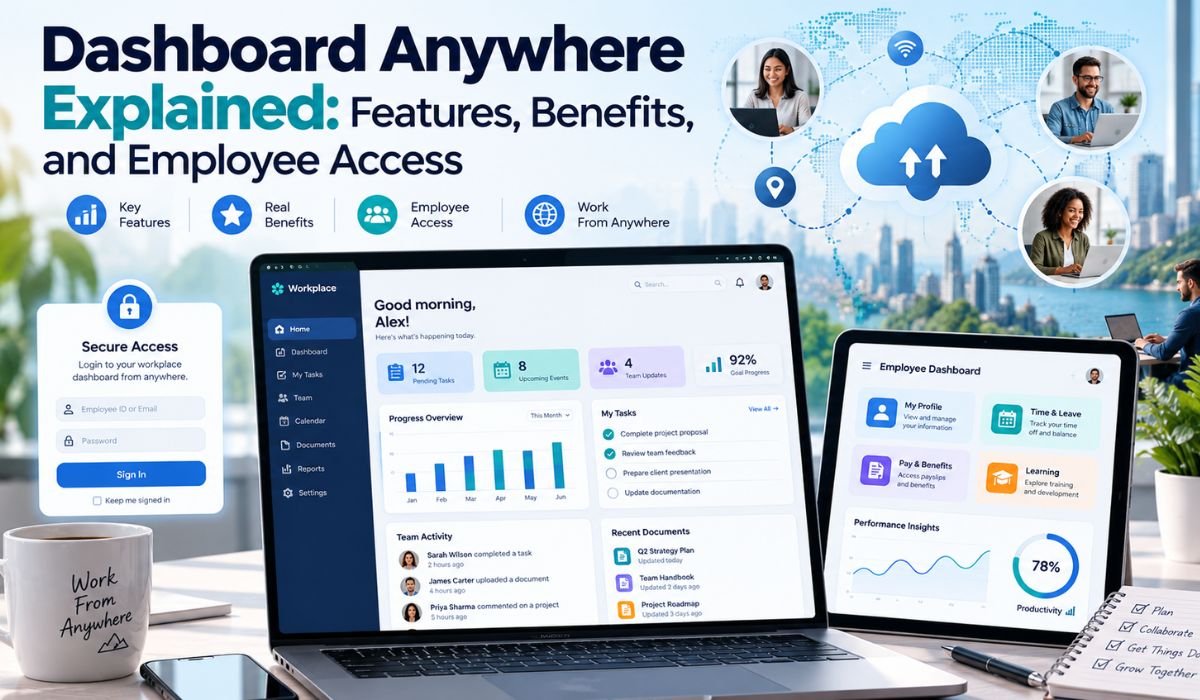
Long before remote and hybrid work became part of everyday business life, large companies were already looking for better ways to connect employees with workplace information. For Chrysler and later Fiat Chrysler Automobiles, commonly known as FCA, Dashboard Anywhere became part of that digital employee environment.
The platform gave workers a central place to find company information and access employee resources. Historical FCA materials confirm that Dashboard Anywhere was an actual employee resource, rather than simply a generic term for a modern workforce dashboard. At different points, FCA directed employees to the platform for workplace information, updates, and other employment-related needs.
That history matters because searching for Dashboard Anywhere today can be confusing. FCA no longer exists as an independent automaker. The company completed its merger with Groupe PSA in January 2021, creating Stellantis. Since then, employee technology, authentication procedures, and internal systems may have changed.
So, while older Dashboard Anywhere information can still explain how FCA supported its workforce, it shouldn’t automatically be treated as a current Stellantis login guide.
This article takes a closer look at Dashboard Anywhere, its connection with FCA and Chrysler, its role in employee communication, the benefits of employee self-service, account security, login problems, former employee access, and what people searching for the platform should understand in 2026.
Quick Information
| Information | Details |
|---|---|
| Platform Name | Dashboard Anywhere |
| Historical Association | Chrysler And Fiat Chrysler Automobiles |
| Common Abbreviation | FCA Dashboard Anywhere |
| Platform Category | Employee Resource And Intranet Platform |
| Main Audience | Authorized Employees |
| Historical Company | Fiat Chrysler Automobiles |
| Current Corporate Successor | Stellantis |
| FCA And PSA Merger | Completed In January 2021 |
| Main Purpose | Employee Information And Workplace Resources |
| Employee Access | Controlled By The Employer |
| Personal Information | Protected Through Employee Authentication |
| Workplace Updates | Historically Available Through Dashboard Anywhere |
| Remote Use | Historically Supported For Employee Resources |
| Current Access Method | May Differ From Historical FCA Access |
| Former Employees | May Need Separate HR Or Benefits Resources |
| Password Assistance | Should Use Authorized Employer Support |
| Security Priority | Use Only Employer-Approved Access Methods |
| Current Relevance | Mainly FCA History And Employee Resource Searches |
What Is Dashboard Anywhere?
Dashboard Anywhere was an employee resource associated with Chrysler and Fiat Chrysler Automobiles. It formed part of FCA’s wider digital workplace environment, helping employees find company information without depending entirely on printed notices, telephone calls, or face-to-face communication.
There is historical evidence of the platform’s practical use. Archived FCA communications, including material issued during the COVID-era return-to-work period, instructed employees to visit Dashboard Anywhere for updated information and answers to common workplace questions.
That evidence helps clear up a frequent misconception. Dashboard Anywhere wasn’t merely a phrase describing any cloud-based employee portal. It had a specific connection to FCA and its workforce.
At the same time, the platform reflected a much broader trend in employment technology. Large organizations increasingly moved routine information and employee services online, giving workers more opportunities to find what they needed without contacting HR for every question.
That basic idea remains highly relevant today, even though the systems used by FCA’s corporate successor may have evolved.
Dashboard Anywhere And FCA
Understanding Dashboard Anywhere requires a little knowledge of FCA itself.
Fiat Chrysler Automobiles emerged from the combination of Fiat and Chrysler and grew into one of the world’s major automotive groups. Its operations stretched across manufacturing plants, offices, engineering facilities, distribution networks, and numerous other workplaces.
Managing communication across a workforce of that scale isn’t simple. A factory employee working an evening shift doesn’t necessarily have the same access needs as an engineer or someone based in a corporate office. Digital employee resources helped bridge those differences.
Dashboard Anywhere became part of that environment, giving FCA a way to make employee information more accessible across its workforce.
The corporate landscape changed substantially in 2021. FCA and Groupe PSA completed their merger in January of that year, forming Stellantis. The new company brought together a large portfolio of automotive brands and inherited the operations of both groups.
That change is especially relevant for anyone searching for Dashboard Anywhere FCA, Dashboard Anywhere Chrysler, or Dashboard Anywhere Login today. Search results may still contain accurate information from the FCA era, but historically accurate information isn’t necessarily current access information.
Why Dashboard Anywhere Was Useful
A workforce portal becomes particularly valuable when employees are spread across different locations, schedules, and job types.
Automotive manufacturing is a good example. Some employees spend most of their working day on a production floor. Others work in engineering, administration, logistics, management, or corporate operations. Many don’t have the same opportunity to sit at a desktop computer and search through company systems.
A centralized resource can make communication much easier.
Dashboard Anywhere gave FCA another channel for delivering workplace information to employees. Archived company communications demonstrate that role particularly clearly. During a period when workplace health procedures were changing rapidly, FCA directed employees to Dashboard Anywhere for updated information and frequently asked questions.
That example illustrates why employee portals matter. When company policies or workplace procedures change, employees need a reliable place to find the latest approved information rather than depending on rumors, outdated documents, or messages passed informally between coworkers.
Who Could Use Dashboard Anywhere?
Dashboard Anywhere was built for an employee environment, not for unrestricted public access.
That distinction is important. Employee systems can contain internal company material and, depending on the service involved, personal employment information. Access therefore needs to be controlled.
What an individual employee can see may depend on several factors, including employment status, job responsibilities, location, department, and account permissions. A production worker may need one set of resources, while a manager, engineer, or corporate employee may require another.
Modern workplace systems commonly follow the same principle. Rather than giving every user access to everything, permissions are generally matched to the person’s role and business needs.
Former employees and retirees present another situation altogether. They may still require employment-related information after leaving the company, including tax documents, pension details, benefits records, or employment verification. That doesn’t necessarily mean their previous active-employee account remains available indefinitely.
For this reason, people shouldn’t assume that every current employee, former worker, or retiree follows the same Dashboard Anywhere access process.
Dashboard Anywhere Employee Access
For many people arriving at this topic through a search engine, the main question isn’t historical. They simply want to know how to access their employee information.
This is where caution becomes particularly important.
Historical FCA material confirms that employees were directed to Dashboard Anywhere for company resources. What it doesn’t establish is that the same FCA-era access method remains the correct one in 2026.
A lot can change in several years, especially after a major corporate merger. Companies replace internal applications, move services to new platforms, update authentication systems, retire old web addresses, and reorganize HR technology.
As a result, an old Dashboard Anywhere bookmark isn’t necessarily a reliable route to a current Stellantis employee service.
Current employees should follow instructions supplied through their workplace, HR department, company communications, or authorized IT support. That approach isn’t only more likely to work; it’s also considerably safer than entering employee credentials into a website discovered through an unfamiliar search result.
Dashboard Anywhere Features And Resources
One of the biggest problems with information about Dashboard Anywhere is that third-party websites sometimes present long lists of features without making clear which ones have actually been documented.
A more accurate approach is to separate verified historical uses from the broader capabilities normally associated with employee portals.
Archived FCA material confirms that Dashboard Anywhere served as a source of employee information and workplace updates. Historical communications also instructed employees to verify personal contact information through Dashboard Anywhere, including details such as their phone number, email address, and home address.
Those documented uses provide a clearer picture of the platform’s role.
Employee intranets and self-service platforms more generally can support a much wider range of functions. Depending on the employer and system, these may include HR resources, benefits information, workplace policies, training materials, employee records, internal communications, and other employment services.
That doesn’t mean every one of those functions should automatically be attributed to every version of Dashboard Anywhere. Keeping that distinction clear makes the information more useful and prevents assumptions from being presented as established facts.
Payroll And Benefits Information
Payroll and benefits are among the most common reasons employees turn to digital workplace systems.
Workers may need to review earnings information, find tax documents, understand deductions, check insurance coverage, examine retirement benefits, or complete an enrollment process. Traditionally, many of these tasks required direct contact with an HR or payroll department.
Employee self-service technology can make the process much easier. When approved information is available digitally, workers can often find routine documents without waiting for someone else to retrieve them.
However, someone searching specifically for Dashboard Anywhere Payroll, Dashboard Anywhere Benefits, or similar terms should avoid assuming that older FCA instructions still apply.
The system used for a particular employment service may have changed following the creation of Stellantis. Different countries, employee groups, and benefits programs may also use different providers or platforms.
For current payroll or benefits needs, employer-approved instructions should take priority over historical online guides.
Employee Information And Company Communication
Communication was one of Dashboard Anywhere’s clearest documented functions.
Historical FCA material directed workers to the platform for updated company information and frequently asked questions. Employees were also instructed to verify their contact details through Dashboard Anywhere.
At first glance, keeping a phone number or email address current might seem like a minor administrative task. For a large employer, however, accurate employee information can be critical.
Companies may need to communicate workplace changes, benefits deadlines, operational updates, emergency information, safety procedures, or other time-sensitive notices. Outdated employee records can make that process harder.
This is where a centralized workforce platform becomes more than an administrative convenience. It can serve as a direct communication bridge between an organization and its employees, particularly when information needs to reach a large and geographically dispersed workforce quickly.
Benefits Of Employee Self-Service
The broader principle behind Dashboard Anywhere remains relevant because employee self-service solves a very practical problem: too many routine workplace tasks once depended on another person.
An employee shouldn’t necessarily need to call HR just to locate a standard document, confirm personal information, or read an official company update. When those tasks can be handled through an approved digital service, the employee gains more control and the administrative team has fewer repetitive requests to manage.
That can make everyday work smoother on both sides.
Centralized information can also reduce confusion. Instead of relying on a coworker’s memory or an old printed document, employees can look for information through an authorized company resource.
Of course, technology alone doesn’t guarantee a good experience. A poorly organized employee portal can create just as much frustration as the processes it replaces. Clear navigation, understandable language, reliable information, and accessible support all play a part in whether self-service actually works.
Dashboard Anywhere And Remote Access
The “Anywhere” in Dashboard Anywhere captures an idea that has become increasingly important in workplace technology: employees don’t always need information while they’re sitting at a company desk.
That was already relevant in automotive manufacturing, where large numbers of workers spend their shifts on production floors or in other environments where a traditional office computer isn’t constantly available.
Digital employee resources can help close that gap. They give workers another way to reach important company information when appropriate access is available.
Still, convenience has to be balanced with security.
A company may allow certain resources to be accessed remotely while placing tighter restrictions on more sensitive systems. Some services can require additional identity checks, approved devices, managed networks, or other security measures.
Employees should respect those restrictions. Trying to bypass corporate access controls can put both personal information and company data at risk.
Dashboard Anywhere Security And Privacy
Security matters whenever a platform deals with employee information.
Workplace systems can potentially contain personal details, employment records, internal company information, or access to other business services. That makes strong identity and access controls essential.
Modern enterprise platforms commonly use measures such as encrypted connections, controlled permissions, secure sessions, identity verification, and additional authentication. Some organizations also use multi-factor authentication or single sign-on as part of a wider identity-management system.
It’s important, however, not to claim that every one of those technologies was used by every version of Dashboard Anywhere unless reliable documentation confirms it.
Employees have responsibilities as well. Even a well-protected corporate system can be put at risk when someone shares a password, approves an unexpected authentication request, or enters credentials into a convincing fake login page.
A simple rule offers strong protection: use the access method supplied by the employer and treat unexpected requests for credentials with caution.
Dashboard Anywhere Login Problems
Someone searching for Dashboard Anywhere in 2026 may face a problem that has little to do with a forgotten password.
The information itself may be old.
A saved FCA-era bookmark might lead to a service that has changed or been retired. An older account may no longer use the same authentication method. A particular HR function could have moved to another system after the Stellantis merger.
There are also more ordinary explanations for login trouble. A password can expire, an account can become temporarily locked, a browser session can fail, or an authentication step may not complete correctly.
The key is not to respond by trying credentials on a series of unofficial websites.
If an old Dashboard Anywhere route no longer works, employees should first confirm the current service through authorized company information. If they’re already using the correct platform and still can’t gain access, official IT or HR support is the appropriate next step.
Password Recovery And Account Safety
Password problems are frustrating, but they shouldn’t push employees toward unsafe shortcuts.
Account recovery should always take place through an authorized employer process. Depending on the system, that may involve an approved password-reset tool, identity verification, or assistance from the company’s IT team.
Employees should never hand over a password, one-time verification code, or other sensitive credential to an unknown person offering to restore Dashboard Anywhere access.
The same principle applies to websites. A page can publish an article about FCA, Chrysler, Stellantis, or Dashboard Anywhere without having any official connection to those organizations. Providing information about an employee portal doesn’t give a website permission to collect employee credentials.
That distinction becomes particularly important with older platform names because people searching for a familiar login may be more likely to trust a page simply because it uses terminology they recognize.
Former FCA Employees And Retirees
Dashboard Anywhere searches don’t come only from active employees.
Former FCA workers and retirees may remember the platform from their time with the company and return to the name years later when they need an employment document.
Their needs can be significant. A former employee may be searching for tax information, pension details, retirement benefits, insurance records, or employment verification.
The challenge is that access often changes once active employment ends. An internal employee account may be disabled or modified, while certain services may move to a dedicated former-employee, retirement, payroll, or benefits platform.
The creation of Stellantis adds another layer to the situation. Someone who originally worked for Chrysler or FCA may now need to follow a current Stellantis procedure or use a benefits provider rather than returning to the employee system they remember.
For that reason, old Dashboard Anywhere credentials shouldn’t be assumed to provide permanent access to post-employment records.
Dashboard Anywhere And Stellantis Today
The relationship between Dashboard Anywhere and Stellantis is straightforward historically but more complicated technologically.
FCA and Groupe PSA completed their merger on January 16, 2021, creating Stellantis. That means FCA’s operations became part of a new corporate organization rather than continuing independently.
Dashboard Anywhere belongs primarily to the Chrysler and FCA chapter of that history.
People still search for the name because old documents, memories, bookmarks, and online articles continue to reference it. Current employees and former workers may also use familiar FCA terminology when looking for resources they once accessed regularly.
What shouldn’t be assumed is that every FCA-era platform remained unchanged after the merger.
Corporate systems evolve. Employee portals are replaced, authentication tools are upgraded, HR services move, and organizations consolidate technology after mergers. That’s why a responsible Dashboard Anywhere guide needs to distinguish clearly between the platform’s documented history and today’s employee-access procedures.
In 2026, current employer instructions should always be considered more authoritative than an old FCA login guide.
Why Dashboard Anywhere Still Matters
Dashboard Anywhere remains interesting even beyond its FCA history because it reflects a much larger transformation in how companies serve their employees.
Today’s workforce is spread across factories, warehouses, offices, homes, retail locations, and the road. Employees increasingly expect the same basic convenience from workplace technology that they experience with other digital services.
That means employee platforms are becoming more connected, easier to search, and more personalized.
Artificial intelligence may help workers locate policies or HR information without digging through multiple menus. Automated workflows can handle repetitive administrative processes more efficiently. Better mobile interfaces can make digital resources more practical for frontline workers who rarely sit behind a desktop computer.
Security will continue to evolve as well. The challenge for employers is to make information easy to reach without making sensitive data easy to steal.
Dashboard Anywhere represents an earlier stage of that continuing journey. The technology and company behind it have changed, but the central idea hasn’t: employees work better when trustworthy workplace information is accessible, understandable, and available when they genuinely need it.
Final Thoughts
Dashboard Anywhere played a genuine role in the Chrysler and FCA employee environment. Historical FCA communications show that workers were directed to the platform for workplace information and updates, giving us a clear picture of why the service mattered.
What has changed is the corporate setting around it.
FCA and Groupe PSA completed their merger in January 2021, creating Stellantis. Since then, employee systems, login procedures, HR technology, and authentication methods may have evolved. That’s why an FCA instruction that was accurate years ago shouldn’t automatically be treated as a current employee-access guide.
For anyone researching Dashboard Anywhere in 2026, the distinction is important. Its history can help explain the platform and its purpose, but current employer-approved resources should be used for actual account access, payroll questions, benefits information, password recovery, and personal records.
There’s also a broader lesson in the story of Dashboard Anywhere. Large organizations work better when employees don’t have to struggle to find basic information. Well-designed self-service technology can reduce administrative friction, strengthen communication, and give workers greater control over everyday employment tasks.
The platform names may change. The companies themselves may merge and evolve. But the need for secure, simple, and trustworthy employee access isn’t going away.
FAQs About Dashboard Anywhere
What Is Dashboard Anywhere?
Dashboard Anywhere was an employee resource associated with Chrysler and Fiat Chrysler Automobiles. Historical FCA material confirms that employees were directed to the platform for workplace information and updates. Although the name can sound like a general description of remote employee software, it had a specific connection with FCA’s workforce environment.
Was Dashboard Anywhere Used By FCA Employees?
Yes. Archived FCA communications specifically referred employees to Dashboard Anywhere for company information and workplace updates. Employees were also instructed in historical material to verify certain contact information through the platform. This provides direct evidence of its role within FCA’s employee environment.
Is Dashboard Anywhere Still Used In 2026?
Employees shouldn’t assume that an FCA-era Dashboard Anywhere service or login process remains unchanged in 2026. FCA merged with Groupe PSA in January 2021 to create Stellantis, and employee systems can change significantly after a major corporate transition. Current workers should use the latest employer-approved access instructions.
Is Dashboard Anywhere Connected To Stellantis?
Yes, historically. Dashboard Anywhere was associated with FCA, and FCA became part of Stellantis through its merger with Groupe PSA. That corporate connection doesn’t prove that the original Dashboard Anywhere platform or its old login procedures remain in use today.
What If My Dashboard Anywhere Login Does Not Work?
Start by confirming that you’re using the current employee service approved by your employer. Old FCA bookmarks or login instructions may no longer be appropriate. If the service is current but your account still doesn’t work, use the authorized password-recovery process or contact company IT or HR support.
Can Former FCA Employees Access Dashboard Anywhere?
Former employees may have different access arrangements from current workers. Services involving tax documents, pensions, retirement benefits, insurance, or employment records may be handled through separate systems. Former FCA employees should use current official instructions for the particular information they need rather than assuming an old Dashboard Anywhere account remains active.
Is Dashboard Anywhere Safe?
Dashboard Anywhere was a genuine FCA employee resource. However, someone searching for it today may encounter unofficial websites using FCA, Chrysler, Stellantis, or Dashboard Anywhere terminology. Employees should never enter workplace credentials into a website solely because its name or design appears familiar. Employer-approved access methods are the safest choice.
Why Do People Still Search For Dashboard Anywhere?
The name remains closely associated with Chrysler and FCA employee services. Former employees, retirees, current workers familiar with older terminology, and people reading archived company documents can all encounter the name. As a result, Dashboard Anywhere continues to generate interest even though FCA became part of Stellantis several years ago.
Learn more and explore exciting content on: Safetrode.com Explained: Features, Content, Benefits, and More
 Wild Rise
 IQ newswire
 Qamer Javed