

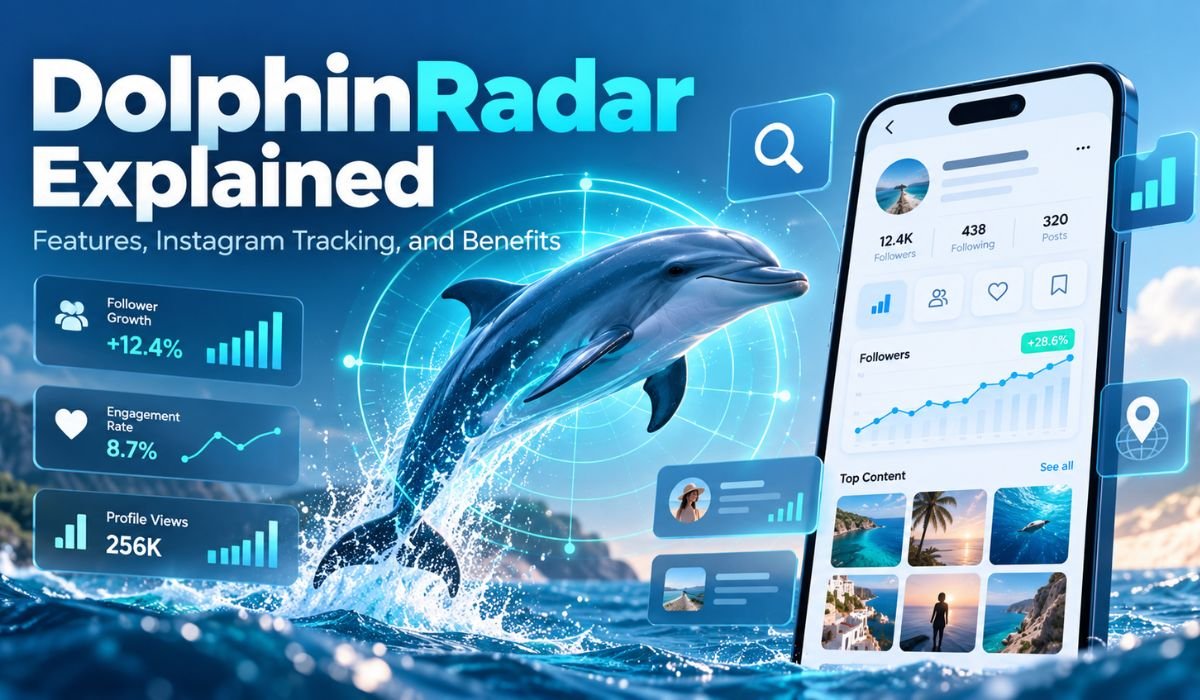
Instagram has grown far beyond its early role as a photo-sharing app. Today, creators use it to build communities, businesses watch competitors and promote products, and millions of people rely on it to discover trends, brands, entertainment, and new ideas. With so much activity taking place every day, keeping track of what happens on public profiles can quickly become time-consuming.
That’s where DolphinRadar enters the picture. DolphinRadar is a third-party Instagram analytics and viewing service built around publicly available Instagram activity. Rather than repeatedly checking the same profiles by hand, users can explore supported public content and, with certain plans, monitor changes over time.
The platform brings several functions together. These include public Story viewing, Instagram Activity Tracking, follower and unfollower monitoring, downloadable reports, and AI-assisted analysis on eligible plans. Some tools are intended for occasional viewing, while others are designed for longer-term monitoring.
There are important boundaries, though. DolphinRadar isn’t an official Instagram or Meta service, and it doesn’t provide unrestricted access to someone’s account. Its tracking depends on information that is publicly observable, and the company itself acknowledges that reports can contain gaps.
Understanding those distinctions is essential. This guide takes a closer look at DolphinRadar, how it works, its main features and benefits, pricing, privacy considerations, and the limitations users should know about before relying on its data.
What Is DolphinRadar?
DolphinRadar is a web-based Instagram analytics and activity-tracking service. According to the company’s current Terms, it collects and organizes publicly accessible Instagram information associated with accounts selected for tracking.
Depending on what is publicly available, that information can include posts, likes, follows, follower changes, Stories, and other visible activity. DolphinRadar then organizes supported information into its own viewing, monitoring, and reporting tools.
The platform operates independently from Instagram. It isn’t owned, sponsored, endorsed, or operated by Instagram or Meta, which is an important point for anyone comparing it with Instagram’s official features.
DolphinRadar is also centered on public information rather than private account access. Its policies state that the service doesn’t access private Instagram accounts, private messages, private Stories, or information that isn’t publicly available.
That makes the platform easier to understand. DolphinRadar isn’t a way to unlock private Instagram data. It’s better viewed as a public Instagram monitoring and analytics service that attempts to make certain publicly observable signals easier to follow.
DolphinRadar Quick Information
| Information | Details |
|---|---|
| Platform Name | DolphinRadar |
| Service Type | Instagram Analytics And Tracking |
| Operator | SESHAT LAB PTE. LTD. |
| Main Purpose | Public Instagram Activity Analysis |
| Supported Social Platform | Primarily Instagram Tracking |
| Access Method | Web-Based Service |
| Instagram Password Required | No, According To DolphinRadar |
| Public Account Tracking | Supported |
| Private Account Access | Not Supported |
| Story Viewing | Available For Public Content |
| Follower Activity | Tracking Features Available |
| Likes Analysis | Available Within Tracking Features |
| Content Downloads | Available Through Selected Tools |
| Activity Reports | Available |
| CSV Reports | Available For Supported Activity Data |
| AI Insights | Available On Selected Paid Plans |
| Instagram Actions | Read-Only; No Posting Or Messaging |
| Payment Processing | Stripe |
| Subscription Renewal | Automatic Unless Canceled |
| Instagram Affiliation | None |
These details reflect DolphinRadar’s published 2026 product information and policies. As with most online services, individual features, prices, and subscription conditions may change over time. Anyone considering a paid plan should confirm the latest details before purchasing.
How Does DolphinRadar Work?
At its core, DolphinRadar works by observing information that is publicly available on Instagram and organizing supported activity into a format that’s easier to review.
The process usually starts with a public Instagram username. Depending on the tool being used, DolphinRadar may attempt to display Stories, posts, Highlights, follower information, comments, or other publicly visible material connected with that account.
Tracking goes a step further. Instead of showing only what is visible at a single moment, the service can observe supported activity over time. Comparing those observations may reveal changes such as new follows, unfollows, or other detectable activity.
Historical information is especially important here. A follower list viewed today can tell you who appears on that list now, but it can’t necessarily explain what changed yesterday. Monitoring becomes more useful when earlier observations are available for comparison.
DolphinRadar also provides automatically generated reports through its tracking service. Current support information refers to weekly reporting, while longer-term subscription options can include additional historical and analytical features.
Still, this shouldn’t be confused with perfect real-time surveillance. Instagram content can disappear, accounts can become private, users can delete posts, and Instagram itself can alter what information is available. DolphinRadar’s Terms acknowledge these limitations and warn that reports may contain gaps.
In other words, a report shows what DolphinRadar detected. It isn’t necessarily a complete record of everything that happened on an Instagram account.
Key Features Of DolphinRadar
DolphinRadar isn’t limited to a single Instagram Story Viewer. Its broader service combines public-content viewing, activity tracking, reporting, and analytical tools.
For public content, the platform offers tools associated with Stories, Highlights, posts, reposts, comments, tagged content, and other supported Instagram media. Certain tools also allow available Stories, Highlights, posts, or videos to be downloaded.
Its tracking features focus more heavily on activity over time. Depending on the service and plan, users can explore follower changes, recent follows, mutual connections, likes, and other publicly observable relationship or engagement signals.
For people who prefer working with data outside the dashboard, DolphinRadar also provides CSV reports for supported activity. This can be useful when reviewing larger sets of information or organizing research.
A more recent part of the service is AI Insights. Selected paid plans include automated analysis intended to interpret patterns found in tracked public activity.
That feature requires careful interpretation. There is a meaningful difference between observing that an account publicly followed another profile and using AI to infer what that action might suggest about someone’s interests, personality, or lifestyle.
DolphinRadar’s own policies make that distinction clear. AI-generated interpretations are described as approximations rather than verified facts. They shouldn’t be treated as psychological assessments or reliable proof of someone’s personality, relationships, intentions, or future behavior.
How To Use DolphinRadar
DolphinRadar is designed around a relatively straightforward browser-based workflow.
A user begins by opening the service and selecting the Instagram viewing or tracking function that fits their needs. For public-content viewing, the next step is generally entering the username of the Instagram profile they want to examine.
What appears after that depends on several factors. The account needs to be public, the requested content must still be available, and DolphinRadar must be able to retrieve the relevant information.
Someone interested in occasional viewing may only need one of the public-content tools. Ongoing Instagram Tracking is different because it relies on repeated observations and historical comparisons.
Premium functions require an appropriate subscription, and dashboard features may require users to create a DolphinRadar account. According to the company’s published information, this can be done without handing over Instagram credentials.
That’s an important security distinction. DolphinRadar states that it doesn’t ask users for their Instagram password, two-factor authentication code, or account recovery code.
Even so, using a third-party platform still involves sharing some information with that service. Account registration, website activity, and subscription payments can all involve data processing. Users should therefore review the platform’s current privacy and subscription terms before signing up.
DolphinRadar Instagram Tracking Explained
DolphinRadar Instagram Tracking makes the most sense when viewed as observation over time rather than an instant window into someone’s Instagram account.
Consider a simple example. If a public account begins following another public profile and that change is available when DolphinRadar checks the account, the service may record it. A later report can then reflect that detected change.
Unfollows work on a similar principle. To identify a change reliably, a monitoring system needs something to compare the latest information against.
That’s why historical tracking can provide more context than a one-time search. Looking at a follower or following list today doesn’t automatically reveal when each connection was created or removed.
There are limits to this process. Instagram users can delete or edit content, switch an account from public to private, or otherwise change what is visible. Instagram can also modify how its platform presents or restricts information.
DolphinRadar acknowledges that these factors can create gaps and delays. Its reports should therefore be interpreted as records of detected public activity, not as guaranteed histories of everything a person has done on Instagram.
That distinction is particularly important when tracking information is being used to draw conclusions about another person or business.
Anonymous Instagram Story Viewing
Anonymous Instagram Story Viewing is likely to be one of the first features that attracts people to DolphinRadar.
The platform provides tools intended to let users view available Stories from public Instagram accounts without opening those Stories through their own Instagram profile. For someone who simply wants to examine public content in a browser, that can be convenient.
Still, the word “anonymous” deserves some explanation.
In this context, anonymity generally refers to not using your personal Instagram identity through Instagram’s normal Story-viewing interface. It doesn’t necessarily mean that no information about your visit is processed by DolphinRadar.
Like other online platforms, DolphinRadar may process information connected with website usage, user accounts, subscriptions, and related activity according to its Privacy Policy.
There is also an important difference between Story viewing and ordinary profile browsing. Instagram Stories have viewer-related functionality that makes anonymous Story tools appealing to some users, while simply visiting a public profile isn’t the same interaction.
The practical takeaway is simple: DolphinRadar’s anonymous viewing should be understood in relation to the Instagram account being viewed, not as a promise of complete anonymity everywhere online.
DolphinRadar Followers And Unfollowers Tracker
Follower and unfollower monitoring is another major part of DolphinRadar’s broader Instagram Tracking features.
The platform can use publicly observable information to identify certain changes involving follows, unfollows, mutual connections, and related activity. When observations are stored over time, users can gain a clearer picture of how public connections have changed.
Historical context matters here as well.
If you only see a person’s current following list, you don’t automatically know who was added last week or who disappeared yesterday. Tracking requires earlier information that can be compared with newer observations.
Even then, results aren’t guaranteed to be complete. An Instagram account might change its privacy settings, information could become temporarily unavailable, or Instagram could alter access to certain data.
For that reason, the disappearance of an account from a report shouldn’t automatically be treated as proof that a particular action occurred at a specific time.
For marketers and creators, follower patterns can still provide useful context. They may help highlight shifts in public connections or audience behavior. However, those changes don’t automatically reveal why something happened, nor do they prove audience quality, customer intent, or campaign success.
AI Insights And Automated Analysis
AI Insights adds another layer to DolphinRadar because it moves beyond simply presenting observed activity.
Depending on the subscription plan, DolphinRadar describes automated analytical features that interpret patterns found in tracked public information. These can include interests, persona-style summaries, lifestyle indicators, notable patterns, engaged accounts, discussion themes, and other inferred observations.
The distinction between observation and inference is critical.
If an account publicly follows another profile, that follow is an observable signal. If an automated system then concludes that the action demonstrates a particular interest or personality characteristic, that conclusion is an interpretation.
The two shouldn’t be treated as equally certain.
DolphinRadar itself acknowledges this limitation. Its policies state that AI-generated outputs can be inaccurate, incomplete, or outdated and shouldn’t be treated as verified facts or professional assessments.
That means AI Insights can be useful for spotting possible patterns or generating questions, but they shouldn’t be used as proof about someone’s personality, relationships, motives, mental state, or likely future behavior.
The same caution applies in professional settings. Automated inferences should never become the sole basis for decisions that could materially affect another person.
Benefits Of Using DolphinRadar
Convenience is perhaps DolphinRadar’s most obvious benefit.
Someone who repeatedly monitors public Instagram activity would otherwise need to revisit profiles manually and remember what changed. A centralized dashboard can make those observations easier to organize.
The platform’s no-Instagram-password approach is another practical advantage. According to DolphinRadar, users don’t need to provide their Instagram credentials to use its tracking service.
Historical reports can also add context. A single visit to a profile gives you a snapshot, whereas stored observations can help reveal changes over a longer period.
CSV exports add another useful layer for people working with larger amounts of information. Marketers or researchers may prefer structured data when reviewing activity outside the DolphinRadar dashboard.
There are also potential time savings. Notifications and scheduled reports can reduce the need to check the same account repeatedly.
Of course, value depends on the user’s purpose. Someone who wants to look at an occasional public Story may have little reason to pay for continuous tracking. A marketer studying public competitor activity over several months could find historical reporting more relevant.
Understanding your goal before subscribing is therefore more useful than simply choosing the plan with the longest feature list.
DolphinRadar For Social Media Marketing
Used carefully, DolphinRadar can have practical applications in social media research and competitor analysis.
Marketers already learn a great deal by studying what competitors publish publicly. Posts, Reels, Stories, captions, visible engagement, and collaborations can reveal how a brand presents itself and communicates with its audience.
Looking at these signals over time may uncover recurring campaign themes, posting patterns, creative formats, partnerships, and audience conversations.
Public comments can be useful too. They may reveal common questions, customer concerns, frequently discussed products, or topics that generate strong reactions.
However, there’s a limit to what public observation can tell you.
DolphinRadar can’t reveal another company’s complete Instagram analytics simply because its profile is public. Internal metrics such as detailed reach, advertising performance, private conversion data, and account-level Insights aren’t available through ordinary public observation.
That’s why DolphinRadar is better treated as a supplementary research tool.
Public activity can help marketers spot patterns and generate ideas, but important business decisions should also draw on first-party analytics, customer research, market data, and other reliable evidence.
Responsible use matters as well. Public availability doesn’t remove copyright, privacy, data protection, or platform-policy considerations.
DolphinRadar Pricing And Subscription Plans
DolphinRadar combines free viewing tools with paid Social Insights subscriptions.
According to the platform’s published 2026 support information, its monthly subscription is priced at $4.49 per month. A quarterly subscription costs $10.99 per quarter, which works out to about $3.66 per month. The annual option is listed at $32.99 per year, equivalent to roughly $2.75 per month.
One detail deserves particular attention: each Social Insights subscription covers one public Instagram account. Someone who wants ongoing tracking for multiple accounts may therefore need additional subscriptions.
Plan features also differ.
DolphinRadar’s current information indicates that AI Insights are available with selected quarterly and annual plans rather than the basic monthly option. The annual plan offers access to a broader collection of analytical modules.
Subscriptions renew automatically unless canceled. DolphinRadar states that users can manage cancellation through their dashboard, with cancellation preventing renewal for the next billing period.
As with any subscription service, readers shouldn’t assume prices or included features will remain unchanged indefinitely. The checkout page and current subscription terms should be reviewed before payment.
Privacy And Data Handling
Privacy is particularly relevant for a platform built around social media monitoring.
According to DolphinRadar’s 2026 Privacy Policy, the service is operated by SESHAT LAB PTE. LTD. The company states that payment card numbers are processed by its payment provider rather than being stored directly by DolphinRadar.
Its policy also describes boundaries around the Instagram information it handles. DolphinRadar says its analytics service doesn’t collect private messages, private Stories, content from private accounts, precise geolocation, or biometric identifiers.
The company further states that it doesn’t sell personal information or share it for cross-context behavioral advertising as those concepts are defined under applicable US privacy laws.
Those are useful disclosures, but they shouldn’t be misunderstood.
A company’s Privacy Policy describes its stated practices. It isn’t the same thing as an independent security audit, and it doesn’t eliminate the normal considerations involved in giving information to a third-party online service.
Users should read the current policy themselves before creating an account, paying for a subscription, or using DolphinRadar for ongoing research.
Is DolphinRadar Safe And Legit?
“Is DolphinRadar safe?” sounds like a simple question, but the answer depends partly on what someone intends to do with the service.
DolphinRadar documents several meaningful boundaries. The company says it doesn’t require Instagram passwords, can’t access private Instagram accounts or DMs, uses third-party payment processing, and limits its service to supported public information.
Its Terms also prohibit activities such as stalking, harassment, doxxing, blackmail, unlawful surveillance, and certain forms of monitoring involving minors.
Those restrictions are important because a public-data tool can still be misused.
There are also limitations on reliability. DolphinRadar doesn’t guarantee that every report will be complete, perfectly accurate, or continuously available. Missing information and delayed observations are possible.
For ordinary public-content research, users can decide whether those limitations are acceptable for their needs.
Greater caution is necessary when information could affect another person’s life. DolphinRadar reports and AI-generated interpretations shouldn’t serve as the sole basis for consequential decisions involving employment, credit, housing, insurance, legal matters, or judgments about someone’s character.
DolphinRadar Limitations And Common Problems
The most important DolphinRadar limitation is also the easiest to understand: the service depends on publicly available information.
It can’t legitimately unlock a private Instagram account, read private messages, or bypass Instagram’s privacy controls.
Even public tracking isn’t necessarily complete.
Stories can disappear before they’re captured. Posts can be removed or edited. Public accounts can become private, and usernames can change. Instagram may also alter the way information is displayed or restrict how third-party services can access it.
Any of these changes can produce gaps in a monitoring history.
AI-generated analysis adds a different kind of uncertainty. An automated interpretation may sound confident even when the underlying evidence supports several possible explanations. That’s why AI Insights should be separated mentally from directly observed activity.
If DolphinRadar doesn’t show expected information, users should begin with the basics. Confirm that the username is correct, make sure the account remains public, and allow for possible reporting delays.
Most importantly, don’t treat missing data as proof that an event never occurred. Absence from a tracking report may simply mean the service didn’t detect it.
DolphinRadar Vs Instagram’s Official Tools
DolphinRadar and Instagram’s official tools aren’t direct replacements for one another because they’re designed for different jobs.
Instagram gives account owners direct access to their profiles and provides eligible professional users with first-party analytics. Those tools are the appropriate starting point for understanding your own reach, impressions, audience behavior, and content performance.
DolphinRadar focuses instead on supported public signals associated with public accounts.
That difference can make it useful for certain kinds of competitor research or general public-content monitoring. However, it can’t provide another account’s private Instagram Insights or internal business analytics.
There’s also the question of authority. Instagram’s own analytics come directly from the platform. DolphinRadar is an independent third-party service whose reports aren’t verified or endorsed by Meta.
For your own Instagram performance, first-party analytics should therefore remain the primary source.
Third-party tools can add another perspective, particularly when examining public competitors, but they work best as supporting resources rather than substitutes for official data.
Responsible Use Of DolphinRadar
The fact that information is public doesn’t mean every possible use of it is appropriate.
DolphinRadar’s own Terms recognize this distinction. They restrict stalking, harassment, doxxing, blackmail, unlawful surveillance, and other harmful activities.
Businesses should take particular care when public social media information is connected with individuals. A follow, like, comment, or AI-generated interpretation rarely tells the full story about someone’s motives or character.
For marketers, a sensible use of DolphinRadar would be studying public campaign themes, creative formats, competitor publishing patterns, visible engagement, or industry conversations.
Trying to infer sensitive personal information or use social media monitoring to intrude on someone’s private life is very different.
The same principle applies to AI Insights. Automated analysis may identify interesting patterns, but it shouldn’t be treated as a factual profile of a person.
Responsible use isn’t simply about following rules. It also improves the quality of the conclusions drawn from the data.
Final Thoughts
DolphinRadar brings several public Instagram research tools into one service. Its features include anonymous public-content viewing, Instagram Activity Tracking, follower monitoring, downloadable reports, historical observations, and AI-assisted analysis on selected plans.
The main attraction is convenience.
Instead of manually returning to public Instagram profiles and trying to remember what changed, users can potentially review detected activity through a centralized dashboard and compare observations over time.
Yet the limitations matter just as much as the features.
DolphinRadar can’t legitimately open private accounts or read direct messages. Its monitoring may contain gaps, and its AI-generated interpretations are estimates rather than verified facts. A report is best understood as a record of what the service detected, not a perfect history of everything that happened.
For marketers, creators, researchers, and other users interested in legitimate public Instagram analysis, DolphinRadar may provide useful additional context. Its historical monitoring features can be particularly relevant when a one-time profile check isn’t enough.
People expecting private-profile access, flawless real-time surveillance, or definitive conclusions about another person’s behavior will find that those expectations go beyond what the service can reliably provide.
Ultimately, DolphinRadar makes the most sense as a supplementary public-data research tool. Use its reports as one source of information, verify anything important independently, and keep privacy and responsible use in mind when interpreting the results.
FAQs About DolphinRadar
What Is DolphinRadar Used For?
DolphinRadar is designed to view, analyze, and organize certain publicly available Instagram activity. Depending on the feature or subscription, users can explore public Stories and other content, monitor follower-related changes, review activity reports, export supported data, and access selected AI-generated insights. DolphinRadar operates independently and isn’t affiliated with Instagram or Meta.
Does DolphinRadar Require An Instagram Login?
DolphinRadar states that users don’t need to provide their Instagram password or connect their personal Instagram account to use its tracking service. Some dashboard and subscription features may require a separate DolphinRadar account. The company also says it doesn’t request Instagram two-factor authentication or recovery codes.
Can DolphinRadar Access Private Instagram Accounts?
No. DolphinRadar’s published Terms state that the service doesn’t access private Instagram accounts, private Stories, direct messages, or information that isn’t publicly available. A legitimate public Instagram viewer shouldn’t be expected to bypass Instagram’s privacy settings.
Can DolphinRadar View Instagram Stories Anonymously?
DolphinRadar offers an Anonymous Instagram Story Viewer for available public content. Here, “anonymous” generally means the Story isn’t being opened through the viewer’s personal Instagram account in the usual way. That shouldn’t be confused with complete online anonymity, since DolphinRadar may still process service-related information under its Privacy Policy.
Does DolphinRadar Track Followers And Unfollowers?
Yes. DolphinRadar advertises tools for monitoring certain publicly observable follower and following changes, including follows and unfollows. Historical observations can help identify changes over time, but DolphinRadar warns that reports may contain gaps because Instagram information can change, disappear, or become unavailable.
Does DolphinRadar Offer Real-Time Instagram Tracking?
Users shouldn’t assume that every action will be detected instantly. DolphinRadar acknowledges possible delays and gaps, and some of its reporting operates on scheduled cycles. The safest way to interpret its tracking is as a record of detected activity rather than a guaranteed real-time history.
How Much Does DolphinRadar Cost?
DolphinRadar’s published 2026 information lists its Social Insights subscription at $4.49 per month, $10.99 per quarter, or $32.99 per year. Each subscription covers one public Instagram account, and features vary by plan. Since subscription pricing can change, users should confirm the current checkout details before purchasing.
Are DolphinRadar AI Insights Always Accurate?
No. DolphinRadar itself describes AI-generated insights as approximate and informational. They can be incomplete, inaccurate, or outdated. These interpretations shouldn’t be treated as verified facts, professional assessments, or the sole evidence behind important decisions about another person.
Learn more and explore exciting content on: FortMyersWA.com Explained: Beaches, Attractions, Food, and Travel Tips