

Starting a nursing career does not always require following the longest traditional route. For people who already have college experience and are ready for an intensive academic commitment, accelerated pathways can provide a more direct way into the profession. Florida is particularly relevant for aspiring nurses because healthcare represents a substantial part of the state’s workforce, while an aging population continues to shape demand for health services. The opportunity may be attractive, but speed should not be the only consideration. Program structure, clinical preparation, eligibility requirements, costs, and the realities of a compressed schedule all deserve attention before making a decision.
Understand What Accelerated Really Means
An accelerated nursing program compresses education into a shorter period than many traditional pathways. That does not mean students learn less. Instead, courses and clinical experiences are delivered on a tighter schedule.
The format can be appealing to people who have already completed substantial college coursework or earned a degree in another field. Previous education may satisfy some requirements, allowing students to concentrate more heavily on nursing preparation.
The tradeoff is intensity. Students may move quickly between lectures, assignments, simulations, exams, and clinical experiences. Falling behind can be difficult to recover from when the next topic arrives almost immediately.
Before applying, consider whether a fast academic pace genuinely fits your current circumstances rather than focusing only on the shorter completion time.
Look Closely at How the Program Works
The word “online” can be misleading in nursing education. Academic coursework may be delivered remotely, but learning to provide patient care requires practical experience.
For example, students comparing accelerated BSN programs in Florida can consider the accelerated program offered by St. Thomas University. Its hybrid format combines online coursework with in-person skills labs, simulations, and clinical rotations. The program can be completed in as few as 16 months and is designed for eligible students with at least 60 college credits, an associate degree, or a non-nursing bachelor’s degree.
That structure illustrates why prospective students should investigate more than course delivery. Where will clinical experiences occur? How frequently must you attend in person? How much travel will be required? Those practical details can influence whether a program genuinely fits your life.
Check Eligibility Before Making Plans
Accelerated programs can have very specific admission requirements. Previous college experience alone does not necessarily guarantee eligibility.
Applicants may need prerequisite courses in subjects such as anatomy, physiology, microbiology, chemistry, nutrition, statistics, or psychology. Programs may also establish minimum overall and science GPAs or require an entrance examination.
There can be nonacademic requirements too. Nursing students commonly need health documentation and background screening before participating in clinical experiences.
Checking these details early can prevent an unpleasant surprise after months of planning. If prerequisites are missing, completing them first may add time to the overall journey even when the nursing curriculum itself is accelerated.
Clinical Experience Matters
Nursing is a hands-on profession. Reading about patient assessment and practicing it in a clinical environment are very different experiences.
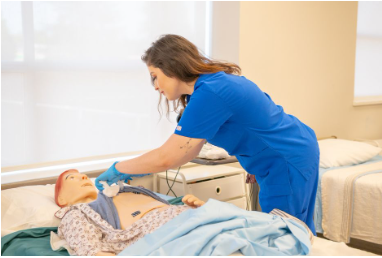
Clinical education gives students opportunities to develop judgment, communication, organization, and practical patient-care skills while working under supervision. Simulation can complement that experience by allowing students to practice difficult scenarios in a controlled environment.
When comparing programs, examine how clinical placements are arranged. Knowing whether the school coordinates placements can save considerable uncertainty later.
It is also worth considering the variety of experiences available. Exposure to different areas of care can help students understand where their interests and strengths may eventually lie.
Prepare for a Demanding Schedule
Accelerated education can require significant adjustments to everyday life.
Students need time for classes, independent study, assignments, labs, clinical rotations, and exam preparation. Clinical schedules may not always align neatly with work or family responsibilities.
A realistic weekly plan is therefore essential. Instead of assuming study will fit into whatever time remains, designate specific periods for coursework and revision.
Sleep deserves attention too. Consistently sacrificing rest to create more study time can make concentration and learning harder. Understanding practical approaches to improving sleep quality may be useful when building routines around an intensive academic schedule.
Preparing family members or housemates for the workload can also help. A strong support system becomes particularly valuable during busy clinical or examination periods.
Think About the Cost Beyond Tuition
Tuition is only one part of the financial picture.
Students may also need to budget for textbooks, uniforms, equipment, transportation, health requirements, testing, and other program-related expenses. A demanding schedule can also affect how many hours someone is realistically able to work.
Create a budget based on the entire period of study rather than looking only at the advertised tuition figure. Include ordinary living expenses and leave room for unexpected costs.
Financial planning may not be the most exciting part of preparing for nursing school, but it can reduce pressure once classes begin. The last thing a student needs during an intensive semester is discovering that basic expenses were underestimated.
Build Study Habits Before Classes Begin
A compressed program leaves little time to develop organizational skills from scratch.
Before the first term begins, establish a calendar system for deadlines, exams, clinical requirements, and personal responsibilities. Decide where you will study and remove obvious distractions from that environment.
Active learning can also be more useful than repeatedly reading the same material. Practice questions, recall exercises, concept explanations, and study groups can help reveal what you genuinely understand.
Good time-management habits can become particularly valuable when several assignments and responsibilities compete for attention.
The objective is not to schedule every minute. It is to make sure important work has a defined place before less important tasks consume the available time.
Look Beyond Graduation
Completing nursing school is an important milestone, but it is not the final step toward working as a registered nurse.
Graduates must meet applicable licensure requirements, including passing the NCLEX-RN. That makes preparation for professional practice an important factor when evaluating programs.
Look at how the curriculum develops clinical judgment and prepares students for the transition from classroom learning to professional responsibilities. Ask how licensure preparation is incorporated and what academic support is available when students struggle.
It is also worth thinking beyond the first job. Nursing can lead toward different clinical specialties, leadership roles, education, and further study. A strong undergraduate foundation can support those later decisions even when you have not yet chosen a specialty.
Choose Speed With Purpose
Finishing sooner can be attractive, particularly for someone changing careers or eager to enter healthcare. But accelerated education works best when speed is paired with preparation.
Before committing, look carefully at admission requirements, clinical expectations, program format, finances, scheduling, and licensure preparation. Consider how the workload will fit alongside employment and personal responsibilities rather than assuming those details will work themselves out later.
A faster route should still provide the knowledge, practical experience, and professional preparation needed for the responsibilities ahead.
When the program fits both your educational background and your everyday circumstances, an accelerated pathway can offer something more valuable than simply saving time: a focused route toward beginning a new professional chapter.
 Qamer Javed
  Wild Rise
  Blitz Blitz