

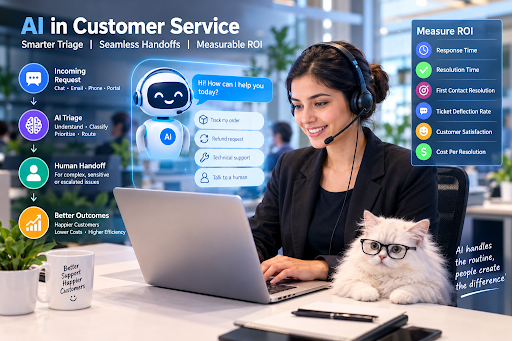
Artificial intelligence is transforming how businesses manage customer service operations. As customer expectations continue to rise, companies are under increasing pressure to provide faster responses, personalized assistance, and consistent support across multiple communication channels. Traditional customer service models often struggle to handle growing ticket volumes, repetitive questions, and complex customer requests without increasing operational costs.
AI-powered customer service offers a practical solution by automating routine interactions, identifying customer needs, prioritizing incoming requests, and helping support teams make better decisions. However, successful implementation requires more than simply introducing a chatbot or connecting an AI model to a customer support platform. Businesses need a well-designed triage architecture, clearly defined human handoff procedures, and reliable methods for measuring return on investment ROI.
Understanding AI-Powered Customer Service Architecture
An effective AI customer service system operates through several interconnected components. These components work together to receive customer inquiries, understand their intent, determine their urgency, and route requests to the appropriate destination.
The first component is the customer interaction layer.
This is where customers submit questions through live chat email messaging applications, or support portals. AI systems analyze incoming messages using natural language processing NLP and machine learning techniques to identify the customer’s intent.
The second component is the classification and triage engine. It evaluates incoming requests based on factors such as urgency, topic, customer history, sentiment, and business priority. For example, a password reset request can usually be handled automatically, while a payment dispute or security-related complaint may require immediate attention from a human agent.
The third component is the response and routing layer. Depending on the complexity of the inquiry, the system either generates an automated response, retrieves relevant information from an approved knowledge base, or transfers the conversation to a qualified support representative.
This structured approach helps organizations reduce unnecessary manual work while ensuring that important customer issues receive appropriate attention.
Building an Intelligent Customer Support Triage System
Customer service triage determines how incoming requests are evaluated and prioritized. Without a reliable triage process, even advanced AI systems can create operational problems by sending complex inquiries to automated workflows or allowing urgent issues to remain unresolved.
A well-designed triage system should consider several important factors.
Intent Recognition: AI should identify what the customer is trying to accomplish. Common categories include technical support, billing questions, account management, product information, and complaints.
Urgency Detection: Not every customer inquiry requires the same response time. Systems should recognize urgent issues, particularly those involving account security, service interruptions, financial problems, or significant customer dissatisfaction.
Sentiment Analysis: Understanding customer sentiment can help identify frustrated or dissatisfied customers. Negative sentiment should not automatically determine priority, but it can provide an additional signal for routing decisions.
Customer Context: Previous interactions, account information, subscription levels, and unresolved support tickets can help AI systems generate more relevant responses.
Confidence Scoring: AI models should estimate their confidence when interpreting customer requests. Low-confidence predictions should trigger additional clarification or human review rather than unsupported automated responses.
Organizations implementing these capabilities should establish clear operational guidelines before deployment. A practical resource covering AI in customer service implementation and human-handoff checklist can help businesses understand the important considerations involved in designing automated support workflows and maintaining effective human oversight.
Designing Effective Human Handoff Mechanisms
Although AI can resolve many routine customer inquiries, human involvement remains essential for complex, sensitive, or unusual situations. A successful customer service strategy should therefore combine automation with accessible human support.
Human handoffs should occur whenever an AI system cannot confidently resolve a request or when the customer’s situation requires human judgment.
For example, a customer experiencing repeated billing errors may initially receive automated troubleshooting instructions. However, if the issue continues or involves a disputed transaction, the system should transfer the conversation to a billing specialist.
An effective handoff process should include the following elements:
- Conversation History: Human agents should receive the complete conversation rather than asking customers to repeat information.
- Issue Classification: The system should explain why the inquiry was transferred and identify its original category.
- Customer Information: Relevant account details and previous support interactions should be available to authorized agents.
- AI Recommendations: The system may provide suggested responses or troubleshooting steps to help agents resolve the issue.
- Clear Escalation Rules: Businesses should define when AI must stop responding and transfer control to a human representative.
The transition should feel natural to customers. They should understand that a human specialist is taking over and should not experience unnecessary delays or repeated questions.
Companies must also monitor handoff performance. A high transfer rate may indicate that the AI system is struggling with certain inquiry categories, while an unusually low transfer rate could suggest that the system is attempting to resolve requests beyond its capabilities.
Choosing the Right AI Projects Before Deployment
One of the most common mistakes businesses make is implementing AI without first identifying the operational problem they want to solve. Not every customer service process needs automation, and deploying AI simply because the technology is available can result in unnecessary costs.
Organizations should begin by evaluating existing support workflows and identifying repetitive, time-consuming tasks that offer measurable improvement opportunities.
For instance, automated responses to frequently asked questions may provide immediate benefits because the information is already documented and relatively consistent. On the other hand, handling complicated refund disputes or interpreting sensitive customer complaints may require greater human involvement.
Before investing in an AI solution businesses should evaluate the expected business impact, available data technical requirements, implementation costs, and potential risks.
This is where choosing an AI project and defining decision criteria becomes particularly important.
Establishing clear decision criteria before selecting a model helps organizations focus on meaningful business outcomes instead of adopting technology without a defined purpose.
A practical project selection process should include:
- Identifying a specific customer service problem.
- Measuring the current performance of the existing process.
- Determining whether sufficient and reliable data is available.
- Evaluating the technical and operational feasibility of automation.
- Defining measurable success criteria.
- Running a controlled pilot before expanding deployment.
This approach reduces implementation risks and makes it easier to determine whether an AI project delivers genuine business value.
Measuring the ROI of AI Customer Service
Return on investment is one of the most important indicators of whether an AI customer service initiative is successful. Businesses should measure both financial improvements and operational performance rather than focusing exclusively on the number of automated conversations.
Several key performance indicators KPIs can help organizations evaluate results.
Average Response Time: Measures how quickly customers receive their first response. AI can significantly reduce waiting times by handling initial inquiries automatically.
Average Resolution Time: Tracks the time required to resolve customer issues. Effective automation can shorten resolution times for common requests.
First Contact Resolution FCR: Measures the percentage of customer issues resolved during the first interaction without requiring additional follow-ups.
Ticket Deflection Rate: Identifies how many customer inquiries are resolved through self-service or AI automation instead of reaching human support agents.
Customer Satisfaction CSAT: Evaluates customer satisfaction following support interactions. Faster responses are valuable, but they should not come at the expense of service quality.
Cost Per Resolution: Measures the average operational cost associated with resolving a customer inquiry. Reducing this figure can indicate improved efficiency.
Businesses should establish baseline measurements before deploying AI. Comparing pre-implementation and post-implementation performance provides a more accurate understanding of the technology’s impact.
For example, if an organization previously required human agents to resolve 10,000 monthly inquiries, automating 3,000 straightforward requests could reduce workload and allow employees to focus on more complex cases. However, the actual financial benefit should account for software subscriptions, integration expenses, maintenance, model usage, and human oversight.
A simplified ROI calculation is:
ROI = (Total Financial Benefits – Total AI Implementation Costs) / Total AI Implementation Costs × 100
This calculation helps businesses evaluate whether their investment is generating measurable returns.
Addressing Data Privacy and AI Governance
Customer service systems frequently process personal information, account details, purchase histories, and other potentially sensitive data. Therefore, businesses must establish appropriate privacy and security controls before introducing AI into customer-facing operations.
Access permissions should be based on employee responsibilities, and customer information should only be provided to authorized systems and personnel.
Organizations should also establish data retention policies, monitor AI-generated responses, and maintain records of important automated decisions where appropriate.
Another important consideration is hallucination prevention. AI systems can sometimes generate inaccurate information, especially when they lack access to reliable source material. Connecting AI applications to approved knowledge bases and implementing response validation can reduce this risk.
Regular testing is also necessary to identify incorrect answers, inconsistent routing decisions, and potential security weaknesses.
Human oversight should remain part of the governance framework, particularly when AI systems handle financial disputes, account access issues, or complaints that could significantly affect customers.
Implementing AI Customer Service Through a Phased Strategy
Rather than automating every support process at once, businesses should introduce AI gradually.
The first phase should focus on identifying suitable use cases and evaluating existing customer service performance. Organizations should document common inquiries, identify repetitive workflows, and determine which tasks can be automated safely.
The second phase involves developing and testing the AI system. This includes integrating customer support platforms, preparing knowledge sources, configuring routing rules, and establishing human escalation procedures.
The third phase should involve a limited pilot. Businesses can initially deploy AI for frequently asked questions or basic account inquiries while monitoring response accuracy, customer satisfaction, and escalation performance.
Finally, organizations can expand automation based on actual performance data. New workflows should only be introduced when existing capabilities demonstrate consistent reliability.
This phased approach makes it easier to identify problems early, control implementation costs, and improve the system over time.
Conclusion
Deploying AI in customer service requires a balanced strategy that combines intelligent triage, reliable human handoffs, and measurable business outcomes. Although automation can reduce response times and operational workloads, its effectiveness depends on selecting appropriate use cases, maintaining accurate information, and establishing clear escalation procedures.
Businesses should evaluate their existing workflows before selecting AI technologies, define measurable success criteria, and continuously monitor performance after deployment.
Ultimately, the most effective customer service model is not one that eliminates human involvement. It is one that uses AI to handle repetitive tasks efficiently while allowing human professionals to focus on situations where experience, judgment, and personal communication make the greatest difference.
 IQ newswire
 Admin