

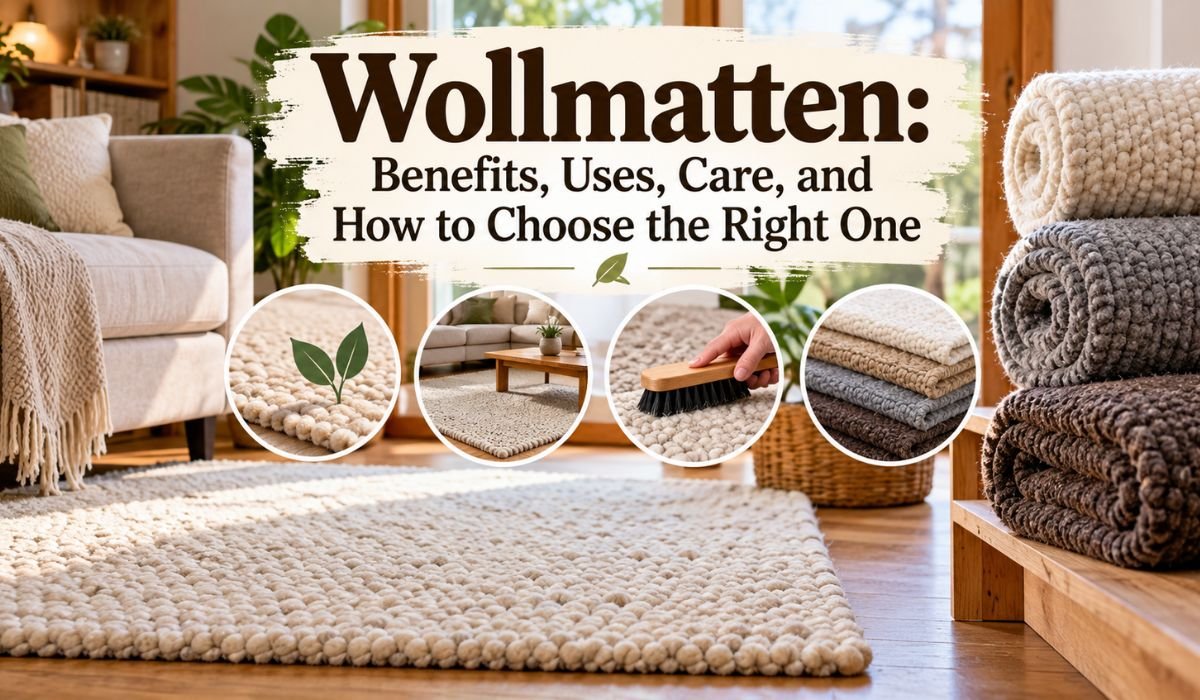
Natural materials have become increasingly visible in modern homes, but their appeal goes beyond appearance. People are paying closer attention to what everyday products are made from, how long they last, and whether those materials genuinely suit the spaces in which they’re used. Wollmatten fit naturally into that conversation.
The German term generally means wool mats, although it covers a surprisingly broad range of products. Some Wollmatten are decorative floor coverings designed to bring warmth and texture into a room. Others are dense felt products, woven mats, technical textiles, or purpose-made wool coverings used in gardens.
What makes wool particularly interesting is the combination of qualities built into the fibre itself. It can trap insulating air, manage moisture vapour, recover from compression, and resist ignition better than many common textile fibres. These aren’t new discoveries. Wool has been used for generations precisely because it performs well in demanding everyday situations.
Still, buying a wool mat isn’t quite as simple as choosing a colour you like. Construction, fibre content, backing, thickness, dyes, treatments, and intended use all influence how a finished product performs. Understanding those details makes it much easier to choose Wollmatten that genuinely suit your home, workspace, or garden.
What Are Wollmatten?
Wollmatten is the German plural term for wool mats, while a single wool mat is called a Wollmatte. It’s best understood as a broad description rather than the name of a particular brand, manufacturing technique, or standardized product.
That distinction matters because two products sold as Wollmatten can be very different.
A wool mat may be woven, felted, tufted, hand-knotted, compressed, or needle-punched. Some are made entirely from wool. Others use a wool surface combined with synthetic fibres, latex, adhesives, backing materials, or other components.
Their purposes vary just as widely. A decorative Wollmatte placed beside a bed is designed to provide comfort and visual warmth. A heavy-duty wool mat may prioritize resilience. A horticultural version is intended to cover soil and eventually break down.
So, when choosing Wollmatten, the name on the product page should only be the starting point. Fibre composition, construction, backing, dimensions, care requirements, and intended application tell you far more about what you’re actually buying.
Quick Information About Wollmatten
| Information | Details |
|---|---|
| Product Name | Wollmatten |
| English Meaning | Wool Mats |
| Singular German Term | Wollmatte |
| Main Fibre | Wool |
| Common Source | Sheep Wool |
| Common Construction | Felted, Woven, Tufted, Knotted, Needle-Punched |
| Indoor Use | Common |
| Garden Use | Available In Purpose-Made Products |
| Insulating Ability | Naturally Associated With Wool Fibre |
| Moisture Behaviour | Wool Absorbs And Releases Water Vapour |
| Fire Behaviour | Naturally Difficult To Ignite |
| Sound Control | Textile Mats Can Help Reduce Reflected Sound |
| Texture | Depends On Fibre And Construction |
| Durability | Depends Strongly On Construction And Use |
| Biodegradability | Natural Wool Can Biodegrade Under Suitable Conditions |
| Synthetic-Free | Only When Full Composition Confirms It |
| Common Locations | Living Rooms, Bedrooms, Offices, Studios |
| Garden Function | Mulching And Soil Coverage |
| Routine Care | Vacuuming And Prompt Spill Treatment |
| Main Buying Factors | Material, Construction, Size, Backing, Care And Intended Use |
How Wollmatten Are Made
The way a Wollmatte is made has a direct effect on how it looks, feels, wears, and responds to cleaning. That’s why construction deserves almost as much attention as fibre content.
Felted wool is produced by encouraging wool fibres to lock together until they form a dense, stable material. Depending on the process, moisture, heat, pressure, agitation, or mechanical action may be involved. Needle-punched Wollmatten achieve a similar type of fibre entanglement mechanically, using specialized barbed needles to repeatedly work fibres together.
Woven products take a different approach. Wool yarns are interlaced to create the finished structure, allowing manufacturers and craftspeople to produce everything from relatively flat surfaces to highly decorative patterns.
Hand-knotted pieces involve much more manual work. Individual knots are tied around a foundation, and the quality of the wool, density of the knots, finishing, and overall craftsmanship can have a major effect on durability and price.
Tufted mats are different again. Yarn is inserted into a backing and then secured. Because additional backing materials and adhesives may be involved, shoppers seeking an entirely natural Wollmatte should check the full product specification rather than looking only at the surface fibre.
None of these methods is automatically superior. A dense felted mat may be ideal for one room, while a woven or hand-knotted piece makes far more sense elsewhere.
Different Types Of Wollmatten
Once you understand how Wollmatten are made, the differences between the main types become much easier to recognize.
Felted Wollmatten generally have a dense, fairly uniform surface. They’re often chosen when firmness, simplicity, and practical performance matter more than a deep, luxurious pile.
Woven Wollmatten offer considerably more variety. Depending on the yarn and weaving technique, they may be thin and understated or thick, textured, colourful, and highly decorative.
Hand-knotted wool floor coverings sit toward the more craftsmanship-intensive end of the market. Well-made examples can be remarkably durable, but the quality of the materials and workmanship matters enormously. A high price alone isn’t proof of superior construction.
Tufted wool mats are popular because they can create a soft, substantial surface without the labour involved in hand knotting. Their backing deserves attention, however, because it forms an important part of the finished product.
Needle-punched wool products tend to be more functional, while garden Wollmatten form another category altogether. These are designed for contact with soil and shouldn’t be confused with decorative indoor floor mats.
Benefits Of Wollmatten
Wool has remained useful for so long because several valuable characteristics occur naturally within the fibre.
Its crimped structure helps create tiny pockets of trapped air. Those spaces contribute to wool’s insulating properties and help explain why a wool floor covering can make a hard surface feel more comfortable.
Wool is also hygroscopic. In simple terms, it can absorb water vapour from the surrounding air and later release that moisture as conditions change. This isn’t the same as saying a wool mat should be allowed to become wet, but it does help explain wool’s distinctive moisture behaviour.
Resilience is another advantage. Wool fibres can bend and recover repeatedly, allowing well-constructed wool textiles to cope with ordinary compression and use.
Then there’s fire behaviour. Wool is naturally difficult to ignite compared with many commonly used fibres, and unlike thermoplastic materials such as polyester or nylon, it doesn’t melt in the same way when exposed to heat.
It’s important, though, not to turn these fibre properties into exaggerated promises about every finished Wollmatte. A mat’s actual performance also depends on its thickness, density, construction, backing, treatments, blends, and where it’s installed.
Warmth And Everyday Comfort
For many people, the most noticeable benefit of Wollmatten isn’t technical at all. It’s simply how they feel underfoot.
Tile, stone, concrete, and some other hard flooring materials can feel cold, especially during cooler weather. Adding a wool mat creates another layer between your feet and the floor while taking advantage of the air trapped within the textile structure.
That makes Wollmatten particularly appealing beside beds, around sofas, beneath desks, or in reading areas where comfort matters.
Thickness makes a difference here. A slim felted Wollmatte won’t provide the same cushioning as a deep-pile wool floor covering, even though both contain the same general type of fibre.
Wool can also make a room feel warmer visually. Natural texture softens spaces dominated by glass, wood, stone, or other hard surfaces, which is one reason wool floor coverings continue to work across both traditional and contemporary interiors.
For places where people stand for long periods, however, a decorative wool mat shouldn’t automatically be treated as specialist ergonomic flooring. Comfort and ergonomic support aren’t exactly the same thing.
Wollmatten And Room Acoustics
Flooring changes more than the way a room looks. It can also influence how the room sounds.
Spaces dominated by hard surfaces tend to reflect sound. In sparsely furnished rooms, those reflections can create an echo or make conversations, footsteps, and everyday noises seem sharper than expected.
Textile surfaces absorb some sound energy rather than reflecting all of it back into the room. A Wollmatte can therefore contribute to a softer acoustic environment, particularly in bedrooms, living rooms, offices, and creative studios.
The amount of improvement depends on several factors. Surface area matters, as do thickness, density, pile, furniture, curtains, and the other materials already present in the room.
A wool mat isn’t soundproofing, and it shouldn’t be presented as a substitute for specialist acoustic treatment. What it can do is become one useful part of a more comfortable interior.
Where Wollmatten Work Best
One of the strengths of Wollmatten is their versatility, but placement still needs some thought.
In a living room, a generously sized wool mat can help connect a sofa, chairs, and coffee table visually. It also introduces a softer surface into areas that might otherwise be dominated by hard flooring.
Bedrooms are another natural fit. A Wollmatte beside the bed provides warmth where it’s immediately noticeable and can make the room feel more settled without requiring wall-to-wall carpeting.
Home offices and creative studios can also benefit from the additional texture and softer acoustics that wool brings.
Entryways are more complicated. These areas deal with concentrated foot traffic, outdoor dirt, wet shoes, and sometimes considerable moisture. A delicate wool floor covering may not be appropriate. If you want Wollmatten in an entrance, choose a construction specifically suited to demanding use.
Whatever the room, dimensions matter. A beautiful mat can still look awkward if it’s too small for the furniture arrangement or interferes with doors and walking routes.
Wollmatten For Gardens
The gardening use of Wollmatten is less familiar, but it’s one of the more interesting applications of wool.
Purpose-made wool mulch mats can be positioned over exposed soil or around plants. By covering the soil surface, they can limit the amount of light reaching some unwanted vegetation and help reduce water evaporation.
Wool also contains plant nutrients, including nitrogen, which can become available gradually as untreated wool breaks down. That doesn’t mean a wool mat should be viewed as a complete fertilizer. Plants require a balanced supply of nutrients, and soil management involves far more than adding wool.
The rate at which garden Wollmatten decompose isn’t fixed. Moisture, temperature, soil organisms, fibre condition, processing, and the thickness of the material all influence what happens over time.
This is precisely why an indoor Wollmatte shouldn’t simply be moved into the garden when it’s no longer wanted indoors. Decorative mats may contain synthetic backing, adhesives, dyes, or treatments that weren’t designed to enter the soil.
For gardening, choose a wool product clearly manufactured and specified for horticultural use.
Are Wollmatten Sustainable?
It’s tempting to describe anything made from wool as sustainable, but the reality deserves a little more care.
Wool is a renewable animal fibre because sheep can grow a new fleece after shearing. Natural wool can also biodegrade under suitable environmental conditions, which distinguishes it from persistent synthetic fibres.
Those facts matter, but they don’t tell the entire environmental story.
Sheep farming has its own environmental impacts. Land use, animal management, processing, washing, dyeing, manufacturing, transportation, packaging, product lifespan, and eventual disposal all contribute to the footprint of a finished Wollmatte.
Material composition complicates things further. A mat may have a wool surface while using synthetic backing, latex, adhesives, or blended fibres elsewhere. In that case, the complete product won’t necessarily biodegrade in the same way as untreated wool.
Longevity also deserves more attention in sustainability discussions. A well-made product that remains useful for many years presents a different consumption pattern from one that’s quickly discarded and replaced.
Instead of asking only whether Wollmatten are sustainable, ask what the complete product contains, how it’s made, how long it’s likely to last, and what happens when it reaches the end of its useful life.
Wollmatten Vs Synthetic Mats
Wool and synthetic mats each have strengths, so the better option depends on what you actually need.
Wollmatten offer wool’s natural resilience, insulating behaviour, moisture-vapour management, and distinctive feel. When a product is genuinely made from pure wool without synthetic components, it also avoids plastic fibre within the wool structure itself.
Synthetic mats made from polyester, nylon, polypropylene, or similar materials can be less expensive. They can also be engineered for specific performance requirements and may be easier to maintain in some demanding environments.
Wool often costs more upfront, particularly when craftsmanship and high-quality construction are involved. Certain stains and cleaning situations may also require more care.
Synthetic materials, on the other hand, don’t share untreated natural wool’s biodegradation characteristics.
There isn’t a universal winner. Think about traffic, moisture, pets, cleaning habits, budget, expected lifespan, and where the mat will be placed. The most practical material is the one that fits those conditions.
How To Choose The Right Wollmatten
The easiest way to make a good choice is to start with the room rather than the mat.
Think about what happens in the space. A quiet bedroom doesn’t create the same demands as a busy hallway, and neither resembles a garden.
Measure carefully before shopping. Check the available floor area, furniture placement, walking routes, and door clearance. A thick Wollmatte may look perfect online but become frustrating if a door repeatedly catches on it.
Next, read the fibre label. If you specifically want pure wool, confirm the percentage. Don’t assume that a product described as a wool mat is made exclusively from wool.
Check the backing as well. It influences grip, floor compatibility, cleaning, and the overall material composition of the product.
Construction, pile height, density, edge finishing, and maintenance requirements should all influence the final decision.
If environmental standards matter to you, credible third-party certification can provide more meaningful information than broad marketing terms such as “green,” “premium,” or “eco-friendly.” Just remember that certifications have specific scopes. A certification only proves what its standard is designed to assess.
Common Buying Mistakes
The wrong Wollmatte isn’t necessarily a poor-quality product. Sometimes it’s simply a good product chosen for the wrong location.
Size is one of the most common problems. Small mats can appear disconnected from large furniture arrangements, while oversized products may obstruct doors or make circulation awkward.
Another mistake is choosing entirely by touch. A deep, luxurious pile feels wonderful in a showroom, but it may be inconvenient in a busy entrance or a household where frequent vacuuming is necessary.
Backing is easy to overlook because it’s largely invisible once the mat is on the floor. Yet it can affect grip, cleaning, floor compatibility, biodegradability, and how accurately the product can be described as natural.
Cleaning assumptions cause problems too. Wool is not automatically machine washable. Depending on the dyes, backing, construction, and finishing, inappropriate washing can lead to shrinkage, distortion, colour changes, or structural damage.
Always treat the manufacturer’s care instructions as the primary guide for the specific product.
Cleaning And Caring For Wollmatten
Wollmatten generally respond best to regular, gentle maintenance rather than occasional aggressive cleaning.
Vacuuming helps remove loose dirt and small abrasive particles before they settle deeper into the textile. The appropriate vacuum attachment and suction depend on the construction. Delicate, looped, or long-pile wool mats may require a gentler approach than dense, low-profile products.
Spills are best addressed quickly. Use a clean, absorbent cloth to blot the affected area rather than scrubbing it. Rubbing can spread a spill or disturb the surface fibres.
Before applying any cleaner, read the care instructions and check whether the product is suitable for wool. Testing in an inconspicuous area is sensible when appropriate.
Avoid soaking Wollmatten unless the manufacturer specifically allows wet washing. The wool fibre may be only one part of the product; dyes, adhesives, backing, and construction can all respond differently to water.
For valuable, hand-knotted, delicate, or heavily soiled pieces, professional cleaning by someone experienced with wool floor coverings may be the safer choice.
Storage And Moth Protection
Wool needs a little extra attention when it’s going into long-term storage.
Clothes moth larvae and certain carpet beetle larvae can damage wool textiles. Stored items are particularly vulnerable because they may remain dark, quiet, and undisturbed for months.
Before storing a Wollmatte, clean it according to its care instructions. Food residue, dust, body oils, and other organic material shouldn’t be left in the fibres. The mat should also be completely dry before being packed away.
Choose clean, dry storage conditions and inspect stored wool periodically when possible.
Cedar and fragrant herbs are often associated with moth prevention, but scent alone shouldn’t be treated as guaranteed protection. Clean textiles, appropriate containment, sensible storage conditions, and regular inspection offer a more dependable approach.
How Long Do Wollmatten Last?
There’s no single lifespan that applies to every Wollmatte.
A well-made wool floor covering placed in a moderate-traffic room and maintained correctly may remain useful for many years. A lightweight mat exposed to wet shoes, heavy foot traffic, strong sunlight, pets, and frequent cleaning will face a very different level of wear.
Construction matters just as much as fibre. Yarn quality, density, knotting or weaving technique, backing, edge finishing, and general craftsmanship all influence durability.
Garden Wollmatten should be considered separately because eventual decomposition may be part of their purpose. Wool can biodegrade in soil, but the rate depends on environmental conditions and how the fibre has been processed.
Instead of asking only how long Wollmatten last, ask whether a particular mat has been designed for the conditions in which you plan to use it. That’s a much better predictor of value.
Wollmatten For Children And Pets
A wool mat can work perfectly well in a busy family home, provided the construction matches everyday life.
Pet owners should pay attention to surface structure. Claws may catch on certain loose or looped textiles, while long pile can make hair and crumbs harder to remove. Colour can make a surprising difference too; pet hair is far more noticeable when it strongly contrasts with the mat.
In homes with young children, stability deserves attention. A loose Wollmatte placed on a smooth floor may move underfoot, so an appropriate anti-slip solution can be important.
Some people also describe wool as itchy. That sensation can be influenced by factors such as fibre diameter and textile construction rather than the simple presence of wool itself. Anyone with a known sensitivity should consider the particular product rather than assuming all Wollmatten will feel or behave identically.
Are Wollmatten Worth It?
For the right space, Wollmatten can offer an appealing combination of comfort, texture, resilience, and natural fibre performance.
They’re particularly attractive to people who appreciate natural materials and are prepared to follow appropriate care instructions. Quality wool may cost more initially, but a suitable, well-constructed product can provide long-term use.
That doesn’t make wool the automatic choice everywhere.
A low-cost synthetic mat may be more practical in some wet, messy, or extremely demanding locations. Likewise, a gardener looking for biodegradable mulch needs a completely different product from someone choosing a soft mat for a bedroom.
Value comes from matching the product to the job.
Before buying, consider fibre content, backing, construction, dimensions, expected traffic, cleaning requirements, and likely lifespan. Those details tell you much more than softness, colour, or a marketing label ever could.
Final Thoughts
At first glance, Wollmatten seem simple enough: they’re wool mats. Look a little closer, though, and the category becomes far more varied.
A compact felt mat, a woven floor covering, a hand-knotted rug, and a biodegradable garden mat can all use wool while serving completely different purposes. That’s why understanding the finished product matters just as much as understanding the fibre.
Wool itself brings some genuinely useful qualities. Its structure can trap insulating air, manage moisture vapour, recover from compression, and resist ignition better than many common textile fibres. Natural wool can also biodegrade under suitable conditions.
What it can’t do is guarantee that every Wollmatte will perform in exactly the same way.
Backing, blends, treatments, construction, craftsmanship, thickness, and intended use all influence the finished product. A wool surface attached to synthetic backing isn’t equivalent to an entirely natural felt mat, just as an indoor rug isn’t interchangeable with a wool mulch mat designed for soil.
For buyers, the best approach is refreshingly simple. Decide where the mat will be used, check exactly what it’s made from, look carefully at construction and backing, understand how it needs to be cleaned, and choose a quality level appropriate to the amount of use it will receive.
Get those decisions right, and Wollmatten can offer much more than attractive texture. The right wool mat can bring warmth, comfort, practicality, and lasting character to a home, workspace, or garden.
FAQs About Wollmatten
What Does Wollmatten Mean?
Wollmatten is the German plural term for wool mats, while Wollmatte is the singular form. The name can refer to several wool-based products, including decorative floor coverings, felted mats, and products designed for practical or horticultural applications.
Are All Wollmatten Made From Pure Wool?
No. Some Wollmatten are made entirely from wool, while others combine wool with synthetic fibres, adhesives, latex, backing, or other materials. If pure wool matters to you, check the complete fibre and material composition before purchasing.
Are Wollmatten Easy To Clean?
They can be relatively straightforward to maintain when cared for correctly. Routine vacuuming and quick attention to spills are useful, but cleaning requirements depend on the mat’s construction, dyes, backing, and finishing. Delicate or valuable products may require professional cleaning.
Can Wollmatten Be Washed?
Some can, but not all. Certain wool products are designed for controlled wet cleaning, while others may shrink, distort, bleed colour, or suffer backing damage if washed incorrectly. Always follow the care instructions supplied with the specific mat.
Do Wollmatten Attract Moths?
Wool can be damaged by clothes moth larvae, particularly when textiles remain stored and undisturbed. Keeping Wollmatten clean, dry, properly stored, and periodically inspected can reduce the risk of damage.
Can Wollmatten Be Used In Gardens?
Yes, provided they’re specifically designed for horticultural use. Purpose-made garden Wollmatten can serve as soil coverings or mulch and may gradually biodegrade. Indoor wool floor mats shouldn’t automatically be used in soil because they may contain backing, adhesives, dyes, or treatments unsuitable for gardening.
Are Wollmatten Better Than Synthetic Mats?
Not necessarily in every situation. Wollmatten provide several useful properties associated with natural wool and can offer excellent comfort and durability. Synthetic mats may be cheaper or easier to maintain in certain environments. The better choice depends on the room, traffic, moisture, maintenance expectations, and budget.
How Do I Choose The Best Wollmatten?
Start with the intended use. Then compare size, fibre content, construction, pile or thickness, backing, cleaning requirements, expected traffic, and floor compatibility. Choosing according to real-world conditions is far more reliable than selecting a mat based only on appearance.
Learn more and explore exciting content on: Peitner Guide: Origin, Gaming Features, and Future Possibilities
 Sky News Agency
 HG Star