

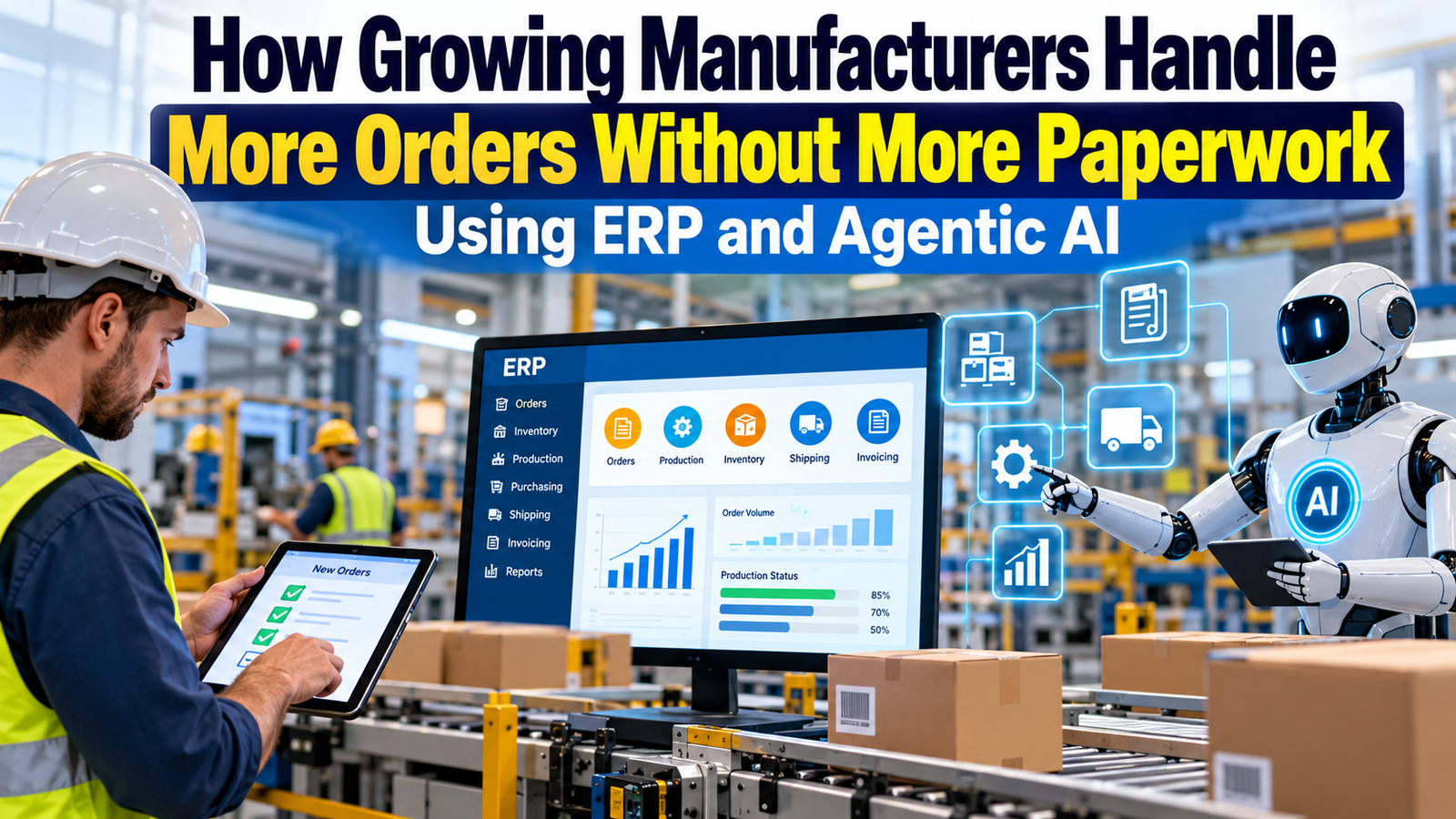
Every manufacturer hits a point where orders start arriving faster than planned. A new distributor signs on, a product line takes off, or a new region opens up. It is the moment the business has worked toward, but it comes with a catch. More orders mean more quotes, more purchase orders, more production runs, more shipments, and, if nothing changes, a lot more administrative work. Growing plants are finding they do not have to pick between taking on new business and keeping the back office under control. With connected data and an AI agent handling the routine steps, they can grow order volume while the paperwork stays flat.
The Hidden Workload Behind Every New Order
Each order carries the same trail of tasks. Someone enters it, checks material availability, confirms pricing and terms, releases the work order, tracks progress, books shipping, and sends the invoice. None of these steps is difficult on its own. At ten orders a week, the team handles them easily. At fifty, the same steps start filling entire days, and the people who should be talking to customers or improving the process spend their time re-keying data and chasing approvals.
The usual response is to hire, and sometimes that is the right decision. But many plants first want to know how much more their current team could handle if the repetitive work came off their plates, so new hires go into roles that actually grow the business.
Enter Data Once and Let It Move Through the Plant
The most effective way to keep paperwork in check is to make sure information is entered once and flows to every step that needs it. A well-configured manufacturing ERP does exactly that. When a sales order is entered, planning, purchasing, production, shipping, and accounting all work from the same record, with no one typing it in again. Inventory updates as material is received and consumed. Production progress is visible to customer service. Shipping confirmations feed directly into invoicing.
Plants that tighten this flow usually find more to simplify. Standardized item numbers and descriptions cut down on mix-ups. Barcode scanning at receiving and picking removes manual entry. Approval workflows inside the ERP replace email chains and paper signatures. Customer-specific pricing and terms stored in one place end the repeated lookups. Each change saves a few minutes per order, and at higher volume those minutes add up fast.
Hand Off Rule-Based Tasks to an AI Agent
Once data flows cleanly, the next step is to look at the routine tasks that remain and spot the ones that follow clear rules. Confirming material is available for a new order. Raising a purchase requisition when stock drops below the reorder point. Sending an order acknowledgment with an accurate ship date. Notifying a customer when their shipment leaves the dock. These are tasks an assistant can prepare or complete while people stay in charge of the outcome.
This is where agentic AI in manufacturing helps growing plants keep up. An AI agent can carry out a short chain of steps toward a goal instead of answering one question at a time. When a new order comes in, it can check on-hand inventory and open supply, confirm capacity on the required work centers, draft an acknowledgment with a realistic ship date, and queue it for a customer service rep to review. When material runs short, it can prepare a purchase requisition with the preferred supplier, the right quantity, and the needed-by date, then route it to a buyer for approval.
Clear Rules Keep the Team in Control
The agent works inside rules the plant defines. The team decides which tasks it can complete on its own, which need a person’s approval, and which stay entirely with people. A plant might let the agent send shipment notifications automatically, require buyer approval on every purchase requisition, and keep pricing exceptions fully manual. Every action is logged with the data behind it, so reviewing what happened takes seconds, and auditors get a clear trail.
How Daily Work Changes as Volume Grows
Plants that work this way tend to see the same patterns. The time from order entry to production release gets shorter, because the availability and capacity checks are already done. Customers receive acknowledgments and shipping updates promptly, which supports stronger accounts. The volume of manual forms and internal emails goes down even as order count climbs.
The team feels the difference too. With routine steps handled consistently, people have room for unusual requests, process improvements, and conversations with customers about what they need next. New hires get up to speed faster because the workflow is defined and documented instead of living in someone’s head.
For More Information: Click Here Blooketwiki
Leadership benefits from the visibility. With orders, inventory, and production connected, it is easier to see where the business is performing, where bottlenecks are forming, and where the next investment should go.
Map One Order From Quote to Cash Before You Automate
Pick a typical order and trace it from the customer’s request to the payment landing. Mark every point where someone enters, copies, re-checks, or emails information. Those points show exactly where the administrative load sits. Then choose two or three that follow clear rules, such as order acknowledgments or purchase requisitions, and start there.
Write down what the agent may do on its own and what must go to a person. Run it alongside the current process for a few weeks, compare its output against what the team would have done, and adjust the rules. Quick wins on a small scope build the confidence to expand to the next set of tasks.
Grow the Business, Not the Back Office
Growth is the goal, and the best way to absorb it is with systems that let a capable team do more of what it already does well. A connected ERP keeps information moving, and an AI agent handles the routine steps in between. The result is a plant that can say yes to more orders, keep customers informed, and keep its people focused on the work that actually moves the business forward.
About the Contributor
Nishkam Batta, Editor-in-Chief, HonestAI Magazine | AI Consultant, GrayCyan AI Solutions
Nish leads an applied AI company helping manufacturing and related companies automate operations with human-in-the-loop AI that integrates into ERPs, WMS, CRMs, and other enterprise tools, with an emphasis on explainable AI, clear audit trails, and measurable outcomes. His team builds agentic ERP systems that execute multi-step tasks inside approved guardrails so humans keep accountability, approvals, and override control.
Book a Consultation | LinkedIn
 HG Star
 Admin