

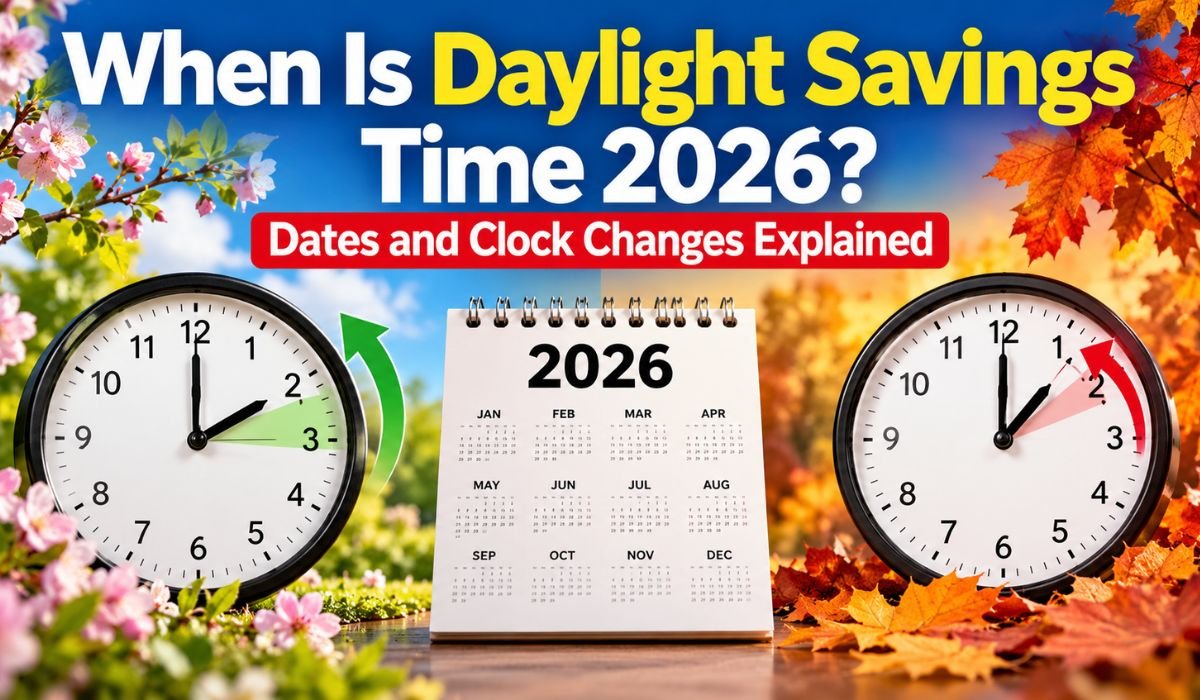
If you’re wondering When Is Daylight Savings Time in 2026, there are two dates worth putting on your calendar. Across most of the United States, Daylight Saving Time began on Sunday, March 8, 2026. It ends on Sunday, November 1, 2026. Both changes take place at 2:00 a.m. local time.
The idea is simple enough. In March, clocks move forward by one hour, a change commonly remembered as “Spring Forward.” In November, they move back by one hour, giving us the familiar phrase “Fall Back.”
Yet that one-hour adjustment has a surprisingly wide reach. It changes when the sun appears to rise and set according to the clock, can temporarily affect sleep routines, and influences everything from morning commutes and school schedules to travel and evening activities.
Daylight Saving Time also remains the subject of a long-running national debate. While many people enjoy having more light in the evening, sleep experts have raised concerns about changing the clocks and about making DST permanent.
So, what exactly happens in 2026, why are we still changing the clocks, and could the practice eventually disappear? Here’s what you need to know.
Quick Information
| Quick Fact | Details |
|---|---|
| Topic | Daylight Saving Time |
| Common Search Term | Daylight Savings Time |
| DST Starts In 2026 | March 8, 2026 |
| DST Ends In 2026 | November 1, 2026 |
| Spring Change Time | 2:00 a.m. Local Time |
| Fall Change Time | 2:00 a.m. Local Time |
| Spring Clock Change | Forward One Hour |
| Fall Clock Change | Backward One Hour |
| Spring Phrase | Spring Forward |
| Fall Phrase | Fall Back |
| Next DST Start | March 14, 2027 |
| Main State Exceptions | Hawaii And Most Of Arizona |
| Arizona Exception | Navajo Nation Observes DST |
| US DST Start Rule | Second Sunday In March |
| US DST End Rule | First Sunday In November |
| Federal Oversight | US Department Of Transportation |
| Current Schedule Introduced | 2007 |
| Standard Term | Daylight Saving Time |
When Is Daylight Savings Time In 2026?
For most Americans, Daylight Saving Time 2026 began on March 8 and will end on November 1.
The spring transition happened at 2:00 a.m. local time. Instead of reaching 2:01 a.m., participating areas moved their clocks directly to 3:00 a.m. That effectively removed an hour from the overnight schedule.
The November change works in reverse. At 2:00 a.m. on November 1, clocks move back to 1:00 a.m. The hour between 1:00 and 2:00 therefore occurs twice.
The dates aren’t identical every year because federal rules don’t tie the changes to fixed calendar dates. Instead, Daylight Saving Time begins on the second Sunday in March and ends on the first Sunday in November.
That’s an important distinction for anyone planning ahead. Rather than assuming DST always starts or ends on the same date, it’s better to check the calendar each year.
What Is Daylight Saving Time?
Daylight Saving Time, usually shortened to DST, is a system that moves clocks one hour ahead of Standard Time during part of the year.
You’ll often hear it called “Daylight Savings Time.” That’s also a popular search phrase, but the official term is Daylight Saving Time, without the extra “s.”
One of the biggest misconceptions about DST is that it somehow creates additional daylight. It doesn’t. The amount of sunlight available on a particular day isn’t determined by our clocks.
Instead, DST changes how daylight lines up with the hours shown on those clocks.
Moving the clock forward shifts an hour of daylight toward the evening according to local clock time. As a result, people generally experience later sunsets during the DST period than they would under Standard Time.
When clocks return to Standard Time in autumn, daylight shifts back toward the morning. Sunrise appears earlier by the clock, but evening darkness arrives sooner as well.
When Do Clocks Spring Forward In 2026?
The Spring Forward 2026 transition took place on Sunday, March 8.
At 2:00 a.m. local time, clocks jumped ahead to 3:00 a.m. in areas that observe Daylight Saving Time. In practical terms, that made the overnight clock schedule one hour shorter.
The effects became noticeable almost immediately. Sunrise and sunset occurred later according to the clock, providing more evening light but less morning light.
For many people, the brighter evenings are one of the most appealing features of DST. There’s more daylight after the typical work or school day for walking, exercising, shopping, gardening, sports, or simply spending time outdoors.
The spring change does come with a tradeoff, however. Because the clock suddenly advances by an hour, sleep schedules can temporarily feel out of sync. Someone who wakes at the same clock time may initially feel as though they’re getting up an hour earlier.
That sudden adjustment is one reason the spring clock change receives particular attention from sleep researchers.
When Do Clocks Fall Back In 2026?
The next major Clock Change In 2026 arrives on Sunday, November 1.
At 2:00 a.m. local time, participating areas turn their clocks back to 1:00 a.m. That’s where the easy-to-remember expression “Fall Back” comes from.
Because the hour between 1:00 and 2:00 a.m. occurs twice, the overnight clock schedule becomes an hour longer. People commonly say they’re gaining an hour of sleep, although that isn’t guaranteed. How much someone actually sleeps depends on bedtime, wake time, and their usual routine.
The bigger difference often becomes apparent later in the day.
After the clocks change, sunrise occurs about an hour earlier by clock time, and so does sunset. That means mornings become brighter earlier, while evening darkness can seem to arrive surprisingly quickly.
It’s one reason the first few days after the November transition can feel so different, even though the natural seasonal loss of daylight is gradual.
Why Do We Change The Clocks?
The basic idea behind Daylight Saving Time is to shift more usable daylight into the evening during the longer days of the year.
Historically, supporters have argued that later evening daylight can benefit recreation, commerce, transportation, and energy use. If people have more natural light available during their active evening hours, the thinking goes, they may need less artificial lighting.
The energy argument, however, isn’t as straightforward today as it might sound.
Modern homes and businesses consume electricity for much more than lighting. Air conditioning, heating, appliances, computers, entertainment systems, and other electronics all contribute to overall energy demand.
Lighting technology has changed dramatically as well. Today’s efficient lighting uses far less electricity than older incandescent bulbs.
Research into DST’s overall energy effects has therefore produced varying results. Climate, location, technology, lifestyle, and patterns of energy consumption can all influence the outcome.
A better way to think about Daylight Saving Time is that it rearranges when we experience daylight according to the clock. It doesn’t create more sunlight, and substantial energy savings shouldn’t be treated as a universal result.
How Daylight Saving Time Developed In America
Daylight Saving Time In The United States has a history stretching back more than a century, and the rules haven’t always been as consistent as they are today.
The United States first adopted a national form of Daylight Saving Time in 1918, during World War I. That arrangement didn’t remain permanently in place, and DST practices became inconsistent in the decades that followed.
Different states and communities could follow different schedules, creating obvious problems for transportation, broadcasting, business, and anyone trying to coordinate activities across state lines.
The Uniform Time Act of 1966 brought greater consistency to the system by establishing a federal framework for time zones and seasonal clock changes.
Even then, the rules continued to evolve.
The country experimented with extended Daylight Saving Time during the energy concerns of the 1970s, and Congress later adjusted the schedule again.
The Energy Policy Act of 2005 extended the DST period. Beginning in 2007, the United States adopted the schedule most Americans recognize today: Daylight Saving Time starts on the second Sunday in March and ends on the first Sunday in November.
Daylight Saving Time Vs. Standard Time
The difference between Daylight Saving Time And Standard Time is relatively simple, but it sits at the center of today’s debate over changing the clocks.
During DST, participating locations move their clocks one hour ahead of Standard Time. The result is later evening daylight according to the clock, along with later morning light.
Standard Time removes that additional hour and restores the regular time-zone offset. In practical terms, that generally means relatively more morning light and earlier evening darkness.
Neither system changes how much sunlight Earth actually receives.
Where the distinction becomes especially important is human biology.
Light is one of the strongest environmental signals controlling the body’s circadian rhythm, the internal timing system that helps regulate sleep and wakefulness.
For that reason, the American Academy of Sleep Medicine has supported permanent Standard Time rather than permanent Daylight Saving Time. Its position emphasizes the closer alignment between Standard Time, morning light, and human circadian biology.
That doesn’t mean everyone prefers Standard Time. Plenty of people value later evening sunlight, which helps explain why finding a broadly popular replacement for seasonal clock changes has proved difficult.
Which States Do Not Observe Daylight Saving Time?
Although most Americans change their clocks twice a year, not everyone does.
Hawaii remains on Standard Time throughout the year, as does most of Arizona. Arizona’s approach makes sense in part because additional summer evening daylight isn’t necessarily attractive in a state known for extreme heat.
There’s an important exception inside Arizona. The Navajo Nation observes Daylight Saving Time, including the portion of its territory located within the state.
Several US territories also remain on Standard Time throughout the year. These include Puerto Rico, Guam, American Samoa, the US Virgin Islands, and the Northern Mariana Islands.
The legal distinction behind these exceptions is worth understanding. Under current federal law, states can choose to exempt themselves from Daylight Saving Time and remain on Standard Time.
What they generally can’t do on their own is move permanently to Daylight Saving Time.
That matters because several states have considered measures supporting year-round DST. Such measures don’t necessarily mean permanent Daylight Saving Time can immediately take effect; federal law remains a key part of the process.
How The Clock Change Affects Sunrise And Sunset
Few aspects of the time change are more noticeable than what happens to sunrise and sunset.
Still, there’s an important point to remember: Daylight Saving Time doesn’t control the actual length of the day.
Seasonal changes in daylight occur largely because Earth is tilted on its axis as it travels around the sun. That’s why summer days are longer and winter days are shorter in much of the United States.
The clock change simply alters the time labels attached to those daylight hours.
Suppose sunset occurs at around 6:00 p.m. shortly before the November transition. Once the clocks move backward, a comparable sunset would appear around 5:00 p.m. by the clock, aside from the small natural seasonal change occurring from one day to the next.
That’s why “Fall Back” can feel so dramatic. Evening darkness suddenly appears an hour earlier according to the clock, even though the astronomical change from Saturday to Sunday isn’t nearly that large.
How Daylight Saving Time Can Affect Sleep And Health
Our bodies don’t operate according to wall clocks alone. They also follow an internal timing system known as the circadian rhythm.
This roughly 24-hour biological cycle helps regulate when we feel alert and when we become sleepy. Exposure to light and darkness plays a major role in keeping that rhythm synchronized with the outside world.
When society suddenly moves its clocks by an hour, our schedules can shift faster than our internal clocks.
The spring transition receives particular attention because it effectively removes an hour from the overnight clock schedule. Research has associated seasonal time changes, especially the spring transition, with short-term sleep disruption and changes in alertness, along with some health and safety outcomes.
Those findings should be interpreted carefully. They don’t mean every person will experience a significant health problem after changing the clocks, nor do they prove that every reported association has the same cause. People’s responses vary depending on sleep habits, age, work schedules, health, and other factors.
Even so, concerns about circadian alignment are among the reasons sleep-medicine experts have argued for ending seasonal clock changes and adopting permanent Standard Time.
How To Prepare For The Time Change
You can’t prevent the clocks from changing, but a consistent sleep routine can make the transition less disruptive.
The best preparation actually begins with everyday habits. Going to bed and waking up at reasonably consistent times helps the body’s internal clock maintain a predictable rhythm.
Ahead of the spring transition, gradually shifting bedtime and wake time earlier can make the eventual one-hour change feel less abrupt. Even small adjustments over several days may be easier than suddenly changing the entire schedule overnight.
Morning daylight can also be useful because light provides a strong signal to the body’s circadian system that the day has begun.
Regular physical activity, predictable meal times, and a relaxing nighttime routine can further support healthy sleep.
Families with young children may find gradual changes especially helpful. Children often rely heavily on established bedtime and wake-up routines, so moving the schedule in smaller steps can make the transition easier.
After the November change, exposure to daylight earlier in the day can similarly help reinforce the new schedule.
Do Phones Change Time Automatically?
For most people, changing the clock has become much easier than it once was.
Modern smartphones, computers, tablets, smartwatches, and many internet-connected devices automatically adjust for Daylight Saving Time when automatic date, time, and time-zone settings are enabled.
Current operating systems generally contain time-zone information that tells the device when local DST transitions occur.
That doesn’t mean every clock in your home will take care of itself.
Traditional watches, wall clocks, microwave ovens, older alarm clocks, some thermostats, and vehicle dashboards may still require manual adjustment.
It’s worth checking important devices after the transition rather than assuming everything has updated correctly. This is particularly important if you have an early flight, work shift, medical appointment, school commitment, or another event where an incorrect clock could create a real problem.
Travelers should also make sure their phones are using the correct local time zone rather than a manually selected setting.
Does Daylight Saving Time Really Save Energy?
Energy conservation is one of the oldest arguments associated with Daylight Saving Time, but modern evidence paints a more complicated picture.
The traditional logic is easy to understand. If people have more daylight available during the evening, they may switch on household lights later and use less electricity for illumination.
But household energy consumption has changed enormously over the decades.
Heating and cooling can represent substantial portions of residential energy use. Moving daylight later may influence those demands differently depending on the region and season. Electronics and appliances add another layer, while modern energy-efficient lighting has reduced the amount of electricity required to illuminate homes.
As a result, studies examining DST and energy consumption haven’t produced one simple conclusion that applies everywhere.
The effect can vary according to geography, climate, technology, household behavior, and the type of energy being measured.
So while energy conservation remains part of DST’s history, it’s misleading to suggest that moving the clocks automatically delivers major energy savings everywhere.
Could Daylight Saving Time Become Permanent?
For years, Americans have debated whether changing the clocks twice annually is still worth the disruption.
That discussion often sounds straightforward: stop changing the clocks. The harder question is what comes next.
One option is Permanent Daylight Saving Time, which would preserve later evening light throughout the year. Proposals including versions of the Sunshine Protection Act have sought changes along those lines.
Another possibility is permanent Standard Time. This approach has received support from sleep and medical experts who emphasize morning light and circadian alignment.
The difference is significant. Ending seasonal clock changes doesn’t automatically mean adopting permanent DST.
Under the current federal framework, states may choose to remain on Standard Time throughout the year. They generally can’t independently adopt permanent Daylight Saving Time without a change in federal law.
Until the law changes, areas participating in DST continue to follow the established March and November schedule.
That also means readers should be cautious when social-media posts claim that an upcoming clock change has been canceled. A proposal, state measure, or political statement isn’t necessarily the same thing as a federal rule taking effect.
When Is The Next Daylight Saving Time Change?
Once Daylight Saving Time Ends on November 1, 2026, participating areas return to Standard Time for the winter.
The next scheduled transition occurs on Sunday, March 14, 2027.
At 2:00 a.m. local time that morning, clocks will move forward to 3:00 a.m., beginning another period of Daylight Saving Time under the current schedule.
You don’t necessarily need to memorize each year’s dates. Remembering the rule is often easier: Spring Forward happens on the second Sunday in March, while Fall Back occurs on the first Sunday in November.
International travelers need to be a little more careful.
Many countries don’t observe Daylight Saving Time at all, and countries that do aren’t necessarily on the same schedule as the United States. That means the time difference between two cities can temporarily change during parts of the year.
It’s worth checking local time-zone information before international flights, virtual meetings, or calls rather than assuming the usual time difference still applies.
Why The Time Change Still Matters
Automatic clocks have made the mechanical side of Daylight Saving Time almost effortless. For many people, their phone quietly updates overnight and that’s the end of it.
Behind the scenes, however, the change remains surprisingly significant.
Transportation systems, workplaces, schools, hospitals, broadcasters, financial markets, computer networks, and international businesses all depend on accurate timekeeping.
There are everyday consequences as well. Clock changes influence whether commuters travel in daylight or darkness, when children leave for school, how much evening light families have available, and how sleep schedules align with morning responsibilities.
These practical effects help explain why Daylight Saving Time remains a public-policy and health discussion more than a century after its introduction in the United States.
The debate isn’t simply about whether people like changing their clocks. It’s also about what permanent time system would best balance human biology, public safety, business interests, recreation, and personal preference.
Understanding those competing priorities gives a much clearer picture of why the issue has been so difficult to settle.
Final Thoughts
Knowing When Is Daylight Savings Time takes much of the confusion out of the twice-yearly clock change.
In 2026, Daylight Saving Time began on March 8, when participating areas moved their clocks forward by an hour. The next change arrives on November 1, when clocks move back one hour and Standard Time returns.
The adjustment itself takes only seconds, especially now that phones and other connected devices often handle it automatically. Its effects, however, reach much further. The time change alters when we experience morning and evening light, can temporarily disrupt sleep routines, and affects schedules across transportation, schools, workplaces, and everyday family life.
The larger debate isn’t going away either. Some Americans favor permanent Daylight Saving Time because they enjoy brighter evenings, while many sleep experts support permanent Standard Time because of its closer relationship with morning light and circadian biology.
For now, the schedule remains straightforward: Fall Back on November 1, 2026, and Spring Forward again on March 14, 2027.
Checking your clocks, alarms, travel plans, and sleep routine before each transition can make the adjustment easier. And while the future of Daylight Saving Time remains open to debate, knowing exactly when and why the clocks change means you won’t be caught off guard when the hour shifts again.
FAQs About Daylight Saving Time 2026
When Is Daylight Savings Time In 2026?
Daylight Saving Time began on Sunday, March 8, 2026, in most US locations that observe it. It ends on Sunday, November 1, 2026. Both transitions occur at 2:00 a.m. local time.
When Do Clocks Go Back In 2026?
Clocks go back on Sunday, November 1, 2026. At 2:00 a.m. local time, clocks return to 1:00 a.m. in participating locations. This marks the return to Standard Time.
Do We Gain An Hour In November 2026?
Yes, in terms of clock time. When clocks fall back, the hour between 1:00 and 2:00 a.m. happens twice. That makes the overnight clock schedule an hour longer, although whether someone actually sleeps an additional hour depends on their routine.
Does Every US State Observe Daylight Saving Time?
No. Hawaii and most of Arizona don’t observe Daylight Saving Time. The Navajo Nation is an important exception within Arizona because it does observe DST. Several US territories also remain on Standard Time throughout the year.
Will My Phone Change Time Automatically?
Most modern smartphones adjust automatically when automatic date, time, and time-zone settings are enabled. Traditional clocks and some appliances, watches, thermostats, and vehicle clocks may still require manual adjustment.
Is Daylight Saving Time Ending Permanently In 2026?
The November 1 transition is the normal seasonal end of Daylight Saving Time, not automatically the permanent end of the system. Under the current federal framework, participating areas are still scheduled to follow the established seasonal DST rules unless the law changes.
When Does Daylight Saving Time Start Again?
Daylight Saving Time is scheduled to return on Sunday, March 14, 2027. At 2:00 a.m. local time, clocks in participating areas will move forward to 3:00 a.m.
Is It Daylight Saving Or Daylight Savings Time?
The official term is Daylight Saving Time, without an “s” after “Saving.” However, Daylight Savings Time is extremely common in everyday conversation and search queries. Both phrases are generally understood to refer to the same clock-changing system.
Learn more and explore exciting content on: Assata Shakur: Biography, Activism, Life in Cuba, and Legacy
 IQ newswire