

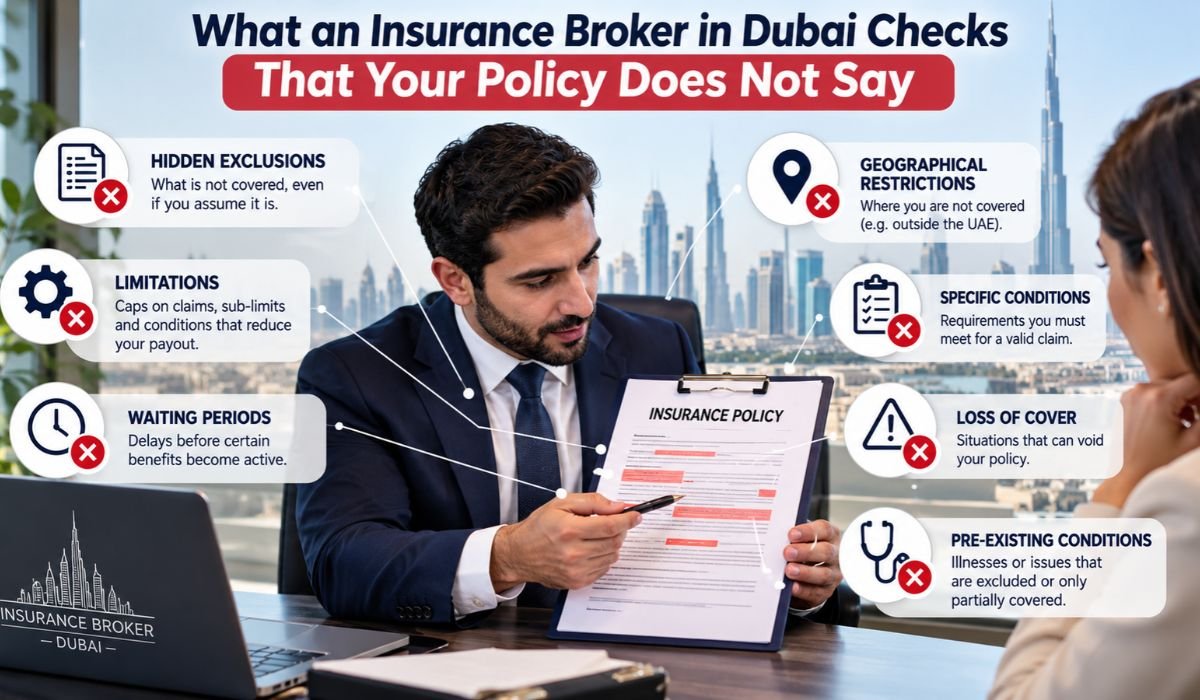
The benefit table is where most people stop reading. It lists an annual limit, a co-insurance percentage and a network tier, and it reads as a complete description of what has been bought.
It describes a product. The policy nowhere states the minimum that product must meet, and neither does the health insurance law, which is why an insurance broker in Dubai may read a regulator’s circular before a quotation. What follows explains where the minimum is set, which documents can override your benefit table, and how to tell which version of a rule you have.
Where the Law Stops Describing Your Cover
Law No. 11 of 2013 is the instrument that makes cover compulsory across the emirate. Article 2 defines Basic Coverage as the minimum health benefits prescribed for a resident under the law’s implementing resolutions. The law names a floor and then declines to describe it.
Its implementing bylaw does the same. Administrative Resolution No. 78 of 2022 defines Basic Coverage as the minimum health benefits a resident must receive under the relevant resolutions, and it includes no schedule of benefits of its own. Article 19 requires a resident package to cover at least the Basic Coverage services that the Dubai Health Insurance Corporation prescribes, and Article 24 requires a registered package to offer the minimum benefits that the same body specifies.
In other words, the obligation sits in the law, and the content sits two documents further on.
The Documents That Set the Actual Minimum
The Dubai Health Insurance Corporation, which operates under the supervision of the Dubai Health Authority, holds three powers that matter to anyone buying cover. The review power has teeth because Article 19 of the bylaw requires the corporation to periodically review packages and their prescribed benefits. Article 31 requires it to issue and publish implementing resolutions, and Article 27 allows it to set standards through periodic circulars.
Three things are therefore decided outside the document you sign:
- What the minimum package must include, which the bylaw leaves entirely to the services the corporation prescribes
- Whether your insurer may sell that cover at all, since an insurance company has to apply to the corporation before it may provide either basic or supplementary cover
- Whether the package exists as an approved product, because insurers must present existing and future packages to the corporation for registration and approval before promoting them
For anyone comparing two quotations for medical insurance in Dubai, that last point changes what the comparison is. Both documents are approved products measured against the same prescribed floor, so an insurance broker in Dubai is reading two registered packages against that floor.
Why Emergencies Ignore Your Waiting Period
The corporation’s Emergency Coverage Directive, document DHIC/HIR-002/2024, took effect on 27 October 2025. Benefit tables do not mention it.
Insurers must cover all emergency conditions regardless of network affiliation. Policies must cover all emergency conditions up to stabilization, regardless of the underlying cause, and the directive names road traffic accidents and work-related injuries among the causes, along with anything else a standard policy would exclude. Emergency conditions also sit outside waiting periods and pre-existing condition exclusions.
Emergency claims from non-network providers have to be settled within seven working days. An insurer may not reject or delay one on the grounds of network, location or pre-authorization status.
A buyer reads the network tier and the waiting period more carefully than anything else on the page, and a directive printed on neither sets both of them aside once a condition is an emergency.
Someone taken to the nearest emergency department after a road traffic accident is therefore not outside cover because that hospital sits above the network tier on their policy.
The limit on this is worth stating plainly. The protection runs up to stabilization, so it is not a general license to use any hospital for any treatment, and whether a presentation counts as an emergency is decided by the directive’s own definition rather than by how urgent it felt at the time.
Reading a Regulation’s Dates Before Its Rules
Every one of these documents carries an identifier, an issue date, an effective date and a revision date on its face. The Emergency Coverage Directive shows a revision date of 7 October 2027. The corporation’s policy document on compliance with the Essential Benefits Plan, DHA/DHI/HE/PP/010, was issued on 24 November 2020 and carries a revision date of 25 November 2022.
Article 31 of the bylaw also sets the clock. A corporation resolution binds the people it applies to only thirty days after publication, unless the resolution itself states a different period.
A copy saved from an email two renewals ago may sit behind a revision. The documents are published, though matching the current version to one specific package is rarely a one-click exercise.
Does a Compliant Policy Stay Compliant?
Not permanently. When the 2022 bylaw came into force, it allowed policies issued before its effective date to continue until they expired or until one year after that date, whichever came first, so a revised floor doesn’t reach into a policy already in force.
It does reach the renewal. Compliance is tested again every time the policy is rewritten, and a package that cleared the minimum last year has been promised nothing about this one.
Two smaller provisions in the same bylaw matter for the same reason. Cover must continue for 30 days after a visa cancellation or until the person leaves the country, and a resident with neither an employer nor a sponsor must arrange cover independently by a deadline the corporation sets.
Frequently Asked Questions
Who decides the minimum health insurance cover in Dubai?
The Dubai Health Insurance Corporation, in practice. Law No. 11 of 2013 defines Basic Coverage by reference to resolutions issued under it, and the 2022 implementing bylaw requires a resident package to cover at least the Basic Coverage services the corporation prescribes. The corporation operates under the supervision of the Dubai Health Authority.
Does my policy change when the regulations change?
Not during its term. The 2022 bylaw let policies issued before its effective date run until expiry or one year after that date, whichever came first. The renewal is when a revised floor applies, and it’s when an insurance broker in Dubai would measure the package against the current documents.
Are emergencies covered outside my network?
Yes, up to stabilization. The corporation’s Emergency Coverage Directive requires insurers to cover all emergency conditions regardless of network affiliation, and to cover them regardless of the underlying cause. It also places emergency conditions outside waiting periods and pre-existing condition exclusions.
What is the Essential Benefits Plan?
A name for the floor itself. The corporation’s policy document describes it as the minimum level of health insurance cover that Dubai residents must meet or exceed, and notes that new group and individual policies issued from 1 January 2015 had to comply with or exceed its standards. Anyone buying a top-up layer must already hold a policy that meets or exceeds it.
Who insures a Dubai resident with no employer or sponsor?
They arrange it themselves. The 2022 bylaw requires residents with neither an employer nor a sponsor to obtain cover by a deadline the corporation sets, covering freelancers, investors and anyone on a self-sponsored permit. This is the group for whom individual medical insurance in Dubai is usually the route to a compliant policy.
What the Benefit Table Leaves Out
The floor your policy has to meet was written somewhere else, by someone else, with its own dates printed on it.
Establish which corporation documents apply to the package and note the effective and revision dates on each. Then read the emergency provisions before the network tier. No brochure for medical insurance in Dubai sets out that part.
That leaves you with a clear view of which parts of your cover are still open to negotiation and which a regulator has already settled. An insurance broker in Dubai working from the current documents can usually tell you which is which before a renewal lands.
 Sky News Agency