

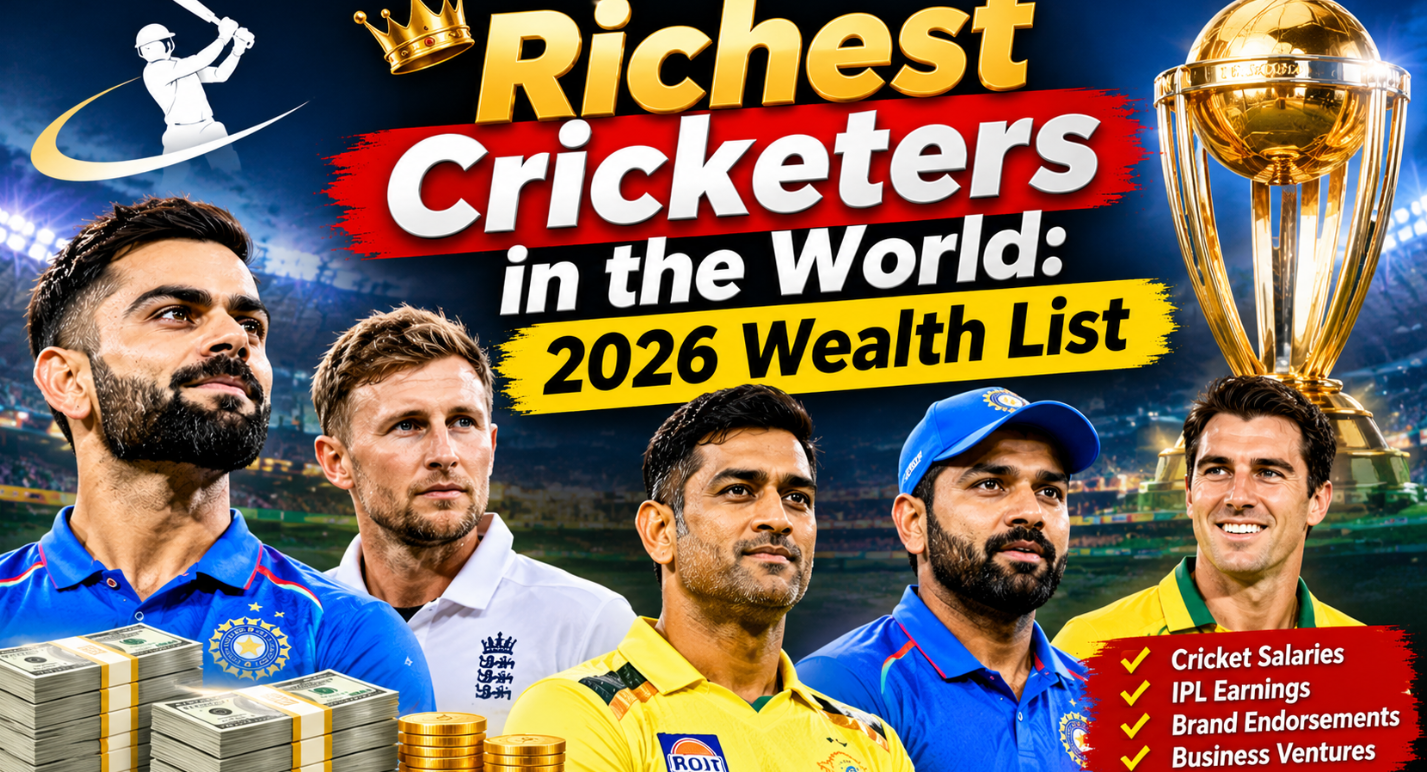
Sachin Tendulkar led a widely circulated 2026 estimate of cricket’s wealthiest personalities, followed by MS Dhoni and Virat Kohli. The list reflects far more than match payments: long international careers, franchise cricket, endorsements, media work, business interests and personal brands all shape a player’s financial position. Net-worth rankings should be read as estimates rather than audited financial statements, but they illustrate how leading cricketers have created lasting value beyond their playing days.
The 2026 estimated top 10
A 2026 ranking published by CricRadar placed five Indian players in the top 10, underlining the commercial scale of cricket in India. It also included major figures from Australia, the West Indies and South Africa, showing that elite international careers can remain financially valuable long after retirement.
| Rank | Cricketer | Country | Estimated net worth |
| 1 | Sachin Tendulkar | India | $170 million |
| 2 | MS Dhoni | India | $125 million |
| 3 | Virat Kohli | India | $120 million |
| 4 | Ricky Ponting | Australia | $75 million |
| 5 | Brian Lara | West Indies | $60 million |
| 6 | Jacques Kallis | South Africa | $48 million |
| 7 | Shane Warne | Australia | $45 million |
| 8 | Virender Sehwag | India | $42 million |
| 9 | Yuvraj Singh | India | $38 million |
| 10 | Rohit Sharma | India | $35 million |
These figures are not official declarations from the players. Wealth assessments can differ because private investments, property, taxes, liabilities, shareholdings and commercial agreements are not always public. A useful reading of such a list is therefore comparative: it identifies the players whose cricket careers and off-field activities have built exceptional earning power.
Why Sachin Tendulkar remains first
Tendulkar’s estimated $170 million placed him clearly at the top of the 2026 list. His position reflects the enduring commercial value of a career that made him one of cricket’s most recognisable figures. A long playing career established his stature, while endorsement agreements and business investments extended his financial profile beyond retirement.
His appeal has also lasted across generations of Indian supporters. That continuity matters in sport, where a player’s earning potential often depends on whether their name remains meaningful after their final international match. Tendulkar’s legacy has continued to carry commercial weight, making him the benchmark in this particular ranking.
MS Dhoni and the value of leadership
MS Dhoni ranked second with an estimated net worth of $125 million. His profile combined wicketkeeping, captaincy and a calm public image, all of which helped him become one of the game’s most prominent personalities. CricRadar attributed his wider wealth-building activity to sports ventures, endorsements, agriculture projects and other business investments.
Leadership can be a particularly valuable asset for cricketers because it gives a player a clear identity beyond statistics. Dhoni’s captaincy record and visibility in franchise cricket helped maintain that identity. The result is a commercial profile that has remained strong through a range of roles connected with cricket and business.
Virat Kohli’s modern commercial reach
Virat Kohli ranked third at an estimated $120 million. His income profile is associated with cricket contracts, brand partnerships, fitness ventures, fashion businesses and social-media influence. That mix demonstrates how active players can use performance, visibility and a distinctive personal image to create multiple revenue streams at the same time.
For fans following an upcoming series, form and conditions remain separate from wealth rankings. Financial stature does not decide a scorecard; team balance, venue and recent performances are more relevant. Readers assessing those sporting factors can use a Cricket Match Prediction resource alongside their own view of the game rather than treating celebrity or commercial value as a measure of likely results.
The international legends behind the Indian trio
Ricky Ponting was fourth in the 2026 estimate, with $75 million. His post-playing involvement in coaching, broadcasting and franchise cricket has helped sustain his connection with the sport. For retired players, these roles can be important because they turn deep knowledge of the game into a second professional career.
Brian Lara followed at $60 million. His standing reflects a celebrated playing career complemented by media appearances, endorsements and cricket-related roles. The ability to remain visible around the sport can be especially significant for former players, as it keeps their expertise and public recognition active long after their international careers have ended.
Jacques Kallis, estimated at $48 million, was sixth. Widely known for his all-round credentials, he built a post-retirement presence through coaching and cricket consultancy. Shane Warne ranked seventh at $45 million. His financial legacy included work as a commentator, mentor and cricket ambassador, demonstrating the broad range of opportunities available to players with distinctive expertise and personalities.
Indian stars with strong post-playing and active-career profiles
Virender Sehwag occupied eighth place with an estimated $42 million. His continuing popularity has been linked to commentary, digital content, business ventures and endorsements. A recognisable playing style can remain part of a former player’s public identity, and Sehwag’s aggressive batting persona has continued to make him a familiar figure in cricket media.
Yuvraj Singh ranked ninth at $38 million. In addition to his cricket career and endorsements, his involvement in entrepreneurship and investments strengthened his commercial portfolio. His place in the list highlights a broader trend: former players increasingly use the networks, discipline and visibility developed through sport to enter business and investment activity.
Rohit Sharma completed the top 10 at an estimated $35 million. CricRadar linked his earnings to international cricket, sponsorship arrangements and endorsement partnerships. As an active India player and captain, his commercial value has been shaped by both sporting responsibilities and public recognition. Active cricketers can have an advantage in maintaining visibility, though their financial standing may also change more quickly as contracts and partnerships evolve.
How cricketers turn fame into long-term wealth
Match fees and central contracts are only one part of the picture. The modern cricket economy creates several routes to earnings, including franchise leagues, commercial partnerships, social-media collaborations, broadcasting, coaching and personal ventures. The Indian Premier League’s prominence has also expanded the commercial environment around cricket, helping players reach audiences that extend beyond international fixtures.
Endorsements are often closely connected to trust and recognisability. A player known for consistency, leadership or a memorable playing style may become attractive to brands because supporters associate those qualities with the individual. This is why long careers can be so valuable: they provide repeated opportunities to build credibility and familiarity with fans.
Business activity is another major differentiator. Investments, sports ventures, real estate interests and entrepreneurship can help transform career earnings into longer-term wealth. However, the exact value of private holdings is usually uncertain. That is one reason rankings from different publications may produce different totals or even alter the order of players.
Reading net-worth lists with care
The difference between income and net worth is important. Income refers to money earned over a period, while net worth is an estimate of assets minus liabilities at a given time. A player might earn heavily in one year without necessarily having the highest long-term net worth, while a retired player may rank highly because of investments and enduring commercial relationships.
The 2026 estimates also show that retirement does not necessarily end a cricketer’s financial influence. Ponting, Lara, Kallis, Warne and Sehwag all appeared in the top 10 because cricket knowledge and public recognition can lead to continued work in media, coaching, advisory roles and business. In that sense, cricketing success can become the foundation for a much longer professional journey.
Conclusion
The richest cricketers list is ultimately a picture of sporting excellence combined with smart off-field opportunities. Tendulkar, Dhoni and Kohli led the 2026 estimates, while legends from several cricketing nations demonstrated the lasting value of reputation, expertise and commercial adaptability. The figures may vary by source, but the wider lesson is clear: the biggest cricket fortunes are rarely built through playing contracts alone.
 Admin