

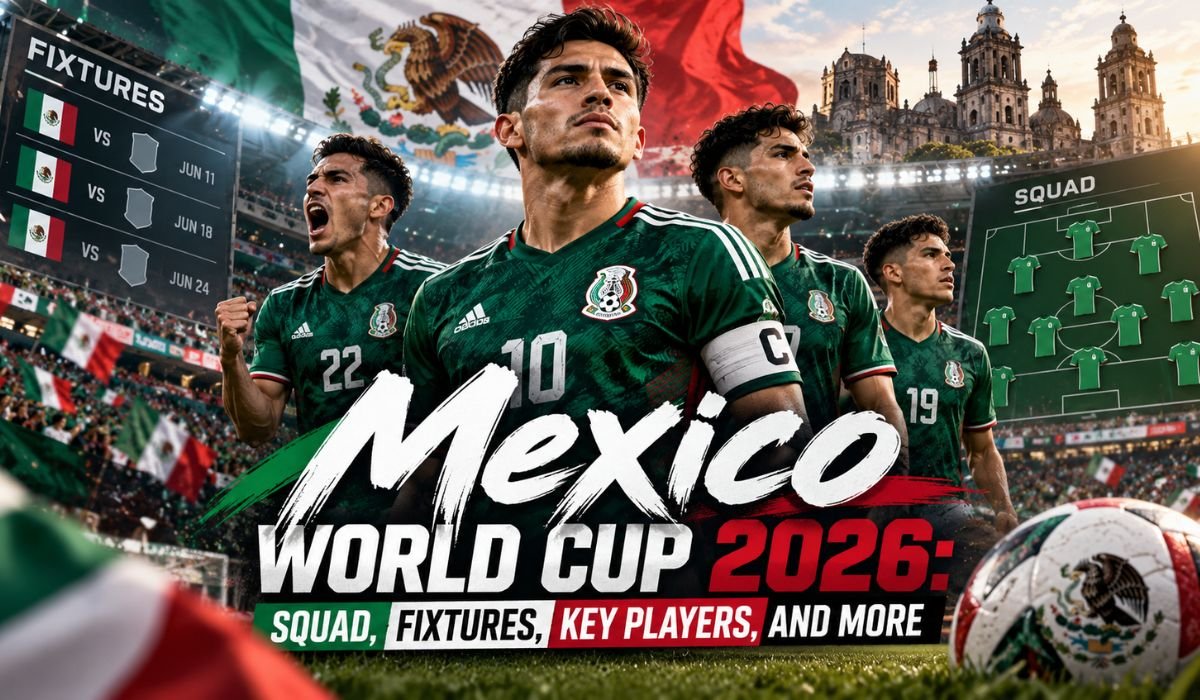
The Mexico World Cup 2026 campaign was always going to feel different. This wasn’t simply another appearance on football’s biggest stage. Mexico entered the tournament as a co-host alongside Canada and the United States, bringing World Cup football back to Mexican soil and placing El Tri in front of a passionate home crowd.
There was history attached to the occasion, too. Mexico had previously hosted the World Cup in 1970 and 1986, and the 2026 edition made it the first country to host or co-host the Men’s FIFA World Cup three times. With that distinction came enormous expectations.
The central question was straightforward: could Mexico use home advantage to make a meaningful run?
Under veteran coach Javier Aguirre, El Tri provided a convincing answer for much of the tournament. Mexico won its group, built its early success around an outstanding defensive record, and finally ended a long wait for another World Cup knockout victory. The journey eventually ended with a dramatic 3–2 defeat to England in the Round of 16.
Mexico didn’t reach the quarter-finals, but its tournament was far from a disappointment. Raul Jimenez and Julian Quiñones delivered important goals, the defense established a strong foundation, and teenager Gilberto Mora emerged as one of the most intriguing figures in Mexico’s next generation.
Quick Bio Information
| Information | Mexico World Cup 2026 Details |
|---|---|
| National Team | Mexico |
| Nickname | El Tri |
| Confederation | CONCACAF |
| Tournament | FIFA World Cup 2026 |
| Host Status | Co-Host |
| Other Host Nations | Canada And United States |
| Head Coach | Javier Aguirre |
| World Cup Group | Group A |
| Group Opponents | South Africa, Korea Republic, Czechia |
| Group Finish | First Place |
| Group Record | Three Wins |
| Group Goals Scored | Six |
| Group Goals Conceded | Zero |
| Round Of 32 Opponent | Ecuador |
| Round Of 32 Result | Mexico 2–0 Ecuador |
| Round Of 16 Opponent | England |
| Round Of 16 Result | Mexico 2–3 England |
| Best Historical Finish | Quarter-Finals |
| Previous Best Finishes | 1970 And 1986 |
| Qualification Method | Automatic As Co-Host |
Mexico At The FIFA World Cup 2026
The 2026 World Cup introduced a new era for the competition. The field expanded to 48 teams, creating a larger group stage and adding a Round of 32 before the more familiar knockout rounds.
For Mexico, though, the tournament was about much more than a new format.
Playing at home offered an obvious advantage, but it also brought considerable pressure. Mexican supporters have high expectations of their national team, and every performance was going to be examined closely.
El Tri entered the competition without being widely regarded as one of the main favorites for the trophy. The squad had experience, physical strength, and proven defenders, but questions remained about attacking creativity and whether Mexico had enough depth to compete with the world’s strongest teams.
Aguirre responded by leaning into the qualities available to him. Mexico played with discipline, stayed compact without the ball, and avoided taking unnecessary risks in dangerous areas. When possession was lost, the team tried to recover it quickly and prevent opponents from developing comfortable attacks.
It wasn’t always spectacular football, but it was effective. More importantly, Mexico looked comfortable with its identity. Rather than allowing the pressure of hosting to become a burden, El Tri used the energy around the tournament to build momentum.
How Mexico Qualified
Mexico didn’t have to navigate the usual CONCACAF qualifying campaign to reach the FIFA World Cup 2026.
As one of the three host countries, Mexico qualified automatically alongside Canada and the United States.
That gave the national team a very different road to the tournament. Instead of worrying about qualifying points and must-win matches, the coaching staff could devote more attention to evaluating players, experimenting with tactical ideas, and deciding which combinations worked best.
Aguirre made extensive use of that freedom after returning for his third spell as Mexico coach in 2024.
Automatic qualification, however, came with its own challenge. Competitive qualifying matches often expose weaknesses that friendlies cannot. Mexico therefore needed to make sure its preparation provided enough intensity to reproduce the demands of World Cup football.
By the time the tournament began, there were signs that the experimentation had paid off. In particular, Mexico looked much more settled defensively than it had at various stages of the build-up.
Mexico World Cup 2026 Fixtures And Results
Mexico’s tournament began against South Africa on June 11, and the hosts immediately delivered the result their supporters wanted.
El Tri won 2–0, with Julian Quiñones and Raul Jimenez getting on the scoresheet. Beyond the result itself, the victory helped remove some of the pressure that inevitably accompanies the opening game of a home World Cup.
Next came Korea Republic at Estadio Guadalajara on June 18. Mexico didn’t need a high-scoring performance. A controlled 1–0 victory was enough to maintain its perfect start and, just as importantly, preserve another clean sheet.
The final Group A match took Mexico back to Mexico City on June 24, where Czechia stood between Aguirre’s team and a perfect group record. Mexico responded with its most convincing group-stage scoreline, winning 3–0.
Three matches had produced three victories, six goals, and no goals conceded.
Mexico then faced Ecuador in the Round of 32 on June 30. El Tri won 2–0, extending its clean-sheet run and ending a 40-year wait for another World Cup knockout victory.
A much tougher challenge followed. England faced Mexico in the Round of 16 on July 5, and an entertaining contest ended 3–2 in England’s favor.
Mexico’s World Cup was over, but its campaign had already delivered several achievements worth remembering.
Mexico World Cup 2026 Squad
Aguirre’s squad was built around a mixture of established internationals and younger players beginning to establish themselves at senior level.
Raul Rangel was among Mexico’s goalkeeping options, while Cesar Montes and Johan Vasquez provided experience in central defense. Jorge Sanchez was one of the players capable of giving the team width from a deeper position.
Edson Alvarez remained an important figure because of his defensive awareness, leadership, and versatility. His ability to operate around midfield and defensive areas gave Aguirre useful tactical flexibility.
Mexico also had several midfield options, including Erik Lira, Luis Romo, and Alvaro Fidalgo. Each offered something slightly different, allowing the coaching staff to adjust the balance of the team depending on the opponent and match situation.
Further forward, Raul Jimenez provided experience and a central attacking presence, while Julian Quiñones gave Mexico pace and directness.
Then there was Gilberto Mora.
The teenager’s inclusion made him one of the squad’s most fascinating players. Mexico wasn’t simply relying on familiar names. By trusting Mora on the sport’s biggest stage, Aguirre also showed a willingness to give the country’s emerging generation genuine responsibility.
Key Mexico Players
Raul Jimenez entered the tournament as one of the most recognizable members of the Mexico squad.
His value extended beyond goals. Jimenez could hold up possession, bring teammates into attacks, occupy central defenders, and use years of international experience to manage difficult moments.
He still contributed on the scoresheet, too.
Jimenez scored against South Africa in Mexico’s opening match and found the net again during the Round of 32 victory over Ecuador.
Julian Quiñones offered a different type of threat. His speed and willingness to run directly at space gave Mexico an attacking dimension that became particularly valuable when opponents pushed players forward.
Quiñones scored Mexico’s opening goal of the tournament against South Africa and struck again against Ecuador.
At the other end of the pitch, Cesar Montes and Johan Vasquez became central to Mexico’s defensive success. Their partnership helped establish the platform for a remarkable run of four consecutive clean sheets to begin the tournament.
Rather than relying on a single superstar, Mexico’s best performances came from several important players understanding and carrying out clearly defined roles.
Gilberto Mora And Mexico’s New Generation
Among all the individual stories surrounding Mexico in 2026, Gilberto Mora’s may have the greatest long-term significance.
Mora entered the World Cup at just 17, an age when most players are still trying to establish themselves in senior club football. Aguirre, however, didn’t treat him as a ceremonial squad member or simply a prospect gaining experience.
He trusted him when the matches became serious.
That faith produced a remarkable milestone against Ecuador. At 17 years and 259 days old, Mora started the knockout match and became the second-youngest player to start a Men’s World Cup knockout game, behind Pele for Brazil against Wales in 1958.
Any comparison with Pele needs obvious caution. Mora is still at the beginning of his career, and attaching enormous expectations to a teenager would do little to help his development.
The more useful takeaway is that he showed enough technical ability and tactical maturity to be trusted in a World Cup knockout match.
For Mexico, that matters. A national team hoping to become more competitive internationally needs talented young players to receive meaningful opportunities rather than simply being described as stars of the future.
Mora received one of those opportunities on the biggest stage available.
Javier Aguirre And Mexico’s Tactical Approach
Few coaches entered the 2026 World Cup with Javier Aguirre’s depth of experience with Mexican football.
Aguirre represented Mexico as a midfielder at the 1986 World Cup. He later coached El Tri at the 2002 and 2010 tournaments before returning for a third spell in charge in 2024.
His experience shaped Mexico’s approach in 2026.
Aguirre didn’t build the team around complicated possession for its own sake. Instead, Mexico generally tried to stay compact, defend important spaces, press at useful moments, and prevent opponents from moving comfortably through central areas.
The full-backs could push forward to create width, allowing attacking players to move into narrower positions. Once Mexico regained possession, the team was willing to attack quickly when space appeared.
That flexibility became especially useful against teams prepared to commit numbers forward.
Some supporters have historically preferred a more adventurous style, but tournament football often rewards organization. Mexico’s results showed why Aguirre values structure so highly.
His side knew what it wanted to do, particularly without the ball.
Mexico’s Defensive Strength
Nothing defined Mexico’s early World Cup run more clearly than its defense.
South Africa couldn’t score against El Tri. Neither could Korea Republic. Czechia also finished its match without a goal.
Then came Ecuador, and Mexico recorded yet another clean sheet.
Four World Cup matches had passed before an opponent finally found the net against Aguirre’s side.
That record couldn’t be credited to one defender or goalkeeper. Mexico defended as a unit. Midfielders worked to close passing lanes before attacks could reach dangerous areas, while the defensive line remained compact enough to limit obvious spaces.
Montes and Vasquez offered strength in central areas, but the work being done in front of them was just as important.
Mexico also reacted aggressively when possession changed hands. Opponents were often forced to make decisions quickly instead of being allowed time to construct attacks comfortably.
England eventually found solutions in the Round of 16, but that shouldn’t erase what came before. Mexico’s defensive organization was one of the strongest and most reliable parts of its World Cup campaign.
Mexico’s Attack And Biggest Challenges
Before the tournament, Mexico’s ability to create chances consistently was a legitimate concern.
The team had already shown it could defend and compete physically. The bigger question was what would happen when Mexico needed to break down an organized defense rather than attack open space.
The World Cup provided some encouraging answers.
Quiñones gave Mexico speed and direct running, while Jimenez provided a reliable central reference point. The midfield also became more effective at recognizing moments when the team could move forward quickly.
Mexico looked particularly dangerous when opponents made mistakes or left space behind their defensive line.
The Ecuador match was a good example. Instead of trying to dominate every phase through slow possession, Mexico was prepared to exploit openings quickly.
Yet the England defeat also highlighted an area that still needs improvement.
Against elite opponents, transition opportunities become harder to find. The best teams can defend space while still controlling possession, forcing opponents to create chances in different ways.
For Mexico to take another step internationally, it needs greater attacking variety and more high-level creative depth.
Mexico’s Home Advantage
Home advantage was never going to guarantee Mexico success, but it certainly shaped the tournament.
El Tri knew the stadiums, understood the local conditions, and could rely on enormous support from Mexican fans. That familiarity mattered during high-pressure moments.
Mexico City also presented a physical factor that attracted considerable attention: altitude.
The city sits more than 2,000 meters above sea level. Players who aren’t accustomed to competing at elevation can find sustained high-intensity activity more demanding because of the thinner air.
That doesn’t mean Mexico won matches simply because of altitude. Football outcomes depend on tactics, execution, fitness, individual quality, and countless match-specific factors.
Still, familiarity with the environment meant Mexico didn’t have to adapt in the same way as some visiting teams.
The emotional advantage may have mattered even more.
Mexico’s supporters gave the team a powerful backdrop throughout the competition, and the atmosphere became particularly memorable when El Tri defeated Ecuador to secure its long-awaited knockout victory.
Mexico’s Perfect Group A Performance
If Mexico wanted to build confidence during the group stage, it could hardly have produced a better set of results.
The 2–0 victory over South Africa was exactly the kind of opening the hosts needed. It settled nerves, energized supporters, and gave the team an immediate platform.
The 1–0 win against Korea Republic was less emphatic but equally important. Mexico remained disciplined and once again kept its opponent from scoring.
Then came the 3–0 victory over Czechia.
By the end of Group A, Mexico had won all three matches, scored six goals, and conceded none.
Finishing first carried practical importance because of the expanded 48-team tournament format. With a Round of 32 now included, group position could affect the difficulty and location of a team’s path through the knockout rounds.
There was also a broader psychological benefit.
Host nations can sometimes ride the emotion of an opening victory before struggling to maintain the same intensity. Mexico avoided that pattern. Its performances remained controlled, and the defensive standards established in the opening game continued throughout the group.
Mexico Finally Ended Its Knockout Drought
For all the statistics Mexico produced during the group stage, the match against Ecuador carried a different kind of weight.
El Tri hadn’t won a World Cup knockout match since 1986.
Four decades had passed since Mexico reached the quarter-finals on home soil, and repeated disappointments had turned the national team’s knockout record into one of the defining narratives surrounding Mexican football.
The 2026 team finally changed it.
Mexico defeated Ecuador 2–0 in the Round of 32, with Julian Quiñones and Raul Jimenez providing the goals.
The defense delivered again, recording a fourth consecutive clean sheet.
Mora’s historic start added another memorable element to the occasion, but the result itself was what mattered most. Mexico had finally won another knockout match.
The expanded tournament format means direct comparisons with previous World Cups require context, but the historical significance of the victory remained clear. A 40-year wait was over.
Mexico Against England
The reward for Mexico’s progress was a much more demanding test against England.
After four consecutive clean sheets, El Tri faced a team with exceptional individual quality and players accustomed to competing at the highest level of European club football.
The match became a far different contest from Mexico’s earlier games.
England found ways to threaten a defensive structure that had previously looked extremely secure. Mexico responded and remained competitive, but the match eventually finished 3–2 in England’s favor.
Jude Bellingham was among the influential figures in England’s victory.
For Mexican supporters, elimination was understandably disappointing. A home World Cup creates dreams of a historic run, and Mexico had already built enough momentum to make those hopes feel realistic.
The defeat also meant El Tri couldn’t match the quarter-final finishes achieved when Mexico hosted in 1970 and 1986.
Even so, the wider picture remained encouraging. Mexico had recovered from its group-stage elimination at Qatar 2022, won its group in 2026, kept four consecutive clean sheets, and ended a decades-long wait for a knockout victory.
Mexico World Cup History And The Quinto Partido
Mexico’s relationship with the World Cup stretches across generations.
The country’s best finishes remain the quarter-final appearances of 1970 and 1986. Significantly, both came when Mexico was the host nation.
Later tournaments produced an unusual pattern.
From 1994 through 2018, Mexico reached the Round of 16 at seven consecutive World Cups. That consistency was impressive, but every one of those campaigns ended at the same stage.
Over time, the phrase “quinto partido,” or “fifth match,” became closely associated with Mexico’s World Cup ambitions. Reaching that elusive stage represented the hope that El Tri could move beyond being a reliable tournament participant and become a genuine contender in the later rounds.
Qatar 2022 ended the Round-of-16 streak in the worst possible way. Mexico failed to advance from its group.
The 2026 tournament introduced another complication when comparing eras. With 48 teams and an added Round of 32, reaching a particular stage no longer requires exactly the same path as it did under the old format.
That context matters.
Still, Mexico’s 2–0 victory over Ecuador carried unmistakable historical importance. Whatever the tournament structure, it was El Tri’s first World Cup knockout win since 1986.
What Mexico World Cup 2026 Means For The Future
It would be easy to judge Mexico’s tournament only by where it ended. Doing so would overlook much of what the team accomplished.
There were clear signs of progress.
Mexico won its group without dropping a point. It began the competition with four consecutive clean sheets. It won a knockout match for the first time in 40 years. Young players also gained experience under the pressure of a home World Cup.
At the same time, England provided a useful reminder of the distance still separating Mexico from the very strongest international sides.
The challenge now is to turn the energy created by the 2026 World Cup into something lasting.
Mexico needs a deeper pool of technically accomplished players, more attacking creativity, and continued opportunities for young footballers to develop in demanding competitive environments.
Gilberto Mora’s emergence is an encouraging sign, but no successful national team can depend on one young prospect.
If Mexico can combine the defensive discipline shown in 2026 with a broader generation of creative and technically strong players, the tournament could eventually be remembered as an important step rather than simply another World Cup campaign.
Final Thoughts
The Mexico World Cup 2026 story didn’t end with the fairy-tale finish home supporters dreamed about, but it still delivered meaningful progress.
El Tri won every match in Group A, scored six goals without conceding, and carried its clean-sheet run into the knockout phase. Mexico then defeated Ecuador in the Round of 32 before pushing England in a 3–2 Round-of-16 defeat.
Raul Jimenez and Julian Quiñones provided important goals. Cesar Montes, Johan Vasquez, and the rest of Mexico’s defensive unit gave the team a dependable foundation. Meanwhile, Gilberto Mora offered supporters an exciting glimpse of what the next generation might bring.
Mexico didn’t emerge from the tournament as an immediate World Cup title favorite, and there are still areas that need considerable development. Attacking creativity and squad depth remain particularly important.
Yet 2026 also showed what Mexico can achieve when tactical discipline, experienced players, young talent, and home support come together.
Above all, El Tri finally ended a 40-year wait for another World Cup knockout victory.
For a football nation that had lived with that frustration for generations, that alone ensures the Mexico World Cup 2026 campaign will hold a distinctive place in the country’s football history.
FAQs About Mexico World Cup 2026
How Far Did Mexico Go In The World Cup 2026?
Mexico reached the Round of 16. El Tri finished first in Group A after winning all three matches, then defeated Ecuador 2–0 in the Round of 32. Mexico’s campaign ended with a 3–2 defeat against England in the Round of 16.
Did Mexico Win Group A?
Yes. Mexico finished first in Group A with a perfect record. El Tri defeated South Africa, Korea Republic, and Czechia, scoring six goals without conceding during the group stage.
Did Mexico Win A Knockout Match?
Yes. Mexico beat Ecuador 2–0 in the Round of 32. The result was especially significant because it represented El Tri’s first World Cup knockout victory since the 1986 tournament, ending a 40-year wait.
Who Coached Mexico At The World Cup 2026?
Javier Aguirre was Mexico’s head coach. He returned for his third spell in charge of the national team in 2024 after previously coaching El Tri at the 2002 and 2010 World Cups. Aguirre had also represented Mexico as a player at the 1986 tournament.
Who Were Mexico’s Key Players?
Raul Jimenez, Julian Quiñones, Cesar Montes, Johan Vasquez, Edson Alvarez, and Gilberto Mora were among the notable members of Mexico’s team. Jimenez and Quiñones contributed important goals, while the defensive unit helped Mexico open the tournament with four consecutive clean sheets.
Why Was Gilberto Mora Important?
Gilberto Mora became the second-youngest player to start a Men’s World Cup knockout match when he faced Ecuador at 17 years and 259 days old. Only Pele, who started for Brazil against Wales in 1958 at a younger age, had done so earlier. Mora’s involvement also made him an important symbol of Mexico’s emerging generation.
Has Mexico Ever Won The FIFA World Cup?
No. Mexico has never won the Men’s FIFA World Cup. Its best performances remain its quarter-final appearances in 1970 and 1986. Both of those tournaments were hosted by Mexico.
What Was Mexico’s Biggest Achievement In 2026?
Ending its 40-year wait for a World Cup knockout victory was arguably Mexico’s most historically significant achievement. El Tri also produced a perfect group-stage record and opened the competition with four consecutive clean sheets, making the campaign a clear improvement on its group-stage elimination at the 2022 World Cup.
Learn more and explore exciting content on: LK210 Port Authority: Features, Fabric, Fit, and Style Guide