

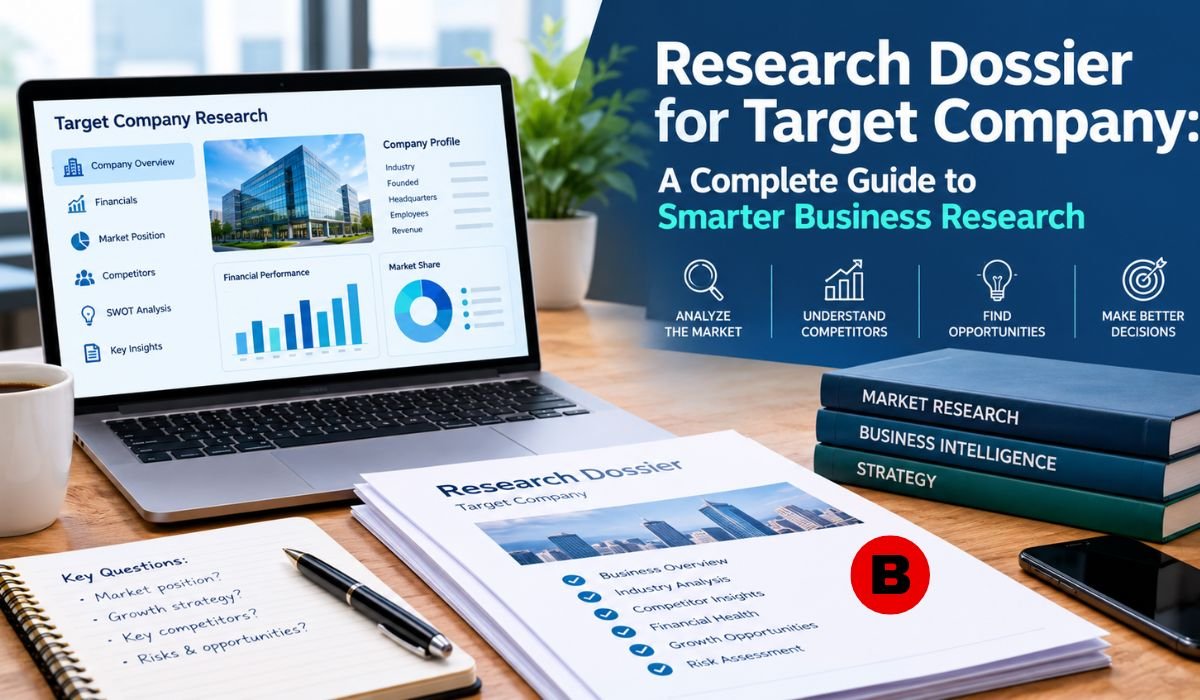
Before approaching a potential client, evaluating a supplier, studying a competitor, or considering an investment, it’s worth taking the time to understand the business behind the name. A company website and a handful of news articles can offer a useful introduction, but they rarely tell the whole story. Ownership structures, financial performance, customer relationships, and potential risks often require a closer look.
That’s where a Research Dossier for Target Company becomes valuable. It brings relevant business information together in one organized document, combining verified facts, credible sources, and informed analysis to build a clearer picture of an organization’s operations, market position, and challenges.
In 2026, conducting reliable company research involves more than gathering search results. Information may be outdated, financial estimates can vary, and corporate announcements often reflect the company’s own perspective. A well-prepared dossier helps readers separate confirmed facts from assumptions, assess conflicting information, and make decisions with greater confidence.
Whether you’re researching a potential business partner or trying to understand a competitor, this guide explains how to build a useful company research dossier, identify dependable sources, assess business performance, and keep your findings relevant over time.
Quick Bio Information: Key Facts About a Company Research Dossier
A quick bio section gives readers a snapshot of the document before they move into the detailed research. It summarizes the dossier’s purpose, scope, and main areas of investigation.
| Information | Details |
|---|---|
| Document Name | Research Dossier for Target Company |
| Primary Purpose | Organize and analyze company information |
| Research Subject | A specific business or organization |
| Intended Users | Researchers, investors, consultants, and business teams |
| Starting Point | A clearly defined research objective |
| Company Background | Legal name, industry, website, and location |
| Historical Research | Founding, milestones, and major changes |
| Ownership Research | Parent company and available shareholding information |
| Leadership Research | Executives, founders, and board members |
| Business Model | How the company generates revenue |
| Product Research | Main products, services, and customer needs |
| Customer Research | Customer groups, markets, and dependencies |
| Financial Research | Revenue, profitability, cash flow, and debt |
| Competitor Research | Direct competitors and alternative solutions |
| Risk Assessment | Financial, operational, legal, and market risks |
| Evidence Management | Source log, dates, and verification |
| Analytical Frameworks | SWOT, PESTLE, and Porter’s Five Forces |
| Update Process | Scheduled reviews and event-based updates |
What Is a Research Dossier for a Target Company?
A research dossier for a target company is a structured document that brings together information and evidence about a particular business. Depending on its purpose, it may cover company history, ownership, leadership, products, customers, revenue sources, financial performance, competitors, market conditions, and potential risks.
The term target company simply refers to the business being investigated. It might be a startup, a private firm, a publicly traded corporation, a manufacturer, or a potential commercial partner.
A standard company profile usually provides basic information about an organization. A research dossier goes a step further by examining how the available facts fit together. For instance, it might explore whether rising revenue is translating into stronger profits or whether reliance on a single major customer exposes the business to unnecessary risk.
The objective isn’t to collect every detail available online. Instead, the dossier should answer specific questions and support its conclusions with relevant, verifiable evidence.
Why Is a Company Research Dossier Important?
Information about a business rarely comes from a single source. Corporate websites, government registries, financial reports, news publications, and industry studies may each reveal a different part of the picture. Without a consistent research process, important details can be overlooked, sources become difficult to track, and historical information may be mistaken for current facts.
A company research dossier provides a central place for these findings. It helps sales teams prepare for client meetings, gives entrepreneurs a clearer view of competing businesses, and allows researchers to assess potential commercial relationships more systematically.
It can also highlight questions that deserve further attention. A company might announce plans to enter a new market, for example, but that announcement alone doesn’t establish whether the expansion will succeed. Researchers still need to consider the associated costs, competitive pressures, customer demand, and operational challenges.
A dossier can’t guarantee that a decision will turn out well. What it can do is provide a stronger evidence base, expose uncertainties, and help decision-makers weigh their options more carefully.
Define Your Research Goals First
Before opening dozens of browser tabs, take a moment to establish what you need to learn. The purpose of your research determines which information matters most and how deeply you need to investigate the company.
A sales professional may want to understand a prospect’s business priorities, expansion plans, products, and decision-makers. Someone conducting competitive research might concentrate on pricing, product features, customer segments, and market positioning. Investment research, meanwhile, generally calls for closer attention to financial performance, ownership, and business risks.
Start by writing a clear objective at the beginning of the dossier. Then identify the questions the report must answer. How does the company generate revenue? Who buys its products or services? Which businesses compete for the same customers? What developments could affect its performance?
A defined objective keeps the research focused and prevents the report from becoming a collection of unrelated facts. If you’re evaluating a supplier, for example, financial stability, delivery capacity, product quality, and compliance may be far more important than a detailed account of its marketing history.
Find and Verify Basic Company Information
Begin with the fundamentals: the company’s legal name, trading name, official website, headquarters, founding date, industry, registration details, and geographic markets. Where relevant, identify its parent company and subsidiaries so that information about related businesses doesn’t get mixed together.
The company’s official website is a sensible starting point. Its About, Leadership, Products, Newsroom, Investor Relations, and Corporate Governance pages may contain useful first-party information. Still, company websites naturally present the business from management’s perspective, so important claims should be checked against independent or official records whenever possible.
Government registries and regulatory databases can help confirm legal identity and other available corporate details. In Pakistan, researchers can start with the Securities and Exchange Commission of Pakistan. For US public company filings, the SEC’s EDGAR Search provides access to corporate disclosures.
Pay particular attention to the company’s name, location, website domain, and industry before combining information from different sources. Several businesses may operate under similar names, and even related brands can have different legal owners. Confirming the company’s identity early helps prevent errors that could undermine the entire report.
Research Company History, Ownership, and Leadership
A company’s history can explain how it arrived at its current position. Rather than listing every event, concentrate on milestones that may have influenced its development, such as major product launches, acquisitions, mergers, international expansion, restructuring, or changes in senior leadership.
Record the dates of these developments and identify the sources behind them. A clear timeline makes it easier to understand the sequence of events and assess how the business has evolved.
Ownership research should establish the parent organization, relevant subsidiaries, and publicly disclosed shareholding information where available. The amount of information you can find will depend on the company’s legal structure and jurisdiction. Publicly reporting businesses generally disclose more information than private companies, although disclosure requirements vary.
Leadership research should focus on relevant executives, founders, board members, and their responsibilities. Changes in senior management can provide clues about strategic priorities, but they shouldn’t automatically be treated as the cause of subsequent business results.
Where ownership or leadership details remain unclear, say so. Distinguishing verified information from unconfirmed claims is far more useful than filling gaps with assumptions.
Understand the Business Model, Products, and Customers
To understand a company properly, you need to know how it makes money. Identify what it sells, who pays for it, and how its products or services reach customers.
Revenue can come from product sales, subscriptions, advertising, licensing, consulting, commissions, or a combination of several sources. A software business may depend heavily on recurring subscriptions, for example, while a manufacturer may be more exposed to production costs, inventory management, and supply-chain disruptions.
Look beyond promotional descriptions when examining products and services. Consider the problems they solve, the customers they’re designed for, and the role they play in the company’s wider business model. This helps explain not just what the company offers, but why customers might choose it.
Customer research should cover publicly documented customer groups, geographic markets, and important commercial relationships. Where reliable evidence is available, examine dependence on major clients, suppliers, distribution partners, or digital platforms. Avoid speculating about confidential arrangements or attempting to obtain private customer information.
These details help reveal how the business operates, where its commercial strengths lie, and which relationships could create vulnerabilities if circumstances change.
Review Financial Performance and Business Health
Financial information provides an important perspective on whether a company’s business model is delivering sustainable results. When reliable figures are available, examine revenue, operating income, net income, profit margins, cash flow, debt, liquidity, capital expenditure, and performance across business segments.
Always note the reporting period and currency alongside financial figures. Results from an earlier fiscal year shouldn’t be presented as though they describe the company’s current position.
Revenue growth, on its own, doesn’t prove that a business is financially healthy. Sales may increase while expenses rise even faster, profit margins weaken, or debt becomes more difficult to manage. Operating cash flow adds another layer of context by showing whether the company generates cash through its regular business activities.
For US reporting companies, Form 10-K contains annual disclosures, Form 10-Q covers quarterly reporting, and Form 8-K reports certain material events. These filings are available through the SEC’s EDGAR system.
Private companies may not publish detailed financial statements. When that happens, explain the limitation clearly. If you use a third-party estimate, identify its source and date, and don’t present the figure as a confirmed company result. A transparent account of what’s unavailable is more reliable than an apparently precise figure without adequate evidence.
Research the Industry, Market, and Competitors
A company’s performance doesn’t depend on its own decisions alone. Industry conditions, customer demand, competitors, technological developments, and regulatory changes can all influence its prospects. Researching these factors helps put company-specific findings into context.
Look for credible information about market size, growth, customer preferences, and important industry developments. Pay attention to publication dates and research methodologies, since market estimates may differ depending on how providers define the industry or calculate its size.
Next, identify direct competitors that serve similar customers with comparable products or services. It’s also worth considering indirect competitors that address the same customer need through a different approach.
Compare businesses using relevant factors such as product features, publicly available pricing, geographic reach, customer segments, distribution channels, and business models. Avoid describing a company as a market leader unless reliable evidence supports that conclusion.
The aim isn’t simply to produce a list of competing brands. A useful comparison explains where the target company appears to have an advantage, where it faces pressure, and which conclusions still need further investigation.
Identify Risks, Challenges, and Growth Opportunities
A balanced dossier examines potential problems just as carefully as positive developments. Depending on the business, relevant risks might include heavy debt, weak cash flow, supply-chain disruptions, legal disputes, regulatory changes, cybersecurity concerns, customer concentration, or dependence on a particular technology.
Focus on risks that have a credible connection to the company rather than filling the report with every problem a business could theoretically face. A supply-chain risk may be especially important for a manufacturer, for instance, while a consulting firm may face different operational and commercial challenges.
Growth opportunities deserve the same level of scrutiny. New products, geographic expansion, partnerships, or rising customer demand may create room for growth, but none guarantees success. Review official announcements alongside independent evidence about market conditions, potential costs, and execution challenges.
To make the findings more practical, assess each significant risk in terms of its likelihood, potential impact, and time horizon. Record the supporting evidence, possible warning signs, and unanswered questions. This approach helps readers distinguish immediate concerns from longer-term uncertainties and identify where further research is needed.
Use Analytical Frameworks to Interpret Your Findings
Once the evidence has been collected, analytical frameworks can help turn separate findings into a more coherent assessment. They provide structure, but they work best when the conclusions are grounded in reliable information.
SWOT analysis organizes findings into strengths, weaknesses, opportunities, and threats. It can help summarize a company’s internal capabilities and external conditions, provided each point is supported by evidence rather than personal opinion.
PESTLE analysis examines political, economic, social, technological, legal, and environmental factors that may affect the business. It’s particularly useful when regulation, economic conditions, or technological change could influence a company’s strategy.
Porter’s Five Forces offers another perspective by examining industry rivalry, the threat of new entrants, substitute products, buyer power, and supplier power. This framework helps explain the competitive pressures surrounding a business and the factors that may influence its long-term position.
These methods shouldn’t replace research or be treated as proof on their own. If a SWOT analysis identifies dependence on a small number of customers as a weakness, for example, the dossier should explain what evidence supports that assessment and acknowledge any information that remains unavailable.
Find Reliable Sources and Verify Important Claims
A credible company research dossier depends on the quality of its evidence. Official company documents, government registries, regulatory filings, and published financial reports can establish important facts. Reputable news organizations, academic research, and established industry publications can add independent context.
Choose sources according to the claim you’re trying to verify. A regulatory filing may be the most appropriate source for reported financial results, while a government registry may help confirm registration details. Independent reporting can provide additional context about a merger, leadership change, or business controversy.
Keep a source log that records each document’s title, publisher, publication date, URL, access date, and the claim it supports. Where possible, include the relevant page or section so another researcher can locate the evidence quickly.
It’s also important to distinguish between different kinds of information. An official disclosure, a third-party estimate, a statement attributed to an executive, and your own analytical conclusion aren’t interchangeable. Label them accordingly.
When credible sources disagree, investigate the reason. They may cover different reporting periods, use different definitions, or rely on different methodologies. Instead of automatically accepting one version, explain the discrepancy and identify what can be established with confidence. This makes the dossier more transparent and easier for others to evaluate.
Build a Reusable Research Dossier Template
A consistent template makes company research easier to repeat, review, and compare. Start with the research objective and executive summary, then move through company identity, history, ownership, leadership, products, business model, customers, financial performance, competitors, risks, and recent developments.
Include an evidence log that connects important claims to their sources. A simple table can record the claim, supporting source, relevant date, confidence level, and known limitations. This gives readers a clear way to check the evidence behind the report’s conclusions.
The executive summary should highlight the most important findings, major risks, key uncertainties, and overall assessment. It shouldn’t attempt to repeat every detail from the main report. Instead, it should help a busy reader understand the central findings quickly.
Presentation matters, too. Use clear headings, concise paragraphs, consistent terminology, and dated figures. Adapt the template to the research objective rather than adding sections simply to make the document longer. A focused report is generally more useful than one packed with irrelevant information.
Common Mistakes to Avoid
One of the most common research mistakes is collecting information without a clear purpose. A lengthy dossier can still fall short if it contains unrelated details but fails to answer the questions that prompted the research.
Outdated information presents another problem. Leadership roles, ownership arrangements, products, locations, and financial results can change over time. Check publication dates and consult current sources before describing time-sensitive details as present facts.
It’s also important not to confuse promotional language with independently verified evidence. A company may describe itself as an industry leader, but that claim doesn’t establish its market position without supporting data.
Other mistakes include mixing estimates with confirmed figures, overlooking conflicting sources, and drawing conclusions that go beyond the available evidence. If a detail can’t be verified, explain the limitation instead of guessing.
These precautions may seem straightforward, but they have a meaningful effect on the final report. Careful sourcing, clear definitions, and honest treatment of uncertainty make the findings more credible and help readers decide how much weight to give them.
Keep Your Research Dossier Accurate and Up to Date
A research dossier shouldn’t be treated as a permanent record of a company’s current position. Its information needs to be reviewed whenever changes could affect the decisions the report supports. How often that happens depends on the business, the industry, and the purpose of the research.
Updates may be necessary after financial results are published, senior executives change, acquisitions are announced, new products launch, or important legal and regulatory developments occur. Preserve historical figures alongside their original reporting periods rather than replacing them without explanation.
Keeping a version history is another useful practice. Record what changed, when the revision was made, and which source supports the update. This makes it easier to track developments and identify earlier conclusions that may no longer hold.
For ongoing projects, assign responsibility for reviewing the dossier and establish a practical review schedule. Some fast-moving businesses may warrant monthly or quarterly checks, while other reports can be reviewed when significant events occur. The goal is to ensure that readers don’t mistake an outdated assessment for a current one.
Conclusion: Turn Company Research Into Actionable Business Insights
A Research Dossier for Target Company is more than a collection of business facts. It provides a structured way to understand an organization, evaluate its market position, identify potential risks, and make better use of the evidence available.
The most useful dossiers begin with clear questions and rely on credible sources. Company history, leadership, products, customers, financial performance, and competitors each contribute a different part of the picture. When those findings are connected carefully, they offer a much clearer understanding than scattered search results can provide.
Good research also recognizes its own limits. Some information won’t be publicly available, and estimates won’t always be equally reliable. Acknowledging those uncertainties helps prevent unsupported conclusions and gives readers a more honest view of what the evidence can—and can’t—establish.
Whether you’re researching a potential client, studying a competitor, or evaluating a business opportunity, the process starts with a clear objective. Document your sources, check important claims, and keep the findings current. With a consistent approach, a company research dossier can become a practical resource for more informed, evidence-based business decisions.
FAQs About Research Dossier for Target Company
What Should a Company Research Dossier Include?
A company research dossier should cover the research objective, company background, ownership, leadership, products, business model, customers, financial performance, competitors, risks, recent developments, and supporting sources. The exact scope depends on the questions the research needs to answer. A supplier assessment, for example, may require more attention to operational reliability and financial stability than a general company overview.
How Do You Research a Private Company?
Begin with the company’s official website, available corporate records, public announcements, leadership information, and credible news coverage. Private companies may disclose less financial and ownership information than publicly reporting businesses, so some details may remain unavailable. Clearly label estimates, identify their sources, and explain which claims couldn’t be independently verified.
What Is the Difference Between a Company Dossier and Due Diligence?
A company dossier provides an organized overview and analysis of a business. Due diligence is a more targeted investigation conducted to support a particular decision, such as an acquisition, investment, or major supplier agreement. Depending on the situation, due diligence may require more extensive financial, legal, operational, and compliance reviews than a general research dossier.
Which Sources Are Best for Company Research?
Useful sources include official company documents, government registries, regulatory filings, annual reports, reputable news publications, and established industry research providers. The best source depends on the information you’re checking. For example, a regulatory filing may be suitable for reported financial results, while independent reporting may provide additional context about a corporate announcement. Cross-check important claims and record the relevant dates.
How Long Should a Company Research Dossier Be?
There’s no standard length. A brief dossier prepared for a sales meeting may need only a few pages, while an in-depth competitive assessment could require considerably more. The important thing is to answer the research questions clearly, provide evidence for significant conclusions, and avoid adding details that don’t contribute to the report’s purpose.
How Often Should a Research Dossier Be Updated?
The update schedule depends on the company’s circumstances and how the dossier will be used. Review it when important developments occur, including financial results, leadership changes, ownership changes, new products, or regulatory decisions. Monthly or quarterly reviews may be appropriate for ongoing research, while other dossiers can be updated whenever a significant event warrants a closer look.
Can You Create a Company Research Dossier Using Free Sources?
Yes. Official company websites, public registries, regulatory filings, corporate announcements, and reputable news sources can provide a useful starting point without requiring paid subscriptions. Free sources may not provide every detail, especially for private companies or specialized market research. Paid databases can fill some gaps, but important claims still need to be checked against appropriate evidence.
How Can You Make a Company Research Dossier More Reliable?
Start with authoritative sources, record publication dates, and cross-check significant claims. Keep confirmed facts separate from estimates and opinions, document conflicting evidence, and identify information that remains unavailable. For high-stakes decisions, such as major investments or acquisitions, use the dossier as a research aid rather than a substitute for appropriate professional advice.
Learn more and explore exciting content on: TozyMagazine.com USA: A Complete Guide to Its Content, Features, and Purpose