

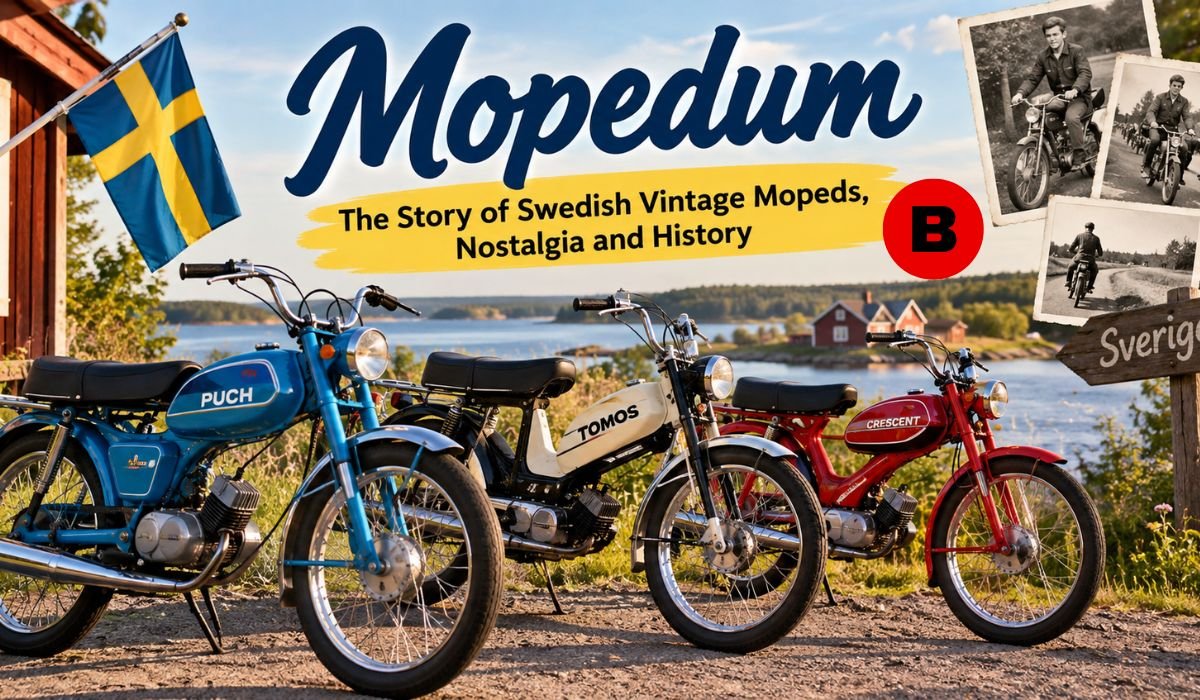
Mopedum is a name that brings together two sides of Swedish history that are easy to connect: the development of small two-wheel vehicles and the memories people attach to them. The name became particularly associated with a former nostalgia museum in Nynäshamn, Sweden, where veteran mopeds were displayed alongside clothing, household items, shops, and other details from everyday life.
The museum wasn’t simply a collection of old machines. Its displays were designed to take visitors back to earlier decades, particularly the years when mopeds were becoming an important part of transportation and youth culture in Sweden.
The physical museum closed permanently in December 2022. Even so, the story behind Mopedum remains relevant. Veteran mopeds continue to interest collectors, restorers, and enthusiasts, while the history of these machines offers a fascinating look at changing transportation habits, technology, and ideas about freedom.
To understand Mopedum properly, it’s worth looking at both the museum and the wider Swedish moped story that made its collection meaningful.
Quick Bio Information
| Mopedum Fact | Details |
|---|---|
| Name | Mopedum |
| Swedish Connection | Sweden |
| Former Attraction | Mopedum – Svenska Nostalgimuseet |
| Former Location | Vikingavägen 39, Nynäshamn |
| Museum Status | Permanently Closed |
| Closure | December 2022 |
| Museum Historical Period | 1952–1979 |
| Main Vehicle Theme | Veteran Mopeds |
| Broader Theme | Swedish Nostalgia And Everyday Life |
| Important Moped Date | July 1, 1952 |
| Major Regulation Change | 1961 |
| Original Legal Term | Bicycle With Auxiliary Engine |
| Early Intended Role | Utility Transportation |
| Later Cultural Role | Leisure, Youth And Freedom |
| Notable Model | Puch Dakota |
| Notable Model | Crescent Compact |
| Notable Model | Monark Monarped |
| Notable Model | Sachs Saxonette |
| Notable Model | Zündapp KS50 |
The Story Behind The Former Mopedum Museum
The former Mopedum Museum took a different approach from a traditional vehicle museum. Instead of placing vintage mopeds in isolation, it presented them within settings designed to resemble everyday Swedish life.
The museum’s journey covered the period from 1952 to 1979. Contemporary descriptions from its final year mention environments such as a 1950s kitchen, a small shop, and a Nynäshamn petrol station, along with clothing, furniture, and other objects from the period.
That setting gave the mopeds greater context. Visitors weren’t just looking at engines, frames, and wheels; they were seeing the kinds of environments in which those machines once belonged.
For people who lived through those decades, such displays could bring back personal memories. Younger visitors could approach the same exhibits as a glimpse into a Sweden that existed before today’s technology and transportation systems became commonplace.
Where Was The Mopedum Museum?
The former museum stood at Vikingavägen 39 in Nynäshamn, Sweden.
Its Nynäshamn location became an important part of the Mopedum story, particularly for visitors interested in Swedish nostalgia and veteran vehicles. The museum attracted more than dedicated collectors because its displays connected the mopeds with ordinary life.
There is, however, an important distinction for people researching Mopedum today. The Vikingavägen address belongs to the former museum. It isn’t a currently operating museum location.
The physical attraction closed at the end of 2022, so older visitor information shouldn’t be mistaken for current opening information.
When Did Mopedum Close?
The physical Mopedum Museum closed permanently in December 2022.
Information published during the museum’s final year reported that the attraction would close at the end of December as its creators moved toward new projects. Its closure brought the museum chapter of Mopedum to an end.
That doesn’t mean the history it represented disappeared. The museum had focused on a period when the moped became deeply connected with Swedish transportation and everyday life. That wider history remains interesting to collectors, historians, and anyone fascinated by vintage vehicles.
The closure also makes historical documentation more important. When a physical museum disappears, photographs, written records, preserved machines, and personal memories become increasingly valuable for understanding what it represented.
Mopedum And Its Online Legacy
The name Mopedum has also been associated with online material about veteran mopeds, classic scooters, collections, maintenance, older machines, and nostalgia.
It’s important, though, to distinguish between the former museum and the broader online subject. The museum itself remains closed; an online reference to Mopedum shouldn’t be interpreted as evidence that the original Nynäshamn attraction has reopened.
What continues is the wider interest in vintage mopeds and the culture surrounding them. For enthusiasts, information about particular models, restoration, ownership, and historical development remains useful regardless of whether the original museum is operating.
In that sense, Mopedum can still serve as a gateway into Swedish moped history, even though the physical museum is now part of the past.
Why 1952 Was A Turning Point In Swedish Moped History
To understand why mopeds became so important in Sweden, it’s necessary to look at July 1, 1952.
On that date, new Swedish legislation established a distinct legal position for what was described as a “bicycle with auxiliary engine.” The category was treated differently from heavier motorized two-wheel vehicles.
Under the rules described in historical research, owners of these machines didn’t need vehicle registration, a driver’s licence, insurance, or vehicle tax. The machines were also expected to retain a bicycle-like character and pedals.
The original idea was largely practical. The moped was intended to provide relatively inexpensive motorized transportation, particularly for people who needed a dependable way to travel to work.
This early history is significant because it shows that the moped wasn’t initially created as a youth-culture symbol. Its first role was much more closely tied to utility and accessibility.
How Swedish Mopeds Changed After 1961
The moped’s identity began changing as manufacturers and riders found new ways to use the machines.
A major regulatory shift came in 1961, when Sweden removed the requirement that mopeds resemble bicycles and have pedals. This opened the door to more purpose-built designs and helped the machines develop an identity distinct from ordinary bicycles.
The change was more than a technical detail. Historical research into Swedish moped culture shows that regulators originally viewed the vehicle primarily as practical transportation, while users and manufacturers increasingly moved it toward leisure.
That tension between intended purpose and real-world use is an important part of the moped’s history. People weren’t content simply to use the machines as basic transportation. They also discovered the freedom and enjoyment that came with having a small motorized vehicle of their own.
How Mopeds Became Part Of Everyday Swedish Life
The attraction of a moped was easy to understand. It provided powered transportation without the size, cost, or complexity associated with a car.
For workers, that could make the daily journey easier. For younger riders, it could open up a much larger area for socializing and exploring.
A moped could mean being able to visit friends, travel to work, or go somewhere beyond the immediate neighborhood without having to depend entirely on someone else.
Over time, that practical benefit became closely linked to independence. The machine wasn’t simply something that moved a person from one place to another. For many riders, it represented a new ability to decide where they could go.
That emotional connection is one reason Swedish vintage mopeds still have such a strong following today.
From Practical Transport To Symbols Of Freedom
The cultural meaning of the moped developed alongside its practical role.
For a young rider, owning or gaining access to a moped could feel like an important step toward adulthood. It provided mobility and a degree of independence that hadn’t existed before.
Historical research into Swedish moped development describes this broader transformation from utility vehicle toward a machine associated with leisure and freedom.
That idea of freedom helps explain why an old moped can be valuable even when it isn’t particularly rare or expensive.
One machine might remind its owner of teenage years, a first long ride, friends from school, a family member who taught them basic mechanical skills, or the excitement of being able to travel independently.
Its financial price may be modest, but its personal value can be considerable.
What Makes A Veteran Moped Special?
There isn’t one feature that makes a Veteran Moped special. Collectors and enthusiasts may be attracted by the machine’s design, engineering, condition, originality, rarity, or history.
Small details can be surprisingly important. A particular fuel tank, frame, lamp, seat, engine component, badge, or control arrangement may help identify a model or production period.
Originality can also matter. Some collectors want a machine preserved as close as possible to its original form. Others prefer a careful restoration that makes the vehicle reliable and usable while retaining its period character.
Even signs of age can have value. A perfectly restored machine and an unrestored original can tell different stories, and both may appeal to different enthusiasts.
Ultimately, the purpose of collecting isn’t identical for everyone. Some owners care most about historical authenticity, while others simply want to enjoy an old machine and keep it running.
Classic Moped Models Enthusiasts Remember
Several models are associated with the veteran-moped world discussed around Mopedum, including the Puch Dakota, Crescent Compact, Monark Monarped, Sachs Saxonette, and Zündapp KS50.
These names also illustrate how varied the classic-moped market became. Manufacturers experimented with different engine arrangements, frame designs, fuel tanks, seats, lamps, and overall styling.
Some mopeds were designed with a practical appearance, while others adopted a more sporty character. Over time, these differences became part of what collectors appreciate.
It’s also important to avoid assuming that every vintage moped is rare or financially valuable. Age doesn’t automatically equal high market value.
Condition, originality, rarity, demand, model popularity, documented history, and parts availability can all influence what collectors are willing to pay. A relatively common machine can still be historically interesting or personally priceless.
Vintage Moped Restoration And Maintenance
Restoring an old moped can be rewarding, but it requires patience. A vehicle that looks complete after decades in storage may still have serious mechanical problems.
Fuel systems can deteriorate. Metal parts can corrode. Cables may become worn, electrical components can fail, and rubber parts often deteriorate with age.
For that reason, restoration should involve more than cleaning and repainting. Anyone intending to ride a vintage machine needs to pay attention to its brakes, tires, steering, fuel delivery, electrical system, and other important components.
There’s also a difference between a cosmetic restoration and a mechanically sound one. A moped can look beautiful while still requiring substantial work before it is suitable for the road.
For many enthusiasts, however, that work is part of the attraction. Restoration combines mechanical problem-solving with historical research and craftsmanship.
Finding Parts For A Classic Moped
Parts availability can make a major difference when restoring a classic moped.
Popular models generally have a larger supply of replacement parts and more accumulated knowledge among enthusiasts. Less common machines can be considerably harder to restore because finding the correct components may require additional research.
Old workshop manuals and original documentation can be especially useful. They can help owners understand how a particular machine was designed and what components belonged to it.
Experienced collectors can also provide practical knowledge that isn’t always obvious from a manual. They may know which parts are interchangeable, which details are period-correct, and which common problems tend to appear on particular models.
For someone interested in historical authenticity, preserving an original part can sometimes be preferable to replacing it. Even a small component can contribute to the story of an individual machine.
Why Mopedum Was More Than A Moped Museum
The former museum’s strongest feature was arguably its emphasis on context.
A moped sitting by itself tells one story. The same moped surrounded by period clothing, furniture, household objects, shops, and other familiar details tells a much larger one.
Contemporary descriptions of Mopedum’s displays highlighted recreated environments representing Swedish life in earlier decades. This approach helped visitors understand that the moped wasn’t separate from society. It was part of everyday life.
That makes the museum interesting from a social-history perspective as well as a transportation perspective.
A vehicle can tell us how people traveled. The objects around that vehicle can help explain how they lived.
Why The 1950s, 1960s And 1970s Still Matter
Mopedum’s focus on the 1950s, 1960s, and 1970s reflects an important period in Swedish moped history.
The museum’s presentation followed the moped’s development from 1952 through 1979, while using everyday environments to create a sense of the period.
For people who lived through those years, these details could be intensely personal. A familiar style of furniture, a petrol station, an item of clothing, or a particular moped could bring back memories that a written history book might never capture.
For younger visitors, the same objects offer a different experience. They provide a glimpse into a time when transportation, technology, and daily routines looked very different from today.
That’s what gives nostalgia museums their particular appeal. They preserve not only objects but also the atmosphere surrounding those objects.
Why Vintage Mopeds Still Attract New Generations
You don’t have to have grown up riding a moped to appreciate one.
For younger enthusiasts, the attraction may come from mechanical simplicity, distinctive styling, restoration, or curiosity about how older vehicles were built.
Modern transportation is increasingly dependent on sophisticated electronics and computerized systems. Vintage mopeds can offer a more direct mechanical experience. Owners who learn the basics can understand and work on many of the systems themselves.
The design also plays a role. Classic frames, fuel tanks, lamps, seats, engines, and controls often have a character that makes older mopeds visually distinctive.
For one enthusiast, a vintage moped may be a childhood memory. For another, it’s simply an interesting piece of engineering.
Preserving Swedish Two-Wheel History
Mopeds don’t always receive the same attention as classic cars or large motorcycles, but their historical importance shouldn’t be underestimated.
These were everyday machines. They were used by ordinary people for commuting, social activities, errands, and leisure. That makes them useful records of everyday transportation and social change.
Preservation can take many forms. A complete moped is valuable, but so are original parts, photographs, brochures, workshop manuals, advertisements, period clothing, and personal stories.
Those supporting materials can help answer questions that technical specifications alone cannot. Who used these machines? Where did they ride them? What did owning one mean to them?
The former Mopedum Museum understood this connection. Its displays treated mopeds as part of a larger cultural environment rather than simply as mechanical objects.
Final Thoughts
Mopedum tells a story that extends well beyond a former museum in Nynäshamn. Its deeper subject is the relationship between Swedish mopeds and the people who used them.
The historical timeline begins with the important legal change of July 1, 1952, when the “bicycle with auxiliary engine” received a distinct position under Swedish regulations. The original purpose was largely practical, providing affordable motorized transportation. By 1961, the rules had changed, removing the requirement for mopeds to resemble bicycles and have pedals.
At the same time, users and manufacturers were changing what the moped meant. A vehicle intended primarily for utility gradually became associated with leisure, independence, youth, and freedom.
That transformation is a major reason veteran mopeds remain fascinating today.
The former Mopedum Museum captured that history by placing its vehicles inside recreated scenes of everyday Swedish life. Although the physical museum closed permanently in December 2022, the memories and historical questions surrounding those machines remain.
A vintage moped may be a piece of machinery, but it can also be a record of a particular time and place. It can represent someone’s youth, a family’s history, a first taste of independence, or simply an era of mechanical design that has now disappeared.
That is ultimately what makes Mopedum worth remembering. It shows that transportation history isn’t always found in the biggest or most advanced machines. Sometimes, a small vehicle with two wheels can tell an unexpectedly large story.
FAQs About Mopedum
What Is Mopedum?
Mopedum is associated with Swedish veteran mopeds, nostalgia, classic scooters, collections, and the history of small two-wheel vehicles. The name was also used for a former nostalgia museum in Nynäshamn, where mopeds were displayed alongside recreated environments and everyday objects.
Where Was The Mopedum Museum?
The former Mopedum Museum was located at Vikingavägen 39 in Nynäshamn, Sweden. The location belonged to the physical museum, which has since permanently closed.
When Did Mopedum Close?
The physical Mopedum Museum closed permanently in December 2022. Contemporary information from its final year reported that the museum would close at the end of that December.
What Did The Mopedum Museum Show?
The museum combined veteran mopeds with recreated settings representing Swedish life. Its historical journey covered 1952 to 1979 and included environments and objects designed to evoke earlier decades, including household and commercial settings.
When Did Swedish Moped History Change In 1952?
A major change took effect on July 1, 1952, when Sweden established a distinct legal category for the “bicycle with auxiliary engine.” The early machines were expected to remain bicycle-like and have pedals, while being subject to fewer requirements than heavier motorized two-wheel vehicles.
What Changed For Mopeds In 1961?
In 1961, Swedish regulations removed the requirement that mopeds resemble bicycles and have pedals. This helped allow more purpose-built moped designs and coincided with the vehicle’s broader shift from utility transportation toward leisure and freedom.
Why Are Vintage Mopeds Still Popular?
Vintage mopeds combine mechanical interest, distinctive design, restoration opportunities, transportation history, and nostalgia. They appeal to people who remember riding them as well as younger enthusiasts interested in older engineering.
Are All Old Mopeds Valuable?
No. Being old doesn’t automatically make a moped financially valuable. Condition, originality, rarity, model, demand, documented history, and parts availability can influence market value. A common machine can still have significant historical or personal value.
Learn more and explore exciting content on: Babeltee: What It Is, Ingredients, Benefits, and How to Make It