

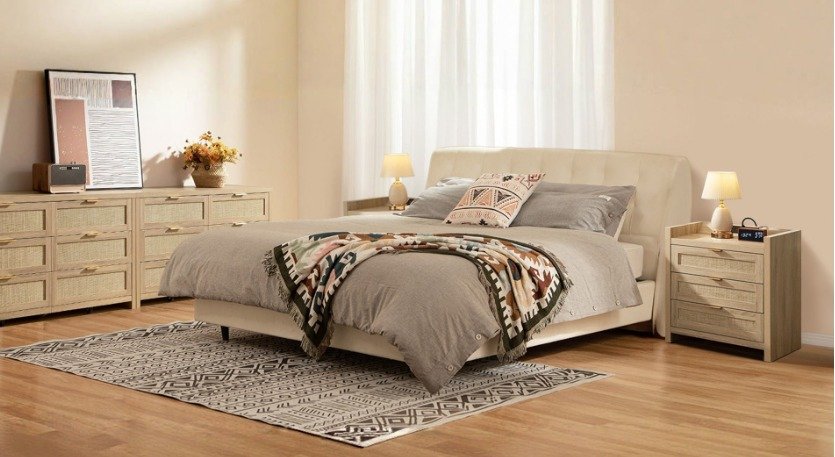
I did not finish my bedroom in one shopping trip. I bought the bed first, then the rest turned up slowly. One month a nightstand. A few months later a dresser. That slow way worked for me, because each piece had to fit the room I actually lived in. The only catch was I needed some kind of order. Without one, the pieces would not belong together.
Start With the Room, Not the Catalogue
I started by browsing furniture. But I learned the room comes first. I walked in and just looked. Where the doors swung. Where the windows sat. Where the sun landed at seven in the morning. A tall wardrobe next to the window blocked that light. A wide dresser on the shortest wall made my small room feel cramped. I sketched it on paper first. It saved me a nasty surprise.
Measure First
I measured every wall. Then the ceiling height. Then the space a drawer needs to actually open, not just its footprint. I left 60 centimetres beside the bed to walk through. Less than that and I shuffled sideways every morning. I took the numbers with me. The first time I skipped that step, I got the width wrong and the piece went straight back in the van. I never guessed again.
Decide What the Room Must Do
My bedroom is not just for sleeping. It holds my work clothes. Books. Spare bedding. Winter coats. Before buying anything big, I listed what had to live in this room and what could go elsewhere. A hallway closet. The top of another wardrobe. That list stopped me buying a huge unit for stuff with a home already.
Choose the Bed, Then Build Around It
I bought the bed first. It was the biggest thing in the room. Size mattered in both directions. Too big and I bruised my hip on the corner more than once. Too small and the room felt unfinished. Once the bed was in place, the rest finally had a job. Support the bed. Store things beside it. Fill whatever wall space was left.
The Bed Sets the Scale
I used the bed as my reference for everything else. Nightstands worked best with the top about level with the mattress. That way my lamp was right there. A glass of water in the middle of the night, without fumbling. A dresser should not tower over a low bed frame. A tall wardrobe needs a high ceiling. When the heights roughly matched, my room looked planned. Even bought months apart.
Add Storage in Layers
I built my storage up in layers. I started with what I touched every day. A nightstand. Phone. Book. Lamp. That was it. Then a dresser for my folded clothes. The bigger storage, the stuff I rarely opened, came last. My daily routine stayed simple. A big unit never dominated a room that only needed something modest.
When I wanted my pieces to share a finish, I looked at complete bedroom furniture sets first and saw how beds, dressers, and nightstands get grouped together. I did not have to buy the whole group. Most people do not. But seeing the pieces side by side made it easier to judge whether a finish would suit my room, before spending money.
Dressers and Nightstands
My dresser earned its place by how the drawers actually worked. Deep drawers were for my bulky things. Sweaters. Jeans. Shallow ones were for the small stuff. Socks. Chargers. My nightstand needed less room, more convenience. One drawer. A surface for a lamp. That was plenty. I bought both in a finish close to my bed frame, and the room read as a set. I tested the drawers in the shop first. Even picked separately.
A Small Rule for Matching Pieces
My pieces came from different ranges, so I picked one thing to match and let the rest vary. The wood tone. The drawer handles. The shape of the legs. Just one. Matching every detail would have looked flat. Matching nothing would have looked random. One shared detail was usually enough. It tied the room together.
Check Clearance Before You Buy
Before I ordered my dresser, I checked the drawers and doors could open all the way. Without hitting the bed. A door frame. A radiator I had forgotten about. I checked the door swings too. A piece that fits against the wall but cannot be used properly is a bad fit, however good it looked. I taped the outline on the floor first. Three minutes. It saved me a second delivery-day surprise.
Finish With Pieces You Can Add Later
The last pieces in my room were the ones it could manage without. A bench at the foot of the bed. A small chair for reading, the one that ended up holding my clothes anyway. An extra nightstand for when a second person moved in. These came last. By then I knew how I used the room. Not how I had imagined it empty.
A coordinated group like the Savanna 6-drawer dresser and nightstands set was my reference. It showed how a dresser and two nightstands can share the same rattan and wood finish, while bed and wardrobe stay separate. Even one piece at a time, a group like that gave me something to measure against.
Leave Room to Change
My bedroom set is not finished, and it still feels complete. I left one wall free. One corner. That empty spot is for a piece I have not found yet. The room stays breathable. Rooms packed wall to wall feel crowded fast.
A Set That Grows With You
Building my set piece by piece took longer than buying it all at once. No question. But it usually fits better. I started with the measurements. I let the bed set the scale. I added storage in layers. And I finished slowly. Now I see what my room still needs.
 Admin
 MUNJAL BLOG