

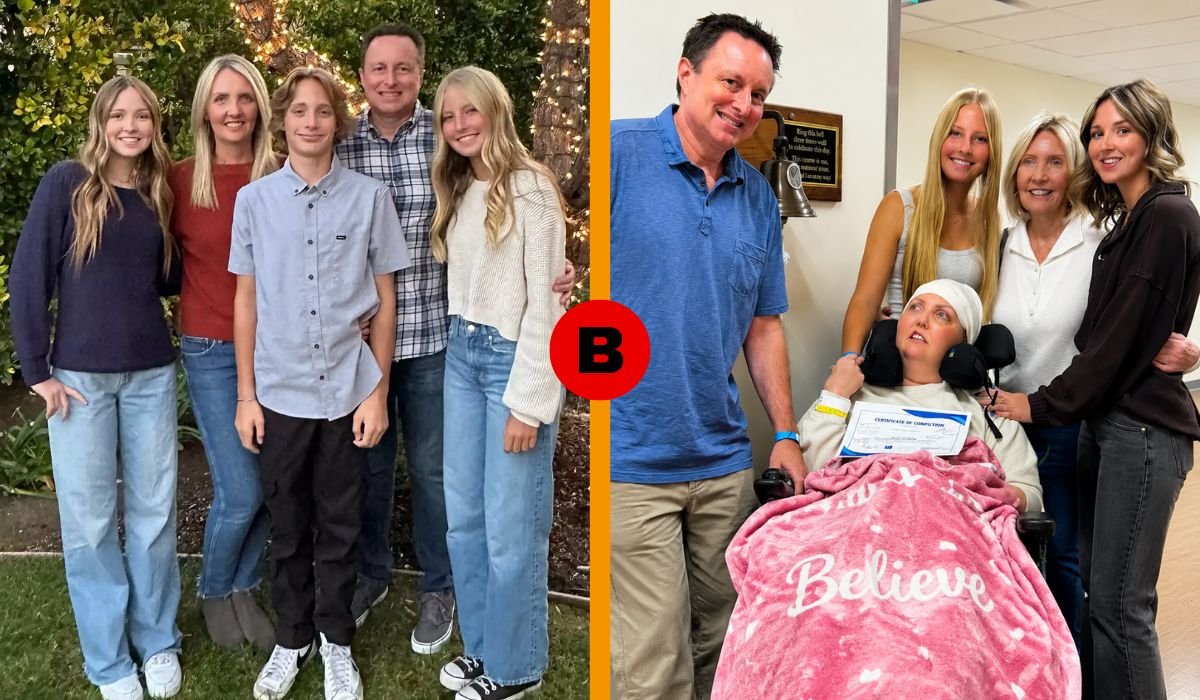
Lori Coble’s story is one of extraordinary family loss, a remarkable new beginning, and, years later, another devastating challenge. She and her husband, Chris Coble, first became widely known after their three young children died following a car crash in 2007. About a year later, the couple welcomed triplets, giving each child a middle name that honored one of the siblings they had lost.
For the next 16 years or so, Lori and Chris focused on raising Jake Christopher, Ashley Lynn, and Ellie Gene and building a life with their family. Then, in 2025, everything changed again.
Chris began noticing unusual changes in Lori’s coordination. What initially appeared as increasing clumsiness eventually developed into more worrying neurological symptoms. In July 2025, Lori was diagnosed with an aggressive glioblastoma.
The months that followed were difficult. Lori underwent brain surgeries, chemotherapy, radiation, rehabilitation, and extended hospital care. She also experienced serious complications, including a stroke and infections. Eventually, she returned home for hospice care.
Lori Coble died on January 21, 2026, at the age of 48.
Her final illness became an important part of her public story, but it doesn’t tell the whole story. To understand who Lori Coble was, it’s also necessary to look at her marriage, her six children, the tragedy her family endured in 2007, the arrival of her triplets, and the years she spent raising them.
Lori Coble Quick Bio Information
| Information | Details |
|---|---|
| Full Name | Lori Coble |
| Known For | Her Family Story And Cancer Battle |
| Husband | Chris Coble |
| Age At Death | 48 |
| Date Of Death | January 21, 2026 |
| Cancer Diagnosis | July 2025 |
| Cancer Type | Glioblastoma |
| Reported Grade/Stage | Stage 4 |
| First Children | Kyle Christopher, Emma Lynn, Katie Gene |
| Kyle’s Age | 5 |
| Emma’s Age | 4 |
| Katie’s Age | 2 |
| Younger Children | Jake Christopher, Ashley Lynn, Ellie Gene |
| Younger Children | Triplets |
| Cancer Treatment | Brain Surgery, Chemotherapy And Radiation |
| Major Hospital Stay | About 40 Days |
| Reported Complications | Stroke, Brain Infection, Lung Infection And Pneumonia |
| Final Care | Hospice Care At Home |
| Reported Time Of Death | 9:25 P.M. |
| Triplets During Final Illness | Teenagers In Their Senior Year Of High School |
Who Was Lori Coble?
Lori Coble was a wife and mother whose family became nationally known after experiencing circumstances few families could imagine. Much of the reliable public information about her life centers on her husband, children, the loss of her first three children, the later arrival of triplets, and her battle with brain cancer.
Some details typically included in online biographies aren’t well documented in authoritative sources. Information about Lori’s education, early childhood, occupation, and complete personal background, for example, hasn’t been widely established. Rather than filling those gaps with assumptions, it’s more accurate to focus on what has been publicly confirmed.
What is clear is that family was central to Lori’s story.
She and Chris were parents to six children altogether. Their first three children died when they were very young. The couple later became parents to triplets and spent roughly the next 16 years raising them before Lori became seriously ill.
That family journey explains why Lori Coble’s story continued to resonate with readers long after the family’s first appearance in the public eye.
Lori Coble And Her Husband Chris Coble
Chris Coble was Lori’s husband and a central figure throughout the family’s story. Together, they faced the loss of their first three children, made the difficult decision to try to become parents again, welcomed triplets, and eventually confronted Lori’s cancer diagnosis.
When Lori’s health began changing in 2025, Chris was also the person who noticed that something didn’t seem right.
According to his account reported by PEOPLE, Lori had started behaving differently physically, particularly in the way she moved and coordinated everyday actions. As her condition became more serious, Chris remained closely involved in her medical care.
During one lengthy hospitalization, he reportedly spent nearly every day at her side.
Chris also spoke openly about the emotional impact of Lori’s diagnosis. The family had already survived one enormous tragedy, and the possibility of losing his wife forced him to confront another. His comments reflected the frustration, fear, anger, and grief that can accompany caring for someone with a life-threatening illness.
Those statements offer valuable firsthand family context, although they shouldn’t be confused with independent medical conclusions about Lori’s condition.
What Happened To Lori Coble’s First Three Children?
The Coble family’s first widely reported tragedy occurred in 2007.
Lori and Chris lost all three of their young children following a car crash. Their son, Kyle Christopher, was 5. Their daughter Emma Lynn was 4, while their youngest daughter, Katie Gene, was just 2.
The deaths changed the family’s life completely.
For Lori and Chris, grief wasn’t an abstract experience. They had lost all three of the children they were raising at the same time. Public accounts of Lori’s later life frequently return to the 2007 tragedy because it became an important part of understanding the family’s journey.
After spending months trying to cope with their loss, Lori and Chris eventually decided they wanted to try to become parents again.
That decision led to another remarkable chapter in their family story.
Lori Coble’s Triplets And Their Meaningful Names
About a year after losing Kyle, Emma, and Katie, Lori and Chris welcomed triplets.
They named them Jake Christopher, Ashley Lynn, and Ellie Gene.
The middle names weren’t chosen by accident. Each created a connection with one of the children’s older siblings.
Jake’s middle name, Christopher, echoed Kyle Christopher. Ashley’s middle name, Lynn, honored Emma Lynn. Ellie’s middle name, Gene, carried forward Katie Gene’s name.
It was a deeply personal way for Lori and Chris to preserve a connection between all six of their children.
That doesn’t mean the triplets should be described as replacements for Kyle, Emma, and Katie. The family’s story instead suggests that the names offered a way to remember the children they had lost while celebrating the lives of the children they were now raising.
For approximately the next 16 years, Lori and Chris focused on Jake, Ashley, and Ellie and the ordinary responsibilities of family life.
Family Life Before Lori Coble’s Cancer Diagnosis
Far less has been publicly reported about those 16 years than about the tragedies that came before and after them. In some ways, that absence of headlines is important.
Lori’s life wasn’t simply a sequence of public tragedies.
Between the arrival of the triplets and her cancer diagnosis, she and Chris spent years doing what parents ordinarily do: raising their children and building family life. Reliable public reporting doesn’t document every aspect of those years, and there is no reason to fill those private spaces with speculation.
By 2025, Jake, Ashley, and Ellie had grown into teenagers. During Lori’s final illness, they were in their senior year of high school.
After years of relative normality, however, the family was about to face another unexpected crisis.
Lori Coble’s First Brain Cancer Symptoms
The first signs that something might be wrong appeared in June 2025.
Chris noticed that Lori was becoming increasingly clumsy. According to his account, she would bump into walls, stub her toes on chairs, and drop drinking glasses.
Any one of those incidents could easily have seemed insignificant on its own. Taken together, however, they formed a pattern that became increasingly difficult to dismiss.
Then another symptom appeared.
In early July, Chris noticed that Lori’s mouth had begun to droop slightly. He described the change as resembling a stroke symptom. At that point, her condition had become too concerning to overlook.
It’s important to put these symptoms in the proper context. They describe Lori Coble’s individual medical experience and shouldn’t be used as a checklist for diagnosing a brain tumor. Changes in balance, coordination, facial movement, or speech can have many different causes.
Sudden facial drooping and other stroke-like symptoms can also signal a medical emergency and should be evaluated immediately by healthcare professionals.
Lori Coble’s Stage 4 Glioblastoma Diagnosis
In July 2025, Lori Coble received the diagnosis her family had feared: she had a large and aggressive glioblastoma.
Public reports described the cancer as stage 4.
For Chris, the news brought back the feeling that his family was once again being forced into a life-changing situation they couldn’t control. He later spoke about feeling overwhelmed, angry, and deeply upset.
He also described beginning to mourn the possible loss of his wife from the day of her diagnosis.
Those feelings are an important part of Lori’s story because serious cancer affects more than the person receiving treatment. Spouses, children, and other family members often find themselves adjusting suddenly to new roles as caregivers while dealing with their own uncertainty and fear.
What Is Glioblastoma?
Glioblastoma is a highly aggressive malignant tumor that develops in the central nervous system, most commonly in the brain.
Authoritative medical sources, including the U.S. National Cancer Institute, describe glioblastoma as a fast-growing tumor. One reason it can be so difficult to treat is that cancer cells may infiltrate nearby brain tissue, making complete surgical removal challenging.
There’s also an important terminology distinction.
News reports about Lori Coble referred to her condition as stage 4 glioblastoma. In modern medical classification, however, glioblastoma is generally described as a grade 4 tumor rather than being staged in the same way as many cancers elsewhere in the body.
Treatment varies according to the patient’s condition and characteristics of the tumor. Surgery may be used to remove as much tumor tissue as safely possible, often followed by radiation therapy and chemotherapy. Rehabilitation and supportive care may also become important.
This medical background helps explain the seriousness of Lori’s diagnosis, but it shouldn’t be used to make assumptions about her individual prognosis or treatment decisions.
Lori Coble’s Brain Surgeries And Stroke
After her diagnosis, Lori underwent two surgeries aimed at removing tumor tissue.
The second operation was particularly difficult. It was described as invasive and complex, and afterward Lori lost control of the left side of her body.
Only a few days later, another major complication occurred.
Lori suffered a stroke and was placed in a medically induced coma. Her recovery required an extended hospital stay that lasted approximately 40 days.
Chris was reportedly at her side on most days during that period.
The experience illustrates just how complicated treatment can become when an aggressive brain tumor affects areas involved in essential neurological functions. Brain surgery requires extraordinary precision because different regions are responsible for movement, speech, sensation, and other vital abilities.
Still, Lori’s experience shouldn’t be treated as typical for every patient. Surgical risks depend heavily on the location of a tumor, its characteristics, the procedure being performed, and the patient’s individual medical circumstances.
Chemotherapy, Radiation And Rehabilitation
Once Lori regained enough strength to leave the hospital, she returned home and began the next stage of treatment.
She received chemotherapy and radiation, both established parts of treatment for many people with glioblastoma following surgery.
Her recovery, however, remained difficult.
According to family accounts, Lori became increasingly tired, while her ability to speak was also affected. Chris believed her overall condition appeared to be getting worse despite the treatment and care she had received.
It’s important not to oversimplify what was happening medically.
Public reporting doesn’t establish that chemotherapy or radiation alone caused Lori’s decline. She was dealing simultaneously with an aggressive brain tumor, the effects of major brain surgery, a stroke, physical recovery, and later serious infections.
Together, those factors made her medical situation exceptionally complex.
The Brain Infection And Another Setback
By mid-November 2025, Lori’s health had become concerning again.
Chris took her to the emergency room, where doctors discovered what was reported as a large infection in her brain.
The discovery represented yet another major setback.
By then, Lori had already undergone multiple brain operations, suffered a stroke, spent weeks in the hospital, gone through rehabilitation, and started chemotherapy and radiation. Now, she was facing another serious medical problem and the possibility of an additional procedure.
Chris spoke publicly about how difficult it was to watch his wife repeatedly endure treatment and complications.
His words also offered a glimpse into the caregiver experience. Serious illnesses such as brain cancer don’t affect only the patient. They can transform daily life for partners and children, who may find themselves balancing medical decisions, emotional strain, practical responsibilities, and uncertainty about the future.
Pneumonia And Lori Coble’s Hospice Care
There was briefly some hope that Lori might feel well enough to speak publicly about what she had experienced.
In early December 2025, she reportedly scheduled a video interview with PEOPLE.
The interview never took place.
The day before it was due to happen, Lori returned to the hospital with a lung infection and pneumonia.
Soon afterward, she was brought home for hospice care.
Hospice is designed to prioritize comfort, symptom management, dignity, and quality of life for people facing advanced life-limiting illnesses. It can also provide important support for relatives and caregivers.
For the Coble family, the move home shifted the focus toward keeping Lori comfortable and allowing her to spend time surrounded by those closest to her.
Chris said during this period that he was trying to make every day as good as possible for his wife. He didn’t want to look back and wonder whether there was more he could have done for her.
How Lori Coble’s Illness Affected Her Family
Lori’s cancer battle unfolded at an especially significant time for Jake, Ashley, and Ellie.
The triplets were teenagers and in their senior year of high school during their mother’s final months.
Understandably, reliable public reporting says relatively little about how each child privately processed Lori’s illness. That boundary is worth respecting. There is no need to speculate about their individual emotions to understand the seriousness of what the family was experiencing.
Their mother’s condition had changed dramatically within only a few months.
At the same time, Chris was navigating several roles at once: husband, father, caregiver, and the family member communicating publicly about Lori’s health.
The experience is a reminder that while cancer treatment focuses medically on one patient, the emotional and practical effects often reach an entire household.
When Did Lori Coble Die?
Lori Coble died on Wednesday, January 21, 2026, at the age of 48.
A family friend told PEOPLE that Lori was surrounded by her family when she died. Chris also publicly announced her death and reported that she passed at 9:25 p.m.
Her death came only about six months after her glioblastoma diagnosis.
In that relatively short period, Lori had undergone two brain surgeries, chemotherapy, radiation, rehabilitation, a lengthy hospitalization, and treatment for serious complications.
A fundraising campaign was also established to provide support for the Coble family during Lori’s illness.
The speed with which her health changed underscores the aggressive nature of the disease she was facing and the intensity of the medical journey her family experienced during the second half of 2025.
What Was Lori Coble’s Cause Of Death?
Lori died following her battle with aggressive glioblastoma.
During her illness, public reports also documented several serious medical complications, including a stroke, a brain infection, a lung infection, and pneumonia.
Those complications are important to understanding her final months, but they shouldn’t automatically be presented as Lori Coble’s official cause of death without an authoritative medical or official record confirming that conclusion.
The most accurate description, based on publicly available reporting, is that Lori Coble died after battling aggressive glioblastoma while experiencing multiple serious medical complications during her treatment and final months.
Making that distinction matters. Health reporting is most trustworthy when confirmed medical facts are clearly separated from reasonable but unverified assumptions.
Lori Coble’s Family And Legacy
It would be easy to view Lori Coble’s life only through the tragedies her family endured. Doing so, however, would miss an equally important part of her story.
For approximately 16 years after the birth of the triplets, Lori and Chris were focused on raising a family.
And within that family, the names themselves carried a remarkable connection across generations.
Kyle Christopher, Emma Lynn, and Katie Gene died in 2007. Their middle names continued through Jake Christopher, Ashley Lynn, and Ellie Gene.
It’s a small detail with enormous meaning.
The names allowed Lori and Chris to remember the children they had lost while celebrating the three children they later welcomed. That connection became one of the most recognizable elements of the Coble family’s story.
When Lori became seriously ill, family again moved to the center of the narrative. Chris remained closely involved in her care, and loved ones were reportedly with her when she died.
As of 2026, Lori Coble is remembered publicly not simply for how her life ended, but for a family journey that encompassed parenthood, grief, rebuilding, illness, and enduring connections between loved ones.
Final Thoughts
No single headline can fully explain Lori Coble’s life.
She was a mother who endured the devastating loss of three young children, later welcomed triplets with her husband, spent roughly 16 years raising them, and then faced an aggressive brain tumor at age 48.
Her medical journey moved quickly after her July 2025 glioblastoma diagnosis. Over the following months, Lori underwent brain surgeries, chemotherapy, radiation, rehabilitation, and prolonged hospital care. She also suffered a stroke and experienced serious infections before eventually returning home for hospice care.
Lori died on January 21, 2026, surrounded by family, according to those close to her.
Yet the lasting thread running through the Lori Coble story isn’t simply tragedy. It’s family.
Christopher, Lynn, and Gene connect the names of the three children Lori and Chris lost with the triplets they later raised. Those names quietly carry the family’s history from one chapter into another.
That connection helps explain why Lori Coble’s story continues to resonate in 2026. Behind the headlines about loss and cancer was a wife and mother whose family spent years finding ways to remember the people they had lost while continuing to care for the people still beside them.
FAQs About Lori Coble
Who Was Lori Coble?
Lori Coble was a wife and mother whose family became widely known after she and her husband, Chris Coble, lost their three young children following a car crash in 2007. The couple later welcomed triplets. Lori was diagnosed with aggressive glioblastoma in July 2025 and died in January 2026 at age 48.
Who Was Lori Coble’s Husband?
Lori Coble was married to Chris Coble. The couple raised six children altogether, although their first three children died when they were young. Chris remained closely involved throughout Lori’s cancer treatment and publicly shared information about her symptoms, hospital stays, treatment, and final months.
How Many Children Did Lori Coble Have?
Lori was the mother of six children. Her first three children were Kyle Christopher, Emma Lynn, and Katie Gene. Following their deaths, Lori and Chris later welcomed triplets named Jake Christopher, Ashley Lynn, and Ellie Gene.
What Happened To Lori Coble’s First Three Children?
Kyle Christopher, Emma Lynn, and Katie Gene died following a car crash in 2007. Kyle was 5, Emma was 4, and Katie was 2. When Lori and Chris later had triplets, they used their first children’s middle names to create a lasting family connection.
What Type Of Cancer Did Lori Coble Have?
Lori was diagnosed with an aggressive glioblastoma in July 2025. News reports described her diagnosis as stage 4 glioblastoma. Modern medical terminology generally classifies glioblastoma as a grade 4 tumor.
What Were Lori Coble’s First Reported Symptoms?
According to Chris Coble, Lori became unusually clumsy in June 2025. She bumped into walls, stubbed her toes against furniture, and dropped objects. In early July, Chris noticed that her mouth appeared to droop slightly, which increased concerns about her health.
When Did Lori Coble Die?
Lori Coble died on January 21, 2026, at age 48. Chris reported that she passed at 9:25 p.m., while a family friend said Lori was surrounded by her family at the time of her death.
Why Do Lori Coble’s Triplets Share Their Siblings’ Middle Names?
Jake Christopher, Ashley Lynn, and Ellie Gene were given middle names connected to Lori and Chris’s first three children: Kyle Christopher, Emma Lynn, and Katie Gene. The naming decision created a lasting link between all six Coble children.
Learn more and explore exciting content on: Jason Statham Net Worth 2026: Salary, Movies, Career, and Wealth