

Melbourne doesn’t commit to a temperature in October. You walk out at eight into air sitting somewhere near 8 °C, you’re back at the tram stop at three in 22 °C and flat sun, and then around six it slides off again, and the wind picks up. For a day like that the knits worth owning are mostly in the crewneck and sweats part of Butter Goods Australia, though honestly the garment matters less than how many of them you’ve got on you.
Spring runs September to November here, autumn March to May, and both do the same annoying thing: the overnight low and the afternoon high sit so far apart that no single garment lands in the middle. A heavy jumper is correct at eight and ridiculous by two. A tee is the reverse.
So the answer isn’t a warmer piece. It’s two or three thinner ones that you can take apart during the day and put back together at night. That’s the whole idea behind shoulder season layering, and it’s why a cold change rolling through at four in the afternoon stops being a problem — you’ve still got the layer you took off in your bag.
What actually goes under a knit
Under a crewneck or a waffle knit you want something flat, thin and dry. Cotton jersey does the job on a mild day — a Basic Tee or an Alloy Logo Tee under a crew is pretty much the default around here. On a colder morning a long-sleeve goes in instead, which is where the Waffle L/S Top in Washed Black does more than it looks like it should.
What doesn’t work is bulk under bulk. Two thick things fight each other, the sleeves bunch at the elbow and the outer piece ends up sitting wrong across the shoulders.
The tee you stop thinking about
A base layer you can’t feel is one you’ll actually wear. A tee with a shorter body length is better under something boxy, because a long hem plus a long hem leaves a hem hanging out all day. Small thing. It drives people mad.
- A plain cotton jersey tee for anything above about 14 °C
- A waffle long-sleeve when the morning starts under 10 °C
- Nothing with a thick chest print under a close-fitting knit, because you’ll see the edge of it
- A shorter-bodied tee under anything with a boxy fit and a drop shoulder
Where the Butter Goods quarter-zip earns its spot
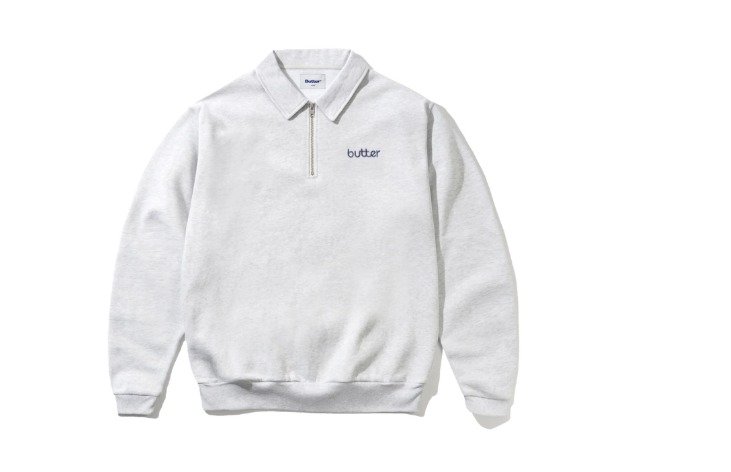
This is the piece that suits a changeable day better than anything else in the range, and the reason is boring mechanics. The Alpine 1/4 Zip Sweater, shown above in Ash and also made in Washed Black and Washed Navy, has a collar you can open and close. Zip up on the platform, drop it halfway on the walk in, pull it fully open when the office heating starts winning. Same garment, three different temperatures.
A crewneck can’t do that. It’s one setting, and on an eight-to-twenty-two day one setting is the problem. The quarter-zip also layers under a jacket without a hood bunching up behind your neck, which matters more than people expect on a tram. At A$81 to A$90 it’s the cheapest thermostat you’ll buy this season.
| Pro Tip: Open the zip before you start sweating, not after. A knit that’s gone damp from the inside stays cold for the rest of the afternoon, and a cold change at five will find it. Dropping the collar two inches on the walk from the tram is usually enough. |
Carrying a layer instead of wearing it
Dressing for a shoulder season means accepting that you’ll be holding something for part of the day. People resist this and then spend the afternoon too hot. A mid-layer you can fold down small is worth more than a warmer one you can’t, which is the real difference between a thin Butter Goods crew and a thick knit sweater when you’re out from eight to eight.
- A crewneck folds flat enough to sit in a backpack without turning into a pillow
- A waffle knit crushes down further again and comes out looking fine
- The Station Knit Sweater, at A$115 to A$120, is the one you commit to wearing all day rather than carrying
- Anything with a kangaroo pocket is fine over an arm but awkward in a bag
And if you’re on a bike or a tram with no room, that decision gets made for you. Thin over thin, then.
The wind off the bay changes the maths
A southerly coming up off Port Phillip makes 15 °C feel like 10 °C, and a knit with an open neck gives that wind somewhere to go. This is the one case where the outer piece should block air rather than hold heat, so the warm layer goes underneath and something tighter-woven goes over the top, even if it’s lighter.
Cuffs do a surprising amount here too. Ribbed cuffs that still grip are the difference between a sleeve that stays put and one that rides up every time you reach for a rail. If you’re buying a Butter Goods Crewneck with wind in mind, the Tread Crewneck in Black Charcoal or the Sketch Waffle Crewneck in Slate Navy both sit closer at the wrist than a worn-in old jumper will.
The forecast gives you one number. The day gives you six.
A phone saying 21 °C is describing about twenty minutes of the day, probably the twenty minutes you’re inside. Dressing for the day means reading the overnight low, the high and whether a change is coming through, then building for the low. You can always take something off.
Sizing helps here too. The knits run S to 4XL, so a crew that goes over a waffle long-sleeve without pulling is a size choice rather than a compromise. Between sizes, I’d size up for the layering piece. Delivery is an estimated 7 to 10 business days, so order for the change in season a couple of weeks early.
Frequently Asked Questions
Can I wear a quarter-zip as the only layer?
On a 15 °C to 20 °C day with no wind, yes, with a tee under it. Below about 12 °C it wants something over the top, mostly because the collar area lets air through once the zip is down.
Two knits at once — does that ever work?
A waffle long-sleeve under a crewneck works, since the waffle is thin and has some give. Two fleece-backed pieces don’t. You’ll feel the inner sleeve dragging inside the outer one within about an hour.
What about a hood under the knit instead of over it?
It bunches. A pullover hood belongs on the outside, or it doesn’t belong in the outfit that day — a zip-thru over a thin crew is the version of that idea that actually sits flat.
Shoulder seasons reward people who plan for the whole day rather than the first ten minutes of it. A thin base, a knit that opens, something in the bag for five o’clock — that’s most of it. Have a look through the knits and crews at Butter Goods, then pick two that work together instead of one that has to do everything alone.