

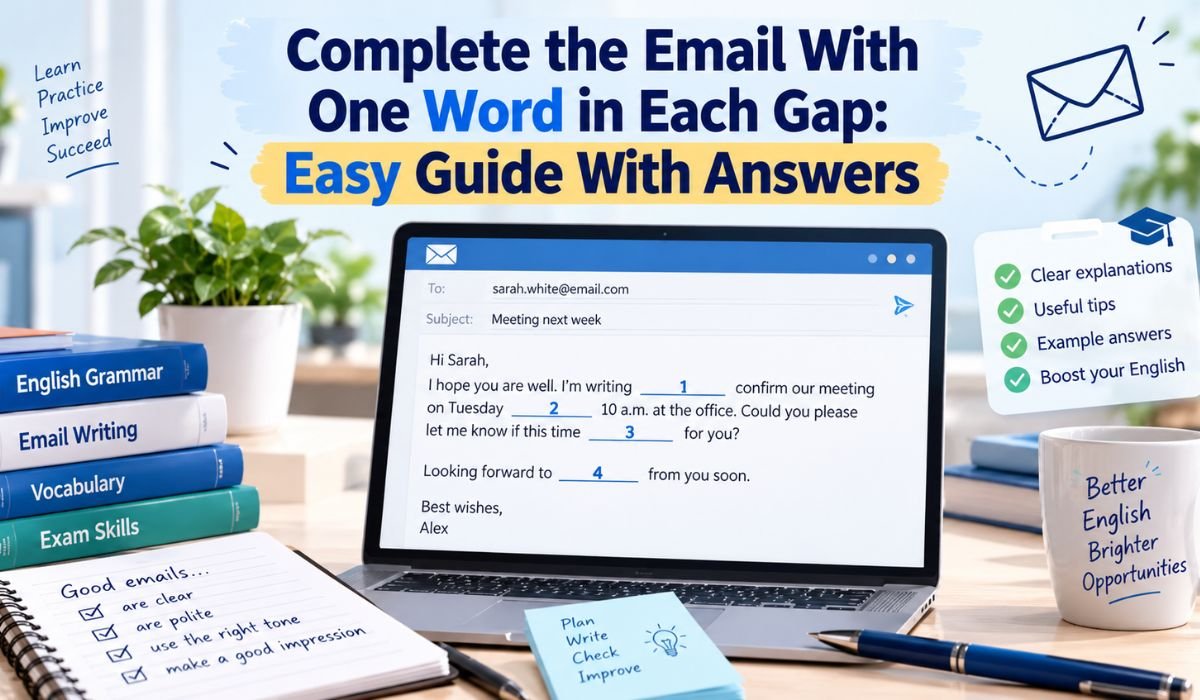
At first glance, Complete the Email With One Word in Each Gap seems like one of the simplest English exercises. There’s an email, a few blank spaces, and only one word is needed for each. Yet those small gaps can reveal a great deal about a learner’s understanding of English.
The missing word usually isn’t complicated. More often, it’s something familiar such as to, for, if, the, it, or with. The real challenge is working out why that particular word belongs there. To do that successfully, you need to understand the sentence, recognize its grammatical structure, and pay attention to the wider meaning of the email.
These exercises are useful for improving everyday English and can also support preparation for open-cloze tasks in Cambridge English qualifications. Exam formats aren’t all the same, however, so it’s important to understand the difference between general email gap-fill practice and the tasks used in a particular examination.
This guide takes a practical approach. Rather than simply giving you answers, it explains the reasoning behind them, shows you how to recognize common patterns, and provides realistic examples you can use to sharpen your skills.
Quick Information
| Information | Details |
|---|---|
| Exercise Type | Gap-Fill or Open-Cloze Practice |
| Main Goal | Add One Suitable Word to Each Gap |
| Main Skill | Grammar and Context |
| Other Skills | Vocabulary and Reading |
| Difficulty | Beginner to Advanced |
| Common Answers | Function Words |
| Common Prepositions | In, On, At, For, To, With |
| Common Articles | A, An, The |
| Common Pronouns | It, We, They, Who, That |
| Common Linkers | And, But, Because, If, Although |
| Common Auxiliaries | Be, Do, Have, Will, Would |
| Common Modals | Can, Could, Should, Might |
| Important Rule | Follow the One-Word Limit |
| Best First Step | Read the Whole Text |
| Major Challenge | Recognizing Grammar Patterns |
| Useful Knowledge | Collocations and Fixed Expressions |
| Exam Relevance | Cambridge Open-Cloze Practice |
| Practical Benefit | More Accurate English Writing |
What Does Complete the Email With One Word in Each Gap Mean?
The instruction is quite literal. You’re given an email containing blank spaces, and your task is to place one suitable word in each blank.
Take a very simple example:
“Thank you ___ your message.”
The answer is for because “thank you for” is the natural English expression.
In an open-cloze exercise, there usually isn’t a list of words waiting for you to choose from. You have to produce the answer yourself. That means looking closely at grammar, sentence structure, common expressions, and context.
A missing word might be an article, preposition, pronoun, auxiliary verb, conjunction, determiner, or relative word. The answer itself may be basic English, but finding it can require careful thought. That’s what makes these exercises more useful than they initially appear.
Why Email Gap-Fill Practice Is Useful
One reason Email Gap-Fill Exercises are valuable is that they bring several language skills together in a realistic context.
Instead of being asked an isolated grammar question, you’re working with connected sentences. You may need to recognize why a noun requires the, why a verb needs have, or why a familiar expression uses to rather than another preposition.
Over time, this kind of practice helps you notice how English sentences are built. Pronouns connect information, conjunctions join ideas, auxiliary verbs help create different verb forms, and prepositions express relationships involving time, place, direction, purpose, and other meanings.
That awareness is useful beyond exercises. Once you start noticing these patterns, they can improve your own emails and everyday writing. Small words become easier to use correctly because you understand the role they’re performing rather than relying entirely on memory.
Words Commonly Used To Fill The Gaps
Many learners expect difficult vocabulary to appear in every blank. In reality, missing words are often ordinary grammatical words that English speakers use constantly.
Prepositions such as at, in, on, to, for, by, and with are common. Articles such as a, an, and the can also appear. Depending on the exercise, a blank might instead require a pronoun, conjunction, modal verb, auxiliary verb, determiner, or relative word.
Consider this sentence:
“I would appreciate ___ if you replied today.”
The natural answer is it.
Now look at another example:
“Please contact me ___ you need any help.”
Here, if makes sense because the second part of the sentence introduces a condition.
A useful habit is to avoid searching immediately for an exact answer. First ask yourself what kind of word is missing. Once you’ve identified the grammatical category, the number of realistic possibilities often becomes much smaller.
How To Find The Correct Missing Word
Good gap-fill technique starts before you write anything. Read the whole email first.
Try to understand the situation. Who appears to be writing? Who is receiving the message? Why has the email been sent? Perhaps the writer is requesting information, arranging a meeting, apologizing for a delay, accepting an invitation, or explaining a problem.
Once you understand the message, return to the individual gaps and examine the words around them.
For example:
“I am interested ___ learning more.”
The adjective “interested” gives you an important clue. In this structure, English uses the combination “interested in,” so in is the natural answer.
When you’ve completed all the blanks, read the email from beginning to end once more. An answer may look possible when you focus on a few nearby words but feel clearly wrong when you hear it in the complete sentence. That final check is worth doing.
Grammar Patterns That Make Answers Easier
Grammar can provide some of the clearest clues in One-Word Gap-Fill Exercises.
Suppose a singular countable noun appears without a determiner. An article may be missing. If a sentence contains a past participle but doesn’t have the auxiliary needed for the intended verb construction, a form of be or have may belong in the gap.
Conditions often use words such as if and unless. Relative clauses may require who, which, or that, depending on what the clause refers to and how the sentence is structured.
These patterns are worth learning because they’re reusable. Memorizing the answer to one exercise helps with that exercise. Understanding the grammar behind the answer helps when the same structure appears in dozens of completely different sentences.
Fixed Expressions And Collocations
Not every gap can be solved through a broad grammar rule. Sometimes the strongest clue is a familiar combination of words.
English contains thousands of collocations and fixed expressions. In email writing, you’ll regularly encounter phrases such as “thank you for,” “interested in,” “responsible for,” “apologize for,” and “look forward to.”
Consider this example:
“I look forward ___ hearing from you.”
The missing word is to.
An important detail is that to functions as a preposition in “look forward to.” That’s why it can be followed by the -ing form “hearing.”
Learning expressions as complete combinations can make gap-fill work much quicker. Instead of rebuilding the phrase word by word every time, you begin to recognize it as a familiar pattern.
Easy Email Gap-Fill Example
Here’s a short example that shows several common patterns working together:
“Hi Emma, Thank you ___ inviting me to your party. I would love ___ come. Could you tell me ___ time it starts? I will let you know ___ I have any problems getting there. See you soon, Mia.”
The answers are for, to, what, and if.
The reasoning is straightforward once the patterns are visible. We say “thank you for” something. “Would love to come” requires to before the base verb. What combines with “time” when asking for the time of an event. Finally, if introduces the possibility of having problems getting there.
What’s useful about this example is that none of the answers involves advanced vocabulary. The challenge comes from knowing how familiar words behave inside complete sentences.
Formal Email Practice With Answers
A professional email introduces slightly different language, although the same basic principles still apply.
“Dear Ms Carter, I am writing ___ ask about the training course. I would like to know ___ there are any places available next month. I am particularly interested ___ the evening sessions because I work during the day. I would ___ grateful if you could send me further information. I look forward ___ hearing from you. Kind regards, Daniel.”
The answers are to, if, in, be, and to.
Each answer belongs to a recognizable construction: “writing to ask,” “know if,” “interested in,” “would be grateful,” and “look forward to.”
Professional emails often rely on established polite expressions. Learning these structures has a double benefit. They become easier to recognize in exercises, and you gain useful language for writing real emails yourself.
Formal And Informal Email Language
Grammar remains important whether you’re emailing a close friend or contacting someone professionally. What changes more noticeably is the tone and style.
A friend might simply ask:
“Can you tell me if you’re coming?”
In a professional setting, someone might write:
“Could you please confirm whether you will be attending?”
Both sentences ask for similar information, but the second sounds more formal and measured.
This difference matters in gap-fill exercises. Don’t look only for a word that is technically possible. Think about the relationship between the people involved, the purpose of the email, and the level of formality. The strongest answer should make sense grammatically while also fitting the tone of the message.
How To Choose When Two Answers Seem Possible
English doesn’t always offer a single possible way to express an idea. Occasionally, two words can fit the same gap without making the sentence incorrect.
Consider:
“Please tell me ___ you can attend.”
Depending on the wider context, both if and whether may work.
A carefully designed exercise should recognize genuinely acceptable alternatives or include enough information to make the intended answer clear. That’s especially important when learners are using practice material to judge their own ability.
If you’re unsure between two answers, widen your focus. Read the whole sentence, then the sentences around it. Check the grammar, meaning, tone, and fixed expressions involved.
The aim isn’t to guess which word happens to appear in an answer key. It’s to understand whether your choice creates natural, accurate English.
Common Mistakes To Avoid
One surprisingly common problem has nothing to do with difficult grammar: learners simply forget the instruction.
If the task says one word, write one word. Adding an extra word may turn an otherwise sensible response into an unacceptable answer.
Prepositions cause plenty of difficulty too. Their use isn’t always predictable, particularly when they form part of a fixed expression. Articles, auxiliary verbs, and relative words can also be easy to overlook because they’re short and don’t always carry obvious lexical meaning.
Another mistake is reading too narrowly. The words immediately beside a blank matter, but the previous or following sentence may contain the clue you actually need.
Spelling shouldn’t be ignored either. In Cambridge B2 First Reading and Use of English, for example, answers in the relevant Use of English tasks need to be spelled correctly.
Above all, don’t assume that a more complicated word must be better. Very often, the missing answer is one of the simplest words in English.
Complete Practice Email With Answers
Now put those ideas together in a longer example. Read the complete message before checking any answers:
“Dear Alex, Thank you ___ your message about the school event. I am pleased ___ hear that you can help us. We have been preparing ___ the event for several weeks, and most arrangements are now complete. Could you let me know ___ you will be available on Friday afternoon? We would also like to know ___ you can bring the equipment we discussed. I would ___ happy to answer any questions. Please contact me ___ you need more information. I look forward ___ seeing you on Friday.”
Suitable answers are for, to, for, if/whether, if/whether, be, if, and to.
Several familiar structures appear here, including “thank you for,” “pleased to hear,” “prepare for,” “would be happy,” and “look forward to.”
The example also illustrates something learners should remember: an exercise can occasionally contain a gap with more than one valid answer.
When you review your work, don’t stop at seeing whether your answer matches. Try to explain why it works. Being able to justify the grammar is a much stronger sign of learning than simply recognizing the expected word.
Email Gap-Fill Exercises In English Exams
Exam information deserves particular care because similar language-learning activities are sometimes described as though they’re identical across different qualifications.
As of 2026, Cambridge B1 Preliminary Reading includes an open-cloze task with six gaps, with candidates writing one word in each gap. B1 Preliminary also assesses email writing separately. Those are different tasks, so the open-cloze section shouldn’t be confused with the writing component.
Cambridge B2 First Reading and Use of English includes an eight-gap open cloze that focuses strongly on grammatical knowledge while also drawing on vocabulary. Cambridge C1 Advanced also includes an eight-gap open-cloze task.
IELTS General Training uses a different approach. Writing Task One asks candidates to respond to a given situation by writing a letter of at least 150 words. It isn’t a standard one-word email open-cloze exercise.
That doesn’t make gap-fill practice useless for IELTS candidates. It can still improve grammatical awareness and accuracy. It simply shouldn’t replace practice with the actual IELTS writing format.
How To Improve Your Gap-Fill Skills
Doing more exercises can help, but simply completing hundreds of blanks isn’t necessarily the fastest route to improvement. What you do after making a mistake matters just as much.
Suppose you repeatedly get prepositions wrong. Instead of treating every error separately, study common combinations such as “depend on,” “interested in,” and “thank someone for.” If articles are causing trouble, review the circumstances in which English uses a, an, the, or no article at all.
Keeping a simple record of errors can be surprisingly revealing. After several practice sessions, patterns often emerge. You may discover that what seemed like a general grammar problem is actually a much narrower difficulty with dependent prepositions or auxiliary verbs.
Regular reading helps as well. The more natural English you encounter, the more often you’ll see the same constructions repeated in meaningful contexts. Eventually, many correct combinations begin to feel familiar before you consciously analyze the grammar.
A Smarter Way To Practice In 2026
Learners now have access to textbooks, digital platforms, online exercises, and AI-based learning tools that can generate practice material almost instantly. That’s convenient, but more practice isn’t automatically better practice.
A useful exercise needs natural English, enough context to support the answers, and a clear grammatical purpose behind each blank. If several answers genuinely work, the material should acknowledge that rather than presenting one arbitrary choice as the only possible response.
For formal exam preparation, official practice materials remain particularly important because they’re designed around the actual examination format and expected level.
The most effective approach is balanced. Work through reliable exercises, investigate your mistakes, read well-written English, learn useful collocations, and practise producing your own emails. Digital tools can give you more opportunities to practise, but careful review is what turns those opportunities into real progress.
Why Context Matters More Than Guessing
Few ideas are more important in gap-fill practice than context.
Imagine seeing a blank directly before the word “Friday.” It’s tempting to choose on immediately because “on Friday” is such a familiar expression. But look at what happens when the meaning changes:
“The meeting is on Friday.”
“Please send the report by Friday.”
“I will be away until Friday.”
The same word, “Friday,” follows three different prepositions. All three sentences are correct because each expresses a different relationship.
This is why solving gaps through word association alone can lead you in the wrong direction. Don’t ask only, “Which word usually comes before this one?” Ask what the sentence is actually trying to say.
Once you start thinking that way, gap-fill exercises become less about guessing and more about understanding how English communicates meaning.
Final Thoughts
Learning how to Complete the Email With One Word in Each Gap isn’t about memorizing a huge collection of answers. It’s about learning to see the structure underneath ordinary English.
Begin with the whole message rather than the individual blank. Understand who is writing, why they’re writing, and what each sentence contributes. Then look more closely at grammar, fixed expressions, collocations, and the words surrounding each gap.
Prepositions, articles, auxiliary verbs, pronouns, conjunctions, and other short grammatical words deserve particular attention. They may look insignificant, but they often determine whether a sentence is accurate and natural.
If you’re studying for an English qualification, make sure your practice reflects the format of the exam you’re actually taking. If your goal is broader language improvement, combine gap-fill work with regular reading and real writing.
Most importantly, don’t measure progress only by the number of correct answers. A better question is whether you can explain why the word is correct. Once you can do that consistently, you’re no longer just filling gaps. You’re developing a stronger understanding of English itself.
FAQs About Complete The Email With One Word In Each Gap
What Does Complete The Email With One Word In Each Gap Mean?
It means you’re given an email containing blank spaces and must place exactly one suitable word into each gap. A good answer needs to fit the grammatical structure while also making sense within the wider message. Reading the whole email before answering usually gives you a much clearer picture of what each sentence requires.
How Do I Know Which Word Belongs In A Gap?
Start by identifying what seems to be missing grammatically. The sentence might require an article, preposition, auxiliary verb, pronoun, conjunction, or another function word. Next, look for fixed expressions and read the surrounding sentences. Grammar narrows your choices, while context helps you confirm which option makes the most sense.
What Words Are Commonly Missing In Gap-Fill Exercises?
Common answers include articles, prepositions, pronouns, auxiliary and modal verbs, conjunctions, determiners, and relative words. Some gaps also test fixed expressions and collocations. The precise language depends on the difficulty and purpose of the exercise.
Can More Than One Answer Be Correct?
Yes. English sometimes allows two different words without making the sentence grammatically incorrect or changing the intended meaning significantly. Well-designed exercises should recognize valid alternatives or provide enough context to make one particular answer necessary.
Is Spelling Important In Open-Cloze Exercises?
Yes. Correct spelling matters in assessed open-cloze work. In Cambridge B2 First Use of English, for example, answers must be spelled correctly. It’s therefore worth leaving enough time to check both your word choices and spelling before finishing.
Are Email Gap-Fill Exercises Used In Cambridge Exams?
Cambridge English qualifications include open-cloze activities, but the exact format varies by exam. B1 Preliminary currently includes a six-gap open cloze in Reading. B2 First and C1 Advanced use eight-gap open-cloze tasks. Email-writing activities and open-cloze activities are separate tasks and shouldn’t be treated as the same exam component.
Does IELTS Use The Same One-Word Email Exercise?
Not as the standard IELTS General Training Writing Task One format. That task requires candidates to write a letter of at least 150 words in response to a situation. One-word gap-fill exercises can still help IELTS learners improve grammatical accuracy, but candidates also need to practise the actual IELTS task format.
What Is The Best Way To Improve At Email Gap-Fill Exercises?
Practise regularly, but spend just as much time understanding your mistakes. Learn common collocations, review grammar patterns that repeatedly cause difficulty, and always use the whole text for context. Most importantly, try to explain why each correct word belongs in the sentence. That turns a simple practice exercise into genuine language learning.
Learn more and explore exciting content on: BrandRank.ai Normalization Transformation Rules: How They Work
 Sky News Agency
 HG Star