

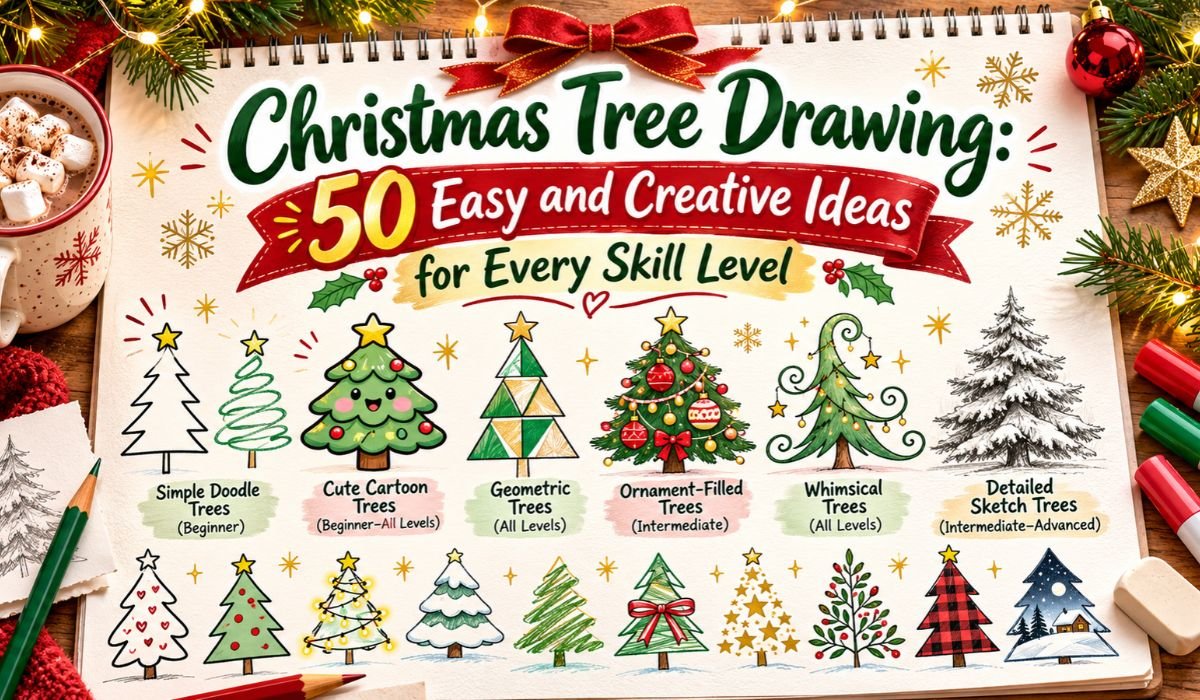
There’s something special about Christmas trees. Their sparkling lights, colorful ornaments, and familiar evergreen branches instantly bring the holiday season to life. A Christmas Tree Drawing offers a wonderful way to capture that festive feeling while enjoying a little creative time.
Perhaps you’re making handmade Christmas cards, planning a holiday activity for your children, or simply looking for something relaxing to do on a winter afternoon. Whatever your motivation, drawing a Christmas tree doesn’t require professional skills or expensive equipment. A sheet of paper, a pencil, and a handful of colors can go a surprisingly long way.
From traditional decorated trees to playful cartoon illustrations and detailed winter landscapes, there’s a style for everyone. This 2026 guide brings together 50 inspiring Christmas Tree Drawing Ideas, practical drawing techniques, coloring advice, and helpful suggestions to make your festive artwork truly your own.
Quick Information About Christmas Tree Drawing
| Feature | Information |
|---|---|
| Activity Name | Christmas Tree Drawing |
| Art Category | Seasonal and Festive Art |
| Suitable For | Children and Adults |
| Difficulty Level | Beginner to Advanced |
| Essential Materials | Pencil, Paper, and Eraser |
| Coloring Materials | Crayons, Markers, and Paints |
| Traditional Colors | Green, Red, Gold, and White |
| Basic Tree Shape | Triangle or Layered Branches |
| Popular Decorations | Stars, Ornaments, and Lights |
| Drawing Styles | Classic, Modern, and Whimsical |
| Estimated Drawing Time | 5 Minutes to Several Hours |
| Popular Season | Christmas and Winter |
| Artistic Techniques | Sketching, Shading, and Blending |
| Skills Practiced | Observation and Hand Control |
| Creative Uses | Cards, Crafts, and Decorations |
| Digital Compatibility | Tablets and Drawing Applications |
| Suitable Locations | Home, School, and Art Studios |
| Previous Experience | Not Required for Simple Designs |
Essential Materials for Christmas Tree Drawing
Before putting pencil to paper, consider the type of drawing you’d like to create. A simple Christmas tree sketch requires very little equipment, while a detailed painting might benefit from a few additional supplies.
An HB pencil is a good choice for sketching initial outlines. Softer graphite pencils, such as 2B and 4B, are helpful when adding shadows and darker details. Keep an eraser nearby so you can adjust your sketch as it develops.
Colored pencils are particularly useful for small ornaments and delicate details. Crayons and washable markers, on the other hand, are convenient choices for children. Watercolors create soft, atmospheric winter scenes, while acrylic paints provide stronger coverage and richer colors.
Regular drawing paper is suitable for most pencil sketches. If you’re working with watercolors, heavier paper, such as 300 gsm watercolor paper, can help reduce buckling. Testing your materials on a spare sheet is also a sensible habit, especially when experimenting with unfamiliar paints or markers.
How to Draw a Christmas Tree Step by Step
The easiest way to approach a Christmas Tree Drawing is to break it down into familiar shapes. Begin with a faint vertical guideline in the center of your paper. This will help you maintain balanced proportions as you build the tree.
Draw a small triangular shape near the top, then add two or three wider layers underneath. These shapes represent the evergreen branches. You can soften their edges with gentle curves or irregular lines if you prefer a more natural appearance.
Next, draw a rectangular trunk beneath the lowest branches and place a star at the top. Add circular ornaments, curved garlands, and tiny Christmas lights. A few wrapped presents around the base can help complete the festive scene.
Once you’re satisfied with the arrangement, erase any unnecessary guidelines and define the final outlines. Begin coloring with lighter shades before introducing darker tones, particularly when using colored pencils. Finish with decorative details and highlights.
This Easy Christmas Tree Drawing technique is straightforward enough for beginners but flexible enough to support more ambitious artwork.
50 Easy and Creative Christmas Tree Drawing Ideas
Finding inspiration is often the most enjoyable part of starting a new drawing. Some people prefer traditional Christmas scenes, while others enjoy experimenting with unusual shapes, imaginative colors, and playful characters.
The following 50 ideas cover a variety of artistic styles and difficulty levels, making it easier to find something that suits your interests.
Easy Christmas Tree Drawing Ideas for Beginners
A Simple Triangle Christmas Tree is a natural starting point for anyone learning to draw. A Classic Christmas Tree introduces familiar evergreen branches, while a Christmas Tree Outline leaves plenty of room for coloring.
Try a Star-Topped Christmas Tree to practice creating a focal point or a Layered Christmas Tree to develop your understanding of proportions. A Christmas Tree With Presents combines several basic shapes, and a Tree With Colorful Ornaments offers an opportunity to practice drawing circles.
For something a little different, experiment with a Black-and-White Christmas Tree, a Spiral Christmas Tree made from flowing curves, or a Christmas Tree Line Drawing created with one continuous line.
Cute Christmas Tree Drawing Ideas for Kids
Children often enjoy giving their drawings a personality. A Smiling Christmas Tree can feature a cheerful expression, while a Kawaii Christmas Tree uses rounded shapes, large eyes, and adorable details.
A Cartoon Christmas Tree encourages playful exaggeration, and a Rainbow Christmas Tree gives young artists the freedom to explore different colors. A Candy Cane Christmas Tree brings a sweet holiday theme to the artwork.
Adding familiar Christmas characters can make drawing even more entertaining. Consider a Christmas Tree With Santa Claus, a Tree With a Snowman, or a Christmas Tree With Reindeer.
A Gingerbread Christmas Tree, decorated with icing-inspired patterns, is another charming option. For a shorter creative activity, a simple Christmas Tree Doodle is always a good choice.
Beautiful and Traditional Christmas Tree Drawing Ideas
If you enjoy the familiar warmth of Christmas decorations, a Fully Decorated Christmas Tree offers plenty of opportunities to draw ornaments, ribbons, and lights.
A Snow-Covered Christmas Tree captures the peaceful atmosphere of winter, while a Christmas Tree With Fairy Lights allows you to experiment with glowing effects. A Vintage Christmas Tree can feature old-fashioned ornaments and traditional festive details.
Natural decorations work particularly well in a Rustic Farmhouse Christmas Tree or a Christmas Tree With Pinecones. Both designs offer interesting textures and earthy color combinations.
Other lovely options include a Christmas Tree With Ribbons, an Elegant Gold Christmas Tree, a Christmas Tree Beside a Fireplace, and a Christmas Tree Inside a Snow Globe. Each creates a different mood while celebrating familiar holiday traditions.
Modern and Creative Christmas Tree Drawing Ideas
Not every Christmas tree needs green branches and red ornaments. A Minimalist Christmas Tree can look striking with just a few carefully placed lines, while a Geometric Christmas Tree combines triangles, circles, and other simple shapes.
An Abstract Christmas Tree offers even more freedom, allowing you to experiment with patterns and unexpected color combinations. A Pink Christmas Tree introduces a playful touch, whereas a Pastel Christmas Tree creates a softer, contemporary look.
You could also design a Christmas Tree Made of Hearts, a Tree Made of Stars, or a Tree Made of Circles. These ideas are especially useful for handmade cards and decorative illustrations.
A Whimsical Christmas Tree invites imaginative branches and unusual ornaments, while a Christmas Tree Mandala combines festive imagery with carefully arranged repeating patterns.
Advanced Christmas Tree Drawing Ideas
Artists looking for a greater challenge can attempt a Realistic Evergreen Christmas Tree, paying close attention to natural branch shapes and textures. A Detailed Pencil Christmas Tree Sketch is another excellent way to practice light, shadow, and tonal variation.
A Watercolor Christmas Tree allows you to explore transparent washes, while a 3D Christmas Tree Drawing develops your understanding of volume and perspective.
More ambitious compositions include a Christmas Tree in a Winter Forest, a Tree Under a Starry Sky, and a Christmas Tree With Realistic Lighting. A Tree With Woodland Animals introduces wildlife and storytelling.
For a more detailed scene, try a Christmas Tree Street Scene featuring buildings and festive surroundings. Alternatively, drawing a Family Decorating a Christmas Tree can capture the joy and togetherness associated with the season.
Different Christmas Tree Drawing Styles
One of the pleasures of Christmas Tree Art is discovering how differently the same subject can be interpreted.
Classic illustrations emphasize familiar evergreen branches and traditional decorations. Minimalist designs take the opposite approach, using simple lines and empty space to create an attractive composition without unnecessary details.
Whimsical drawings leave room for exaggerated shapes and unexpected colors. Rustic artwork generally favors natural textures, earthy shades, pinecones, and understated ornaments. Cartoon illustrations focus more on personality, while abstract designs encourage artistic expression through patterns, shapes, and colors.
An enjoyable exercise is to draw the same Christmas tree in several styles. You’ll quickly notice how changing the outline, decorations, or color palette can transform the entire illustration.
Best Colors for Christmas Tree Drawings
Green, red, gold, and white remain familiar favorites in Christmas artwork. Their association with traditional holiday decorations makes them an easy starting point, but there’s no reason to limit yourself to conventional choices.
Blue and silver create a cool, winter-inspired appearance. Gold and cream can make a drawing feel elegant, while muted green and brown work particularly well for rustic designs. Pink, lavender, and other pastel shades are attractive choices for cute and modern illustrations.
Rather than combining too many colors at once, choose two or three dominant shades and introduce smaller accents. This often creates a more balanced result.
Adding darker colors underneath branches and lighter shades along exposed surfaces helps establish depth. Save your brightest highlights for selected ornaments and lights so those details naturally attract attention.
How to Decorate Your Christmas Tree Drawing
Decorating a Christmas Tree Drawing is where your individual style really begins to emerge. Even the simplest outline can become memorable with a thoughtful arrangement of ornaments.
Start with larger decorations, then fill suitable gaps with smaller details such as bells, berries, stars, and candy canes. Draw garlands as gentle curves that follow the direction of the branches.
Try varying the size and placement of your ornaments rather than arranging everything at identical intervals. Leaving some greenery visible prevents the tree from appearing crowded.
Small white highlights can make shiny baubles look reflective, especially when they face the main light source. You might also include ornaments featuring family initials, favorite symbols, or meaningful memories. These personal details can turn an ordinary festive sketch into something much more distinctive.
How to Make a Christmas Tree Drawing Look Realistic
Creating a Realistic Christmas Tree Drawing begins with looking closely at actual evergreen trees. Although many have a roughly triangular shape, their branches aren’t perfectly even. They vary in length, thickness, and direction.
Instead of drawing every pine needle individually, use short, directional strokes to suggest groups of needles. Overlapping branch shapes will help establish a fuller appearance.
Decide where the light is coming from before adding shadows. Branches facing the light should generally appear brighter, while overlapping or sheltered areas need darker tones.
If you’re drawing a snow-covered tree, leave irregular white patches across the upper surfaces of branches. Pale blue or gray shading can suggest shadows in the snow. A soft ground shadow beneath the tree will also help anchor it within the scene.
Subtle reflections on ornaments and consistent lighting can make the finished illustration feel much more convincing.
Christmas Tree Drawing With Different Art Materials
The materials you choose can influence both the appearance of your artwork and the experience of creating it.
A Christmas Tree Pencil Drawing is ideal for practicing outlines, texture, and shading. Colored pencils offer greater flexibility when building colors gradually, while markers produce bold shapes and clean edges that suit greeting cards and decorative designs.
Watercolor Christmas Tree Art has a softer character. Painting onto damp paper allows colors to spread and blend naturally, whereas applying paint to dry paper creates sharper details. Acrylic paints offer stronger coverage and can produce interesting brush textures.
Digital drawing is another worthwhile option. Modern drawing applications provide adjustable brushes, editable layers, and reusable color palettes. These features make it easier to test different backgrounds, decorations, and artistic styles without permanently changing the original sketch.
Christmas Tree Drawing Activities for Kids and Families
Christmas Tree Drawing for Kids can turn an ordinary afternoon into an enjoyable family activity. Younger children can begin with triangles, circles, and stars, while older children may prefer creating complete holiday scenes.
Drawing activities offer opportunities to practice hand control, recognize shapes, explore colors, and make creative decisions. Parents and teachers can introduce festive coloring sessions, classroom projects, or handmade Christmas card activities.
Choose age-appropriate, non-toxic supplies and supervise younger children when necessary.
It’s also worth remembering that children don’t need to follow a traditional color scheme. If they want to draw a purple Christmas tree with rainbow ornaments, encourage their imagination. The enjoyment of creating something together matters far more than achieving a perfect result.
Creative Ways to Use Christmas Tree Drawings
Once you’ve finished your artwork, why leave it hidden inside a sketchbook?
Small Christmas tree illustrations make lovely personalized gift tags, while larger drawings can become framed seasonal decorations. You can also use your designs for greeting cards, holiday invitations, festive posters, scrapbook pages, or homemade coloring sheets.
Scanning or photographing your artwork allows you to reuse it in digital designs and social media graphics while preserving the original.
For something more personal, consider creating a new Christmas Tree Drawing every year. Write the date beside each illustration and keep them together in a folder or scrapbook. Over time, the collection can become a charming record of changing artistic styles and family Christmas memories.
Common Christmas Tree Drawing Mistakes
Many drawing difficulties begin during the initial sketch. Pressing too hard with a pencil, for example, makes unwanted lines difficult to erase. Gentle strokes give you more freedom to adjust shapes and proportions.
Another common mistake is making every branch identical when attempting a realistic tree. Small variations in branch length and direction will usually create a more natural appearance.
Too many decorations can also hide the structure of the tree. Leaving occasional spaces between ornaments helps maintain visual balance.
Watercolor artists sometimes encounter unwanted color bleeding when adding fresh paint over a damp layer. If you’re aiming for crisp details, allow the earlier wash to dry first. However, controlled blending on damp paper can be useful when creating soft backgrounds.
Building darker colors gradually and preserving lighter areas will generally produce more convincing depth.
Helpful Drawing Tips for Every Skill Level
If you’re a beginner, concentrate on getting comfortable with basic shapes before worrying about complicated details. Light pencil guidelines can help you maintain proportions, while simple decorations make coloring more manageable.
Intermediate artists can experiment with overlapping branches, different textures, gradual color blending, and consistent lighting. More experienced artists might explore perspective, reflective ornaments, detailed backgrounds, or mixed-media techniques.
Before starting a larger illustration, try sketching three small versions of the same Christmas tree. Change the branch shapes, decoration placement, or color palette in each one. These quick preliminary sketches can help you discover which composition works best.
Using real evergreen trees or your own holiday photographs as references is another useful habit. Careful observation, combined with regular practice, can gradually improve both your confidence and artistic skills.
Final Thoughts
Christmas Tree Drawing offers something more meaningful than simply creating a festive picture. It’s a chance to slow down, explore your imagination, and spend time doing something enjoyable during a busy holiday season.
The 50 ideas in this guide demonstrate just how versatile Christmas Tree Art can be. A simple triangle, a colorful cartoon, and a detailed winter landscape may look completely different, yet each can capture the warmth and charm of Christmas.
There’s no need to compare your artwork with someone else’s. Choose a design that appeals to you, work with materials you enjoy, and experiment without worrying about perfection.
Whether your finished drawing becomes a handmade card, a festive decoration, or a treasured family keepsake, its greatest value often comes from the creativity and memories behind it.
FAQs About Christmas Tree Drawing
How Do You Draw a Christmas Tree Easily?
Begin with three progressively wider triangular layers to represent the branches. Add a rectangular trunk and place a star at the top. Finish with circular ornaments, simple garlands, and your favorite festive colors. Using light pencil guidelines makes the process easier.
What Is the Best Christmas Tree Drawing for Beginners?
A simple triangular Christmas tree is an excellent choice because it requires only basic shapes. Once you’re comfortable with the outline, you can gradually introduce layered branches, decorations, shadows, and additional festive details.
What Colors Are Best for Christmas Tree Drawing?
Traditional Christmas illustrations often feature green, red, gold, and white. Blue and silver work beautifully for winter scenes, while pink and pastel colors suit modern designs. Choosing a small selection of complementary or contrasting shades helps maintain a balanced appearance.
How Can I Draw a Realistic Christmas Tree?
Observe the way natural evergreen branches grow and overlap. Vary their lengths, use short directional strokes to suggest pine needles, and maintain consistent lighting. Combining darker shadows with lighter highlights will help create convincing texture and depth.
How Do You Draw Glowing Christmas Lights?
Draw small bulbs along gently curved wires. Give each bulb a bright center and surround it with a soft colored halo. Adding slightly darker shades to nearby branches can help emphasize the impression of glowing lights.
Can Children Draw Christmas Trees Easily?
Absolutely. Basic triangles, circles, and stars make Christmas Tree Drawing accessible to children with different skill levels. Washable markers, age-appropriate crayons, and simple coloring activities can make the experience both manageable and enjoyable.
What Paper Is Best for Christmas Tree Drawing?
Ordinary sketching paper works well for pencils, crayons, and most dry drawing materials. If you’re using watercolors, heavier watercolor paper is generally more suitable because it handles moisture better and can reduce buckling.
How Can I Use My Christmas Tree Artwork?
Finished Christmas tree illustrations can be transformed into handmade greeting cards, personalized gift tags, holiday posters, printable coloring pages, and seasonal decorations. You can also digitize your artwork for social media or preserve it as a meaningful family keepsake.
Learn more and explore exciting content on: Christmas Sweater Guide: Festive Styles, Cozy Comfort, and Holiday Outfit Ideas
 Wild Rise