

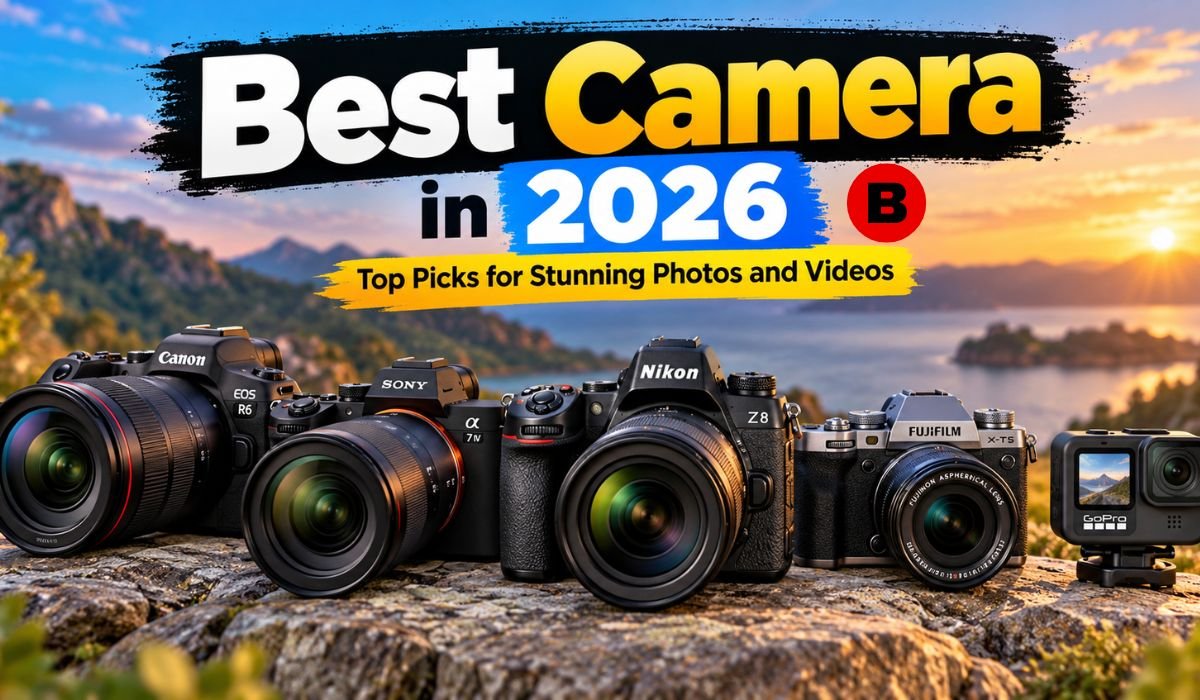
Finding the Best Camera in 2026 isn’t as straightforward as it might seem. Walk into a camera store or browse photography websites, and you’ll find everything from compact mirrorless models to sophisticated professional cameras. Many promise exceptional image quality, lightning-fast autofocus, and cinematic video. The difficult part is figuring out which features actually matter to you.
The truth is, a camera that works beautifully for a wedding photographer might be completely unsuitable for someone filming travel videos. A wildlife enthusiast needs different equipment from a beginner who simply wants sharper family photographs.
Fortunately, today’s cameras offer more choice than ever. You don’t necessarily need to spend thousands of dollars to capture impressive images or create polished videos.
In this guide, we’ll explore ten of the Best Cameras for Photography and Video in 2026, including models from Nikon, Sony, Canon, Fujifilm, and Olympus. We’ll look beyond the marketing claims to explain what each camera does well, where it falls short, and who should consider buying it.
Best Cameras in 2026: Quick Comparison
Before getting into individual models, it’s worth understanding what separates these cameras.
The Nikon Z8 is an excellent choice for professionals who need outstanding still photographs and advanced video recording. Sony’s A7R V is particularly impressive when image detail and autofocus accuracy matter most. Meanwhile, Canon’s EOS R7 offers a more accessible route into serious photography without sacrificing too many advanced features.
If portability is your priority, the Sony a6700 and Nikon Z fc deserve attention. Both are easier to carry than larger professional systems, although they serve slightly different audiences.
Here’s how the leading models compare.
| Camera | Best For | Sensor | Maximum Video Resolution |
|---|---|---|---|
| Nikon Z8 | Professional photography and video | 45.7MP Full-Frame | 8K 60p |
| Sony A7R V | Autofocus and detailed images | 61MP Full-Frame | 8K |
| Canon EOS R7 | Beginners and wildlife | 32.5MP APS-C | 4K 60p |
| Sony A7R IV | High-resolution photography | 61MP Full-Frame | 4K 30p |
| Nikon Z fc | Everyday photography | 20.9MP APS-C | 4K 30p |
| Canon EOS R6 Mark III | Low-light photography | 32.5MP Full-Frame | 7K |
| Sony a6700 | Travel and content creation | 26MP APS-C | 4K 120p |
| Nikon D850 | Professional DSLR photography | 45.7MP Full-Frame | 4K 30p |
| Olympus OM-D E-M10 IV | Lightweight everyday shooting | 20.3MP Micro Four Thirds | 4K 30p |
| Fujifilm X-T50 | Creative photography | 40.2MP APS-C | 6.2K 30p |
Keep in mind that maximum video resolution doesn’t tell the whole story. Some recording modes introduce cropping, limit frame rates, or require faster memory cards. Image quality, handling, and lens selection deserve just as much attention.
How These Cameras Were Selected
A useful camera recommendation should consider more than impressive specifications.
For this guide, the selections are based on published manufacturer information, independent professional reviews, and the practical requirements of different photographers. Image quality, autofocus reliability, video features, portability, lens compatibility, and long-term value all play a part.
These recommendations don’t represent original hands-on testing conducted specifically for this article. Instead, they bring together established product information and published evaluations to help readers make informed comparisons.
That’s an important distinction because camera performance can change considerably depending on the lens, lighting conditions, shooting settings, and photographer’s experience.
Rather than suggesting one model is perfect for everyone, the goal is to identify where each camera makes the most sense.
Nikon Z8: Best Overall Camera for Photography and Video
There’s a reason the Nikon Z8 frequently appears in discussions about professional mirrorless cameras. It combines outstanding photographic performance with video capabilities that would have seemed extraordinary only a few years ago.
At its heart is a 45.7MP stacked full-frame sensor. That provides enough resolution for detailed landscapes, commercial photographs, and large prints, while its fast readout supports demanding action photography.
Wildlife and sports photographers will appreciate the sophisticated subject-detection autofocus. The camera can follow moving subjects, helping photographers maintain focus when the action becomes unpredictable.
The Z8 also offers exceptionally fast electronic burst shooting. Its highest frame rates come with restrictions on resolution and file format, but they’re still useful when capturing fleeting moments.
Video is another major strength. The camera supports 8K recording, internal RAW formats, and professional color workflows. These capabilities make it suitable for commercial productions as well as ambitious independent filmmaking.
Astrophotographers aren’t forgotten, either. Nikon includes night-vision display settings and specialized low-light focusing features that make working under dark skies more comfortable.
The compromises are mainly practical. The Z8 is relatively heavy, expensive, and packed with controls that beginners may not need.
Still, for an experienced photographer who wants one dependable camera for almost every assignment, it’s difficult to overlook.
Sony A7R V: Best Camera for Autofocus and High-Resolution Images
Some cameras are designed around speed. Others prioritize portability. The Sony A7R V places exceptional image detail and intelligent autofocus at the center of the experience.
Its 61MP full-frame sensor captures intricate textures and fine details, making it particularly appealing to landscape, portrait, architectural, and commercial photographers.
That resolution also provides considerable freedom when editing. You can crop an image substantially while retaining enough detail for many professional applications.
But the A7R V isn’t simply about megapixels.
Sony’s dedicated AI processing system improves subject recognition, allowing the camera to identify people, animals, birds, insects, and different types of vehicles. This helps maintain accurate focus even when subjects move or change position.
The electronic viewfinder is exceptionally detailed, while the four-axis rear screen offers useful flexibility when composing photographs from awkward angles.
There’s also in-body image stabilization and 8K video recording, although some recording modes involve cropping and other limitations.
The main drawback is the amount of data this camera produces. Large RAW files quickly consume storage space and can place significant demands on older computers.
Photographers who regularly work at high ISO settings should also examine its noise performance rather than assuming higher resolution guarantees better night photographs.
For professionals who value precision, detail, and reliable subject tracking, the A7R V remains a compelling choice.
Canon EOS R7: Best Camera for Beginners and Wildlife Photography
The Canon EOS R7 occupies an interesting position. It’s approachable enough for enthusiastic beginners, yet powerful enough to handle photography that would challenge many entry-level cameras.
Its 32.5MP APS-C sensor produces detailed images, while Canon’s subject-tracking autofocus helps keep people, animals, and vehicles sharply focused.
Wildlife photography is one of its strongest applications.
Because the sensor is smaller than full-frame, a lens produces a narrower field of view at the same focal length. That can be useful when photographing distant birds or animals, although it doesn’t physically increase the lens’s magnification.
The EOS R7 also offers fast continuous shooting, making it easier to capture movement at precisely the right moment.
For video, there’s 4K recording and a fully articulating touchscreen. In-body image stabilization helps reduce camera shake, while dual SD card slots provide useful flexibility for storing or backing up images.
Of course, there are compromises.
The APS-C sensor affects wide-angle lens choices, particularly for astrophotography. Some demanding video modes may also encounter temperature-related recording limitations.
Even so, the R7 offers something valuable: a camera that beginners can learn on without quickly outgrowing.
Sony A7R IV: Best Camera for High-Resolution Photography
Not every worthwhile camera needs to be the newest model on the shelf.
The Sony A7R IV is a good example. Although newer cameras have introduced more advanced autofocus and video features, its 61MP full-frame sensor remains exceptionally capable.
For landscape photographers, that resolution helps preserve fine details across expansive scenes. Portrait and studio photographers can capture textures with impressive clarity, while architectural photographers benefit from the flexibility to crop and straighten compositions.
The A7R IV also includes effective autofocus and in-body stabilization, making it useful beyond carefully controlled studio environments.
Video recording reaches 4K, which remains sufficient for many projects. However, filmmakers seeking advanced codecs, high frame rates, or newer subject-recognition features will find more capable alternatives.
Another consideration is storage. Those large RAW files add up quickly, particularly during long professional shoots.
Where the A7R IV becomes especially interesting is pricing. If you find one at a substantial discount compared with the A7R V, it may represent excellent value for photography-focused users.
There’s little reason to pay for features you won’t use, especially when an older camera already delivers the image quality you need.
Nikon Z fc: Best Budget-Friendly Camera for Everyday Photography
The Nikon Z fc takes a different approach from the technology-heavy cameras above. Its appeal begins with the experience of using it.
Inspired by classic Nikon film cameras, the Z fc features traditional exposure dials and a distinctive retro design. These controls aren’t merely decorative. They encourage photographers to experiment with shutter speed, ISO, and exposure compensation.
Inside is a 20.9MP APS-C sensor capable of producing attractive photographs in a wide range of everyday situations.
Street photography, family portraits, travel, and casual landscapes are all comfortably within its abilities.
The camera also records 4K video and includes a fully articulating screen, making it useful for occasional vlogging or social media content.
Its relatively light body is another advantage. A camera that’s comfortable to carry is more likely to accompany you on spontaneous outings.
However, the Z fc doesn’t include in-body stabilization, and its shallow grip may feel awkward with larger lenses.
For someone who enjoys photography as a creative hobby and wants to develop manual shooting skills, the Z fc offers an engaging alternative to more complicated systems.
Canon EOS R6 Mark III: Best Camera for Low-Light Photography
Low-light photography can expose weaknesses that aren’t obvious when shooting outdoors on a bright afternoon.
Autofocus may struggle, image noise becomes more noticeable, and camera shake can ruin otherwise promising photographs.
The Canon EOS R6 Mark III is designed to handle demanding conditions while offering the versatility expected from a modern hybrid camera.
Introduced in November 2025, it features a 32.5MP full-frame sensor, advanced subject-tracking autofocus, and electronic continuous shooting at up to 40 frames per second.
Its video features are equally ambitious, including internal 7K RAW recording and high-frame-rate 4K options.
For wedding and event photographers, this combination is particularly useful. Lighting can change quickly, and important moments rarely wait for ideal conditions.
The R6 Mark III is also worth considering for astrophotography, although its capabilities shouldn’t be judged by sensor size alone.
A fast lens, accurate focus, stable tripod, and suitable exposure settings remain essential for photographing stars and night landscapes.
It’s a powerful option for photographers who need dependable performance across challenging lighting situations, especially when video is part of their work.
Sony a6700: Best Lightweight Camera for Travel and Video
Travel photography often involves a difficult compromise. You want excellent image quality, but you don’t want to carry a heavy camera bag everywhere.
The Sony a6700 offers an appealing solution.
Its 26MP APS-C sensor captures detailed photographs, while its compact body makes it easier to pack for trips, city walks, and everyday adventures.
Sony’s AI-assisted autofocus system helps recognize and follow moving subjects. That makes the camera useful for photographing people, animals, and unpredictable scenes.
Video creators get particularly strong features, including 4K recording at up to 120 frames per second. This high-frame-rate mode uses a crop, but it still provides useful slow-motion possibilities.
The fully articulating touchscreen is convenient for self-recording, and in-body stabilization helps with handheld shooting.
There are limitations worth knowing about. The camera has only one memory card slot, which may concern professionals who require immediate backups. Long recording sessions can also be affected by temperature and camera settings.
For travel photographers, vloggers, and creators who regularly switch between stills and video, however, the a6700 offers an excellent balance of performance and portability.
Nikon D850: Best DSLR Camera for Professional Photography
Mirrorless cameras dominate much of today’s conversation, but that doesn’t mean a capable DSLR has suddenly become obsolete.
The Nikon D850 remains an excellent example of what a professional DSLR can achieve.
Its 45.7MP full-frame sensor delivers detailed photographs with strong dynamic range, particularly at lower ISO settings.
Landscape photographers appreciate its ability to preserve fine textures and subtle tonal differences. Studio and architectural photographers benefit from its high resolution, while its robust construction suits demanding professional use.
Unlike mirrorless cameras, the D850 uses an optical viewfinder. Some photographers prefer this direct view of the scene, especially during extended shooting sessions.
Battery endurance is another advantage when using the optical viewfinder.
The camera can record 4K video, although its live-view autofocus doesn’t match the sophisticated tracking systems found in many newer mirrorless models.
Its size and weight may also discourage travelers.
For photographers who already own Nikon F-mount lenses, however, the D850 can remain a practical and financially sensible choice.
Olympus OM-D E-M10 Mark IV: Best Compact Camera for Everyday Use
The Olympus OM-D E-M10 Mark IV demonstrates that enjoyable photography doesn’t require a large camera.
Built around a 20.3MP Micro Four Thirds sensor, it offers a compact interchangeable-lens system that works particularly well for travel and everyday photography.
One of its most useful features is five-axis in-body image stabilization. This helps reduce blur caused by small hand movements, making handheld photography more manageable in a variety of situations.
The camera also supports 4K video and includes a tilting touchscreen.
Micro Four Thirds lenses can be relatively small, allowing photographers to carry several focal lengths without filling an entire backpack.
Naturally, the smaller sensor introduces some compromises. Very low-light conditions can be more demanding, and the autofocus system isn’t as sophisticated as those found in newer premium cameras.
Still, the E-M10 Mark IV has a clear advantage: convenience.
For family photography, city breaks, and casual creative projects, a lightweight camera that’s always within reach can be more useful than a professional system left at home.
Fujifilm X-T50: Best Camera for Creative Photography
Photography isn’t always about technical perfection. Sometimes, the pleasure comes from experimenting with color, light, and atmosphere.
That’s where the Fujifilm X-T50 feels particularly appealing.
Its 40.2MP APS-C sensor provides impressive detail, but the camera’s creative controls are what distinguish it from many competitors.
A dedicated Film Simulation dial gives photographers quick access to Fujifilm’s distinctive color styles. These profiles can produce attractive JPEG images directly from the camera, reducing the need for extensive editing.
The X-T50 offers 20 Film Simulation modes, giving photographers plenty of room to experiment.
It also supports 6.2K video, AI-assisted subject detection, and five-axis in-body stabilization rated for up to seven stops under specified testing conditions.
The compact design suits street photography, portraits, and travel, although battery endurance and limited weather protection deserve consideration.
For photographers who enjoy developing a recognizable visual style, the X-T50 offers an especially rewarding experience.
How to Choose the Best Camera in 2026
Before spending money on a new camera, think about the photographs and videos you actually want to create.
If most of your pictures involve family occasions, holidays, and everyday moments, portability and straightforward controls may matter more than professional recording formats.
Wildlife photographers have different priorities. They need reliable autofocus, fast shooting speeds, and access to suitable telephoto lenses.
Video creators should pay closer attention to recording formats, stabilization, microphone connectivity, and overheating limitations.
Sensor size is another important consideration.
Full-frame cameras offer a larger imaging area, which can provide advantages in low light and depth-of-field control. APS-C cameras often deliver an excellent balance of image quality, affordability, and portability. Micro Four Thirds systems can be particularly convenient when carrying several lenses.
Don’t forget the complete cost of ownership.
A camera body may appear affordable until you add lenses, batteries, memory cards, and accessories. Choosing a system with reasonably priced lenses can make a significant difference over time.
The best buying decision usually comes from matching equipment to real needs rather than chasing the most impressive specification sheet.
Mirrorless vs DSLR Cameras: Which Should You Buy?
If you’re purchasing your first interchangeable-lens camera in 2026, mirrorless is generally the more future-oriented choice.
Most major manufacturers now concentrate their newest camera and lens development on mirrorless systems. These cameras commonly provide sophisticated autofocus, electronic viewfinders, and advanced video recording features.
Electronic viewfinders also allow photographers to preview exposure and certain image settings before capturing a photograph.
DSLR cameras, however, still have their place.
Their optical viewfinders offer a direct view through the lens, and many models provide excellent battery life. The used market also contains an extensive selection of compatible lenses.
For someone who already owns a collection of DSLR equipment, switching systems may not be necessary.
Ultimately, both formats can produce outstanding photographs. The difference lies in how they handle, what features they offer, and how well they fit your existing equipment.
Best Camera for Different Photography Styles
There’s no universal camera that suits every type of photography equally well.
Portrait photographers often prioritize accurate eye autofocus and lenses capable of producing attractive background blur. A full-frame camera can be useful, but excellent portraits are also possible with smaller sensors.
Landscape photography places greater emphasis on dynamic range, lens sharpness, and the ability to preserve detail across bright and dark areas.
Wildlife and sports photographers need responsive autofocus, fast burst shooting, and suitable telephoto lenses.
For travel photography, weight becomes particularly important. A smaller camera with a versatile lens may be more enjoyable during a full day of exploring.
Astrophotography introduces its own challenges. Photographing the Milky Way requires careful exposure, accurate focusing, and often a fast wide-angle lens.
These differences are worth understanding before purchasing. The right camera should make your favorite style of photography easier, not simply offer the longest list of features.
Best Camera for Video, YouTube, and Content Creation
A camera that produces beautiful photographs won’t necessarily be the best choice for video.
For most YouTube channels, interviews, tutorials, and social media projects, good 4K recording provides more than enough resolution.
Autofocus reliability, audio quality, and stabilization often make a greater difference to the finished video.
The Sony a6700 is particularly attractive for creators who need a compact camera with advanced video features. The Canon EOS R7 offers a capable alternative for beginners, while the Nikon Z8 is designed for more demanding professional productions.
A fully articulating screen makes filming yourself easier. Microphone connectivity is also valuable because clear audio can have a major effect on how professional a video feels.
Before purchasing, consider how long you typically record, whether you’ll film handheld, and how powerful your editing computer is.
There’s little benefit in recording enormous 8K files if your workflow doesn’t require that resolution.
Essential Camera Accessories and Common Buying Mistakes
Buying a camera is only the beginning of building a useful photography system.
The lens you choose can influence your results as much as the camera body itself. A versatile zoom lens works well for everyday shooting, while a fast prime lens can be particularly useful for portraits and low-light scenes.
A sturdy tripod becomes essential for long exposures, night photography, and carefully composed landscapes.
Spare batteries and reliable memory cards are also worth budgeting for, especially if you travel or record video regularly.
One mistake many buyers make is assuming more megapixels always mean better photographs. Resolution matters, but lighting, lens quality, autofocus accuracy, and technique are equally important.
Another common problem is overlooking camera weight.
A large professional camera may look impressive on paper, but if carrying it becomes uncomfortable, you may find yourself using it less often.
Whenever possible, try handling a camera before buying it. Controls, grip design, and overall comfort are difficult to judge from specifications alone.
Quick Bio Information: Important Camera Facts
| Camera Term | What It Means |
|---|---|
| Full-Frame Sensor | An imaging sensor measuring approximately 36 × 24mm. |
| APS-C Sensor | A smaller sensor format commonly found in enthusiast cameras. |
| Micro Four Thirds | A compact sensor format with a 2× crop factor. |
| Megapixels | A measurement of image resolution rather than overall quality. |
| ISO | A setting that influences image brightness and signal amplification. |
| Aperture | The lens opening that controls light transmission and depth of field. |
| Shutter Speed | The amount of time the sensor is exposed to light. |
| Autofocus | Technology that automatically adjusts focus on selected subjects. |
| Image Stabilization | A system that reduces blur caused by camera movement. |
| RAW Files | Image files that retain extensive sensor information for editing. |
| 4K Video | Video commonly recorded at 3840 × 2160 pixels. |
| 8K Video | Higher-resolution video that requires more storage and processing power. |
| Dynamic Range | The range of brightness levels a camera can capture. |
| Burst Rate | The number of photographs a camera can capture each second. |
| Lens Mount | The connection system that determines lens compatibility. |
| Crop Factor | A way of comparing fields of view across different sensor sizes. |
| Weather Sealing | Protection against certain environmental conditions, not waterproofing. |
| Electronic Viewfinder | A small digital display used to preview and compose photographs. |
Final Thoughts: Which Is the Best Camera in 2026?
Choosing the Best Camera in 2026 ultimately comes down to understanding what matters most to you.
The Nikon Z8 is an outstanding choice for professionals who need a versatile camera for demanding photography and video work. The Sony A7R V is particularly appealing when fine detail and intelligent autofocus are priorities.
For beginners, the Canon EOS R7 offers an excellent combination of performance and room to grow. Travelers and content creators may find the smaller Sony a6700 more practical, while the Fujifilm X-T50 brings a distinctive creative experience to everyday photography.
The Canon EOS R6 Mark III deserves attention from photographers who regularly work in difficult lighting, and the Nikon D850 remains a capable option for those invested in DSLR equipment.
Whichever model you choose, remember that a camera is a tool rather than a guarantee of great photographs.
Understanding light, composition, timing, and your equipment will have a lasting impact on your results. A camera that feels comfortable, fits your budget, and encourages you to shoot regularly is often the smartest investment.
FAQs About the Best Camera in 2026
What Is the Best Camera Overall in 2026?
The Nikon Z8 is among the strongest professional all-round cameras available in 2026. Its 45.7MP full-frame sensor, advanced autofocus, high-speed shooting, and 8K video capabilities make it suitable for a wide range of photography and filmmaking applications.
However, its weight and premium price may be unnecessary for casual photographers. A smaller camera could provide better value depending on your needs.
Which Camera Is Best for Beginners?
The Canon EOS R7 is an excellent option for beginners who want a camera they can continue using as their photography skills develop.
Its reliable autofocus, image stabilization, and versatile shooting capabilities make it suitable for portraits, wildlife, travel, and video.
For those who prefer a more traditional shooting experience, the Nikon Z fc is another appealing choice, particularly because its physical controls encourage learning manual exposure settings.
What Is the Best Camera for Photography and Video?
The Nikon Z8 is a powerful choice for professional hybrid shooting, offering high-resolution photographs and advanced video formats.
For creators who want something smaller and more affordable, the Sony a6700 provides excellent autofocus, detailed photographs, and impressive 4K recording capabilities.
The right choice depends on whether you prioritize professional production features, portability, or overall system cost.
Which Camera Is Best for Low-Light Photography?
The Canon EOS R6 Mark III is a strong option for low-light photography, thanks to its full-frame sensor and advanced autofocus capabilities.
It’s suitable for indoor events, night portraits, and astrophotography.
However, camera choice is only part of the equation. A lens with a wide maximum aperture, stable support, and carefully selected exposure settings can make a substantial difference when photographing dark scenes.
Are Mirrorless Cameras Better Than DSLRs?
For most people buying a new camera system in 2026, mirrorless cameras offer greater flexibility through modern autofocus systems, electronic viewfinders, and advanced video features.
DSLR cameras remain excellent tools, especially for photographers who already own compatible lenses.
Neither format automatically produces better photographs. Image quality depends on the camera, lens, shooting conditions, and photographer’s technique.
How Many Megapixels Do You Need for Good Photos?
Most photographers will find that a camera with approximately 20–30 megapixels provides more than enough resolution for everyday photographs, social media, and many print sizes.
Higher-resolution cameras offer advantages for large prints, detailed commercial work, and heavy cropping.
However, more megapixels don’t automatically improve low-light performance, autofocus, or overall image quality.
Which Camera Is Best for YouTube and Vlogging?
The Sony a6700 is an excellent option for YouTube creators and vloggers who want a compact camera with strong autofocus and advanced 4K recording.
Its fully articulating screen makes self-recording easier, while its lightweight body is convenient for travel.
The Canon EOS R7 is another capable alternative, especially for creators who want to combine video production with wildlife, portrait, or everyday photography.
Can a Budget Camera Take Professional-Quality Photos?
Absolutely. Professional-looking photographs depend on much more than camera price.
A budget camera paired with a suitable lens can produce excellent results when the photographer understands lighting, composition, focus, and exposure.
In many situations, investing in a better lens or improving your photography skills will produce a more noticeable improvement than replacing a perfectly capable camera body.
Editorial Sources and Further Reading
For accurate specifications and product information, readers can consult official resources from Nikon, Sony, Canon, OM Digital Solutions, and Fujifilm.
Nikon’s official camera information is available at Nikon, while Sony publishes product specifications through Sony Electronics.
Canon maintains product documentation at Canon, and Fujifilm provides detailed camera information through Fujifilm X.
Independent publications such as DPReview and Space.com also offer professional camera reviews and practical comparisons.
Product availability, firmware capabilities, and prices may change, so checking the latest manufacturer information before purchasing is recommended.
Learn more and explore exciting content on: DreamMeaniing.com USA: Website Features, Safety, and Honest Review