

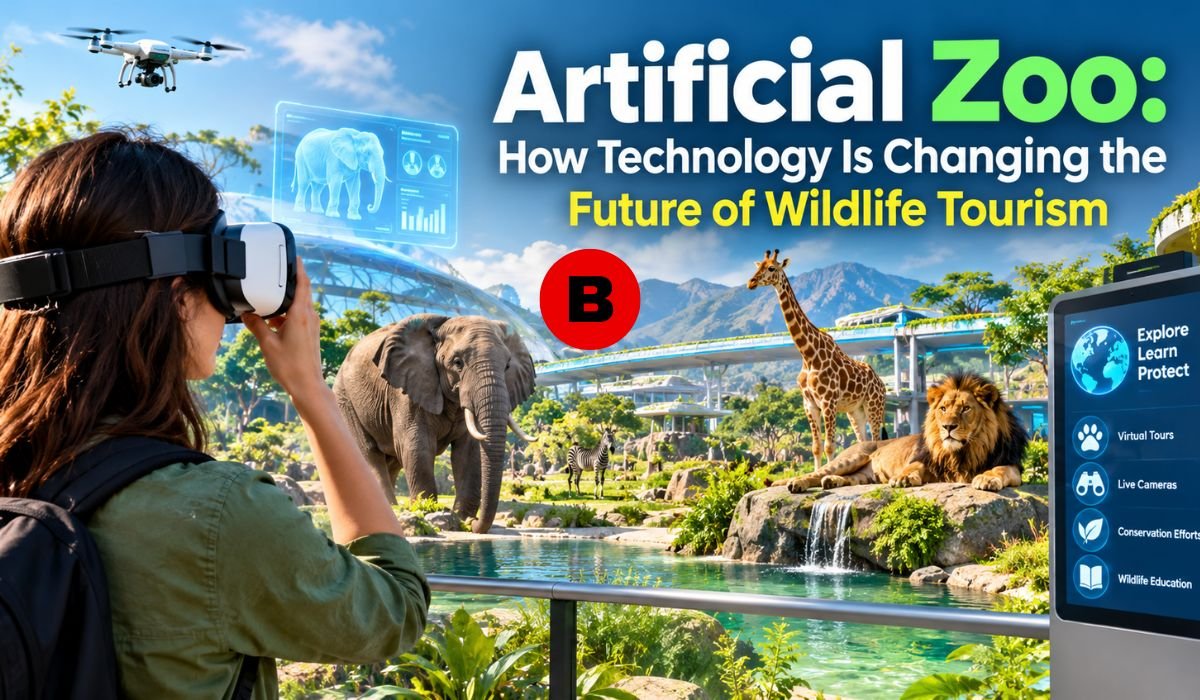
For generations, people have visited Zoos, Aquariums, Safaris, and Wildlife Park to see animals they might never encounter in the wild. These places have played an important role in introducing people to unfamiliar species and teaching them about nature. But the way we experience Wildlife is changing as technology becomes more sophisticated.
Today, Robotics, Virtual Reality, Augmented Reality, Artificial Intelligence, Digital Simulation, and immersive displays are opening new possibilities. One emerging idea at the center of that change is the Artificial Zoo.
An Artificial Zoo isn’t necessarily one specific type of attraction. The term can describe an immersive wildlife experience built around Digital Animals, Robotic Animals, Virtual Environments, Projection Mapping, Interactive Displays, or a combination of these technologies. Some concepts may be entirely artificial, while others could blend digital experiences with traditional live-animal exhibits.
The idea is particularly interesting because technology is already being used in real wildlife education and conservation. The Smithsonian’s National Zoo, for example, provides virtual educational programs, while conservation researchers are increasingly turning to Artificial Intelligence to analyze wildlife images and ecological information.
That means an Artificial Zoo isn’t simply a futuristic replacement for a Traditional Zoo. Its more realistic potential is to become another way for people to experience Wildlife, understand ecosystems, and develop a greater interest in Conservation.
Quick Bio Information
| Fact | Information |
|---|---|
| Concept | Artificial Zoo |
| Main Purpose | Wildlife Education, Immersive Experiences, And Entertainment |
| Core Technologies | VR, AR, Robotics, Projection, Digital Simulation, And AI |
| Live Animals Required | No, Not For A Fully Artificial Experience |
| Virtual Safari | Possible Through Immersive Digital Environments |
| Robotic Animals | Can Recreate Physical Animal Movement And Appearance |
| Extinct Species | Can Be Digitally Or Robotically Recreated |
| Educational Potential | High When Content Is Scientifically Accurate |
| Conservation Role | Primarily Education, Awareness, And Engagement |
| Traditional Zoo Relationship | Can Complement Rather Than Automatically Replace It |
| Family Appeal | Strong Potential For Interactive Learning |
| Accessibility | Indoor Digital Experiences May Improve Access For Some Visitors |
| Main Ethical Question | Whether Artificial Experiences Are Transparent And Responsible |
| Major Limitation | Technology Cannot Fully Reproduce Living Wildlife |
| Scientific Requirement | Accurate Information And Appropriate Expert Input |
| AI Role | Personalization, Data Analysis, And Conservation Applications |
| VR Role | Immersive Simulated Habitats And Wildlife Experiences |
| AR Role | Digital Wildlife And Information Over Real Environments |
| Robotics Role | Physical Representation And Interactive Experiences |
| Future Potential | More Immersive, Educational, Accessible, And Personalized Wildlife Tourism |
What Is An Artificial Zoo?
An Artificial Zoo is an immersive wildlife attraction that recreates animals, habitats, or natural environments primarily through technology instead of relying entirely on living animals. Depending on its design, visitors might encounter Robotic Animals, Animatronic Creatures, Digital Wildlife, Virtual Reality environments, Augmented Reality experiences, large-scale projections, or interactive educational installations.
There isn’t one fixed formula for creating an Artificial Zoo. One venue might focus heavily on life-sized Robotics, while another could use Digital Simulation and immersive screens as its main attractions. A different facility could combine these technologies with conventional zoo exhibits.
That flexibility is one of the most interesting parts of the concept. A physical wildlife attraction has to work within the limits of its buildings, habitats, climate controls, animal-care requirements, and available space. Digital environments don’t face exactly the same restrictions. In a single building, visitors could potentially move from an African Savanna to an Arctic landscape and then explore an underwater ecosystem.
Technology also makes it possible to introduce people to species that can’t be displayed as living animals. Extinct Species, for instance, could be recreated digitally or mechanically for educational purposes.
Still, transparency is important. Visitors should always understand whether they’re looking at a living animal, a Robot Animal, a digital creation, or a simulation. That distinction helps maintain trust and prevents entertainment from being confused with scientific reality.
How Does An Artificial Zoo Work?
An Artificial Zoo would typically rely on several technologies working together rather than one device doing all the work. Imagine entering a large room where panoramic projections turn the walls into a rainforest. Birds can be heard in the distance, rainfall surrounds the visitor, and a Digital Animal appears to move through the landscape.
Virtual Reality can make the experience even more immersive by placing visitors inside a simulated habitat. Augmented Reality takes a slightly different approach, adding Digital Wildlife or information to the visitor’s existing surroundings.
Projection systems can transform floors, walls, and ceilings into changing landscapes. Directional or Surround Sound can reproduce animal calls, rainfall, waves, wind, and other environmental sounds. Sensors can make installations respond to visitors, allowing the experience to feel more interactive.
Robotics adds another physical dimension. A life-sized robotic animal can move its head, change position, or imitate certain behaviors, giving visitors a sense of scale and physical presence.
But realistic movement shouldn’t be mistaken for genuine animal behavior. A robotic elephant might look and move like an elephant, yet it doesn’t have the biological needs, instincts, personality, or unpredictable behavior of a living creature.
That distinction is important. Research published in 2025 on robotic animals in zoological settings suggested that the technology could offer opportunities to represent rare or extinct species and reduce certain concerns connected with captivity. At the same time, the research raised questions about authenticity and the effectiveness of conservation messaging.
Technology Behind An Artificial Zoo
Virtual Reality is likely to remain one of the most useful technologies for an Artificial Zoo. It can place visitors inside environments that would otherwise be difficult or expensive to experience firsthand. Someone could explore a rainforest, follow a simulated animal migration, or descend into a digital marine ecosystem without physically traveling to those locations.
Augmented Reality offers another possibility. Instead of replacing the visitor’s surroundings, AR can add Digital Animals, maps, scientific information, or educational content to a physical environment. The Smithsonian has already experimented with realistic three-dimensional wildlife representations and AR-based educational experiences, showing that this technology can be used for learning as well as entertainment.
Projection Mapping can turn an ordinary room into a forest, desert, ocean, or polar landscape. Meanwhile, advanced audio systems can add environmental sounds that make the setting feel more convincing.
Robotics and Animatronics provide physical scale and movement. Artificial Intelligence could eventually add another layer by supporting personalized learning, interactive storytelling, and data analysis.
AI is already being used in genuine Wildlife Conservation research. Smithsonian researchers, for example, have been developing AI skills and systems to help analyze large collections of wildlife imagery gathered through cameras, drones, and other technologies.
This is an important distinction. Artificial Intelligence isn’t simply a tool for making a wildlife attraction more entertaining. It is increasingly becoming part of the scientific work used to understand and protect real animals.
What Can Visitors See Inside An Artificial Zoo?
The potential range of an Artificial Zoo is much wider than that of a conventional animal enclosure. A single attraction could recreate an African Savanna, tropical rainforest, Arctic environment, coral reef, desert, or deep-ocean habitat.
Visitors could encounter Digital Elephants, Lions, Giraffes, Whales, Sharks, Birds, Reptiles, and Insects. Technology could also bring Extinct Species back to life in a visual or robotic form, giving people the opportunity to learn about animals that disappeared thousands or millions of years ago.
A Virtual Safari could simulate the experience of traveling through a wildlife habitat without requiring a physical safari vehicle. A marine exhibit could take visitors beneath the ocean without requiring scuba equipment. A prehistoric installation could introduce children to extinct animals while explaining Evolution and the changing history of Earth’s ecosystems.
The most valuable experiences, however, would go beyond simply presenting impressive animals. Visitors should also learn where those animals live, what they eat, how they behave, how their ecosystems function, and what threats they face in the real world.
That’s where an Artificial Zoo can move beyond entertainment and become a meaningful educational experience.
Artificial Zoo Vs. Traditional Zoo
An Artificial Zoo and a Traditional Zoo offer fundamentally different experiences. A Traditional Zoo cares for living animals and can contribute to veterinary care, animal welfare, research, education, conservation breeding, and wider conservation projects.
An Artificial Zoo can recreate animals and environments without keeping every featured species on site. It can also present Extinct Species or ecosystems that would be extremely difficult, or impossible, to reproduce through living collections.
That doesn’t automatically mean one format is better than the other.
A living animal offers something technology can’t fully reproduce: genuine biological behavior. Animals can respond to their surroundings, interact with one another, and behave differently from one day to the next. That unpredictability is an important part of observing Wildlife.
Artificial experiences, meanwhile, can provide opportunities that living collections cannot easily offer. They can recreate extinct species, simulate inaccessible environments, and deliver controlled educational experiences without requiring a live animal to be present.
The two approaches may eventually work alongside each other. A Traditional Zoo could use VR or Robotics to explain species that aren’t part of its collection, while an Artificial Zoo could direct visitors toward real conservation organizations, protected habitats, and responsible wildlife experiences.
Modern zoos also serve purposes that extend well beyond displaying animals. Professional zoological institutions emphasize animal care, conservation, education, research, and safety as important parts of their work.
Why Are Travelers Interested In Artificial Zoo Experiences?
Travelers are increasingly interested in experiences rather than simply visiting another landmark and taking photographs. An Artificial Zoo fits naturally into that shift because it can turn Wildlife Tourism into something interactive and participatory.
The concept could also bring wildlife experiences into urban areas. Someone staying in a major city could potentially explore several ecosystems inside one indoor attraction rather than traveling to multiple countries or remote destinations.
For families, that combination of entertainment and education could be especially appealing. Parents and children can explore an environment together, while students can experience habitats that would otherwise be difficult to study in person.
There’s also room for greater flexibility. A technology-based attraction could potentially offer different experiences depending on a visitor’s interests. Someone might choose a quiet educational journey, while another visitor could prefer a more adventurous Virtual Safari.
That flexibility may make Artificial Zoos attractive to people who don’t normally visit Traditional Zoos or who want something different from a conventional wildlife exhibit.
Is An Artificial Zoo More Ethical?
The ethical side of the Artificial Zoo is one of the most interesting parts of the discussion. A completely artificial attraction doesn’t need live animals to perform for visitors. As a result, it can avoid certain concerns associated with captivity, transportation, breeding, and public display.
But it’s too simple to say that every Artificial Zoo is automatically more ethical.
Technology can still be used poorly. An attraction might prioritize spectacle over Education, exaggerate animal behavior, or leave visitors with the impression that a simulation accurately represents nature in every detail.
Transparency is therefore essential. Visitors should know whether they’re watching a living animal, a robotic representation, an animation, a VR simulation, or a projection.
The 2025 research into robotic animals in zoos highlighted this issue. Artificial exhibits may reduce some ethical concerns and make it possible to represent rare or extinct animals, but they can also raise questions about authenticity and the strength of conservation messages.
For that reason, responsible Artificial Zoos should make it clear where entertainment ends and scientific representation begins.
Can An Artificial Zoo Support Conservation?
An Artificial Zoo can play a useful role in Conservation Education, although its role needs to be described realistically. A digital simulation can’t protect a rainforest, restore a wetland, or stop poaching on its own.
What it can do is help people understand why those real-world efforts matter.
An immersive experience could show how a forest changes following deforestation. Another could demonstrate the impact of plastic pollution on marine life. A Virtual Migration could allow visitors to follow an animal across a landscape while explaining why habitat corridors are important.
Technology can also make complicated conservation science easier to understand. In 2026, Smithsonian researchers were using AI to help analyze large collections of wildlife imagery. That work shows how digital tools are becoming part of real conservation science rather than remaining limited to entertainment.
A responsible Artificial Zoo should build on that principle. Its conservation claims should be based on credible scientific information, and its educational content should help visitors understand the difference between a simulated experience and actual conservation work.
Ideally, the attraction should also encourage visitors to support legitimate conservation efforts rather than suggesting that watching a simulation is enough to protect Wildlife.
Educational Or Entertainment?
The strongest Artificial Zoo experiences will probably combine Education and Entertainment rather than choosing one over the other.
Entertainment is what captures attention, especially for younger visitors. Education is what can make the experience meaningful after the initial excitement has faded.
A child might walk into an Artificial Zoo because they want to see a giant robotic elephant. Once inside, an interactive exhibit could explain where elephants live, how they communicate, what they eat, and how habitat loss affects their populations.
This approach is already visible in digital wildlife education. Smithsonian programs have used virtual learning to teach students about animals, habitats, adaptation, and Conservation. Its digital projects have also used AR to let young audiences interact with realistic wildlife representations.
Adults can engage with more detailed information, too. An immersive experience could explore climate change, migration patterns, biodiversity, habitat fragmentation, or the technology scientists use to monitor Wildlife.
For an Artificial Zoo to establish Expertise and Trust, the educational material should be developed or reviewed by appropriate professionals, such as zoologists, conservation scientists, animal-care specialists, educators, or other subject experts.
The attraction should also distinguish established scientific information from speculation and entertainment.
Is An Artificial Zoo Good For Children?
Children could become one of the most important audiences for Artificial Zoo experiences. Digital environments can make complicated scientific concepts easier to understand because children aren’t simply reading about an ecosystem; they’re able to explore it.
A Virtual Safari could demonstrate how animals use different parts of their habitat. An interactive ecosystem could show what happens when one species disappears. A Digital Animal could help children explore anatomy or behavior without disturbing a living creature.
However, immersive technology isn’t comfortable for everyone.
Loud sounds, flashing lights, dark rooms, sudden movements, and VR experiences may overwhelm or frighten some children. Parents should therefore check age recommendations and sensory information before visiting.
A well-designed attraction should also consider different learning and accessibility needs. Some children may learn best through visuals, while others may respond better to audio explanations or interactive activities.
The Smithsonian’s virtual education programs provide a useful example of how digital wildlife education can incorporate accessibility features, including captions, interpretation, and screen-reader-compatible activities.
Planning An Artificial Zoo Visit
Because Artificial Zoos can vary significantly, visitors shouldn’t assume that every attraction offers the same type of experience.
Before booking, it’s worth finding out whether the venue focuses mainly on VR, Robotics, Projection Mapping, AR, interactive displays, or a combination of technologies. Visitors should also check the expected duration, age recommendations, accessibility information, headset requirements, motion effects, and sensory warnings.
People who are prone to motion sickness may want to ask whether VR experiences are optional. Families with young children may prefer attractions that provide more educational displays and fewer intense visual or physical effects.
Crowds can make a noticeable difference, too. When an attraction relies on interactive stations, sensors, or personal headsets, a quieter session can provide more time to explore without constantly waiting for equipment.
Planning ahead doesn’t take away from the experience. In many cases, it simply makes the visit more comfortable and enjoyable.
Accessibility And The Artificial Zoo
Accessibility could become one of the most valuable advantages of technology-based Wildlife Tourism. A Traditional Safari may involve long journeys, uneven ground, outdoor temperatures, or physically demanding conditions. An indoor Artificial Zoo can provide a more controlled setting.
Digital experiences can also support different learning preferences. Some visitors may prefer visual displays, while others may benefit from audio descriptions or interactive content.
However, accessibility shouldn’t be assumed simply because an attraction is indoors or digital. The building, equipment, software, seating, signage, staff training, and educational content all play a role.
The Smithsonian’s virtual education programs demonstrate how digital wildlife learning can incorporate accessibility features such as captions, interpretation, and screen-reader-compatible materials.
Artificial Zoo operators that take accessibility seriously can potentially make Wildlife Education available to audiences who might find some conventional wildlife experiences difficult.
Limitations And Challenges
Artificial Wildlife can look remarkably convincing, but it isn’t identical to real Wildlife. A robotic elephant can reproduce certain movements, yet it doesn’t breathe, feed, communicate, form social relationships, or react to its environment like a living elephant.
That difference matters because part of the appeal of wildlife is its unpredictability. A real animal may behave differently each time someone observes it. Its actions are shaped by biology, surroundings, social relationships, and individual personality.
There are practical challenges as well. Advanced Robotics, projection systems, sensors, VR equipment, and software require substantial investment and ongoing maintenance. If a major technical component fails, an entire experience may be interrupted.
Then there’s the question of authenticity. If visitors aren’t clearly told that an exhibit is artificial, they may develop an inaccurate understanding of animal behavior or lose trust in the attraction.
Research published in 2025 emphasized transparency as an important issue in public acceptance of robotic animal exhibits.
The best Artificial Zoos will therefore need to balance visual realism with honesty. The goal shouldn’t be to trick visitors into believing a machine is alive. Instead, the technology should help them understand the real animal more clearly.
Could Artificial Zoos Replace Traditional Zoos?
A complete replacement is unlikely, and there’s little reason to assume that it should happen.
Traditional Zoos and Artificial Zoos can perform different functions. Living collections can support animal care, veterinary science, behavioral observation, conservation breeding, research, and public education. Artificial environments can provide experiences that living collections cannot easily deliver.
Technology is already finding uses inside real zoological settings beyond visitor entertainment. A 2025 review examined the use of technology as Environmental Enrichment for captive animals, including interactive systems designed to encourage species-appropriate behavior and cognitive stimulation.
That suggests the future may not be about Traditional Zoos versus Artificial Zoos. Instead, technology could become another tool used by zoological institutions.
A zoo could combine living exhibits with VR, Robotics, AR, and interactive educational environments. A museum could create a Virtual Safari. A conservation center could use AR to explain work being carried out in the field.
In that model, technology doesn’t compete with Nature. It helps people understand it.
The Future Of Wildlife Tourism
Wildlife Tourism is likely to become increasingly connected to digital technology. Virtual Tours, live animal cameras, mobile applications, AR, and online education are already allowing people to interact with wildlife without physically traveling to a zoo or remote habitat.
The Smithsonian, for example, provides virtual animal experiences and live cameras that allow people to observe Wildlife remotely.
Artificial Intelligence could eventually make these experiences more personalized. An Artificial Zoo might adjust explanations based on a visitor’s age or interests, while interactive systems could respond to the way visitors explore an exhibit.
AI is also becoming useful in real Conservation Research, where scientists can use it to process large quantities of wildlife imagery and identify patterns that would be difficult to analyze manually.
At the same time, Digital Wildlife Technology brings new responsibilities. Researchers have highlighted its potential to expand access to biodiversity information while also raising questions about how wildlife data and digital representations of animals are collected, managed, and presented.
The most successful Artificial Zoos will therefore need more than impressive graphics and advanced machines. Scientific accuracy, accessibility, responsible storytelling, transparent communication, and genuine educational value will matter just as much.
Final Thoughts
The Artificial Zoo is best understood as an emerging approach to Wildlife Education and Tourism rather than a straightforward replacement for Traditional Zoos. Its real promise lies in bringing together technology and reliable science to help people understand animals and ecosystems in ways that aren’t always possible through physical exhibits.
A Digital Elephant can’t replace a living elephant. A Virtual Rainforest can’t reproduce every biological relationship found inside a real forest. Likewise, a Robotic Animal can’t provide every emotional or scientific experience that comes from observing living Wildlife.
But technology can open another door.
It can introduce visitors to an extinct species, allow them to follow a virtual migration, demonstrate habitat loss, or take them inside an ecosystem they may never have the opportunity to visit. Most importantly, it can turn complicated scientific information into something people can see, hear, explore, and remember.
If those experiences encourage curiosity and responsible action, they can serve a valuable purpose.
The future of Wildlife Tourism may not be a choice between Nature and Technology. Instead, it could be about using technology responsibly to help more people understand why the natural world matters and why protecting it should remain the ultimate goal.
FAQs About Artificial Zoo
What Is An Artificial Zoo?
An Artificial Zoo is an immersive wildlife experience that uses technologies such as Robotics, Virtual Reality, Augmented Reality, Digital Simulation, Projection Mapping, and Interactive Displays to recreate animals or natural environments. It can be completely artificial or combine digital experiences with live-animal exhibits.
How Does An Artificial Zoo Work?
An Artificial Zoo brings several technologies together to create an immersive environment. Depending on the attraction, visitors may encounter Robotic Animals, projected landscapes, Digital Wildlife, VR simulations, surround sound, interactive screens, and sensor-based experiences. The technology can work together to create a more engaging educational environment.
Can An Artificial Zoo Show Extinct Animals?
Yes. Digital and Robotic technology can recreate Extinct Species that can’t be displayed as living animals. This makes the concept useful for teaching visitors about prehistoric Wildlife, Evolution, extinction, and changes in Earth’s ecosystems.
Are Artificial Zoos More Ethical Than Traditional Zoos?
A fully artificial attraction can avoid some concerns associated with keeping live animals for public display. However, it isn’t automatically more ethical. Responsible design, scientific accuracy, transparency, and honest communication all matter. Visitors should be able to tell when an animal or environment is artificial.
Can Artificial Zoos Help Wildlife Conservation?
Artificial Zoos can support Conservation Education by showing how habitat destruction, climate change, pollution, and biodiversity loss affect Wildlife. However, they can’t replace real habitat protection, wildlife research, rescue programs, or field conservation. Their strongest role is educating visitors and encouraging greater interest in genuine conservation efforts.
Are Artificial Zoos Suitable For Children?
They can be highly engaging for children because they combine Wildlife Education with interactive technology. Parents should still check age recommendations and sensory warnings. VR, loud sounds, flashing lights, dark rooms, and sudden movements may be uncomfortable for some children.
Can Artificial Zoos Replace Traditional Zoos?
Artificial Zoos are unlikely to replace Traditional Zoos completely. Living collections can support animal care, veterinary work, research, conservation programs, and direct observation of living animals. Artificial experiences offer different advantages and are more likely to complement traditional wildlife education.
What Is The Future Of Artificial Zoos?
Future Artificial Zoos could combine increasingly sophisticated Robotics, Artificial Intelligence, VR, AR, immersive projection, and personalized Education. Their long-term success will depend not only on realistic technology but also on scientific accuracy, accessibility, transparency, responsible design, and meaningful connections to real-world Conservation.
Learn more and explore exciting content on: Kennisandra Jeffries: Her Career, Family, Marriage, and Life Today