

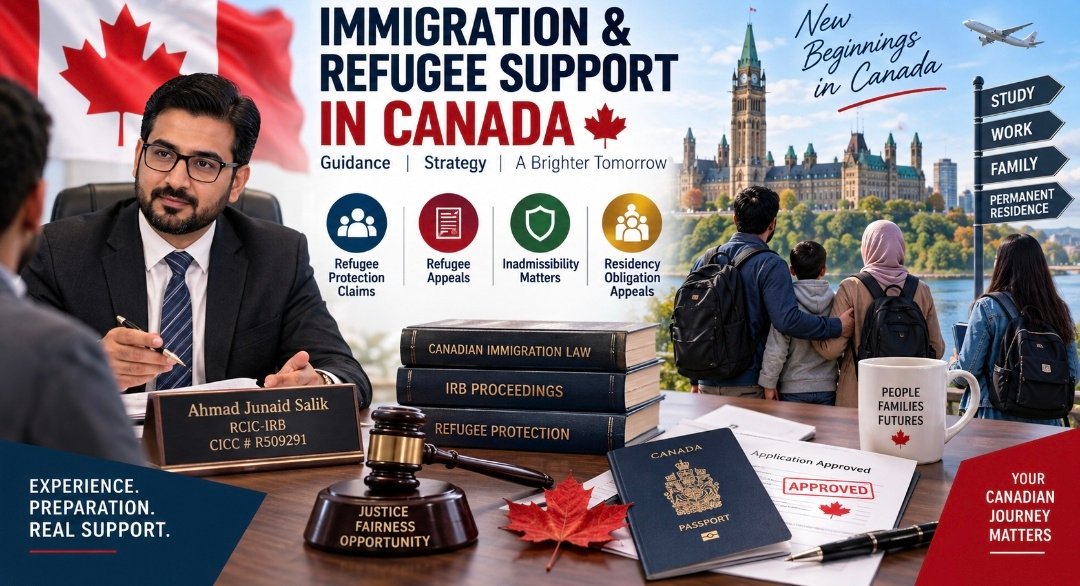
Refugee protection, inadmissibility, and residency obligation appeals require more than forms—they require careful evidence, strategy, and preparation.
Proceedings before Canada’s Immigration and Refugee Board (IRB) can affect a person’s safety, family unity, and ability to remain in Canada. Whether the matter involves an asylum claim, a refugee appeal, inadmissibility, or a permanent resident’s residency obligation, the process is usually time-sensitive and evidence-driven. Ahmad Junaid Salik of Euro Consultants Canada Inc. assists clients with evaluating their circumstances, organizing records, preparing testimony or written submissions, and understanding the procedural options available at each stage.
Understanding the Main IRB Matters
Asylum and refugee protection claims. The Refugee Protection Division (RPD) decides whether a claimant is a Convention refugee or a person in need of protection. A persuasive claim depends on a complete and internally consistent account, identity evidence, proof of personal risk, relevant country-condition material, and credible testimony.
Refugee appeals. Eligible negative RPD decisions may be reviewed by the Refugee Appeal Division (RAD). The appeal generally requires a careful analysis of the refusal reasons, identification of errors of fact, law, or mixed fact and law, and a properly organized appellant’s record. New evidence may be considered only where the applicable legal requirements are met.
Inadmissibility matters. The Immigration Division (ID) conducts admissibility hearings concerning whether a person may enter or remain in Canada. The underlying issues can involve criminality, misrepresentation, security, medical or financial concerns, or non-compliance with immigration law. Preparation may include reviewing the Minister’s allegations, addressing the legal test, gathering contextual evidence, and assessing the consequences of a possible removal order.
Residency obligation appeals. Permanent residents generally must comply with Canada’s residency obligation. When a negative determination is made, an eligible appeal to the Immigration Appeal Division (IAD) may address both legal compliance and, where available, humanitarian and compassionate considerations. Travel history, reasons for time outside Canada, establishment, family impact, efforts to return, and the best interests of affected children may all be relevant, depending on the facts.
Why Ahmad Junaid Salik?
Ahmad Junaid Salik is a Regulated Canadian Immigration Consultant with IRB authorization / Specialization (RCIC-IRB) and CICC licence number R509291. He has been practising as a regulated consultant since 2013 in Canada and works on immigration applications, refugee claims, IRB appeals, admissibility matters, and related proceedings. He holds an LLB from the University of London and vast experience immigration litigation.
What Makes His Approach Distinct?
- IRB-focused authorization: His RCIC-IRB designation reflects authorization to represent clients in matters before the IRB, rather than limiting his work to routine application preparation.
- End-to-end case preparation: His stated approach covers initial assessment, evidence review, disclosure, hearing preparation, written advocacy, and post-decision planning.
- A broader immigration perspective: Experience across temporary residence, permanent residence, family sponsorship, humanitarian applications, and enforcement-related matters can help identify how one proceeding may affect the client’s wider immigration strategy.
- Structured evidence analysis: The emphasis is on timelines, corroboration, credibility risks, documentary gaps, and the legal issues that the decision-maker must resolve.
- Client readiness: Plain-language explanations and preparation for questioning can help clients understand the process and present their evidence clearly and consistently.
These features offer a more useful basis for comparison than broad claims such as “the best” or “better than everyone else.” Prospective clients should compare representatives by verifying current licensing, relevant IRB authorization, experience with the specific type of proceeding, communication practices, written retainer terms, fees, and the proposed case-preparation plan.
How His Law Degree Supports Client Applications and Appeals
- Identifying the governing legal test: His legal education can help him connect a client’s facts to the statutory requirements, regulations, and legal principles that the decision-maker must apply.
- Spotting strengths and risks early: Legal training supports a disciplined review of credibility concerns, inconsistencies, missing evidence, inadmissibility allegations, and procedural issues before they become central problems.
- Building a coherent case theory: Rather than presenting documents in isolation, he can organize the application or appeal around a clear legal position supported by a logical chronology and relevant evidence.
- Assessing the value of evidence: A law degree strengthens the ability to distinguish material evidence from background information, evaluate reliability, and identify where corroboration or explanation may be needed.
- Preparing persuasive submissions: Training in legal research, analysis, and writing can assist in framing facts accurately, addressing the applicable legal criteria, responding to concerns, and presenting arguments in a structured manner.
- Interpreting decisions and planning next steps: Where an application or claim is refused, legal education can help in reviewing the reasons, identifying possible factual or legal errors, and assessing whether an appeal or other remedy may be available.
- Preparing clients for questioning: Understanding advocacy and evidentiary principles can support focused preparation, helping clients answer truthfully, clearly, and consistently without memorizing a scripted account.
- Considering the wider legal impact: His training can help him recognize how statements, documents, or findings in one immigration proceeding may affect another application, appeal, or enforcement matter.
These skills do not guarantee a particular result, but they can contribute to a more focused, complete, and legally responsive presentation of the client’s case.
International students and UAE residents looking to pursue higher education in Canada can benefit from reliable canada study visa consultants in UAE. Professional guidance can help students select suitable Designated Learning Institutions, understand study permit requirements, organize financial and academic documentation, and prepare a well-structured application. The right support can make the process of planning and applying to study in Canada more straightforward.
A Clear, Case-Specific Path Forward
Every IRB matter turns on its own facts, evidence, legal framework, and deadlines. Ahmad Junaid Salik’s combination of IRB-focused authorization, broad immigration practice, and structured case preparation may be especially relevant to clients seeking representation in refugee protection, appeal, inadmissibility, or residency obligation proceedings. A confidential consultation can help determine the applicable process, immediate deadlines, evidentiary needs, and realistic options. Blooketplay
Disclaimer: This article provides general information only and is not legal advice. Immigration and refugee law changes, and outcomes depend on individual facts. Verify a representative’s current status with the College of Immigration and Citizenship Consultants and obtain advice about your specific circumstances.
 Admin
Admin