

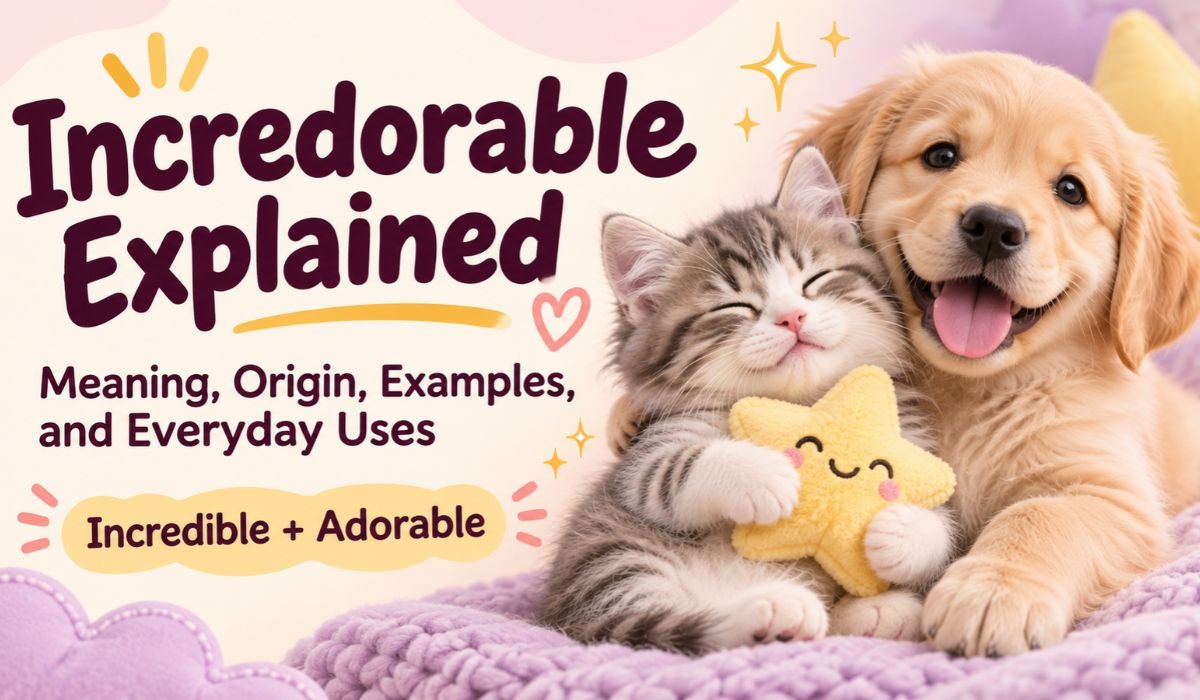
Sometimes, the word adorable just doesn’t do a moment justice. Think of a sleepy puppy cuddling its favorite toy, a child proudly presenting a handmade birthday card, or a tiny kitten discovering its reflection for the first time. These little moments can be so charming that they seem to deserve a word of their own.
That’s where Incredorable comes in.
A playful combination of incredible and adorable, Incredorable describes something exceptionally cute, lovable, or endearing. Although it hasn’t been confirmed as standard dictionary vocabulary, the expression has a documented history and offers an interesting glimpse into the creativity of the English language.
Whether you’ve encountered it online or simply want to expand your vocabulary, this guide explains the meaning, origin, pronunciation, and everyday uses of Incredorable in 2026.
Quick Bio Information
| Attribute | Details |
|---|---|
| Word | Incredorable |
| Language | English |
| Simple Meaning | Incredibly Adorable |
| Extended Meaning | Exceptionally Cute or Endearing |
| Word Category | Informal Expression |
| Word Formation | Incredible + Adorable |
| Linguistic Classification | Portmanteau |
| Part of Speech | Adjective |
| Number of Letters | 12 |
| Emotional Tone | Positive and Affectionate |
| Communication Style | Casual and Playful |
| Documented Published Use | May 16, 2017 |
| Published Reference | Star Tribune |
| Referenced Journalist | James Lileks |
| Original Creator | Unknown |
| Dictionary Status | Major Dictionary Entry Unconfirmed |
| Standard Pronunciation | Not Established |
| Common Applications | Captions, Messages, and Creative Writing |
| Closest Alternative | Incredibly Adorable |
| Formal Writing Suitability | Generally Limited |
What Does Incredorable Mean?
At its simplest, Incredorable means incredibly adorable. It’s an affectionate expression used when something is unusually cute, charming, or delightful. The word captures a stronger emotional reaction than adorable alone, often combining genuine affection with a little humor and excitement.
Picture a puppy trying to climb onto the sofa, only to fall asleep halfway through its ambitious adventure. You could certainly call the scene adorable, but describing it as incredorable adds another layer of enthusiasm.
The expression isn’t restricted to physical appearance, either. A thoughtful surprise, a charming handmade gift, or an unexpectedly sweet gesture can inspire the same reaction. That’s what makes it such an interesting addition to informal vocabulary. It describes not only what someone sees but also how that experience makes them feel.
How Is Incredorable Formed?
The construction of Incredorable is surprisingly straightforward. It brings together two familiar English words, incredible and adorable, to create an expression that carries elements of both meanings.
In linguistics, this process is known as a Portmanteau. According to Collins Dictionary, a portmanteau combines parts of existing words and their meanings into a new term. The literary use of this concept is historically associated with Lewis Carroll’s 1871 book Through the Looking-Glass.
Many familiar expressions follow the same pattern. Brunch combines breakfast and lunch, smog brings together smoke and fog, and staycation blends stay and vacation.
Incredorable works much the same way. Even if you’ve never encountered the expression before, its recognizable components offer useful clues about what it means.
Origin and History of Incredorable
While Incredorable might sound like something invented during the social media era, its documented history stretches back several years.
On May 16, 2017, journalist James Lileks featured the expression in a word-of-the-week column published by the Star Tribune. He presented it as an intensified version of adorable, capturing the kind of enthusiasm that an ordinary compliment might not fully express.
That newspaper reference provides credible evidence that the expression existed by 2017. However, it doesn’t tell us exactly when the word was created or who originally invented it.
Since Incredorable combines two widely recognized English words, it’s entirely possible that different people arrived at the same expression independently. Its precise origin remains unknown, and attributing its invention to Lileks would go beyond the available evidence.
Is Incredorable a Real English Word?
The answer depends on what you mean by a real word. Incredorable has appeared in published writing and communicates a recognizable meaning, so it isn’t simply a random arrangement of letters.
However, a dedicated entry in major dictionaries such as Cambridge or Merriam-Webster hasn’t been confirmed.
Dictionary editors typically examine how consistently and widely people use an expression before deciding whether to include it. Dictionary.com, for example, explains that new entries require evidence of meaningful use across a substantial community over time.
A single newspaper appearance doesn’t automatically make an expression part of standard English vocabulary.
For now, Incredorable is best understood as an informal English coinage. There’s nothing inherently wrong with using it creatively, provided your audience understands what you’re trying to communicate.
How to Pronounce Incredorable
If you’ve only encountered Incredorable in writing, you might wonder how to say it aloud. Its unusual spelling can make pronunciation seem less obvious than it actually is.
One possible pronunciation is in-kreh-DOR-uh-buhl, placing emphasis around the central “dor” sound.
This pronunciation is a suggested interpretation of the blended spelling rather than an officially recognized pronunciation. No authoritative dictionary guide has confirmed a universally accepted way of saying the expression.
For English learners, the easiest approach is to recognize its relationship to incredible and adorable. Informal expressions sometimes develop variations in pronunciation, particularly when they haven’t become established vocabulary.
In relaxed conversations, a small difference in pronunciation is unlikely to cause confusion if the context is clear.
Incredorable vs. Incredible vs. Adorable
Although incredible, adorable, and Incredorable share parts of their spelling, they aren’t interchangeable.
Cambridge Dictionary describes incredible as something difficult to believe or exceptionally impressive. Adorable, on the other hand, refers to someone or something that inspires affection because of its charming or lovable qualities.
Incredorable brings these two ideas together, with particular emphasis on affection and cuteness.
| Word | Meaning | Example |
|---|---|---|
| Incredible | Astonishing or impressive | The mountain views were incredible. |
| Adorable | Cute or lovable | The sleeping kitten was adorable. |
| Incredorable | Exceptionally cute or endearing | That kitten wearing a tiny sweater looks incredorable. |
A breathtaking landscape can be incredible without being adorable. Likewise, a charming little toy may be adorable without being astonishing. Incredorable is most effective when you want to express an especially enthusiastic and affectionate response.
How to Use Incredorable in a Sentence
Incredorable generally functions as an adjective, which means it can describe a person, animal, object, experience, or quality. Despite its informal nature, it fits comfortably into familiar English sentence patterns.
You might say, “She adopted an incredorable little rabbit,” placing the adjective directly before a noun. Alternatively, you could say, “Your handmade teddy bear looks incredorable,” using it after a linking verb.
Both examples communicate the intended meaning without requiring a lengthy explanation.
Although Incredorable appears with a capital letter in article headings, it doesn’t normally require capitalization within a sentence unless it comes at the beginning.
When writing for readers who may be unfamiliar with the expression, a little descriptive context helps make its meaning immediately clear.
Describing Cute Animals
If there’s one setting where Incredorable feels particularly natural, it’s in descriptions of animals. Pets have a wonderful ability to turn ordinary activities into unexpectedly charming moments.
Imagine a tiny dog attempting to carry an oversized stuffed animal across the living room. Or perhaps a kitten has discovered that an empty cardboard box makes the perfect sleeping place.
Calling these moments incredorable captures more than their appearance. It reflects the amusement and affection they inspire.
A pet owner might share a photograph with the caption, “My puppy finally learned how to sit, and his proud little face was incredorable.”
Accompanied by a photograph or video, the expression becomes even easier for unfamiliar readers to understand.
Describing People, Gifts, and Sweet Moments
Not everything incredorable needs to have paws, whiskers, or a fluffy tail. The expression can also describe thoughtful gestures and objects that carry emotional significance.
Consider a child making a birthday card for a parent or a friend carefully decorating a miniature house with tiny flowers. These experiences may be memorable because of the effort, affection, and personality behind them.
Saying, “The little details on your handmade card are incredorable,” offers a warm compliment that recognizes the creator’s thoughtfulness.
When describing people, however, it’s worth considering the relationship. A playful expression that feels affectionate between close friends could sound overly familiar in the workplace. As with any personal compliment, sensitivity and context matter.
Everyday Uses of Incredorable
One of the appealing qualities of Incredorable is that it doesn’t require a special occasion. You could use it while chatting with friends, responding to a photograph, writing a birthday message, or sharing a pleasant experience with someone close to you.
The expression gives conversations a slightly more personal tone, particularly when familiar compliments don’t capture your enthusiasm.
Still, it works best when used spontaneously rather than deliberately inserted into every conversation. Not everyone appreciates unusual vocabulary, and some readers may need a moment to recognize the intended meaning.
A helpful rule is to ask whether the phrase incredibly adorable would work naturally in the sentence. If it would, Incredorable may be an appropriate creative alternative.
Incredorable in Social Media
Online communication has created plenty of opportunities for playful language. Social media captions, comments, and personal messages often rely on short expressions to communicate feelings quickly.
Incredorable could fit naturally into an Instagram post featuring a lovable pet, a Facebook update about a handmade gift, or a short video capturing a heartwarming family moment.
A caption such as “An incredorable little moment that made my entire day” feels lighthearted and personal without requiring additional explanation.
However, there’s no reliable evidence establishing Incredorable as a widespread viral trend in 2026. Its potential appeal shouldn’t be confused with proven popularity or measurable engagement.
The real value of the expression is its ability to communicate personality and emotion.
Synonyms and Alternatives to Incredorable
Creative expressions are enjoyable, but familiar vocabulary sometimes communicates the same feeling more effectively.
Incredibly Adorable is the closest alternative to Incredorable because it preserves both the affectionate meaning and the sense of enthusiasm. Readers are also more likely to understand it immediately.
Other suitable expressions include Exceptionally Cute, Charming, Endearing, Delightful, Precious, Heartwarming, and Irresistibly Cute.
Each carries a slightly different emotional quality. Endearing works particularly well when describing someone’s lovable behavior, while heartwarming is often more appropriate for a moving or thoughtful experience.
Your choice ultimately depends on what you’re describing and who will read it. An imaginative caption may benefit from unusual vocabulary, whereas an article written for an international audience may be clearer with established expressions.
When Should You Avoid Incredorable?
As enjoyable as Incredorable can be, it isn’t suitable for every type of communication. Academic essays, technical reports, official documents, and professional correspondence generally require language that is clear and widely understood.
Imagine reading a product specification that describes an item as incredorable without explaining its size, materials, or practical features. The description might sound enthusiastic, but it wouldn’t provide the information a customer actually needs.
The same principle applies to professional feedback. Specific observations are usually more helpful than subjective or playful compliments.
There is still room for Incredorable in creative marketing, greeting cards, personal blogs, and imaginative storytelling. The important consideration is whether the expression contributes to the message or distracts readers from it.
Common Mistakes When Using Incredorable
Perhaps the most common misunderstanding is assuming that Incredorable can replace incredible in every situation.
A groundbreaking scientific discovery, an outstanding business achievement, or a remarkable sporting performance might all be incredible. Unless there’s an affectionate or charming quality involved, describing them as incredorable would probably sound misplaced.
Another potential mistake is expecting every reader to recognize the expression. Someone encountering it for the first time might assume it’s a spelling error.
The surrounding sentence offers a useful clue. In a description of something sweet or lovable, Incredorable is likely to be deliberate wordplay. In a sentence expressing shock or disbelief, incredible may have been the intended word.
Using the expression selectively helps preserve its playful character while reducing unnecessary confusion.
Why Creative Words Like Incredorable Matter
Language has never been completely static. People continually adapt familiar words, create new expressions, and experiment with different ways of communicating their feelings.
Incredorable offers a small but interesting example of that creativity. Rather than inventing an entirely new concept, it reshapes existing vocabulary to express a particular emotional response.
Some informal expressions eventually gain widespread recognition and enter dictionaries. Others remain part of personal conversations, small communities, or creative writing.
Whether Incredorable will become established English vocabulary remains uncertain. Its future will depend partly on how widely and consistently people continue using it.
Even without formal dictionary recognition, expressions like this have value. They encourage imagination, allow people to develop their own communication styles, and sometimes make an ordinary conversation a little more memorable.
Final Thoughts
Incredorable is a charming example of what happens when familiar English words come together in an unexpected way. Combining incredible and adorable, it offers a playful means of expressing affection when ordinary compliments don’t quite capture the feeling.
Its documented newspaper appearance in 2017 demonstrates that the expression has existed for nearly a decade, although its original creator and exact history remain uncertain.
In 2026, Incredorable continues to offer an interesting example of creative English wordplay. It can bring personality to social media captions, warmth to personal messages, and humor to descriptions of lovable animals or thoughtful gestures.
You don’t need an extensive vocabulary to express yourself meaningfully. Sometimes, combining two familiar words is enough to capture a feeling that deserves something a little more special.
FAQs About Incredorable
What Does Incredorable Mean?
Incredorable means exceptionally cute, charming, or lovable. It’s a playful combination of incredible and adorable, generally used to communicate strong affection and enthusiasm toward someone or something.
Is Incredorable a Real English Word?
Incredorable is a documented informal English expression with an understandable meaning. However, its inclusion in major standard dictionaries hasn’t been confirmed, making it more suitable for creative and casual communication.
Who Invented Incredorable?
The original creator of Incredorable remains unknown. Journalist James Lileks featured the expression in a Star Tribune column on May 16, 2017, but that publication doesn’t establish that he invented it.
Is Incredorable a Spelling Mistake?
Not necessarily. When someone uses Incredorable to describe something exceptionally cute or lovable, it’s likely intentional wordplay. In an unrelated context, however, it could be an accidental misspelling of incredible.
How Do You Pronounce Incredorable?
One possible pronunciation is in-kreh-DOR-uh-buhl. This reading follows recognizable elements of the blended words, although no authoritative standard pronunciation has been established.
Can Incredorable Be Used as a Compliment?
Yes. Incredorable can serve as an affectionate compliment for a lovable person, thoughtful gesture, charming object, or cute animal. Its suitability depends on the relationship between the people communicating and the surrounding context.
Is Incredorable Suitable for Formal Writing?
Generally, Incredorable works better in casual conversations and creative writing. Established alternatives such as incredibly adorable, charming, and endearing are usually preferable in professional, academic, and official documents.
What Is the Best Synonym for Incredorable?
Incredibly Adorable is the closest equivalent. Exceptionally Cute, Absolutely Precious, Delightful, Charming, and Endearing are also useful alternatives, depending on the situation.