

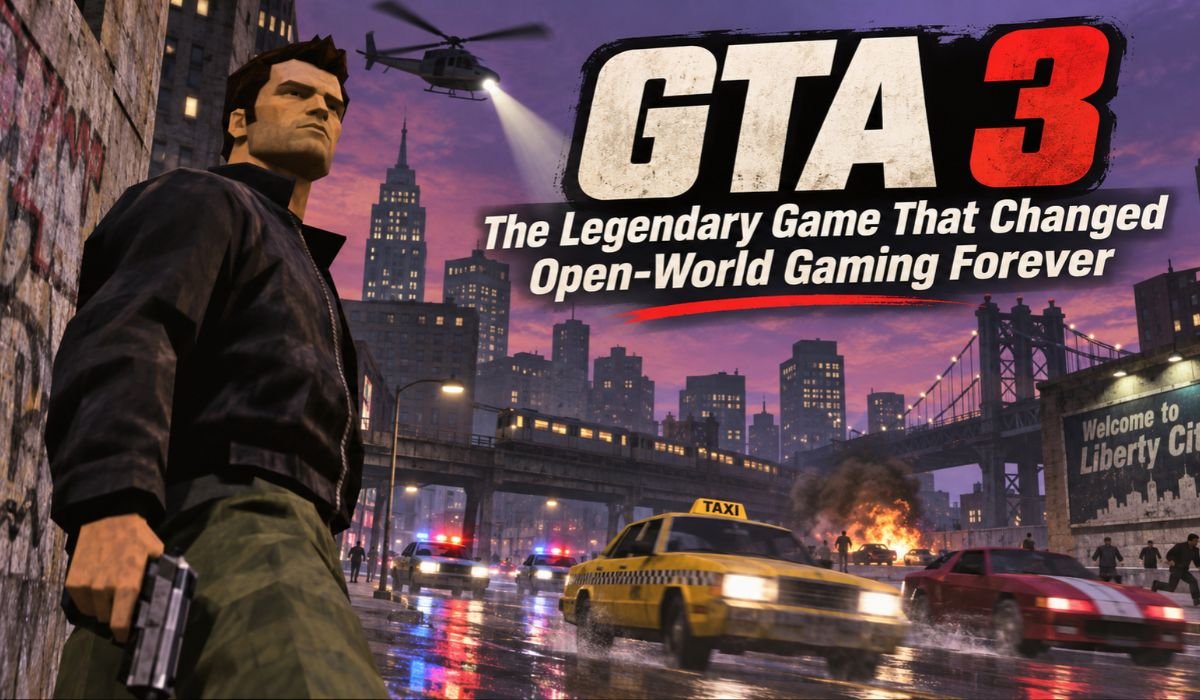
Some video games entertain us for a few hours. Others leave a mark that lasts for decades. GTA 3 belongs firmly in the second category.
When Grand Theft Auto III arrived in October 2001, it offered something that felt extraordinary at the time: a sprawling 3D city where players could explore freely, steal cars, take on criminal missions, and discover adventures without constantly being told where to go.
Developed by DMA Design and published by Rockstar Games, GTA 3 took the series beyond its original top-down format and introduced a new way to experience urban open-world gaming. Its fictional Liberty City wasn’t simply a backdrop for missions. It became an essential part of the adventure.
GTA 3 didn’t invent open-world gaming, but it helped bring the genre into the mainstream. Its combination of freedom, storytelling, driving, and action influenced countless games that followed.
More than 25 years later, the original adventure still holds a special place in gaming history. From its unforgettable setting to its lasting influence on modern titles, here’s why GTA 3 remains such an important game in 2026.
GTA 3 Quick Information
| Game Information | Details |
|---|---|
| Official Name | Grand Theft Auto III |
| Common Name | GTA 3 or GTA III |
| Original Release Date | October 22, 2001, in North America |
| Developer | DMA Design, Later Rockstar North |
| Publisher | Rockstar Games |
| Original Platform | PlayStation 2 |
| Windows Release | 2002 |
| Xbox Release | 2003 |
| Genre | Open-World Action-Adventure |
| Main Character | Claude |
| Main Setting | Liberty City |
| Story Setting | 2001 |
| Game Engine | RenderWare |
| Main Antagonist | Catalina |
| Major Locations | Portland, Staunton Island, Shoreside Vale |
| ESRB Rating | Mature 17+ |
| Definitive Edition Release | November 11, 2021 |
| Gameplay Perspective | Third-Person |
| Main Activities | Driving, Combat, Exploration, Missions |
| Franchise | Grand Theft Auto |
What Is GTA 3 and Why Is It Important?
At its heart, GTA 3 is a crime-driven action-adventure game about Claude, a silent criminal trying to survive Liberty City’s dangerous underworld while seeking revenge against the woman who betrayed him.
The story provides direction, but the real attraction is the freedom surrounding it.
Players can travel across the city, take jobs from criminal organizations, experiment with different vehicles, or simply wander through unfamiliar neighborhoods. Traffic fills the roads, pedestrians move along sidewalks, and radio stations bring personality to every journey.
That might sound ordinary today, but in 2001, experiencing so many connected activities inside a 3D city was remarkable.
Earlier Grand Theft Auto games already encouraged open-ended exploration. What GTA 3 did differently was translate that freedom into an immersive third-person environment.
The result wasn’t just another crime game. It became a model for how open-world adventures could work.
The History of GTA 3 and Its Development
Behind GTA 3’s success was a development team attempting something unusually ambitious for its time.
DMA Design, the Scottish studio that later became Rockstar North, wanted to preserve the chaotic freedom of earlier Grand Theft Auto games while moving the experience into three dimensions.
That transition brought serious technical challenges.
The PlayStation 2 had far less processing power and memory than modern gaming systems. Developers had to create a city filled with vehicles, pedestrians, buildings, and missions without overwhelming the hardware.
Using RenderWare technology, the team built Liberty City around interconnected districts and carefully designed environments.
The developers also made practical compromises. Access to different islands was tied to story progression, helping manage both gameplay pacing and technical demands.
When GTA 3 launched in North America on October 22, 2001, its combination of freedom and mature subject matter immediately attracted attention.
Critics praised its ambitious design, while its violence and criminal themes sparked controversy.
Despite the debate, GTA 3 became one of the defining releases of the PlayStation 2 generation and helped establish Rockstar Games as a major force in the industry.
GTA 3 Story Explained: Claude’s Journey Through Liberty City
GTA 3 wastes little time introducing its central conflict.
The story opens with a bank robbery that ends in betrayal. Claude’s girlfriend and criminal partner, Catalina, shoots him and escapes, leaving him to face the consequences.
Claude survives, escapes police custody, and begins rebuilding his life within Liberty City’s criminal underworld.
His search for revenge takes him through a dangerous network of Mafia families, street gangs, corrupt officials, and influential business figures.
Unlike many modern video game protagonists, Claude never speaks during the story. His silence is one of the game’s most recognizable features.
Instead, characters such as Salvatore Leone, Maria Latore, Asuka Kasen, Donald Love, and Ray Machowski carry much of the dialogue.
Their competing interests shape Claude’s journey, and the people who initially appear trustworthy don’t always remain allies.
Eventually, his pursuit of Catalina leads to a final confrontation.
The storyline may be less complicated than those of later GTA games, but its straightforward structure works well with the game’s mission-driven design.
Exploring Liberty City: GTA 3’s Most Important Location
Liberty City is more than the setting of GTA 3. In many ways, it’s the game’s most memorable character.
Inspired largely by New York City, the fictional metropolis is divided into three major districts, each with a distinctive atmosphere.
Portland is where the adventure begins. Its industrial streets, docks, factories, and warehouses introduce players to the city’s working-class neighborhoods and organized crime.
As the story progresses, players reach Staunton Island, a more developed area featuring skyscrapers, commercial districts, and government buildings.
The final major district, Shoreside Vale, offers another change of scenery. Residential neighborhoods, winding roads, hills, and Francis International Airport give it a different character from the earlier locations.
Bridges and tunnels connect these areas, although normal access becomes available gradually through story progression.
What makes Liberty City memorable isn’t simply the number of streets players can explore.
It’s the atmosphere created by moving traffic, pedestrians, changing weather, radio broadcasts, and neighborhoods that feel distinct from one another.
Even when nothing particularly important is happening, driving through Liberty City can feel like an adventure of its own.
GTA 3 Gameplay: Driving, Combat, and Player Freedom
The appeal of GTA 3 gameplay comes from its willingness to let players make their own decisions between missions.
You can follow the main storyline, explore unfamiliar streets, take on optional activities, or experiment with the game’s systems.
Driving plays a major role in almost everything.
Sports cars offer speed, heavier vehicles provide durability, and different handling characteristics can make a real difference during difficult missions.
Combat introduces another challenge. Players use firearms, explosives, and close-range weapons while facing rival criminals and law enforcement.
The wanted-level system makes reckless behavior increasingly dangerous. As the player’s wanted level rises, police responses become more aggressive.
There are also opportunities to step away from the main story.
Taxi driving, ambulance missions, firefighting, and vigilante activities provide additional objectives and rewards.
Of course, GTA 3 doesn’t offer unlimited freedom. Its main storyline is largely linear, and some locations remain locked until players reach particular missions.
Still, the combination of structured objectives and open exploration became one of the franchise’s defining strengths.
GTA 3 Characters and Criminal Organizations
Liberty City wouldn’t be nearly as memorable without the criminals and powerful figures who control its streets.
Catalina serves as the game’s main antagonist, and her betrayal sets Claude’s entire journey in motion.
Salvatore Leone leads an influential Mafia family, while Maria Latore becomes closely involved in Claude’s increasingly complicated situation.
Asuka Kasen introduces Claude to the Yakuza, opening another chapter in the city’s criminal conflicts.
Other important characters include Joey Leone, Toni Cipriani, Luigi Goterelli, Donald Love, and Ray Machowski.
Each has different motives, loyalties, and expectations.
One of the more interesting aspects of GTA 3’s storytelling is how quickly relationships can change.
Claude might complete several missions for one organization before discovering that its interests conflict with those of another.
These shifting alliances give the narrative tension and make Liberty City’s criminal world feel unpredictable.
GTA 3 Missions: Memorable Challenges and Side Activities
GTA 3 missions are remembered for their variety, but also for their difficulty.
The early assignments are relatively simple. Players deliver passengers, drive to specific locations, and become familiar with the city.
Later missions demand faster reactions, better driving skills, and more careful planning.
Bomb Da Base: Act II stands out because players must protect an ally during an attack involving a cargo ship.
S.A.M. introduces a dangerous aircraft interception, while The Exchange brings Claude’s revenge story to its conclusion.
These missions can still be challenging today.
The original game’s aiming controls, limited checkpoints, and sometimes unforgiving vehicle handling leave little room for mistakes.
Fortunately, the main storyline isn’t the only attraction.
Hidden packages, unique stunt jumps, emergency-service missions, and vehicle challenges encourage players to spend more time exploring.
For those who enjoy discovering every secret, GTA 3 offers plenty to do beyond its central campaign.
How GTA 3 Changed Open-World Gaming Forever
To understand GTA 3’s importance, it’s worth remembering what many action games looked like before its release.
Traditional level-based adventures often guided players through carefully controlled environments. GTA 3 offered a different experience by placing multiple gameplay systems inside one connected 3D city.
Driving, combat, exploration, and storytelling weren’t separate experiences. They were different parts of the same world.
Players could interrupt their journey between missions to explore neighborhoods, steal vehicles, or attract police attention.
That freedom gave the game a sense of unpredictability.
GTA 3 wasn’t the first title to experiment with open environments, and its success didn’t happen in isolation. However, it helped demonstrate the commercial and creative potential of the 3D urban sandbox.
Its influence became particularly visible in later Grand Theft Auto releases and other city-based action games.
Perhaps its greatest achievement was changing what players expected from virtual worlds.
A city no longer needed to function merely as scenery. It could become a place where exploration itself was entertaining.
GTA 3 Graphics, Soundtrack, and Technical Achievements
Looking at GTA 3 today, its graphics clearly belong to an earlier generation.
Character models are simple, environments have limited detail, and distant objects don’t always appear as smoothly as they do in modern games.
Yet these limitations shouldn’t overshadow what the developers accomplished.
In 2001, a city featuring moving traffic, pedestrians, changing weather, and a day-night cycle was an impressive technical achievement.
The soundtrack also deserves considerable credit.
GTA 3’s fictional radio stations helped create a world that felt larger than its physical map.
Head Radio offered fictional pop music, Flashback 95.6 featured tracks associated with the film Scarface, and Chatterbox FM entertained listeners with satirical talk-radio conversations.
Together with fictional advertisements and distinctive presenters, these stations gave Liberty City its personality.
The original game does have frustrations, particularly its aiming, camera controls, and limited mission checkpoints.
But those shortcomings also reveal how much action-adventure games have developed since GTA 3 first appeared.
GTA 3 vs. Vice City and San Andreas
GTA 3 laid the groundwork for two of Rockstar’s most celebrated follow-up games.
Grand Theft Auto: Vice City, released in 2002, took the series to a colorful, 1980s-inspired setting.
Its protagonist, Tommy Vercetti, had a speaking role, giving the story a stronger central personality. Music, fashion, and atmosphere became even more important to the experience.
Then came Grand Theft Auto: San Andreas in 2004.
San Andreas expanded the formula considerably, introducing a larger world, character customization, more activities, and additional gameplay systems.
Compared with these successors, GTA 3 is noticeably simpler.
Its map is smaller, its protagonist is silent, and its gameplay options are more limited.
However, that simplicity makes it particularly interesting from a historical perspective.
Playing GTA 3, Vice City, and San Andreas in release order reveals how quickly Rockstar developed its open-world formula during the early 2000s.
GTA 3 Cheats, Secrets, and Hidden Features
For many players, cheat codes were almost as memorable as GTA 3’s missions.
They allowed players to experiment with weapons, vehicles, health, wanted levels, and unusual gameplay effects.
The codes vary depending on the platform, so it’s important to use instructions designed for the correct version.
Players should also be careful when saving after using cheats, since certain effects can interfere with normal progress.
Beyond cheats, Liberty City contains plenty of secrets worth discovering.
There are 100 hidden packages scattered throughout the map. Collecting them unlocks useful rewards at safehouses, providing an incentive to explore less obvious locations.
Unique stunt jumps, vehicle challenges, and hidden areas offer additional distractions.
New players will benefit from learning the city’s layout, practicing vehicle handling, and saving regularly.
These simple habits can make the game’s more demanding missions considerably easier.
GTA 3 Definitive Edition: Original vs. Remastered
GTA 3 returned in November 2021 as part of Grand Theft Auto: The Trilogy – The Definitive Edition.
The remastered version introduced higher-resolution textures, revised lighting, improved draw distances, and updated controls.
Modern targeting and more convenient mission restarts also made certain parts of the game easier to approach.
However, the Definitive Edition had a troubled launch.
Players and reviewers reported technical problems, visual inconsistencies, and changes that sometimes weakened the atmosphere of the original release.
Rockstar subsequently released updates to address various issues.
A November 2024 update also introduced Classic Lighting mode, intended to bring the remastered trilogy’s visual atmosphere closer to the original games.
Choosing between versions largely comes down to personal preference.
The original GTA 3 preserves its classic presentation, while the Definitive Edition offers modern conveniences and updated visuals.
For longtime fans, the older version may feel more authentic. Newcomers may appreciate the remaster’s more accessible controls.
Can You Still Play GTA 3 in 2026?
Yes, GTA 3 remains available to play in 2026, although the options depend on your platform and region.
The original game launched on PlayStation 2 before arriving on Windows and Xbox. Later versions expanded its availability to mobile devices and additional systems.
Today, the Definitive Edition provides one of the more convenient ways to experience the game on supported modern consoles and computers.
Players who already own the original PC release can also revisit it, although compatibility adjustments may be necessary on newer operating systems.
It’s worth checking official storefronts before purchasing, since availability, system requirements, and supported features can change.
For someone discovering GTA 3 for the first time, the Definitive Edition may offer the smoother introduction.
Those interested in experiencing the game as it originally appeared may prefer the classic version.
Why GTA 3 Still Brings Back Childhood Memories
There’s another reason GTA 3 remains important, and it has little to do with graphics or technology.
For many players, the game is connected to memories of growing up in the early 2000s.
Its mature themes, unpredictable gameplay, and seemingly endless city streets made it an unforgettable experience for young gaming enthusiasts.
In a November 2026 Business Insider essay, writer Kyle Phillippi described secretly watching his older brother play GTA 3 when he was nine years old.
Twenty-five years later, he found himself searching for quiet moments to play GTA 6 after his wife and young son had gone to bed.
The circumstances had changed completely, but his enthusiasm for Grand Theft Auto remained.
It’s a familiar feeling for people who grew up with video games.
Returning to an old favorite can bring back memories of childhood, family, and a time when exploring a virtual city felt like discovering an entirely new world.
GTA 3’s lasting appeal comes partly from that emotional connection.
GTA 3’s Influence on GTA 6 and Modern Open-World Games
The journey from GTA 3 to GTA 6 shows just how dramatically open-world gaming has evolved.
GTA 3 helped establish the foundations of the modern Grand Theft Auto experience: interactive cities, vehicle-based exploration, criminal storytelling, and optional activities.
Later entries expanded those ideas with larger environments, more detailed characters, improved combat systems, and increasingly sophisticated world design.
Modern games can deliver experiences that would have seemed almost impossible in 2001.
Yet the central appeal remains surprisingly familiar.
Players still enjoy exploring unfamiliar locations, discovering unexpected activities, and deciding how to spend their time inside a virtual world.
That’s why GTA 3 continues to matter.
It helped establish a design philosophy that Rockstar refined over the following decades, while influencing expectations across the wider gaming industry.
Final Thoughts: Why GTA 3 Remains a Gaming Legend
More than two decades after its release, GTA 3 remains one of the most important chapters in video game history.
It helped transform the Grand Theft Auto franchise and demonstrated how driving, combat, storytelling, and exploration could come together inside a connected 3D city.
Some elements haven’t aged particularly well. The controls can feel awkward, the graphics are dated, and certain missions remain frustrating.
But those weaknesses don’t diminish the game’s historical achievements.
For longtime fans, returning to Liberty City can feel like revisiting a familiar part of childhood. For newcomers, it’s an opportunity to experience the foundations of a franchise that helped reshape modern gaming.
GTA 3’s greatest legacy isn’t simply that it offered players a city to explore.
It’s that the game showed how much fun could come from giving players the freedom to decide what happened next.
Frequently Asked Questions About GTA 3
When Was GTA 3 Released?
GTA 3 was originally released in North America on October 22, 2001, for PlayStation 2. The Windows version followed in 2002, while the Xbox release arrived in 2003. Since then, the game has appeared on additional platforms, including mobile devices and modern consoles through updated editions.
Who Developed GTA 3?
GTA 3 was developed by DMA Design, a Scottish video game studio that later became Rockstar North. Rockstar Games published the title. The development team transformed the earlier Grand Theft Auto formula into a fully three-dimensional urban adventure, helping establish the foundation for later games in the series.
Who Is the Main Character in GTA 3?
Claude is the main character in GTA 3. He’s a silent criminal who seeks revenge after being betrayed by his partner, Catalina. Throughout the story, Claude works for different criminal organizations while navigating Liberty City’s dangerous underworld. His lack of dialogue remains one of his most distinctive characteristics.
Is GTA 3 Still Worth Playing in 2026?
Yes, particularly for players interested in gaming history or classic open-world adventures. GTA 3 offers memorable missions, a distinctive setting, and the freedom that helped make the franchise famous. However, newcomers should expect older graphics, less refined controls, and some difficult missions.
What Is the Difference Between GTA 3 and GTA 3 Definitive Edition?
GTA 3 Definitive Edition includes updated textures, revised lighting, improved draw distances, modernized controls, and more convenient mission restarts. The original version preserves the classic visual style and gameplay mechanics. Both tell the same story, but they offer somewhat different playing experiences.
How Long Does It Take to Complete GTA 3?
Most players can finish GTA 3’s main storyline in approximately 15 hours, although completion time varies depending on skill and familiarity with the missions. Players who explore Liberty City, collect hidden packages, and complete optional activities may spend considerably longer with the game.
Why Was GTA 3 So Revolutionary?
GTA 3 helped popularize the modern 3D urban open-world game. It combined driving, combat, exploration, and mission-based storytelling inside one connected environment. Although earlier open-world games existed, GTA 3 demonstrated how appealing this formula could be to a mainstream audience.
Is GTA 3 Connected to Vice City and San Andreas?
Yes. GTA 3, Vice City, and San Andreas belong to the franchise’s original 3D continuity. Each game features its own protagonist and primary setting, but they share certain characters, organizations, and story references. Playing all three offers a clearer understanding of how Rockstar developed its fictional criminal universe.
Learn more and explore exciting content on: Jason GTA 6: Meet Dylan Rourke, the Actor Behind Rockstar’s New Hero